
EPISODE · Feb 25, 2014 · 15 MIN
Satelittes
from 5 of the Best · host John Palmer
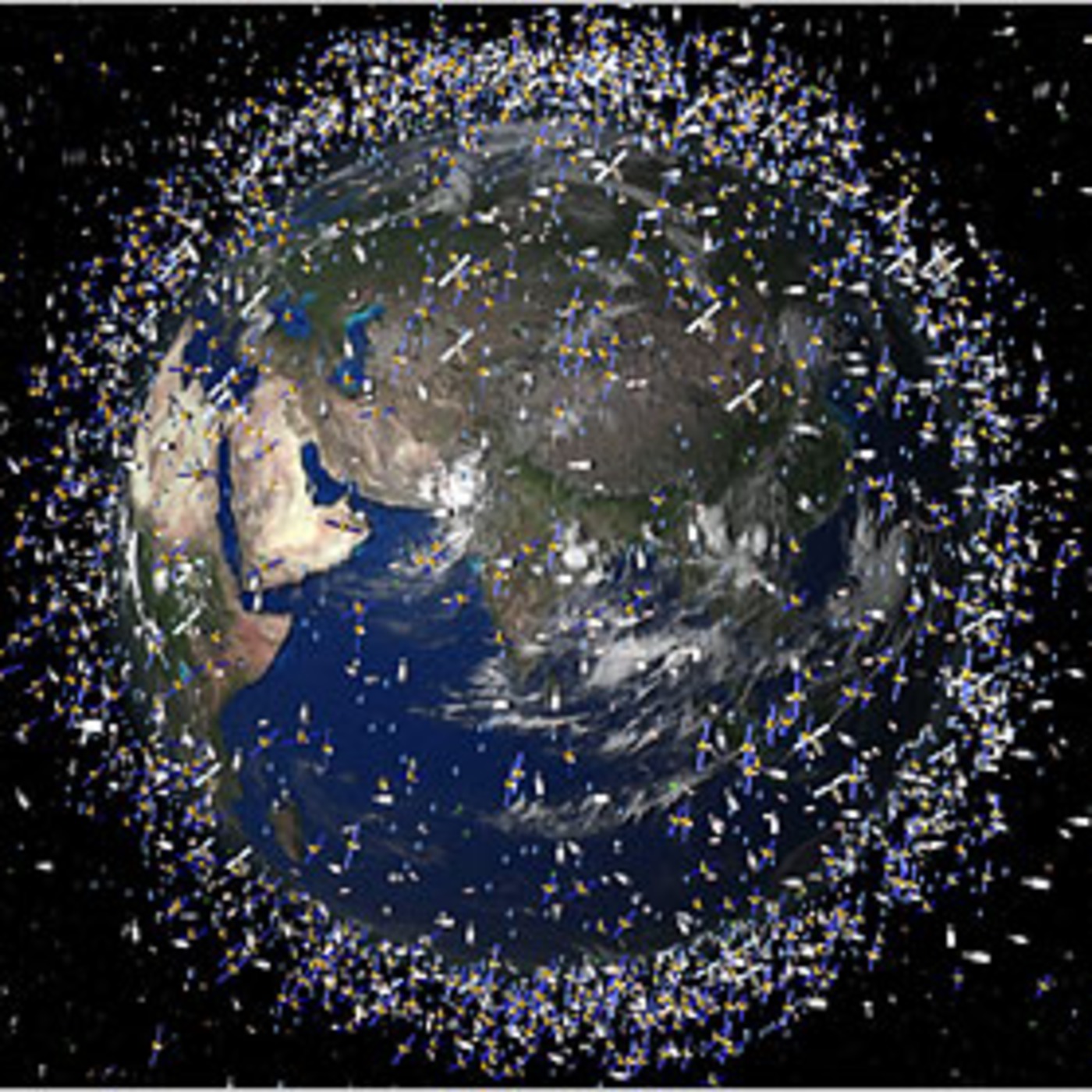
fiveofthebest.podomatic.com new episode 12 th march still traveling and having little trouble, will try to add pics tomorrow Satelittes Satellites operate in extreme temperatures from −150 °C (−238 °F) to 150 °C (300 °F) and may be subject to radiation in space. Satellite components that can be exposed to radiation are shielded with aluminium and other radiation-resistant material Communication satellites range from microsatellites weighing less than 1 kg (2.2 pounds) to large satellites weighing over 6,500 kg (14,000 pounds). Advances in miniaturization and digitalization have substantially increased the capacity of satellites over the years. Early Bird had just one transponder capable of sending just one TV channel. The Boeing 702 series of satellites, in contrast, can have more than 100 transponders, and with the use of digital compression technology each transponder can have up to 16 channels, providing more than 1,600 TV channels through one satellite. A signal that is bounced off a GEO satellite takes approximately 0.22 second to travel at the speed of light from Earth to the satellite and back. This delay poses some problems for applications such as voice services and mobile telephony. Therefore, most mobile and voice services usually use LEO Satellites face competition from other media such as fibre optics, cable, and other land-based delivery systems such as microwaves and even power lines. The main advantage of satellites is that they can distribute signals from one point to many locations. As such, satellite technology is ideal for “point-to-multipoint” communications such as broadcasting. Satellite communication does not require massive investments on the ground The Intelsat spans theToday there are approximately 150 communication satellites in orbit with over 100 in geosynchronous orbit. globe, and domestic satellites such as the USSR's Molniya satellites. Western Union's Westar, and Canada's Anik - serve individual countries. The Intelsat V is the latest in its space-craft series, it can handle 12,000 telephone circuits and two color television transmission simultaneously. Which of the following whirls around the Earth at 5 miles per second? Hubble Space Telescope. The Hubble Space Telescope is named after Edwin Hubble (1889-1953). Hubble's Law (also named after Edwin Hubble) is a theory that suggests that there is a constantly expanding universe. Weather Satellites The first weather satellite was launched on February 17, 1959. What was the name of this satellite? Vanguard 2. Vanguard 2 was designed to measure cloud cover, however, this satellite was poor in collecting data as a poor axis and rotation kept it from collecting meaningful information. TIROS-1 which was launched by NASA in 1960, was the first successful weather satellite and operated for 78 days. THE MOON The prevailing hypothesis today is that the Earth–Moon system formed as a result of agiant impact, where a Mars-sized body (named Theia) collided with the newly formed proto-Earth, blasting material into orbit around it that accreted to form the Moon.[20] This hypothesis perhaps best explains the evidence, although not perfectly. The Moon is drifting away from the Earth:The Moon is moving approximately 3.8 cm away from our planet every year. It is estimated that it will continue to do so for around 50 billion years. By the time that happens, the Moon will be taking around 47 days to orbit the Earth instead of the current 27.3 days. Evolution of moon 7 min http://www.youtube.com/watch?v=TuHasBN-U1c 4 min good video http://www.youtube.com/watch?v=aSV98i0jzro STRANGE SATELLITES Lapetus moon Iapetus was discovered by Giovanni Domenico Cassini, an Italian–French astronomer, in October 1671 Cassini correctly surmised that Iapetus has a bright hemisphere and a dark hemisphere, and that it is tidally locked, always keeping the same face towards Saturn. This means that the bright hemisphere is visible from Earth when Iapetus is on the western side of Saturn, and that the dark hemisphere is visible when Iapetus is on the eastern side. The dark hemisphere was later named Cassini Regio in his honour. A further mystery of Iapetus is the equatorial ridge that runs along the center of Cassini Regio, about 1,300 km long, 20 km wide, 13 km high. It was discovered when the Cassini spacecraft imaged Iapetus on December 31, 2004. Peaks in the ridge rise more than 20 km above the surrounding plains, making them some of the tallest mountains in the Solar System. The ridge forms a complex system including isolated peaks, segments of more than 200 km and sections with three near parallel ridges.[27 MIMAS Mimas is a moon of Saturn which was discovered in 1789 by William Herschel.[8] It is named after Mimas, a son of Gaia in Greek mythology, and is also designated Saturn I. With a diameter of 396 kilometres (246 mi) it is the twentieth-largest moon in the Solar System and is the smallest astronomical body that is known to be rounded in shape because of self-gravitation. The surface area of Mimas is slightly less than the land area of Spain. The low density of Mimas, 1.15 g/cm³, indicates that it is composed mostly of water ice with only a small amount of rock. TRITON Triton is unique among all large moons in the Solar System for its retrograde orbit around its planet (i.e., it orbits in a direction opposite to the planet's rotation). Most of the outer irregular moons of Jupiter and Saturn also have retrograde orbits, as do some ofUranus's outer moons. However, these moons are all much more distant from their primaries, and are small in comparison; the largest of them (Phoebe)[f] has only 8% of the diameter (and 0.03% of the mass) of Triton. HUBBLE SPACE TELESCOPE Launch: April 24, 1990 from space shuttle Discovery (STS-31) Deployment: April 25, 1990 Mission Duration: Up to 20 years Servicing Mission 1: December 1993 Servicing Mission 2: February 1997 Servicing Mission 3A: December 1999 Servicing Mission 3B: February 2002 Servicing Mission 4: May 2009 Size Length: 43.5 ft (13.2 m)Weight: 24,500 lb (11,110 kg) Maximum Diameter: 14 ft (4.2 m) Cost at Launch $1.5 billion Spaceflight Statistics Orbit: At an altitude of 307 nautical miles (569 km, or 353 miles), inclined 28.5 degrees to the equator (low-Earth orbit)Time to Complete One Orbit: 97 minutes Speed: 17,500 mph (28,000 kph) Optical Capabilities Hubble Can't Observe: The Sun or Mercury, which is too close to the Sun Sensitivity to Light: Ultraviolet through infrared (115—2500 nanometers) First Image: May 20, 1990: Star Cluster NGC 3532 Data Statistics Hubble transmits about 120 gigabytes of science data every week. That's equal to about 3,600 feet (1,097 meters) of books on a shelf. The rapidly growing collection of pictures and data is stored on magneto-optical disks. Power Needs Energy Source: The Sun Mechanism: Two 25-foot solar panels Power usage: 2,800 watts Pointing Accuracy In order to take images of distant, faint objects, Hubble must be extremely steady and accurate. The telescope is able to lock onto a target without deviating more than 7/1000th of an arcsecond, or about the width of a human hair seen at a distance of 1 mile. Hubble's Mirrors Primary Mirror Diameter: 94.5 in (2.4 m) Primary Mirror Weight: 1,825 lb (828 kg) Secondary Mirror Diameter: 12 in (0.3 m) Secondary Mirror Weight: 27.4 lb (12.3 kg) Power Storage Batteries: 6 nickel-hydrogen (NiH) Storage Capacity: equal to 20 car batteries International space station It’s the most expensive object ever built At an estimated cost of $100bn dollars, the ISS is the most expensive single object ever built by mankind. Roughly half of the total price was contributed by the USA, the rest by other nations including Europe, Japan and Russia. Tracy Caldwell in cupola module
Embed this episode
What this episode covers
fiveofthebest.podomatic.com new episode 12 th march still traveling and having little trouble, will try to add pics tomorrow Satelittes Satellites operate in extreme temperatures from −150 °C (−238 °F) to 150 °C (300 °F) and may be subject to radiation in space. Satellite components that can be exposed to radiation are shielded with aluminium and other radiation-resistant material Communication satellites range from microsatellites weighing less than 1 kg (2.2 pounds) to large satellites weighing over 6,500 kg (14,000 pounds). Advances in miniaturization and digitalization have substantially increased the capacity of satellites over the years. Early Bird had just one transponder capable of sending just one TV channel. The Boeing 702 series of satellites, in contrast, can have more than 100 transponders, and with the use of digital compression technology each transponder can have up to 16 channels, providing more than 1,600 TV channels through one satellite. A signal that is bounced off a GEO satellite takes approximately 0.22 second to travel at the speed of light from Earth to the satellite and back. This delay poses some problems for applications such as voice services and mobile telephony. Therefore, most mobile and voice services usually use LEO Satellites face competition from other media such as fibre optics, cable, and other land-based delivery systems such as microwaves and even power lines. The main advantage of satellites is that they can distribute signals from one point to many locations. As such, satellite technology is ideal for “point-to-multipoint” communications such as broadcasting. Satellite communication does not require massive investments on the ground The Intelsat spans theToday there are approximately 150 communication satellites in orbit with over 100 in geosynchronous orbit. globe, and domestic satellites such as the USSR's Molniya satellites. Western Union's Westar, and Canada's Anik - serve individual countries. The Intelsat V is the latest in its space-craft series, it can handle 12,000 telephone circuits and two color television transmission simultaneously. Which of the following whirls around the Earth at 5 miles per second? Hubble Space Telescope. The Hubble Space Telescope is named after Edwin Hubble (1889-1953). Hubble's Law (also named after Edwin Hubble) is a theory that suggests that there is a constantly expanding universe. Weather Satellites The first weather satellite was launched on February 17, 1959. What was the name of this satellite? Vanguard 2. Vanguard 2 was designed to measure cloud cover, however, this satellite was poor in collecting data as a poor axis and rotation kept it from collecting meaningful information. TIROS-1 which was launched by NASA in 1960, was the first successful weather satellite and operated for 78 days. THE MOON The prevailing hypothesis today is that the Earth–Moon system formed as a result of agiant impact, where a Mars-sized body (named Theia) collided with the newly formed proto-Earth, blasting material into orbit around it that accreted to form the Moon.[20] This hypothesis perhaps best explains the evidence, although not perfectly. The Moon is drifting away from the Earth:The Moon is moving approximately 3.8 cm away from our planet every year. It is estimated that it will continue to do so for around 50 billion years. By the time that happens, the Moon will be taking around 47 days to orbit the Earth instead of the current 27.3 days. Evolution of moon 7 min http://www.youtube.com/watch?v=TuHasBN-U1c 4 min good video http://www.youtube.com/watch?v=aSV98i0jzro STRANGE SATELLITES Lapetus moon Iapetu(continued)
NOW PLAYING
Satelittes
No transcript for this episode yet
Similar Episodes
No similar episodes found.
Similar Podcasts
No similar podcasts found.