Satellite Close Approach Defense
from The Innovation Attorney Podcast Hosted by The Innovation Attorney
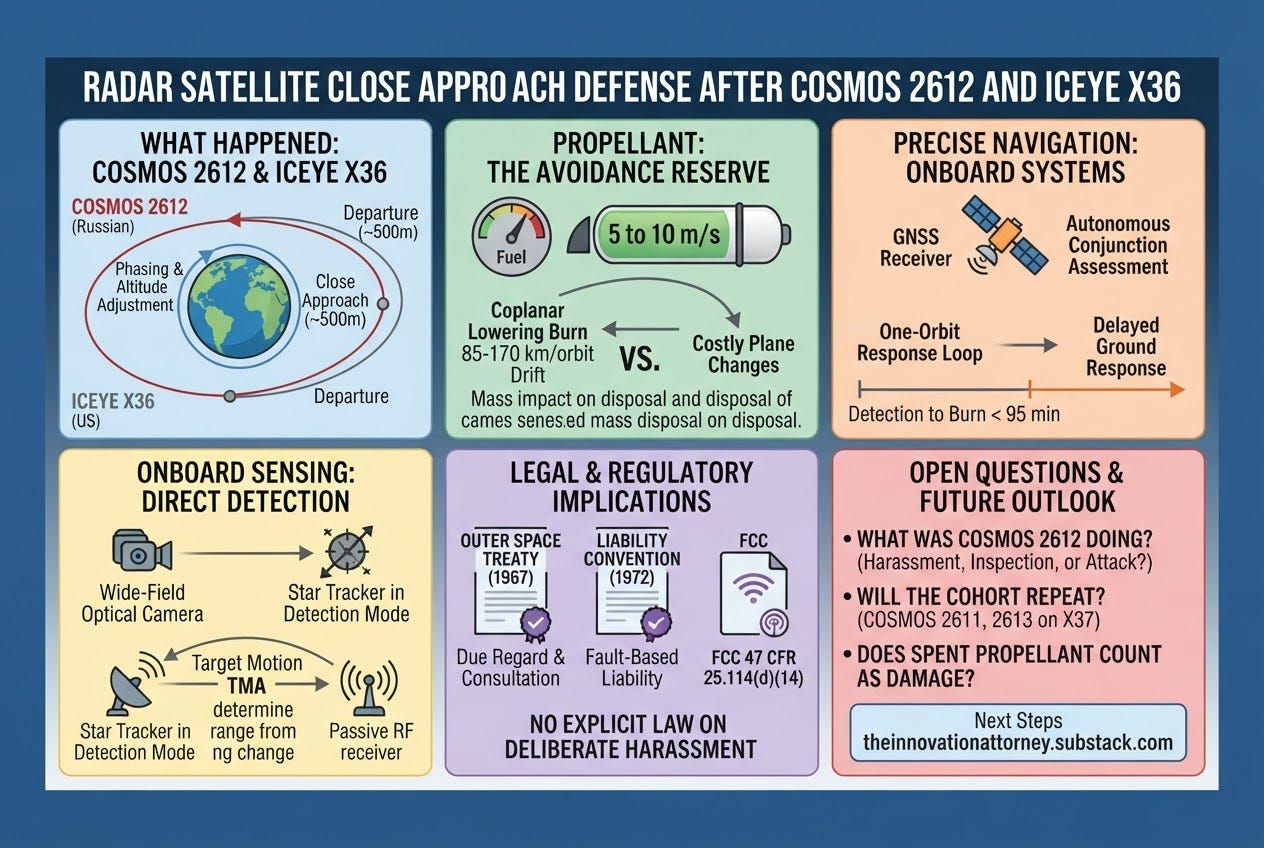
A radar imaging satellite needs 5 to 10 meters per second of reserve, onboard precise navigation, and relative sensing to answer a close approach like COSMOS 2612.¹ That figure comes from first order orbital mechanics applied to the October 2026 encounter, in which the Russian satellite COSMOS 2612 closed from about 400 kilometers to roughly 500 meters of ICEYE X36, a 90 kilogram synthetic aperture radar satellite registered in the United States.¹² The encounter ran from October 15 to October 19, 2026. Public orbital elements show COSMOS 2612 spent about 67 meters per second of change in speed after September 30 to arrive, and about 105 to 117 meters per second in May to match the orbital plane of its target.² A radar satellite operator cannot match that budget. A reserve of 5 to 10 meters per second buys a separation of 85 to 170 kilometers per orbit after a coplanar lowering burn, which exceeds the roughly 10 kilometer standoff that states have generally kept.⁴ Propellant is half the answer. Public element sets for small objects in this orbit carry in track uncertainty near 1.9 kilometers, which is nearly four times the distance LeoLabs reported at closest approach.² A satellite that depends on public tracking data cannot see an event of this size. It needs its own satellite navigation receiver, a way to sense a neighbor directly, and a software path that turns a detection into a burn within one orbit. The legal exposure follows the engineering. Operators licensed under 47 CFR 25.114(d)(14) already disclose collision avoidance capability, and the Liability Convention of 1972 assigns fault based liability for damage in space.⁷¹⁰ Neither text addresses a deliberate approach that causes no collision. Detailed Findings What Happened Between COSMOS 2612 and ICEYE X36? COSMOS 2612 made a controlled, multi week approach to ICEYE X36 between September 30 and October 19, 2026, and held position within about 500 meters of the target on October 17 and 18, according to the commercial tracking firm LeoLabs.¹ The Russian satellite was one of six, COSMOS 2609 through 2614, launched on a single Soyuz 2.1b from Plesetsk in April 2026.³ Public element sets show the approach began with phasing, not speed. COSMOS 2612 raised its orbit about 47 kilometers on September 30, descended 47.8 kilometers on October 11 and 12 to match the target altitude, and closed from about 480 kilometers to about 3 kilometers on October 15 and 16 with burns of under 2 meters per second each.² It then held station behind the target on a loop about 1.6 kilometers tall, and on October 18 raised its orbit 2.3 kilometers to leave. By October 19 it was 292 kilometers behind and drifting away at about 350 kilometers per day.² The closest distance carries uncertainty. LeoLabs reported about 500 meters with high confidence. An independent reading of the public catalog supports a range of roughly 150 to 650 meters in the early hours of October 18, and a 25 meter figure that circulated cannot be derived from public data at all.²³ ICEYE reported moving its own satellite and told the press its constellation architecture is designed for continuity.¹² The Pentagon declined to comment.⁴ How Much Propellant Does a Radar Satellite Need to Respond to a Close Approach? A radar imaging satellite needs a dedicated avoidance reserve of 5 to 10 meters per second, sized for a coplanar phasing burn instead of a plane change. These figures are the author’s first order calculation, using a circular orbit near 500 kilometers, an orbital speed of about 7.6 kilometers per second, and a semimajor axis of about 6,871 kilometers. The altitude is an assumption drawn from published descriptions of the ICEYE constellation.⁶ The calculation reproduces the Russian numbers, which is the reason to trust it. A two burn altitude change of Δa costs a total change in speed near v times Δa divided by twice the semimajor axis. For the 47.8 kilometer descent that gives about 26 meters per second, and public estimates put the real burn near 27 to 28.² A plane change of 0.88 degrees costs about v times the angle in radians, or about 117 meters per second, which sits at the top of the 105 to 117 meter per second range estimated for the May burns.² Applied to the defender, the same equations give the exchange rate that matters. ICEYE lowered its satellite about 0.5 kilometers on June 25 and 26, 2026, a maneuver under 1 meter per second, and the calculation puts that burn near 0.3 meters per second.² A 5 meter per second reserve raises the altitude change to about 9 kilometers. An altitude offset produces an along track drift of roughly three times pi times the offset per orbit, so a 9 kilometer offset opens about 85 kilometers per orbit, and a 10 meter per second reserve opens about 170 kilometers. Plane changes lie outside any defender’s budget. Moving the orbital plane by even 0.1 degree costs about 13 meters per second, and the attacker holds the geometry advantage because it has already matched the plane to within 0.002 degrees.² Evasion therefore has to be in plane, early, and repeatable. COSMOS 2612 closed at about 400 kilometers per day with a 2.3 kilometer altitude offset, which covers the last 3 kilometers in about 11 minutes. A defender that waits for confirmation inside that range has minutes to act, far less than the 95 minute orbit.² In my years as a nuclear submarine officer, the closest point of approach was a number the watch team computed continuously from bearings and ranges that each carried error. A plot whose error exceeded the predicted miss distance gave us nothing to act on, and we treated it as a contact of unknown intent. A satellite operator reading public elements with a 1.9 kilometer in track covariance against a 0.5 kilometer miss distance holds the same plot.² How Accurately Must a Satellite Know Its Own Position and Its Neighbor’s? A satellite needs onboard position knowledge in the meter range and neighbor knowledge within a few hundred meters to make an avoidance decision at these separations. Public element sets cannot supply either. KeepTrack’s analysis put the in track uncertainty for COSMOS 2612 near 1.9 kilometers, and it found gaps in the public record of about 14 hours for COSMOS 2612 and about 8 hours for ICEYE X36 on October 17 and 18, during the closest approach.² A dual frequency satellite navigation receiver gives the host satellite its own position independent of any catalog. The neighbor’s position still comes from outside, which makes the quality of the conjunction data service the limit on what the operator can know. The Department of Commerce is building the Traffic Coordination System for Space under Space Policy Directive 3 of June 18, 2018, and its September 2025 pilot plan called for up to five commercial conjunction assessment screening providers and one independent data quality monitor.⁵¹¹ The pilot describes screening for collisions, not detection of a deliberate approach by an object that stays outside collision thresholds. What Onboard Sensing Detects an Uncooperative Neighbor? Onboard sensing for an uncooperative neighbor requires a sensor that reports relative bearing without help from the neighbor, and the practical candidates are a wide field optical camera, a star tracker run in a detection mode, and a passive radio frequency receiver. This is the author’s engineering assessment. No public document describes what sensing, if any, ICEYE X36 carries for this purpose. A star tracker already images the sky many times per second. A tracker modified to report any moving point source inside a defined range would give bearing and bearing rate for a neighbor inside a few kilometers, which is the range COSMOS 2612 occupied for about two days. Range then comes from the change in bearing as the host maneuvers, a technique the submarine force knows as target motion analysis. A passive receiver tuned to expected crosslink and telemetry bands adds a second line of evidence and tells the operator whether the … This is a public episode. If you'd like to discuss this with other subscribers or get access to bonus episodes, visit theinnovationattorney.substack.com/subscribe
Embed this episode
No transcript yet.