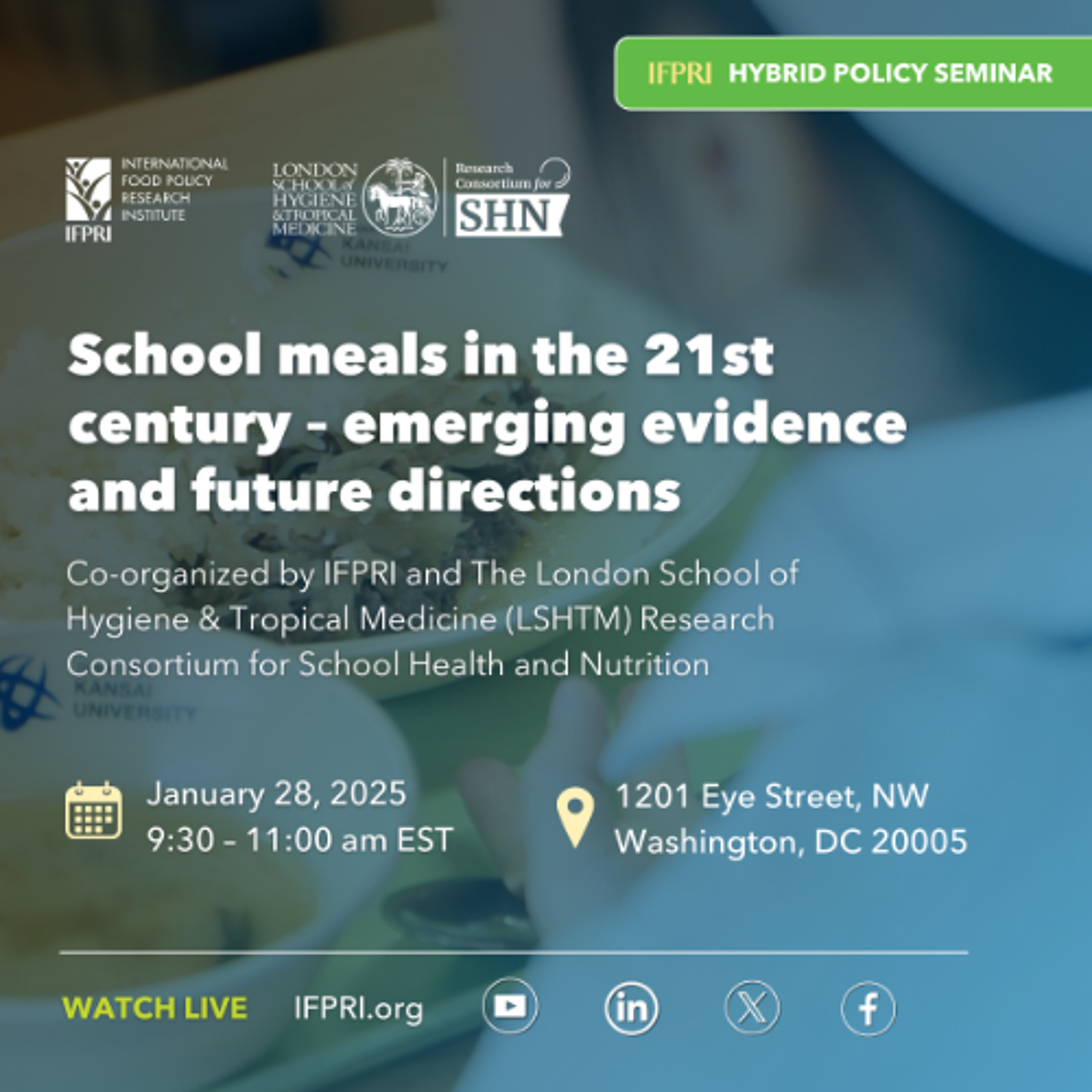
School meals in the 21st century – emerging evidence and future directions episode artwork

EPISODE · Jan 27, 2025 · 1H 43M

School meals in the 21st century – emerging evidence and future directions

from IFPRI Podcast · host International Food Policy Research Institute

This event is co-organized by IFPRI and The London School of Hygiene & Tropical Medicine (LSHTM) Research Consortium for School Health and Nutrition Undernutrition during childhood and early adolescence has long-term consequences for development and health, and for girls it can affect the survival and wellbeing of their children. Diet-related risk factors are estimated to cause 20% of global mortality, and changes in food systems have led to rapid shifts to unhealthy diets and reductions in physical activity, contributing to the increase in rates of overweight and obesity. Moreover, current dietary and population trends will exacerbate risks to humans and the planet. School feeding programs, or school meals, are a widely implemented safety net with documented impacts across social protection, education, health and nutrition dimensions, and substantial projected economic returns to investment. Globally, programs reach over 400 million children for a total investment of over $50 billion a year. By being most effective for the most disadvantaged children, school meal programs can “level the playing field” in education, health, and nutrition. Experiences in high- and middle-income countries have also linked school meals to food systems transformation, where food procurement for school meals is used as an outlet for commercial farmers. National governments in LIMCs have shown interest in explicitly linking food systems transformation with the school feeding market through “home-grown” school feeding (HGSF). In HGSF, the “structured demand” for school food and related services is channeled to smallholders and other supply chain actors with the intent of stimulating agricultural productivity, increasing incomes, improving diets, and reducing food insecurity. More about this Event: https://www.ifpri.org/event/school-meals-in-the-21st-century-emerging-evidence-and-future-directions/ Welcome and Introduction Purnima Menon, Senior Director, Food and Nutrition Policy; Acting Senior Director, Transformation Strategy, IFPRI Donald Bundy, Professor, London School of Hygiene and Tropical Medicine (LSHTM) School Meals are Evolving: Has the Evidence Kept up? Harold Alderman, Research Fellow Emeritus, IFPRI New Evidence from Impact Evaluations Impact evaluation of the home-grown school meal model in Jordan: Simone Lombardini, Evaluation Officer, World Food Programme (WFP) Impact evaluation of the home-grown school meal model in The Gambia: Benedetta Lerva, Economist, Development Impact (DIME), Development Economics, The World Bank Impact evaluation of an added milk intervention to a micronutrient fortified school feeding program in crisis settings: Lilia Bliznashka, Research Fellow, IFPRI Panel Discussion: Moving from evidence to action Mangani Katundu, Secretary for Education, Government of Malawi Donald Bundy, Professor, London School of Hygiene and Tropical Medicine (LSHTM) Lynnette Neufeld, Director, Food and Nutrition Division, Food and Agriculture Organization (FAO) Kagwiria Koome, Manager, Food, The Rockefeller Foundation Mia Blakstad, Window Manager, Food and Nutrition, The World Bank Arlene Mitchell, Executive Director, Global Child Nutrition Foundation (GCNF) Moderator and Closing Remarks Aulo Gelli, Senior Research Fellow, IFPRI Links: Subscribe IFPRI Insights newsletter and event announcements at www.ifpri.org/content/newsletter-subscription

This event is co-organized by IFPRI and The London School of Hygiene & Tropical Medicine (LSHTM) Research Consortium for School Health and Nutrition Undernutrition during childhood and early adolescence has long-term consequences for development and health, and for girls it can affect the survival and wellbeing of their children. Diet-related risk factors are estimated to cause 20% of global mortality, and changes in food systems have led to rapid shifts to unhealthy diets and reductions in physical activity, contributing to the increase in rates of overweight and obesity. Moreover, current dietary and population trends will exacerbate risks to humans and the planet. School feeding programs, or school meals, are a widely implemented safety net with documented impacts across social protection, education, health and nutrition dimensions, and substantial projected economic returns to investment. Globally, programs reach over 400 million children for a total investment of over $50 billion a year. By being most effective for the most disadvantaged children, school meal programs can “level the playing field” in education, health, and nutrition. Experiences in high- and middle-income countries have also linked school meals to food systems transformation, where food procurement for school meals is used as an outlet for commercial farmers. National governments in LIMCs have shown interest in explicitly linking food systems transformation with the school feeding market through “home-grown” school feeding (HGSF). In HGSF, the “structured demand” for school food and related services is channeled to smallholders and other supply chain actors with the intent of stimulating agricultural productivity, increasing incomes, improving diets, and reducing food insecurity. More about this Event: https://www.ifpri.org/event/school-meals-in-the-21st-century-emerging-evidence-and-future-directions/ Welcome and Introduction Purnima Menon, Senior Director, Food and Nutrition Policy; Acting Senior Director, Transformation Strategy, IFPRI Donald Bundy, Professor, London School of Hygiene and Tropical Medicine (LSHTM) School Meals are Evolving: Has the Evidence Kept up? Harold Alderman, Research Fellow Emeritus, IFPRI New Evidence from Impact Evaluations Impact evaluation of the home-grown school meal model in Jordan: Simone Lombardini, Evaluation Officer, World Food Programme (WFP) Impact evaluation of the home-grown school meal model in The Gambia: Benedetta Lerva, Economist, Development Impact (DIME), Development Economics, The World Bank Impact evaluation of an added milk intervention to a micronutrient fortified school feeding program in crisis settings: Lilia Bliznashka, Research Fellow, IFPRI Panel Discussion: Moving from evidence to action Mangani Katundu, Secretary for Education, Government of Malawi Donald Bundy, Professor, London School of Hygiene and Tropical Medicine (LSHTM) Lynnette Neufeld, Director, Food and Nutrition Division, Food and Agriculture Organization (FAO) Kagwiria Koome, Manager, Food, The Rockefeller Foundation Mia Blakstad, Window Manager, Food and Nutrition, The World Bank Arlene Mitchell, Executive Director, Global Child Nutrition Foundation (GCNF) Moderator and Closing Remarks Aulo Gelli, Senior Research Fellow, IFPRI Links: Subscribe IFPRI Insights newsletter and event announcements at www.ifpri.org/content/newsletter-subscription

NOW PLAYING

School meals in the 21st century – emerging evidence and future directions

0:00 1:43:10

No transcript for this episode yet

We transcribe on demand. Request one and we'll notify you when it's ready — usually under 10 minutes.

That Hoarder: Overcome Compulsive Hoarding That Hoarder Hoarding disorder is stigmatised and people who hoard feel vast amounts of shame. This podcast began life as an audio diary, an anonymous outlet for somebody with this weird condition. That Hoarder speaks about her experiences living with compulsive hoarding, she interviews therapists, academics, researchers, children of hoarders, professional organisers and influencers, and she shares insight and tips for others with the problem. Listened to by people who hoard as well as those who love them and those who work with them, Overcome Compulsive Hoarding with That Hoarder aims to shatter the stigma, share the truth and speak openly and honestly to improve lives. The Small Business Startup School – Business Notes | Financial Literacy | Retail Psychology – For Professionals & Entrepreneurs The Small Business Startup School Inc. Starting or buying a small business? While personal circumstances may vary, business patterns remain timeless. On The Small Business Startup School, we explore strategies, insights, and practical solutions to help entrepreneurs confidently navigate their journey.Hosted by Ola Williams—a retail entrepreneur, fintech founder, and financial coach with over two decades of experience—this podcast marries financial awareness and retail psychology with optimism to deliver actionable takeaways.Join us to learn, grow, and connect as we uncover the keys to business success.Let’s continue to learn together and be encouraged to keep on connecting! DIOSA. Carolina Sanper This podcast is a sacred space created by Carolina Sanper where you connect with your inner wisdom and embody your magnetic feminine power.It is the realization that the mystical realm is where you plant the seeds of your desired reality.It is a portal to your true essence: awareness, presence, and receiving with ease. Welcome home, DIOSA. 🖤 XXX Tech by SOVRYN Dr. Brian Sovryn The crossroads between technology, sensuality, and metaphysics - and the longest running anarchist podcast in the world! Brought to you by Dr. Brian Sovryn.

Frequently Asked Questions

How long is this episode of IFPRI Podcast?

This episode is 1 hour and 43 minutes long.

When was this IFPRI Podcast episode published?

This episode was published on January 27, 2025.

What is this episode about?

This event is co-organized by IFPRI and The London School of Hygiene & Tropical Medicine (LSHTM) Research Consortium for School Health and Nutrition Undernutrition during childhood and early adolescence has long-term consequences for development...

Can I download this IFPRI Podcast episode?

Yes, you can download this episode by clicking the download button on the episode player, or subscribe to the podcast in your preferred podcast app for automatic downloads.
URL copied to clipboard!