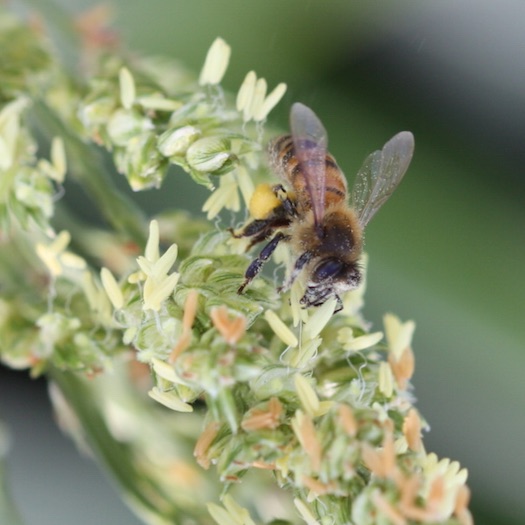
Farmers are well aware of the importance of honeybees, but pesticides are a reality of modern agriculture. Could the benefits of pesticides outweigh the risk to bees? A recent study from the UT Institute of Agriculture says yes. This is Agcast, brought to you by the University of Tennessee Institute of Agriculture.
I'm Ginger Rousey. In 2015, scientists with the University of Tennessee observed 16 honeybee colonies for one year. These colonies were located in different environments ranging from intense agricultural production to no agricultural or very little agricultural production. As you might expect, the honeybees in the high agricultural areas were exposed to more agricultural pesticides.
But what is surprising is these higher levels of exposure did not appear to have an impact on these hives. In fact, according to the study, these hives grew faster and generally performed better than bee hives in non-ag areas. Researchers published their findings in a recent issue of the journal Economic Intimology. We sat down with one of the co-authors, University Intimologist Scott Stewart, to discuss.
Here's our conversation. So in your latest research paper, were you surprised at all about the findings? Not really. I kind of knew all along that agriculture probably wasn't the big boo-y man that everybody thought it was for us bees.
We know there could be some issues. We know when we spread insecticides. Sometimes we can harm bees and we need to be aware of that. But we also know agriculture provides a lot of food resources for bees.
Really, that's what that paper shows is that, you know, without agriculture bees, we're hungry. Now, I guess somebody can make you argument if those fields were full of wildflowers and blossoms and everything, the bees would be even happier. And that may be true, but that's not the real world. We have to grow crops.
We have to make living and we need to make food for the world population. Is there anything surprising in the study? I guess what surprised me the most was how little pesticide contamination we found in the hives and agricultural areas. We also found in the area that we designated the non-agricultural area, which was at least three miles from any crops, that those bees found some crops.
They didn't find a lot of it, but they forged out as far as they could because those bees were going hungry. They really didn't have enough food resources. And, you know, the area was such that really it was kind of the woods and there wasn't a lot of flower and plants for them. So I guess it surprised me just how far they will go when they have to.
Yeah, how far will be steadily for things? So, you know, normally people will say something like three to five kilometers is a normal foraging range. So that puts you right around three miles at the maximum distance. But, you know, when necessary they won't go farther.
There's adequate food sources nearby. You know, I think one of the issues we do see as in some of our data indicates that you need to have some variety in there. And things besides agricultural crops, you know, agricultural crops are good food resources, but they're really a food resource for two or three months during the year. And that's maybe the downside of not having some areas while habitat or flowers for the bees.
Again, I don't think pesticides are near the impactful factor that people think they are. I think food resources and grow them. And we know grow them. We know grow them by some major problems for bees as well.
In your study, you evaluated three things. Colony weight, colony thermal regulation and then brood size is like right. Correct. One of those three of those said in manufacturers and in Germany being health?
Yeah, they really are. And I think you could think of animal health. There are people health is if they're growing well and putting on weight. That's an indication of good reproduction and good health.
Of course, you know, people want to get a certain size. You don't want to keep on waiting. But, you know, think of children. You know, you want them to grow normally and develop and get bigger in size.
And that's a good thing. If you start seeing where during the summer months when the population is supposed to be growing, they stay flat or declining. That indicates a problem. And we've seen that for unknown reasons.
We've had hives that start to grow or won't grow well at all. And it seems like invariably those are the ones that struggle to make it to the fall. And you might have a hive two foot away that takes off and grows almost exponentially. You almost have to think of these bees as these hives as individuals.
So a bunch of bees in each one, but they act like an individual and they behave differently. What have you learned? You've been studying bees for how many years now? It's five years.
Pretty intense. So what's something that you learned since in your time doing this? I've learned a lot about bees. It's really been very educational because I'm an animal just but I'm not a bee expert.
So I guess I learned to appreciate the bees a little bit and handle it a little more carefully. Also, I think the first research impacts, I feel, and one of the reasons I got into this work is that we were concerned that all the hype was true. That Ag was really having a serious negative effect on bees. And a lot of the initial hype started around seed treatments.
And I just feel like really we've addressed that very well. That we're getting very little risk from the insecticide seed treatments to pollinators and honeybees in particular. And really, if we're going to try to address the potential negative impacts of insecticides on bees, we need to be thinking about foliar applications and how we're making them to make sure we're not exposing bees unnecessarily. And we also need to acknowledge there's other factors that are just as are more important.
You look at social media, pesticides, pesticides. And it really means probably several positions down on the list from the top of key factors. Well, talk about that. And there are other scientific studies that talk about pesticides having a negative impact on bees.
So how do you resolve your work with what you're seeing in some of your fellow scientists doing? Yeah, that's a great question. And I don't want to make the conclusion that pesticides can't have a negative effect on bees. We've observed in our own trials where we've seen some bee mortality.
We call it front door mortality where they actually die at the entrance. And usually that indicates they're exposed in a field. Now, the hives didn't suffer, but individual bees suffered. So we saw some bee mortality that we know was related to pesticides.
I think it's very complicated. And a lot of the studies that look at bee health, to me, I look at them and it's like, well, you're trying to prove that insecticides are harmful to the insects. And we know they are. And a lot of the studies are done in the laboratory.
And those aren't very realistic settings. That bee hive is very complicated. They may forage in an exposed crop or they may forage in 20 different things. And because they're not always just being exposed in the laboratory constantly, they don't have the same reaction.
So if you look at a lot of the studies, they'll talk about sub-lethal effects. Sub-lethal effects on fly or reproduction. And they talk about using field relevant doses. But I would argue a lot of those sub-lethal effects, they're not very sub-lethal.
And the way they expose the insects is not the way the hive is exposed in the real world. And, you know, I don't... You had a good... go ahead, share your sub-lethal.
So, you know, sub-lethal by definition means that, you know, things that affect the behavior or how the insect performs that don't kill it. And, you know, there's a lethal effect about pesticide and there's no effect. And there's a lot of room in between. So, you know, by definition, you can say sub-lethal only kills 20% of bees.
And the other 80% are going to be affected, but they're not going to be dead. So, to me, that's not sub-lethal necessarily. And I always give the example, and it's kind of a morbid example, that if I walked into a room with three people and shot one of them dead on average, that's sub-lethal. And, you know, science and the scientists will be finding that dose, that kind of thing, is sub-lethal effect.
But there's clearly lethality there. And the other thing you got to consider is a lot of the... When they look at the dose, they're saying sub-lethal is a laboratory expression where they... Measure mortality after 24 hours.
That same dose may be very lethal if continually exposed for a week. So, you really have to be aware of how you're defining sub-lethal. You know, I've made the argument, if you look at sub-lethal effects of insecticides, probably any of them at some sub-lethal dose are going to have a negative effect on bees. Probably, if you fit on a solution to table salt, it would have a negative effect on the bees that you can measure in the least laboratory.
You know, what would you like to see in the future of bee research going? What's next? You had this study on that cultural landscape, so what's coming up next? Well, I think we've kicked this neonicotinoid honeybee thing around enough.
I mean, if we keep looking and keep looking, no insecticides are going to be able to survive the level of scrutiny that the neonics have. And that's probably what's going to next. I think we need to really start looking a little bit more closely at landscape level research. And it's much more challenging to do.
And that's one reason people tend to work in small scales or in the laboratory. But, you know, we need to start looking at how exposure in the real world, from agricultural crops, from the bees on pest, like the bero mites I mentioned earlier, diseases. And even some of the chemistries that are being introduced by beekeepers, because they're using insecticides and their high-tech cause problems. I think we need to start doing that.
That's kind of what our study did. And just, unfortunately, when you do that kind of work, you tend to get flaudier results. You know, it's harder to do. It's harder to replicate agricultural field settings.
You know, you can't just run 30 bees in a lab. You know, there's not, you know, we really were challenged in this study because really what we'd like to have had is an agricultural area that didn't use insecticides or pesticides in an agricultural area that was similar that did. So we'd have a control and an uncontrolled. Well, if you can find an agricultural area in this area that doesn't use insecticides, we'd like to.
We just don't have it. And, you know, you have to keep in mind the scale we're looking at these bees are forgents in any direction. So all of a sudden you're talking about 20, 25 square miles to avoid overlap. It's just really challenging.
Yeah. Well, what is, if you had a take-on point for this study or just your thoughts on where we're going and where people need to be aware of as far as bee health, what would it be? Well, I think we're spending way too much time in emphasis chasing the little things and not the big things. I think if we really want to help bee health in the long term, and I'm not talking just about honeybees, but pollinators, we need to think more about the habitat.
And when you think about pesticides, and we're doing a lot of education with our growers and applicators about applying insecticides, being careful about bees. You know, there's a lot of legislation coming out, talking about when we can apply pesticides to crops that are on blooms. That's kind of beyond my area. But I think we need to focus as much or more attention on providing those bees some habitat and also managing the rural heights with good tools that don't hurt the bees themselves.
So that was an interesting thing in the article that the brood reproduction was best in a low ag area that had a lot of, well, was there really low ag as you would think of agriculture, but there was also urban, like, land-safe and forest. And that thought was because of these kind of diversity of pollen. Exactly, and that location is actually here. And of course, this is an agricultural experiment station, so you can't call it low ag.
But if you look in terms of the radius of that bee, you know, that's everything's really in a half mile, essentially, those highs. And then it turns into urban area and forested area. And my postdoc, my homo, Alvaraca, who's done most of this work in recent years, you know, studied the diversity of the pollen, the bees were carrying it. And it seemed to correlate well with their health.
And I think it makes perfect sense. There was not only agricultural crop pollen, there was other pollen from, we don't necessarily know where. Some of it was from urban environments, some of it was from natural landscapes. And besides there just being diversity, it was probably diversity in time.
There was things available in the crops ran out that the other sites didn't necessarily have. And again, generally, if you look at our study, ag was good for the bees, but having that extra diversity here seemed to help the bees. And I think it makes perfect sense. It's just a good, varied, well-viled diet, you know, which is what people need to do, right?