
EPISODE · May 16, 2025 · 12 MIN
Sebastian Brant (1457–1521) - Charting Madness at the Dawn of Modernity
from The Cogitating Ceviché Podcast · host Conrad T Hannon
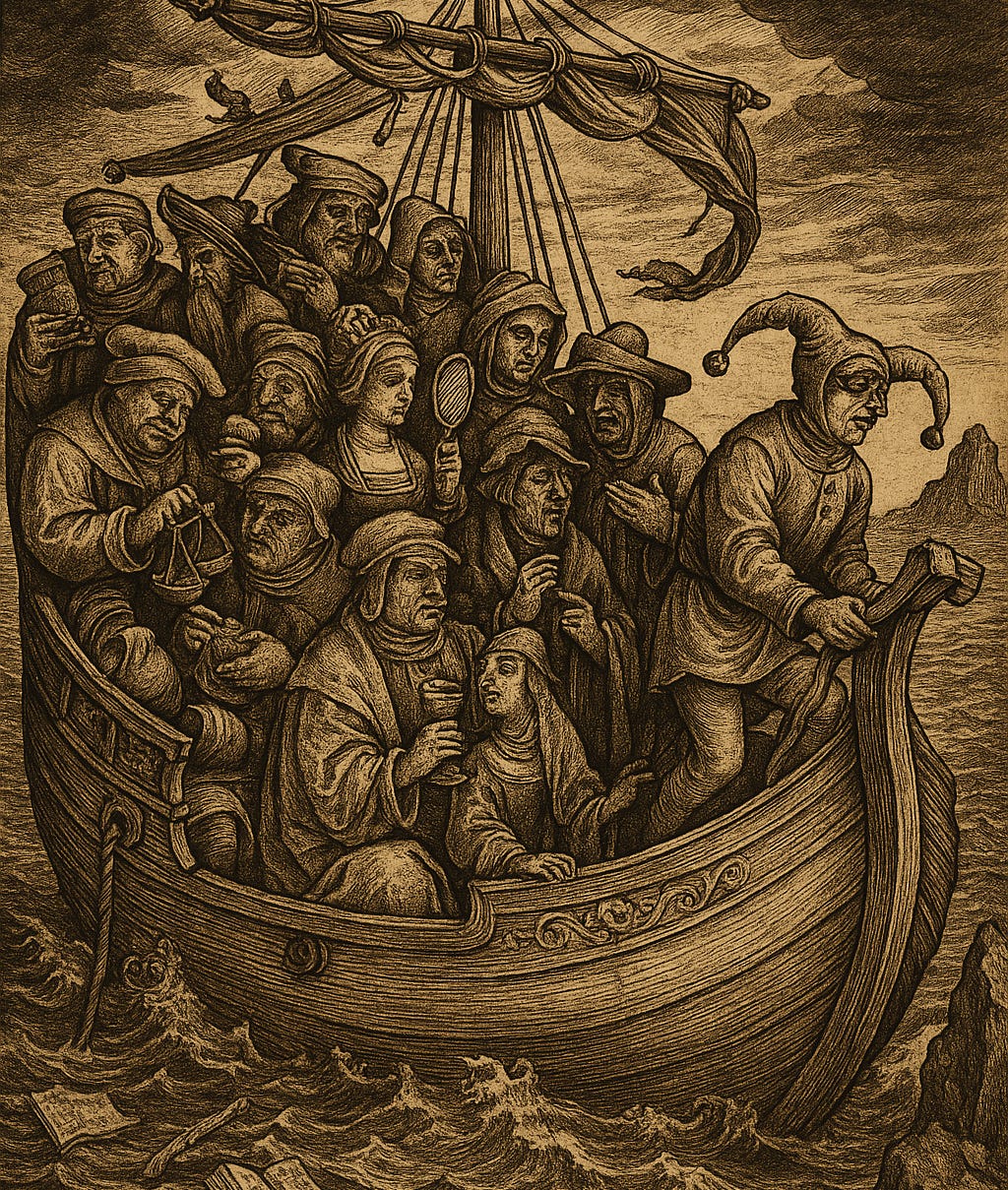
The Cogitating Ceviche PresentsSebastian Brant (1457–1521) - Charting Madness at the Dawn of ModernityHonoring the Satirists and Thinkers Who Altered Our Perspectives #80By Conrad Hannon Narration by Amazon PollyPrefaceAt the uneasy twilight of the Middle Ages, when the certainties of medieval Christendom were fraying and the humanist dawn had yet to break fully across Europe, a jurist-poet from Strasbourg cast off in a vessel destined for literary immortality. That man was Sebastian Brant, and his masterpiece, "The Ship of Fools" (Das Narrenschiff, 1494), became one of the most influential satires of its time—an allegorical voyage through the vices, hypocrisies, and absurdities of a society adrift between epochs. More than a moral tract, Brant's work served as a cultural reckoning: a mirror for the world that mocked its reflection, a call to reform masquerading as a carnival of lunacy. His contribution helped pave the path from medieval didacticism to Renaissance critique, and his influence echoed well beyond the Rhine, shaping satirical traditions for centuries to come.Early Life and InfluencesSebastian Brant was born in 1457 in Strasbourg, a Free Imperial City of the Holy Roman Empire—an urban crossroads where ecclesiastical authority, bourgeois ambition, and the stirrings of intellectual ferment coexisted in uneasy harmony. His father was an innkeeper, affording Brant early exposure to a wide range of human types, from clerics and students to soldiers and traders, whose idiosyncrasies would later populate his verse.He matriculated at the University of Basel in 1475, first studying in the arts faculty and then in law, eventually earning a doctorate in both civil and canon law by 1489. Though formally trained in jurisprudence, Brant exhibited a humanist's hunger for classical texts and theological reflection. His academic grounding in Roman legal traditions, Christian scholasticism, and German vernacular poetry laid the foundation for a uniquely hybrid literary voice—erudite yet accessible, moralizing yet humorous, orthodox yet confrontational.Basel itself was a hotbed of printing innovation, home to publishers and illustrators who would amplify Brant's vision. The city stood at the cultural crossroads of German, French, and Italian influences, enriching Brant's perspective. By the time he published "The Ship of Fools," Brant was not just a scholar but a civic intellectual, steeped in both the bookish culture of the university and the regulatory ethos of late medieval municipal governance. This dual identity—as both academic and citizen—would inform his satirical perspective, allowing him to critique society from within rather than without.Major Works and ThemesThe Ship of Fools (1494)Brant's magnum opus, "Das Narrenschiff," was nothing short of a cultural phenomenon. First published in Basel with over 100 woodcuts—many attributed to the young Albrecht Dürer—the book was an immediate commercial and critical success. It quickly went through numerous editions and was swiftly translated into Latin, French, English, and Dutch, spreading its influence throughout Europe. The work is structured as a parade of fools, each representing a different human vice or societal failure: vanity, gluttony, ignorance, superstition, greed, and more. Brant's fools are not exotic jesters but recognizable figures drawn from every stratum of society—clerics, nobles, merchants, scholars, and peasants alike.The book's organization is brilliant in its simplicity—a series of short chapters, each devoted to a particular type of fool, with accompanying woodcuts that reinforce the textual critique. This episodic structure allowed readers to dip in and out of the text, making it accessible to a broad audience at a time when literacy was still limited. The ship itself serves as the unifying metaphor—a vessel of delusion carrying its passengers not toward salvation but toward folly's inevitable consequences.Critique of Society and PowerThough Brant did not explicitly attack the Church as an institution—his allegiance to Catholic orthodoxy remained firm throughout his life—his satire took sharp aim at corrupt clerics, lazy prelates, and charlatans who exploited faith for personal gain. He savaged the bureaucracy of indulgences and the neglect of scripture by a self-satisfied clergy, foreshadowing many of the grievances that would soon be voiced by Martin Luther. But Brant's targets were broader still: self-important academics disconnected from practical wisdom, vain nobility obsessed with lineage rather than virtue, gossiping housewives spreading discord, and fraudulent astrologers misleading the gullible all came aboard his ship, sailing not toward wisdom but toward the mythical land of Narragonia.One of the book's most radical elements was its insistence that folly was not confined to the margins of society but had permeated its core institutions. It was a proto-democratic impulse clothed in medieval garb—the suggestion that status offered no immunity to moral decay, and that authority itself might be foolishness in disguise. In an age of rigid hierarchy, such leveling criticism was quietly revolutionary.Defense of Justice and ValuesBeneath its ridicule, "The Ship of Fools" was a deeply moral text. Brant believed passionately in order, education, and religious piety—not as mere traditions to be preserved, but as bulwarks against chaos and social dissolution. He was not a nihilist mocking the world for amusement; he was a concerned jurist who saw satire as a surgical tool to excise folly and preserve the body politic. His goal was not destruction but correction, not rebellion but reform. The ideal society he envisioned was not revolutionary but restored: one in which rulers ruled wisely, priests preached sincerely, and citizens lived with humility and diligence.Yet even in his earnestness, Brant recognized the perverse comedy of human nature. His fools are drawn with sympathy as much as scorn. They are not evil so much as absurd, and their descent into folly is often tragicomic—too close for comfort, too true to ignore. This balance between judgment and compassion gives his work lasting appeal; we laugh at his fools because we recognize ourselves among them.Rhetorical Style and TechniquesBrant's satire was shaped by the medieval tradition of memento mori and ars moriendi, yet it innovated significantly within that frame. He employed allegory and personification, following in the footsteps of Dante and the Roman de la Rose, but his tone was more caustic and his characters more mundane. He used rhyme and rhythm to drive home moral points, crafting verses that were both memorable and musical, using the vernacular German language with unprecedented skill.The use of woodcut illustrations was another key technique that set Brant's work apart. These images acted as visual satire, reinforcing and sometimes extending the grotesquery of the textual portraits. Dürer's early hand—if indeed it was his—elevated the book's impact, making folly not just imaginable but visually unavoidable. The interplay of text and image created a multi-sensory satire that transcended literacy barriers, drawing in readers who might otherwise never confront such moral commentary.Brant also employed classical allusions, biblical references, and proverbial wisdom, weaving them together in a tapestry that appealed to both learned and common readers. This synthesis of high and low culture mirrored his view that folly was universal, crossing boundaries of class and education.Controversies and CriticismsAlthough "The Ship of Fools" was widely celebrated in its time, Brant's orthodoxy and nationalism have drawn criticism from later interpreters. Some view him as a conservative moralist rather than a revolutionary thinker, more interested in maintaining social order than in challenging underlying power structures. His occasional xenophobia—particularly his hostility to foreign influence on German culture and his advocacy for German linguistic and cultural purity—has not aged well in our more cosmopolitan era. He also failed to embrace some of the more radical currents of Renaissance humanism; Erasmus, who admired Brant's poetry, nonetheless saw him as intellectually rigid in his adherence to scholastic methods.Brant was not persecuted for his work—indeed, he enjoyed a successful career as a legal scholar and civic advisor in Strasbourg after returning from Basel—but he was swept aside by history's turning tide. As the Reformation ignited across German-speaking lands, Brant remained loyal to Catholicism and retreated from the polemical scene, unwilling to align with Luther's theology despite sharing many of his criticisms of ecclesiastical abuse. In this way, Brant became a transitional figure: honored by posterity but overtaken by the bolder revolutionaries he helped inspire.Some modern scholars have also questioned the originality of Brant's concept, noting that the "ship of fools" motif had precursors in medieval carnival traditions and literary works. However, most acknowledge that Brant's genius lay not in inventing the metaphor but in expanding it into a comprehensive social critique, executed with unprecedented artistic and commercial success.Impact and LegacyBrant's "Ship of Fools" helped establish satire as a popular and profitable literary form in the vernacular. It bridged the medieval tradition of moral allegory with the early modern appetite for social critique, and it did so without the shield of Latin, making its jabs intelligible to the rising literate middle class. The book's immense popularity laid groundwork for later satirical works, including Erasmus's "Praise of Folly," Thomas More's "Utopia," and the Protestant polemics of the Reformation era.In England, Alexander Barclay adapted "The Ship of Fools" into verse in 1509, expanding its influence in the Anglophone world. Over the centuries, the term "ship of fools" has entered common usage as a metaphor for doomed endeavors steered by incompetence, echoed in works from Hieronymus Bosch's painting to Katherine Anne Porter's novel and beyond. Michel Foucault would later use the image of the ship of fools in his "History of Madness" to illustrate changing attitudes toward unreason.Brant's influence extended beyond literature into visual arts. The woodcuts that accompanied his text—whether by Dürer or others—established a visual vocabulary for depicting folly that would influence generations of artists. The dance of death, the world upside down, the fool's cap and bells—all these motifs gained renewed currency through Brant's work.Today, Brant is remembered as both a product and critic of his age: too pious for the radical humanists, too worldly for the religious mystics, and too cautious for the iconoclasts who would soon tear apart the fabric of medieval Christendom. But in his moment, he did something rare—he gave folly a face and then demanded it be recognized in the mirror. His ability to blend moral seriousness with satirical wit, erudition with accessibility, made him a literary pioneer whose influence extends far beyond his own time.ConclusionSebastian Brant's "Ship of Fools" was not merely a catalogue of late medieval misbehavior—it was a cultural turning point. By dressing up moral critique in carnival costume, Brant made satire accessible, poetic, and popular. He held up a mirror to society not to despair but to reform, not to mock aimlessly but to warn lovingly. His voice was one of clarity in a world drifting toward stormier waters, calling his readers back to the solid ground of wisdom and virtue.In honoring Brant, we recall that the fool is not always the one wearing bells. Sometimes, the greatest madness is thinking we are immune to it. Brant reminded his readers then—as he reminds us now—that the voyage to Narragonia remains perpetually open to all, and only wisdom, self-knowledge, and moral clarity can turn the rudder toward safer shores. His enduring legacy is the recognition that satire, at its best, is not mere mockery but medicine—a bitter draught that heals even as it stings.Thank you for your time today. Until next time, stay gruntled. This is a public episode. If you'd like to discuss this with other subscribers or get access to bonus episodes, visit thecogitatingceviche.substack.com/subscribe
Embed this episode
NOW PLAYING
Sebastian Brant (1457–1521) - Charting Madness at the Dawn of Modernity
No transcript for this episode yet
Similar Episodes
No similar episodes found.
Similar Podcasts
No similar podcasts found.