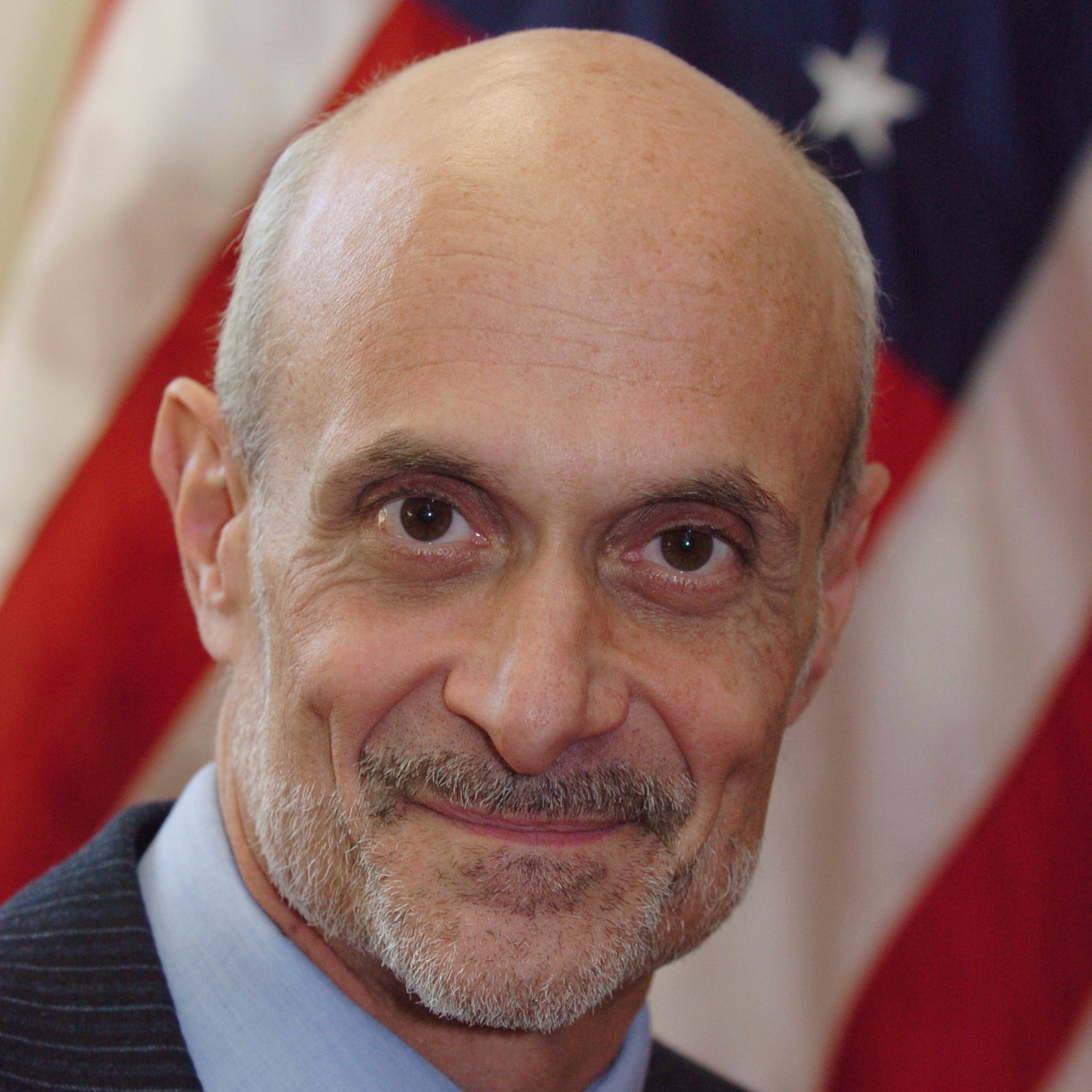
Hi everyone and welcome to CMS On Air, the podcast on migration, refugee and population issues brought to you by the Center for Migration Studies of New York. I am Rachel Reyes, CMS's Director of Communications. In this episode, Executive Director Donald Crowen speaks with Michael Turdoff, former Secretary of the U.S. Department of Homeland Security.
They speak on migration, refugee protection and national security issues. The conversation was recorded on July 9, 2016, days before the recent terrorist attack in Orlando, Florida. And now here is Don's interview with Secretary Turdoff. We're very pleased to be speaking today to Michael Turdoff.
Secretary Turdoff has served as the Chief Federal Prosecutor who in the mid-1980s secured racketeering convictions against the heads of the five New York Mafia families. He was the Assistant Attorney General of the Criminal Division from 2001 to 2003. The Secretary of the Department of Homeland Security from 2005 to 2009 had a federal judgment of the Third Circuit U.S. Court of Appeals and is now the Executive Chairman of the Turdoff Group, which he co-founded.
Mr. Secretary, thank you for making time to speak with us today. We really appreciate it. Great.
And we're going to talk mostly about immigration-related security issues, if that's okay. So, Secretary Turdoff, the security of the U.S. and European Immigration and Refugee Systems has received significant attention over the last two years. In addition, we're approaching the very sad days, September 11, 2001, the anniversary of that attack.
And I wonder if you might start by reflecting on the vulnerabilities that were exposed by the attacks, as well as the migration-related security lessons U.S. intelligence law enforcement and security agencies took from line line. Well, it's important to recognize that the hijackers who came in on 9-11 did not come in as immigrants, they came in as visitors. And they had visitors visas.
And one of the things that was revealed by the terrible tragedy and the horrible crime of September 11th was that we were weak in terms of not only our visa screening system, but our ability to connect the dots up. Using the tools we have now, if we went back in time, we could have prevented a lot of these people from coming into the U.S. But we didn't have the tools and we didn't integrate them back 15 years ago. And that's why we had a certain vulnerability.
But again, I want to emphasize these were not migrants. And they weren't refugees. They were just visitors. So, was it information sharing?
Is that what you mean by integration? It was information sharing? It was information sharing. It was information integration and turning it into an operational outcome that allows you to prevent people from getting in who might be dangerous.
Right. So in the immediate aftermath of 9-11, the U.S. enforcement agencies and immigration agencies were really trying desperately to prevent what they thought was a next attack that they felt was imminent. With the benefit of hindsight, could you speak a bit to the successes and some of the lessons learned from that?
You know, both from a security, I would say, in a civil liberties perspective and a national unity perspective. From some of the more controversial initiatives of that year, I'm thinking of things like the NCEER's program, some of the preventive detention and arrests that took place in other measures. So, first, I think if you look at it from a security perspective, you'd have to say it was very successful because, although we had good reason to fear terrorist attacks following on to September 11, in fact, there were some plots that were contemplated. In fact, there wasn't a successful attack in the U.S.
during the succeeding eight years. So, we obviously succeeded in that. I think from a civil liberties standpoint and from a general public reaction standpoint, what's remarkable is that although there was an initial surge of uncertainty and anxiety and, to some degree, acting out against people who are our lineage, if I actually quieted down pretty quickly, President Bush went out there very forcefully and said, we're going to be aggressive in preventing terrorists from getting in and carrying out attacks, but we're not going to condemn a whole religion or a whole people. I think that was the appropriate balance.
So, things actually quieted down relatively soon after September 11. As far as the individual practices were put into effect, everything actually was within the law, but it was well, in fact, not properly adapted to doing the terrorism. For example, we did use legal tools that were available under the immigration laws and the criminal laws to arrest people or to detain them for questioning if they had some connection to the terrorists. And that might have been a financial connection.
It might have been a commonality of an address or something of that sort. But actually, pretty quickly, again, things settled down. There were some legal changes that allowed the government to do things a little bit more easily. But again, I don't think there was any wholesale abrogation of civil liberties.
The NCR's program in particular, did you want to talk about that? Because that's at least the call and registration program. Well, that was, yeah. As an average listener, that was a program to register people from certain countries, especially.
And again, it was a program which, as a short-term solution was understandable, eventually it was abandoned as we got better intelligence. And I do want to stress it was focused on people from particular countries, not based on religion, per se. But again, it was a registration program. And it was designed, at least in the short term, to stabilize what was a very uncertain and potentially catastrophic situation.
There's been substantial concern related to the recent terrorist attacks in Europe, and in particular the return of European jihadists, basically, to their home countries. Perhaps this is a smaller issue, but an issue nonetheless here in the United States as well. And also concern related to the infiltration of terrorists into the refugee and migrant flows which are pretty unregulated into Europe. What's the Europe need to do now from a security perspective and in the future, from a security perspective, to securitize the flows and to allow for a robust refugee system?
Well, I think Europe is now where we were prior to September 11th. Even in terms of their intelligence collection capabilities, and they're not fully stitched together in terms of pulling together, collecting, integrating as a whole of the intelligence that they do have in the various departments and agencies in various countries. And in fact, I'm currently involved up with a European think tank on a project to really make recommendations for retooling European intelligence. I think they need to do a number of things.
First of all, there's a lot more that can be collected simply based on first simple travel information relating to people coming in or returning from overseas, particularly from countries where we do know there's a diaspora or ISIS activity going on. That would give much greater visibility to who's coming in and who's going out. A better understanding of what's going on in communities and a better integration of communities into the life of the countries, will in many cases reduce the incentive people have to affiliate themselves with extreme groups. That means better community engagement, but also means coming up with a narrative against violent extremism that tells young, particularly young men that they're better off making their state in a European country with a future than to go to fight in Syria or in Iraq.
So there's a whole series of things they need to do. And again, finally, refugee issue, it's much better to process refugees near where they are fleeing in a safe location where you can vet them and interview them, than to be presented with a situation where they arrive on your shore. And now it's kind of too late. They're there at it's very hard to, at that point, really examine them.
Thank you. Does the situation in Europe present vulnerabilities to the United States? It's been raised in the context of the visa waiver program, for example. And if so, what needs to be done to reduce those vulnerabilities both in terms of US, European cooperation, but also in terms of perhaps the US immigration policies?
Well, there's been a concern going way back to September 11th, 2001, but the possibility that radicals from Europe would come to the US and Zachary Smisowi was an example that which you'd read, the shoe bomber. So this is not a new problem. We do have, for you to read a waiver of countries, between our collection of passenger information and our electronic system for travel authorization, we all will get visibility into pretty much everybody who comes from Europe and to the US, even without a visa. And much of what we've been able to build analytically from an intelligence standpoint allows us to identify people who need a closer look than even put into secondary and maybe even return back home.
So those tools have worked well and they continue to work well. There have been some recent changes, particularly as it relates to Europe, it means you've gone to certain countries and that's understandable and sensible, but it's again reasonable. So I don't think this is a cross for panic. It was a cross for making sure that we are continuing to carefully examine the information we do get about people traveling into look for leapages or connections that might warrant a red flag.
In the visa waiver program, in particular, has been strengthened from a security perspective to the point that it's a secure program in Europe? I think it is. No problem is perfect, of course. And we've had, if you look at the few terrorist attacks that have been successful in the US, they've come from people who are roughly resident here.
So it's certainly not the only vulnerability we have. But again, I think the program does collect sufficient basic information that it is, the code will be quite a robust security program. And then don't forget when people come in, they get interviewed by somebody at the border. And that means there's an opportunity to eyeball somebody and really see whether there's something going on that warrants a closer look.
And the customs inspectors who do that work are very well trained and detecting people who are being deceptive or evasive. You and former Secretary of the Department of Homeland Security, Jen Palatano recently wrote an open letter, evoking the nation's heritage and its identity as a nation of immigrants and as a haven for refugees. Do you think our government has done a good job of creating a robust and a secure refugee resettlement program that both honors that heritage and is a secure program as well? I think general our program is secure and works well.
Now, a lot of people learn of the misimpression because they look at Europe that somehow we, people, refugees just show up and they get admitted. In fact, we work with the UN in place and it's basically an 18 month to two year process from the time somebody first comes out and looks to be taken into his refugee to when they finally get resolved. And we do examine them, they're interviewed to the extent we can run records, checks, those are done. If you were trying to place a terrorist operative in the US, probably the least efficient way would be the refugee resettlement program.
The other piece of this is we have traditionally been good about placing refugees in communities where they can be integrated and get proper social services. And if you go back to where Vietnamese vote people who were refugees, many of them became among the most successful Americans making contributions in government, in business, in all areas of life. Is there a case to be made and maybe you've just made it this strong refugee protection policy actually furthers US interests and US security? I do think it's strong refugee policy because first of all, we are a nation largely composed of refugees or descendants of refugees and everybody will remember times their own ancestors were fleeing from something, whether it was in Russia or the communist state over in Vietnam.
And many of our leading lights in this country are the product of that migration. As long as we're secure and we're genuinely determining that people are entitled to asylum, this can be a way of invigorating our country with people who are highly motivated because they're really prepared to take a perilous journey and to dislocate themselves to come to make a new life for themselves. And I think that's generally a good thing. So I wanted to ask you, following up on your comments about President Bush after 9 a week, about two ideas that have been raised in the presidential campaign, the first is placing a moratorium on the entry of Muslims into the United States.
Did you want to do you think that that idea is a viable idea, a good idea, would it enhance US security or would it undermine it? I think that's a ridiculous idea, a ridiculous for a couple of reasons. First of all, I think it way, way overstates the degree to which Muslims are somehow associated with terrorism. I'm questioning whether some Muslims were extreme but that is a minority.
But we also don't test people based on their religion as a base for entering into the United States. So you would know what somebody's religion was and how you could prove what their religion was. And I will tell you from looking back on the cases we investigated of radical Islamists in the US, many of them were converts who started out as Christians and at some point they became radicalized and almost converted as an afterthought to the decision to become extreme. You would not know these people were Muslim because they looked like they have blonde hair and blue eyes or they're Hispanic looking.
So it's both an idea that's earliest to the value of America and utterly impractical to enforce in the real world. And then the second idea is the construction of a fence or wall on the entire US-Mexico border. Is that a viable idea or a good security idea or not? So when I was a senator we broke about 600 miles of fence along the southern border and there is value of fence in some parts of the border where the distance between the border and what I call the vanishing point which is either a town or a highway is very short and you need to have a little bit of delay so you can interdict people from coming over.
But there are other parts of the border where a fence makes no sense at all. It doesn't add any value. It's just a waste of money. And actually if you're looking to drive down illegal immigration it's much more effective to focus on employers and employment and to create a more robust e-verify system and have it more widely used and frankly to couple it with legal temporary migration so that work needs are satisfied in illegal ways, supposed to be illegal way.
To try to do all this by putting up a fence or a wall as I try to row a boat with one or you're just going to go around in circles. Do you think that there's a misalignment in terms of funding between border security versus employment verification or internal enforcement? I don't know if there's a misalignment of funding. I think the business community has for years at least when I was going to push back against an overly robust employment verification system.
And I think that's a mistake. Although I think in fairness for those jobs where you can't find Americans to do the work, you can't really do a robust enforcement program unless you also create a legal way people can hire workers, including temporary workers. And those two want to be really part of the same solution. So Mr.
Secretary of Organization is organizing a large conference in July. I'm rethinking the global refugee protection system and it badly needs to be rethought because of the 60 million people more refugees now than at any time since World War II. I wonder if you could give us your thoughts on what needs to be done to address these multiple refugee-producing crises over the long term. Well, I would so first of all, the issue of refugee-movement migration is shoving up to be one of the huge national security issues over the next decade because simply the sheer number of people moving not only puts most people themselves at risk in terms of their own security, but can cause a real dislocation in a society when all of a sudden hundreds of thousands of people show up and now you've got to figure out how you manage the process.
You also don't want to have a situation where people are just stagnating in camps year in and year out because you're creating essentially a hospitable environment for people to recruit extremists and criminals. So I think you've got to look at the system end to end. Part of that means dealing with countries that have failed states and trying to at least manage them in such a way you can have a rule of law and some law and orders so people don't have to flee. When you do have war and you do have a flight, you need to have a robust system for housing people continuing to educate them and processing them in a secure but reasonable time frame if they are going to move to someplace else.
And frankly, it's enough of a global issue that warrants the whole global community kicking in money to make sure that could be operated in an inefficient way. And finally, when people do qualify for asylum and are moved into host countries, there has to be a process in place to integrate them, get them educated, make sure they can find work so that they become productive members of society and not simply imbittered clusters of people who are really marginalized. In our own hemisphere, there are real rule of law deficiencies in the northern triangle states of Central America driving children and families with young children to the United States in large numbers. What do you think needs to be done to solve that crisis and to address it?
I think first and foremost, we've got to work with local governments down there to strengthen the rule of law and not to have things directly to what would be a failed state within our own hemisphere. And so that I think is a top priority. We also have to be clear in the messages that we sent that coming into the country legally will not guarantee that you get to stay and that we are prepared to apprehend people and hold them while they're processed. You don't want to create a perverse incentive for people to come because they believe that once they set foot across the border, they're home free.
So I think some of the tough things that Secretary Johnson has done about sending people back are important in making sure people don't have an unrealistic expectation about the value of them of fleeing across the border illegally. Do you think that there's been an appropriate balance between enforcement and protection in those cases and an expedited consideration or a full consideration of people's claims? There's been a little bit of schizophrenia. I mean, I think that sometimes our elements within the government and the public that are strongly advocating for a very lenient approach, the law actually is not that lenient.
It's pretty tough in terms of what the standards are. And I do think that that means you have to, when people don't qualify, they have to be removed. I think what would be a big mistake would be to suggest that you can not qualify and nevertheless de facto be granted amnesty. You were a strong champion is the Secretary of Homeland Security for Immigration Reform.
But did you sketch out what you think would be the essential elements of the next big immigration reform bill, whether it's comprehensive immigration reform or some other language, in particular the enforcement dimensions of it? So I think there are three critical elements. I don't know. One is the issue of enforcement at the border, having what it means, again, having appropriate tactical infrastructure and personnel at the land borders and also appropriate screening at our airports.
The second is appropriate interior enforcement and making sure employers are disincentivized to hire leaders. But at the same time, you have to have a method to bring people into the country who want to work on a temporary basis, properly identified and properly regulated, who are going to pick up the labor demand that is now being satisfied by illegal workers. Those three allow you in an efficient way to really, you can't eliminate illegal crossings, but you can really reduce it. If you don't have those, then again, it's a little bit like trying to roll a boat with one order.
You're not going to really make progress going forward. And do you want to talk a bit about what you think the prospects are for immigration, a broad immigration reform bill, if there's a Democratic president come January or a Republican? You know, we've had a Republican president who tried, we had a Democratic president who I think if you portal people, majority of people in the country, you lay out what I have laid out. And even if you say that people who have been here for a long period of time without authorization should be at least allowed to get temporary visas, I think you're going to get a significant majority of people who support that.
I think two things need to happen for this to occur. One is you do have to demonstrate to people that you are committed to the enforcement side of this, which is why when we were in office, we were pretty tough. And maybe some people thought overly tough, but we wanted to make that point. And secondly, you've got to recognize that nobody's going to get everything they want, and both sides have to come up with something that answers at least the basic requirements of fairness and security that they're looking for without insisting that it's everything I want and nothing you want.
Are there additional things that the United States needs to do moving forward to address the terrorists that aren't related to maybe migrants, both domestically and in terms of our foreign policies? Well, I think, you know, much as people don't want to be involved in foreign wars, one thing we've learned starting on 9-11 is when you have disorder and disruption and failed states and other parts of the world, they are going to reach out and touch us. The ocean is no longer an adequate protection against that. It behooves us working with our allies to come up with solutions that will stabilize problems in the region.
I'm not talking about promoting ideal democracy. I mean, fundamental rule of law, fundamental order, and fundamental peace, because without that, you're going to constantly have a pool of recruits. A second idea of the European's need to raise their ability to collect and integrate intelligence, and they have to be more willing to share with us. Some countries do, others get very reluctant to do so.
But this is a global threat and it requires a global response. And finally, I do think we need to understand better what is driving people into the arms of extremists. And in many ways, the way extremists recruit is the way gangs recruit in South America. It's by presenting themselves as tough guys and promising all kinds of benefits to these young people, young men, but also young women who come and join them.
And we need to undercut that narrative. Some of that is through persuasion. And some of it is, frankly, by making sure that ISIS and groups like that don't win, that they are seem to be losing, and that they're seem to be losing ground. Do you have any final thoughts for us?
We very much appreciate you're taking the time to speak with us today. Well, I think migration, it's an important issue. Often a lot of different elements get confused. People confuse immigrants who are coming to work with people who are coming to visit.
Terrorism and crime get conflated. But I do think that if you look at each element of the solution, there is a solution here that will first of all manage migration problem and reduce illegal migration. But at the same time, we've got to go back to the source of a lot of the migration, whether it's fear of violence or even concerns about economic development. The more we can help countries in other parts of the world develop stability and economic growth, the more people will want to stay.
And then instead of having people fleeing to coming to the US, some of them are coming illegally, well, people who want to basically consume American goods or produce products that Americans want, and that's what we mean for everybody. Thank you very much. My pleasure. To learn more about Secretary Turdoff's organization, the Turdoff Group, visit their website at www.turdoffgroup.com.
CMS on Air is produced by the Center for Migration Studies of New York, thanks to my publisher of pillbox productions LLC for sound editing this episode. And to stay up to date on the Center for Migration Studies of New York, including our research projects, publications, events, and video, visit us at CMSNY.org.