we are going to do this, but with the heart of our members to come back. At the end of the day, I am not going to be able to get into it because I am speaking with you, but I don't want to read this, but I will not be able to read it. I am not going to read this. I want to be able to read that.
I am not going to read it. I am not going to read it to you. I am not going to read it. I am not going to read it with you.
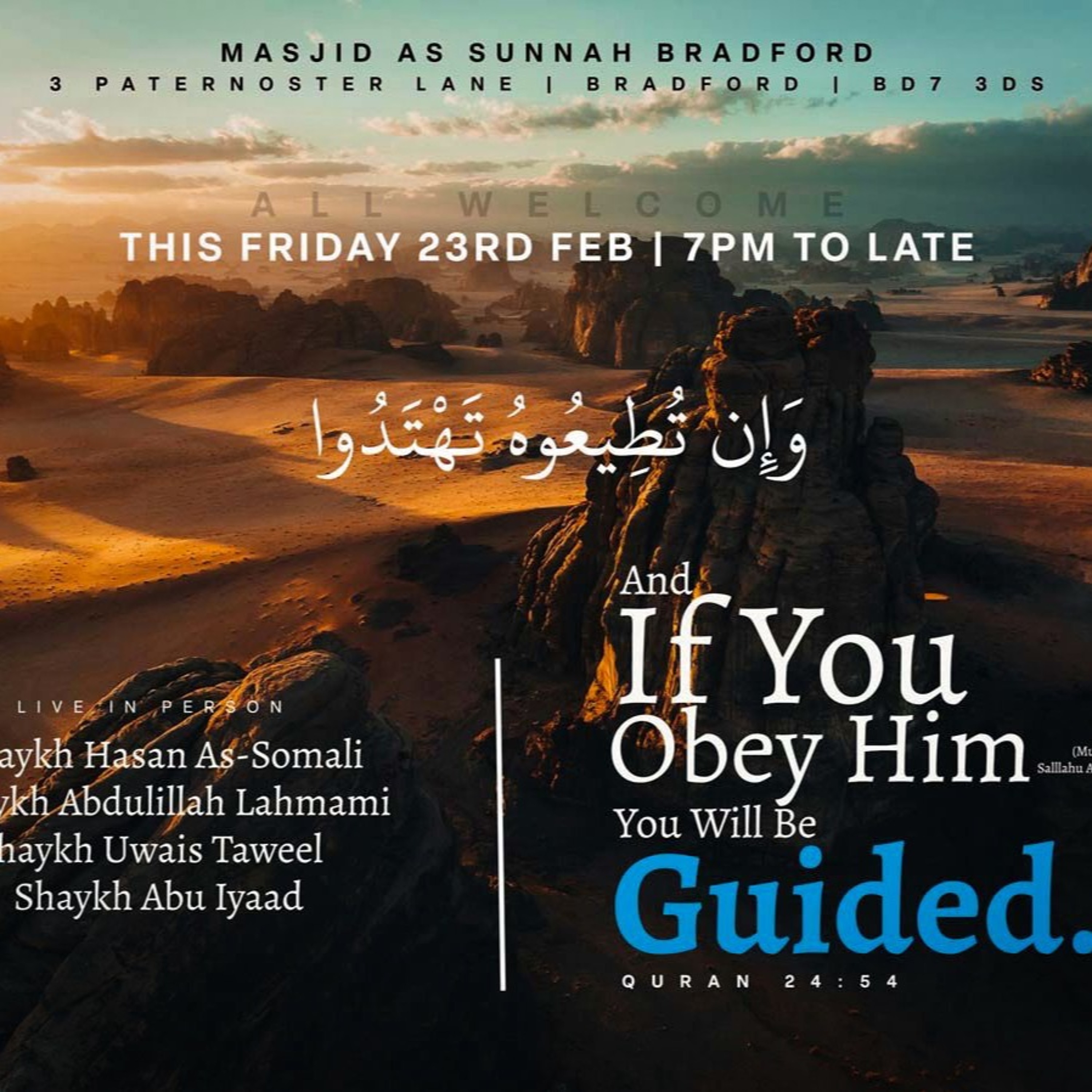
I would like to welcome everybody to this evening of lectures by some of the some of the machea who are visiting us from abroad, and alhamdulillah we are gathered in a house among the houses of Allah, so alhamdulillah, and to receive admonition and a reminder and to seek the ill of that, which the scholars throughout the centuries have expended great efforts to acquire, to purify, to preserve, and to convey in a trustworthy manner. And I want to introduce the evening, just with a short reminder, to do with seeking knowledge, and being patient upon seeking knowledge, and balancing between the trials and the tests of life, and the rights that we have in terms of the worldly affairs, to balance that with knowledge, and vice versa to balance seeking knowledge with the rights of, in terms of the dunya. And the messenger of Allah, so some said, in an authentic hadith, echris, alhammayana folk, be eager for that which will benefit you. Was the imbillah, and seek aid from Allah, wolar d'aajis, and do not become, do not be rendered incapable of feel that you don't have the means or the other capacity.
So here we are commanded to pursue that which is of benefit to us. And this obviously is knowledge, and seeking knowledge, and that's why we see, explained in the Quran, and in the sutna, the virtues of seeking knowledge from the hadith is the same to the messenger of the sasalam, mayuridillah, wilililah, wililah, wililah, wililah, the whom, so ever Allah intends to show goodness, he will grant him understanding of the religion. Likewise the famous hadith of Abu Dardar, Ravi Al-Wahu, Anho that you know, speaking about, seeking knowledge. So the messenger of al-Sasalam said, in that lengthy hadith, man Salaka, d'Aryakan, yabatari fihi elman, Salaka, lahobihi, darikan, illaljannah.
Whoever sets out on a path seeking knowledge, then Allah will make easy for him, a path to paradise. Indeed the angels, they spread out their wings, out of pleasure for the seeker of knowledge. And indeed the scholar, everything seeks forgiveness for him that is in the heavens and the earth until even, the fish that is in the water. And the excellence of the scholar, wafadulul alaymih, alalayabidih, the excellence of the scholar over the worshiper is like the excellence of the moon over all of the other stars.
And indeed the scholars in the Ullamah, wahrathatul ambiyar, they are the inheritors of the prophets, and indeed the prophets, they do not leave neither Dinar nor Dirham as inheritance, but they leave knowledge, wahrathul alaym. So whoever takes from that knowledge, then indeed he has taken with a great and mighty portion. And so in what follows in Shala Tala, I want to just give a handful of examples from the people of knowledge, and the way in which they sought knowledge, and the efforts they had to go through, the sacrifices they had to make, and for us to reflect upon that, and how Allah subhanahu wa ta'ala from his mercy, and from his bounty has made it easy for us in the modern life to travel with ease, to travel vast distances by plane, and our moshaiqah were coming this evening to give lectures, sheqhasan, sheqawes, sheqha'dulillah, they all traveled from abroad, from Medina, from Morocco, from America, and this is with the ease of travelling on an airplane, and then to travel by car, as many of you as all of us have come today, the ease with which Allah subhanahu wa ta'ala has opened up the ability to travel to seek knowledge, and not only that, to have knowledge at our fingertips, by way of technology and development of communication, and perhaps in a way, maybe it's the case that because of the ease with which we are able to seek knowledge, that that knowledge doesn't have the same value, that it would have in the hearts of the scholars, some examples of which we are going to give today in Shala, so you can see why that knowledge held such a value in their hearts, and why we are unable to treat that knowledge with the same value, and this is so that we can recognise our own shortcomings and deficiencies, and the fact that we can never be like those great scholars, and this should then in colleges to strive even further, and to seek forgiveness and our shortcomings, and to realise the efforts that we have to make in order to be safe in our religion, by gaining knowledge and work, and to be safe from trials, and the necessity of striving, despite or alongside, the ease with which Allah has made things for us, travel to hear knowledge, to record knowledge, and all these other benefits that we have in the modern life, which are from the favours and bounties of Allah subhanahu wa ta'ala. So the first example I want to start with is the example of Abu Khartim al-Razi, Arahim al-Rahul-Rahul-Tahala, from the great scholars of the third century, Hejra, and he says, he mentions that the first year in which I left for knowledge, to see Khadith, I spent seven years, and I enumerated the distance which I walked upon my two feet, and that distance was, he said, it was more than a thousand farsach, a thousand farsach, and one farsach is equal to eight, just over eight kilometres, about 8.3 kilometres.
So that would mean that he walked on his feet, 8,300 kilometres, which is around five and a half, six thousand miles. So he says, then after that, I abandoned counting, it was too much to count. So he said, wa-hah-raj-do, min-al-bhah-rain. So I came from Bah-rain, and so the Bah-rain, in that time, is not the Bah-rain today.
The Bah-rain, in that time, was simply the eastern part of Arabia known as Al-Hsa. So he started from there, he came, illa-missa-marsh-ian. So I came from basically one side of the peninsula, to the other side, to the western part, towards Tamissar, which today would be Egypt. Summa illa-ramla.
Then he went into what is Palestine, which is near the Makdis, Ramla, Marsh-ian. Summa illa-demash-kha. So from there, he then went across to up to Syria, Damascus. And then he said, Summa illa-and-darkia, which is Antioch.
So now he's moving north, up towards the southern part of modern day Turkey. Summa illa-dar-sus, which is a nearby place in the same region. Summa illa-jak-to illa-himps. Then I came down to himps back down into Syria.
Summa minha illa-rak-bat. Summa-rak-b-to illa-rak-b-to illa-ir-rak. So then he then made his way to Iraq, and kul-luhad-a wa-an-a-ib-n-o-a-shir-in-a-sana. And all of this while I am at the age of 20 years.
So this is Abu-hati-mar-ra-zih, seeking knowledge, seeking hadith. And like I said to you, the amount of effort you have to put in to acquire something, whether it is knowledge, whether it is wealth, whether it is even friendship, friendships which you acquire, trustworthy friendship over long, long periods of time. Then the more that has value in your heart. And that's why these scholars, as you listen to more of these stories, you can see why that knowledge took root in their hearts and they valued it so really.
Another example here would be Ibn-kathir, or haimur-luh-luh-huh-a-huh-a-huh, and he's describing about himself, whilst he is writing the book, Jamiro-l-luh-masa-anid, in which he brings together hadith and the isnads. So he says, well asil-to-ak-tob-wafihi, well asil-to-ak-tob-wafihi, if it lay. I did not cease to write during the night. Was Siraj, Yoonawu Nisou, while the lamp would flicker.
So when you have the lamp with oil, sometimes it flickers, and there's more light, sometimes there's less light. So in that way, he's writing at nighttime, until he says, had the hababasri-mar-ra-hu, until he lost his eyesight on account of writing in this way, which obviously causes a strain in the flickering, and so eventually he lost his eyesight. So this is what these scholars, when we read, the Sirobana Cathedral and we read the other books these scholars wrote, we don't forget, or we forget and we don't remember that what these scholars expended of effort, just so that we today can open a book with ease and read that knowledge. Likewise, from Ibhanul Jyoshi, Raim Hula, and he said that I used to love the sweetness of seeking knowledge, and I would encounter so many difficulties, but those difficulties, Mahua Indi, A'hla, Minal Asal.
So in other words, in seeking knowledge, there would be so many hardships and difficulties, but within those hardships to feel that hardship, that itself would be sweeter than honey, to taste that hardship. Le Adjilimah Atlubu, Wajurju, just because of the love of what I'm seeking and pursuing of knowledge. So he said, I was in the youth, Kuntofiz-Amal, Siba, and I would take with me round buns of bread, which were really tough and hard. So you couldn't actually bite the bread, because it was that hard.
So then I would travel, I would seek knowledge, and I would stop at certain places in a place called A'hisa, but this is a region in Iraq, south of Baghdad, where there's little villages and streams and rivers. So he would stop in order to dip the hard bread or to eat it, but with the water, because you couldn't eat it any other way. And so he would continue like this, and he would answer this, was only in order to pursue knowledge. So basically, this sweetness that he would taste would be the taste of knowledge, not the bread.
So when he acquired the knowledge, the acquisition of knowledge would be so great, and would be so sweet that whatever hardship and the food and whatever, it wouldn't mean anything. Another example is from Imam Ahmad Rahimah, Lahut Al-A'lah, and Imam Ahmad, he traveled to Yemen. And whilst he was in Yemen, his clothing was stolen. Somebody stole his clothing, his robes.
And so what he did is that he remained in the house, and he closed the door. And when his companions, the associates, they couldn't find where he was, they came to him, and they said to him outside the house, what happened? So he told them what happened. So then they offered him some gold, some pieces of gold, and he didn't accept it.
Imam Ahmad, he refused to take that money for nothing. So then, what he did was, he took one Dinar, but only on the basis that he would offer them a service, which would be to write or to inscribe knowledge, or to copy or to transcribe. And so he took that Dinar basically as Ujurah, meaning like a rental, as like for his service. He wouldn't take anything for nothing.
And so then he wrote books for them, and he wrote books on that basis. So here even in seeking knowledge, you look at the honor and the dignity of the people of knowledge, in that they are not taking any money, because there are many elements to this, which is sincerity, and struggling, and striving, and having no portion. For anything except seeking the face of Allah subhanahu wa ta'ala. And so once again, this is why we see, why were these scholars great scholars?
Because this is what they had to go through in order to acquire this knowledge, which then caused them to be remembered because of their sincerity, and that knowledge was transmitted. And that's why today we can gain, in our religion, because of the efforts of these scholars, because of incidents like this. Also Imam al Bukhari, Rahim al-Law-Tala, which is the most authentic book after the book of Allah subhanahu wa ta'ala. And again, we do not have any appreciation of what these scholars went through.
So Imam al Bukhari, Rahim al-Law, he, as mentioned by Al-Khatib Al-Bargad, Rahim al-Law in his biography of Imam al-Bargari, he mentions that narrating from Amr, perhaps Al-Ashikar said, that the people were with al-Bargari, they lost him, they couldn't trace him for a couple of days, because they were all writing hadith together in Al-Bastra, then he disappeared. So they couldn't find where's Imam al-Bargari gone. So they said, for Talab Nahu, for Wajad-Nahu, for Ybaitin, Wahuwahua, or Yann. So we started looking for him, and eventually we found him in a house, and he was in that house, he was naked with no clothing.
And what had happened is, is that his clothing, won out, torn, to tatters he, basically the clothing had gone. He had nothing literally to wear. So they said, Fajdamatna, Wajdamatna, U'durahim. So we gathered together, and we bought some, we brought some money, some dara, did comes together until, we managed to buy him a thob, and then we closed him, and then he came back to us once again, writing hadith.
So when you read Al-Bargari, then remember that Imam al-Bargari went through these efforts, to the extent that just having one item of clothing expired, worn, finished, could no longer be worn again, and out of, you know, he kept himself in the house, because of that reason, he couldn't come out, for that reason, until his companions had to come and buy him a thob, and even he didn't come out and tell, he didn't start asking for help, and start begging and saying this and that, whatever, indignity and honour, he remained in his house, until his companions found it strange, and then it came to find him and then ask him what's happened, and then, you know, this is Al-Azul-Jul bringing help and assistance to Imam al-Bargari, without him losing his dignity and honour, maintaining his dignity and honour. And until even more than that, Imam al-Bargari, Y'allahim, he even used to eat, had to eat from the grass, from the ground. As we see, he would have no food with him to eat, and he would say himself, as he mentions about himself, as is mentioned in Sir Al-Alamanulah, he says, so, you know, he went to Azkallan, so he went to Azkallan, which is in Palestine. So he said, what the hell did they eat, and what did they eat, and all of my, what I wanted to spend, had expired.
And so then I had to start eating from the, like the growth, the herbage, from the earth, and I would not tell anybody this. So he'd not tell anybody, he did not complain to anybody, and this is how he would feed himself, and this is how he would feed himself, from the earth, the earth, the earth, the earth. And none of the other things. So, one of the third day of eating from the grass, from the herbage from the ground, someone came to me and I did not know who it was, and he gave to me a bag, container of dinars and he said, spend this upon yourself.
So again, once again, we see, he spent a few days, didn't complain to anybody, anybody didn't bake for food, and he tried to, you know, get by in this manner, maintain this honor, maintain his dignity until Allah brought relief and help to him. This is the way, this is the character and the effort of these scholars who brought us this knowledge. Likewise we have heard him, or him or Allah, and he says the hardships that he went through in seeking knowledge, and he says that in the year 214, after Hijra, I was spent eight months in Basra, and it was my intention to stay there for about a year, but all of my expenditure to my wealth, it expired. So then I began to sell my clothes until I was able to remain there a bit longer until all of that expired as well.
So even the clothes that he brought, he had to sell them just in order to be able to keep seeking knowledge. And then also he says that I had a friend with me who's on the journey, and we would go to the misha'i'r and we would listen to the hadith until the evening. And then my friend would leave and I would go to my house, or where he was staying, and all I had was to drink water, no food. And then in the morning my companion would come, then we would go again to seek knowledge, and I would remain with him listening to hadith upon this great hunger without any food.
And then I would return back hungry. Then the next day when the companion came to me and said let's go listen to knowledge, he said I'm unable to come, because I'm so weak that I'm unable to come out. So his companion said, Ma, that fuck, what's caused you to be so weak? He said I will not hide anything from you.
I have spent two days, I have not eaten anything there in. And so this companion said I have got left one d'inar. I have one d'inar with me. I will give one half to you, and we leave the other half in order to pay if we want to, you know, someone's service or whatever it might be, travel or something like this.
So we keep that one half. And so therefore we left Al-Bassarah and I had with me one half of A-D-N-R. One half of A-D-N-R. So these are just small, a few simple examples from the scholars, there are many, many more.
So you can see the efforts expended by these, or the Ma, by these scholars, by these great noble scholars as a result of which we today can have in our hands this Elm. And so to really round off, I don't want to continue any longer to round off, we have to be grateful to Allah Subh'anaHu Wa Ta-A-la, like I said, that we have in our possession all of these ways and means by which knowledge is literally in our fingertips, at our fingertips. We are able to travel with the ease of the car, of the airplane, of the train, of the bus, of the food is everywhere. And we don't think twice about these favours and bounties.
And that's one of the reasons why the knowledge that we acquire doesn't have the value of the knowledge that Imam Al-Bakhari acquired, or Imam Ahmad Akwaid, or Abu Ha'atim acquired. Because look at the efforts that they had to go through in order to just listen to Ahadith. And then on top of that, there is the Firkh, the understanding. And so in light of that, this is just a small reminder to myself, first and foremost, and encouragement to all of you, will handle Allah.
Doesn't mean that just because obviously Allah has made it easy for us, but there is a level of striving that we still have to go through, to leave your home, to leave your family, to even to travel by plane, by train, by car. There is still effort, there is still becoming tired and wary. All of that is still there, we will handle that. So it is still some effort.
But given this ease, it means there is no excuse for us not to seek this elm and to remove this gel from ourselves and to seek this Firkh of creed, first and foremost, of the Akhida of Tahid, which is the foundation. And then Firkh in the Ibad, in the act of worship and then in the Mu'am Al-alad, in the dealings that we have, all of this is obligatory upon us to seek this elm. So we have to strike a balance, as I said, between the Dunya and likewise the Dean, as we see in the Quran when the people said to Barun, well, it turns out, no siba kam in the Dunya, do not forget your portion of the world. So alongside seeking knowledge, there are rights, the reguties, the obligations, and that's why we see in the hadith of the messenger of Allah, son of Allah, when he said, for in alizawjika, alika haqan, walizawjika, alika haqan walizawjika, alika jasadika, alika haqan.
He said, indeed, for your wife, there is a right, and for your guest, there is a right, and for your body, there is a right. So it does not mean that we have to abandon the world and everything becomes seeking knowledge, nor is it obviously that we fulfill the rights and abandon seeking knowledge, what we have to strike a balance in between the two. And this will vary for every person, not every person is in the same circumstances. Allah has put each of us in different circumstances, some people, Allah facilitates for them the seeking of knowledge with more time, with more ability, with more understanding, but everyone has to strive in accordance with what is in his capacity in order to remove the jal as we said and to lay the foundations and to help him fulfill the obligations which are due upon him.
And so this is all I wanted to really say, well, we have with us today, Sheikh Hassan al-Sawali, Sheikh Awaisat Awil, Sheikh Abdullah, and Sheikh Ali al-Lahmamih, and these are students of knowledge who have sat with the Allah with the scholars, the likes of Sheikh Mokbil and Sheikh bin Biz, and Sheikh Rabih and Sheikh Obaid and Sheikh Zaid al-Maddrachal, and other than them, from the great scholars of this era. And so we ask Allah to tell us what you will benefit us for what we are going to listen to. And Shah Allah, as we said, the moment you leave your house, come to the message you are engaged in, this is Ibadah, to seek knowledge and to seek ill. And so this is not a light affair, as I said, and believe it, like you heard in those narrations, there should be, as Ibn Al-Jawzi said, the tasteness that you sweet, the sweetness that you taste, sorry, that when you go through hardships and you listen to knowledge, or you hear a narration, or you hear something from a scholar, or you hear an aya or a hadith, that you know, the latha, the taste of that sweetness is something that should drive you and keep you going, and pursuing this ill in Shah Allah, and their inshallah, the Allah.
First lecture today will be by Sheikh Hassan, and so we will leave the floor for him to convince his lesson in Shah Allah, very, very surely inshallah.