
EPISODE · Jun 1, 2026 · 20 MIN
Self-Improving Language Models with Bidirectional Evolutionary Search
from Best AI papers explained · host Enoch H. Kang
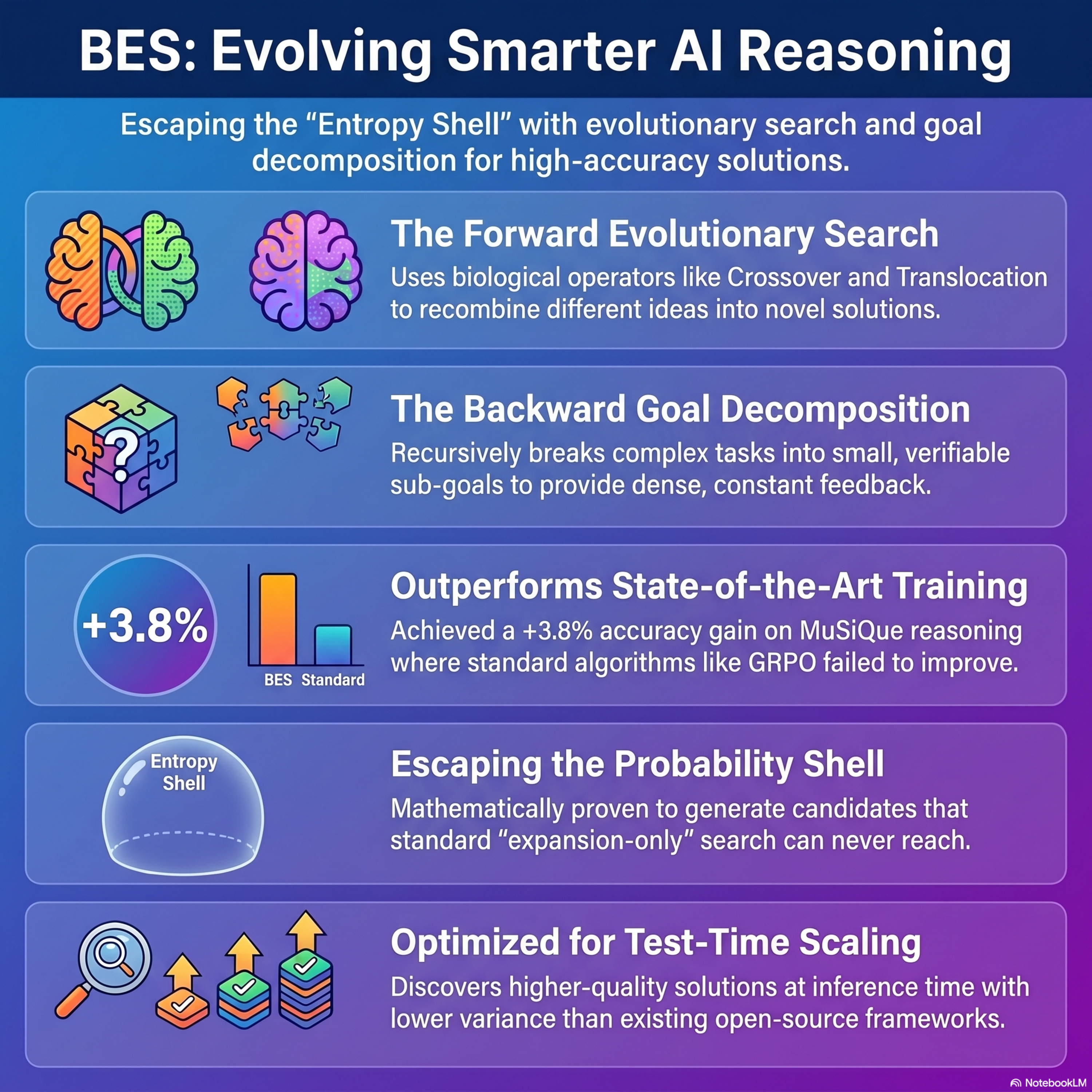
Researchers have developed Bidirectional Evolutionary Search (BES) to overcome the limitations of standard language model sampling, which often struggles with sparse feedback and predictable outputs. While traditional methods like tree search are confined to a narrow "entropy shell" of high-probability responses, BES escapes this range by using evolutionary operators such as crossover and translocation to recombine successful segments from different trajectories. Simultaneously, a backward search process decomposes complex goals into manageable sub-goals, providing the dense feedback necessary to guide the forward search. Theoretical analysis demonstrates that this dual approach can exponentially reduce the number of samples required to solve difficult reasoning problems. Experimental results confirm that BES significantly improves performance in both model training and real-time inference across logical, mathematical, and agentic tasks. By integrating genetic algorithms with goal decomposition, the framework enables models to discover novel, high-quality solutions that standard autoregressive generation would likely miss.
Embed this episode
Ready to play
Self-Improving Language Models with Bidirectional Evolutionary Search
No transcript for this episode yet
Similar Episodes
No similar episodes found.