
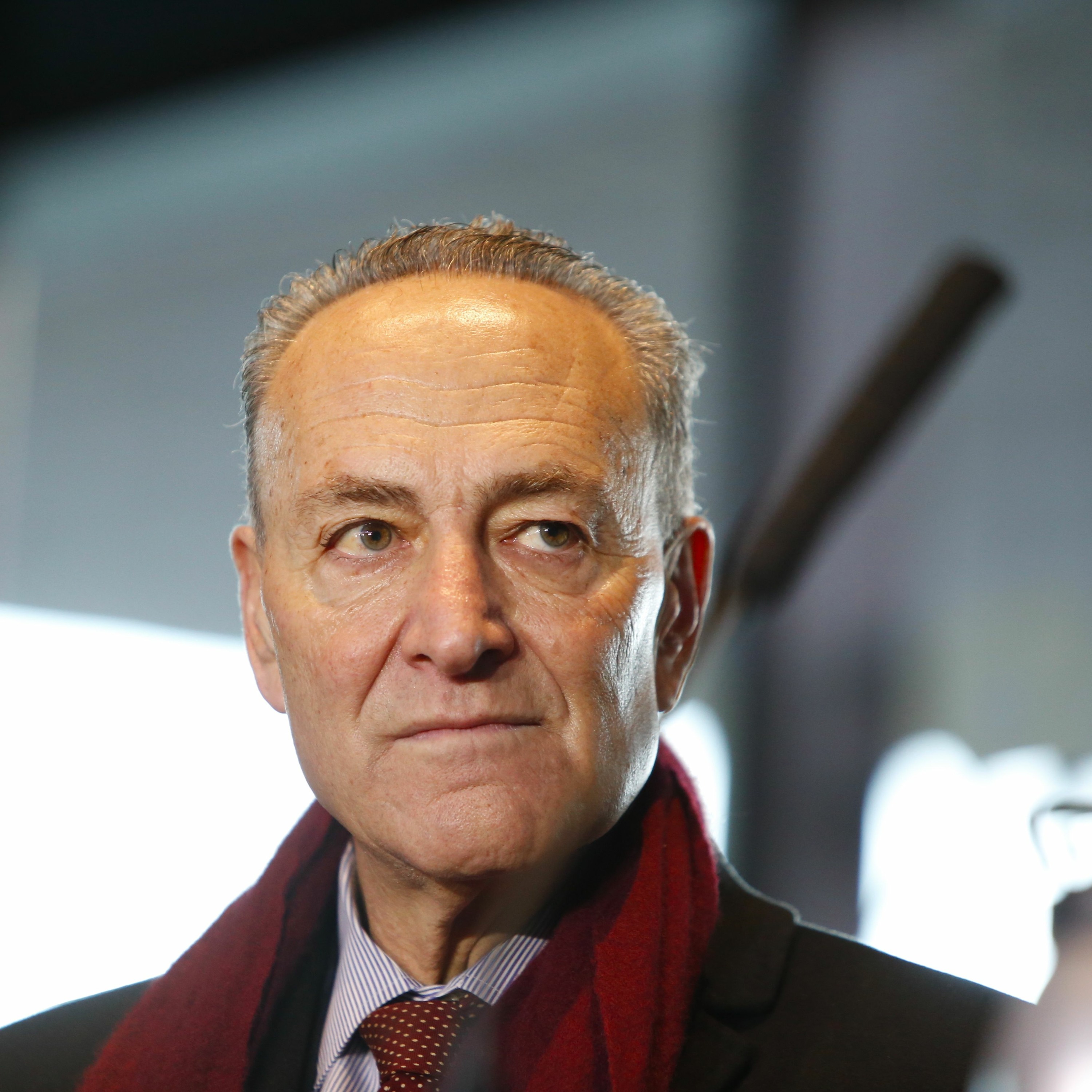
Hi everyone and welcome to CMS OnAir, the podcast on migration, refugee and population issues brought to you by the Center for Migration Studies of New York. I am Rachael Reyes, CMS's Director of Communications. Today, CMS OnAir features Senator Charles E. Schumer, the Senior U.S.
Senator for the State of New York. Elected to the U.S. Senate in 1998, Senator Schumer has been instrumental in furthering comprehensive immigration reform legislation. He was involved in the Immigration Reform debates in Congress in 2006 and 2007, and currently sits on the Judiciary Committee, where he is ranking member of the Subcommittee on Immigration, Refugees and Border Security.
A few years ago, on April 16, 2013, Senator Schumer introduced into the U.S. Senate the Border Security Economic Opportunity and Immigration Modernization Act of 2013, also known as S744. The Immigration Reform Bill was particularly notable because it had been written and negotiated by the Gang of Eight, a bipartisan group of U.S. Senators including Democratic Senators Schumer, Bob Menendez, Michael Bennett and Richard Durban, and Republican Senators Jeff Flake, Lindsey Graham, John McCain and Marco Rubio.
Among S744's original provisions, the bill would have increased security measures along the border, established a new visa program for lower skilled workers, and provided a pathway to citizenship to undocumented immigrants living within the United States. Although the Senate passed the bill on June 27, 2013, the U.S. House of Representatives did not take the bill up to a vote, and it died with the closing of the 113th Congress. Senator Schumer is now in line to become the Senate Minority Leader in the next Congress, and in the event the Democrats become the majority in the U.S.
Senate in November 2016, he would become the Senate Majority Leader. The Senate Majority Leader manages the legislative calendar for the U.S. Senate, and can help ensure the consideration of specific legislation, including immigration reform. In this special episode, Kevin Applebee, CMS's senior director of International Migration Policy, speaks with Senator Schumer about the prospects for immigration reform in the next Congress, and how immigration reform and supporters might prepare for another immigration debate.
Senator Schumer also gives his views on the presidential election season, and how the focus on immigration might impact the election's outcome and beyond. Welcome to CMS on air. I am Kevin Applebee, Director of International Migration Policy for the Center for Migration Studies of New York. Today, we welcome U.S.
Senator Charles Schumer to the podcast to discuss the issue of immigration. Welcome, Senator, and thanks for joining us. It's good to be here, Kevin, and I just want to thank you, CMS. That's a great job helping immigrants, and so does the Brooklyn Diocese, so thank you for your good work.
And thank you. Senator, you've been a long-term champion of reforming our nation's immigration laws, and in 113th Congress, you were a leader in shepherding immigration reform legislation through the U.S. Senate, only to see it not be considered and eventually die in the U.S. House of Representatives.
Could you give our listeners your sense of where the issue of immigration reform stands today in Congress, and the prospects for its consideration in the future? Yes. As everyone knows, it's become a major issue in the campaign, particularly in the Republican primary. And that sort of is a mirror of what happened in the Senate.
We passed the bill in the Senate broad and bipartisan. John McCain, Republican of Arizona, was my lead sponsor. We had our famous gang of eight for Democrats, for Republicans, from among the most liberal, to among the most conservative in the Senate, come together. And we got the support of just about everybody.
We had business and labor. We had the Catholic Church and the liberal Protestant churches, but also the evangelical Protestant churches, the tech community, agriculture, both the growers and workers. Everyone knew it would be good for America. But there was a small group of people in the House of Representatives who represent sort of the hard ride on immigration, who were posed.
And the Speaker was reluctant to cross them. They've been given voice in this Republican primary because the Republican primary was pretty far to the right, like the Democratic primary moves pretty far to the left. And so the language has been hostile. There is a rainbow at the end of the storm here.
I think that in 2017, both Democrats and Republicans will come together and pass immigration reform. Paul Ryan has made no secret about the fact that he has been open to immigration reform. The new Speaker of the House, our Republican Democratic Coalition in the Senate will be alive and well. And I think if the election results show that this anti-immigration hostility won't work politically, people will say, let's get it done.
I am optimistic. And if I become the Democratic leader, knock wood, place God, I'm going to make it a high priority. Well, can I ask you real quick about the election, the presidential election, because Donald Trump has received quite a bit of support, and he favors, of course, a wall along the entirety of the U.S.-Mexico border, and deportation for all undocumented immigrants. Are you concerned that the negative political environment he's creating against immigrants could have an adverse impact on the terms of a future immigration debate?
Well, I don't think so, because he's appealing ultimately to him. He doesn't even get a majority in the Republican primary. He gets 35 or 40 percent. That's about a third.
The Republican's primary represents about a third of the, or the Republican party, about a third of America, Democrats are third, independents are third. So you take a third of the third. It's 10 percent. The vast majority of Americans, even a majority of Republicans, are pro-immigration and want to build.
So I think while his language has worked in the primary, it really should he become an nominee, work against him in the general election, and not be a barrier. The one thing I worry about, I hope it doesn't encourage people to be anti-immigrant, because, as you know, I believe immigration is very good for America, and very good for New York. So should we get to next year and things turn out as you hope, and Congress turns the immigration reform legislation, what would you like to see included in any legislation? Will we start with the 2013 bill?
The 2013 bill was a pretty good compromise, and if it could get people from among the most conservative in the Senate, like Jeff Flake, to among the most liberal in the Senate, like Dick Durbin, it's a pretty good model, and it had broad support. Are there some small changes that would be made? But in general, the path to citizenship, arduous, but real, would stay. The bringing in workers at either the high end or low end, where the Americans can't fill the jobs, high end engineers, low end, picking crops would stay, not allowing people, new people to come in in areas where we had plenty of workers, construction and things like that, would stay as well.
So the basic platform would stay. What about, some advocates are concerned about what the enforcement reforms would be? The enforcement was pretty tough. But because there was a part of the goal at the end of the rainbow, citizenship, the advocates were willing to accept it.
Would there be some modifications? Yes, I would hope so, in a more progressive direction. But you know, we've waited so long for this to happen. I am one who practices the art of the possible, and as much as if I wrote a bill, it might be different than this bill, and more to the advocates liking, to compromise so that you can get something very real done is worth it.
And to take the 11 million people out of the shadows, allow them to work immediately, allow them to travel immediately, and then go through the path along and arduous one admittedly, but become citizens, that's the American dream. The reason we're different than Europe. When people come here, we say you can be Americans, and they want to be Americans. When people emigrate to Europe, we see it now.
They don't let them become citizens no matter what they do. Right. Right. So you have great experience in this area.
What areas do you think would be the most contentious in that version? You don't have to swallow hard. Well, you know, the path to citizenship is a long and hard one, and making it certain is key. Not allowing, I think, what I share with the advocates is, we're willing to go along with that.
But you have to make sure it's real, and that some future president who had a different view couldn't cut it off. Right. Yeah, one area of concern is the 1996 bill that was passed under former President Clinton, and the due process problems that have... Yeah.
Well, Robert Menendez worked really hard on the due process. It's an improvement over current law, but there could be still further improvements. And we'll try to get bipartisan agreement on those. Terrific.
What would you say to supporters of immigration reform moving forward? How do we prepare for a potential immigration debate coming at us immediately after election? We're going to talk about it right now. But the close of the Republican primary were immigrants who used this political football by too many candidates.
But once we go to the much broader general election, where it's not the 10 percent on the hardest right, but everybody. And once we get into a new Congress, it'll be a much brighter day. So what I'd say to advocates and to average immigrants is, don't give up hope. The best is yet to come.
And I am not certain, but quite very hopeful that we will get a very good bill along the lines of the bill that was passed by the Senate in 2017. And it'll be worth waiting for, I hope. Great. One last question.
CMAS Center for Migration Studies is very interested in the issue of the integration of immigrants into society and how that's an important element of any sound immigration policy. Absolutely. And it's led the way in integrating immigrants into the birth of the nation. What can the rest of the nation learn from the New York experience?
Well, here in New York, our population is growing from 7 million to 90 to 8 and a half. Our job creation is higher than the average in the country. And even incomes are growing up at a faster level in the country for average and poorer people. And we are the center of immigration in America.
So it's a pretty good lesson that a good strong immigration policy benefits everybody economically. And in fact, if our bill had passed, the Schumer McCain bill, the CBL, which is a non-partisan scoring agency, said the GDP would go up 3.5%. That is more than any democratic spending program or any Republican tax cut. And the reason is simple.
You let immigrants and their energy and their work ethic loose. They do great things for themselves and their family, but also for our city and the country. Thank you, Senator, for joining us today. We look forward to working with you in the future.
And I want to thank CMAS again and the Brooklyn Diocese for the good work you do. Thank you. To learn more about Senator Schumer, visit his website at www.shummer.senet.gov. And to stay up to date on the Center for Migration Studies of New York, including our research projects, publications, events, and video, visit us at cmsny.org.