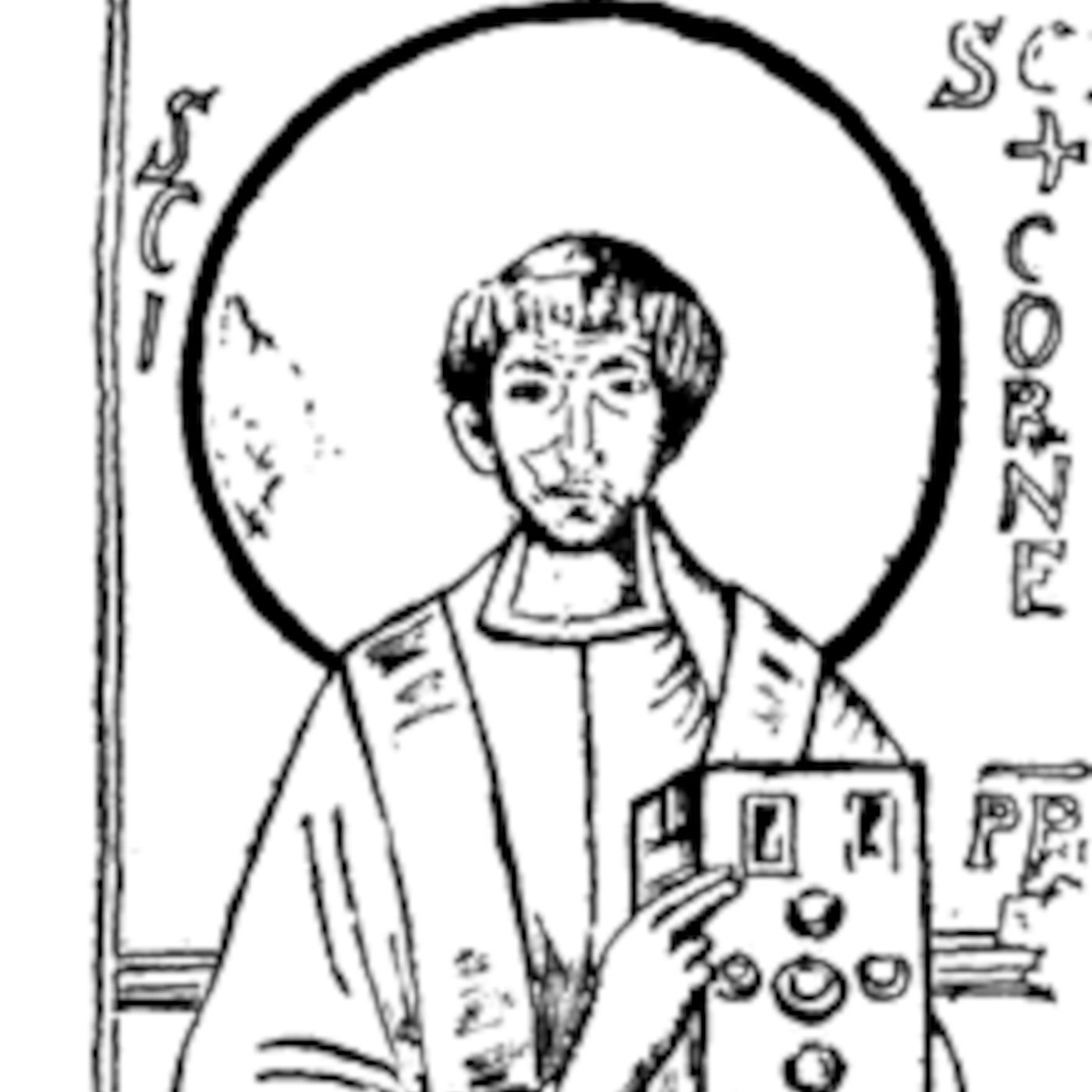
September 16: Saint Cyprian, Bishop, Martyr
from Catholic Saints & Feasts Hosted by Fr. Michael Black
September 16: Saint Cyprian, Bishop, Martyr c.200–258 Memorial; Liturgical Color: Red Patron Saint of Algeria and North Africa The faithful soak up the blood of their beheaded bishop The elegantly named Thaschus Caecilius Cyprianus was born in an uncertain year in that buzzing beehive of early Christianity known as Roman North Africa. His biography epitomizes that of many greats of his era: a classically educated Roman citizen of renown finds Christ as an adult, leaves behind his exalted civic status, trades Empire for Church, and places his gifts and reputation at the service of the people as a bishop of consequence. But because he lived in times of hot persecution, Cyprian’s life did not come to a peaceful end like others with similar biographies, such as Saints Hilary, Ambrose, Augustine, or Paulinus of Nola. The mighty Bishop Cyprian was sentenced to death by a local bureaucrat. On the fateful day, he knelt in the burning sand and waited for the heavy Roman sword to lop off his head. Cyprian’s cult of martyrdom sprang up instantly, even as the faithful, carrying white cloths, soaked up the holy blood that dripped from his torso. His name was soon placed in the Roman Canon, where it remains today, spoken from the altar and heard by the faithful at Mass in Eucharistic Prayer I. Cyprian was a big-hearted, well-educated “man about town” when, in his mid-forties, he was converted by the example and words of an old priest. He redirected his life, made a vow of chastity that astonished his friends, and even abstained from his greatest pleasure—the works of pagan authors. In all of Cyprian’s Christian writings, there is not one single citation of these pagans whose style and thought Cyprian had so admired. Once converted, Cyprian’s mind focused on Scripture and the growing canon of Christian theology, mostly that of his fellow North African Tertullian. Soon after his baptism, Cyprian was ordained a priest, and in 248, after first resisting the appointment, he was made the bishop of his home city of Carthage. His impressive bearing and refined education earned him deep respect among the faithful. His biographer, a deacon named Pontus, wrote about Cyprian precisely so that the great man would be known for the example of his entire life, not just his last few heroic moments. Under the persecution of the Emperor Decius (249–252), which so marked the life of the third-century Church, many Christians lined up at the office of their local Roman official to offer token worship to pagan gods and to receive a libellus, or small sheet, documenting their apostasy. Cyprian lost all his possessions in this persecution but avoided capture by going into hiding. He governed his diocese remotely through letters. He was also compelled to defend his flight against criticism levelled by bishops in both Rome and North Africa that he was avoiding martyrdom. Once the tide of persecution subsided, Cyprian returned to Carthage and was lenient but clear, like his contemporary Pope Cornelius, in reintegrating the lapsi back into the Church once they had performed a suitable penance. The roiling debate over how to pastorally respond to the lapsi divided the Church in North Africa, with some priests arguing no forgiveness was possible for idolaters, and others demanding that the lapsi perform onerous penances before they were received again into the fold. Cyprian responded to these divisions by writing a treatise on Church unity, arguing that the Pope’s teaching on this matter must be obeyed: “There is one God, one Christ, and but one episcopal chair, originally founded on Peter, by the Lord’s authority. There cannot be set up another altar or another priesthood.” Cyprian later clashed with Pope Stephen I over the validity of the sacraments performed by priests who had apostatized, a matter resolved after both mens’ death in favor of the Roman position of leniency. Cyprian’s fellow North African, Saint Augustine of Hippo, in Book Five of his Confessions, recounts how his mother, Monica, prayed in a shrine dedicated to Saint Cyprian in the port city of Carthage around 375 A.D. So, approximately one hundred and twenty years after Cyprian’s death, his legacy was firmly established, fresh and alive, as it still is today. Saint Cyprian, you served the unity of the Church as a bishop, understood the beauty and necessity of the sacraments, and accepted death over apostasy. Inspire all bishops to be magnets, drawing the faithful toward Christ and the Church through their teaching and witness.
Embed this episode
No transcript yet.