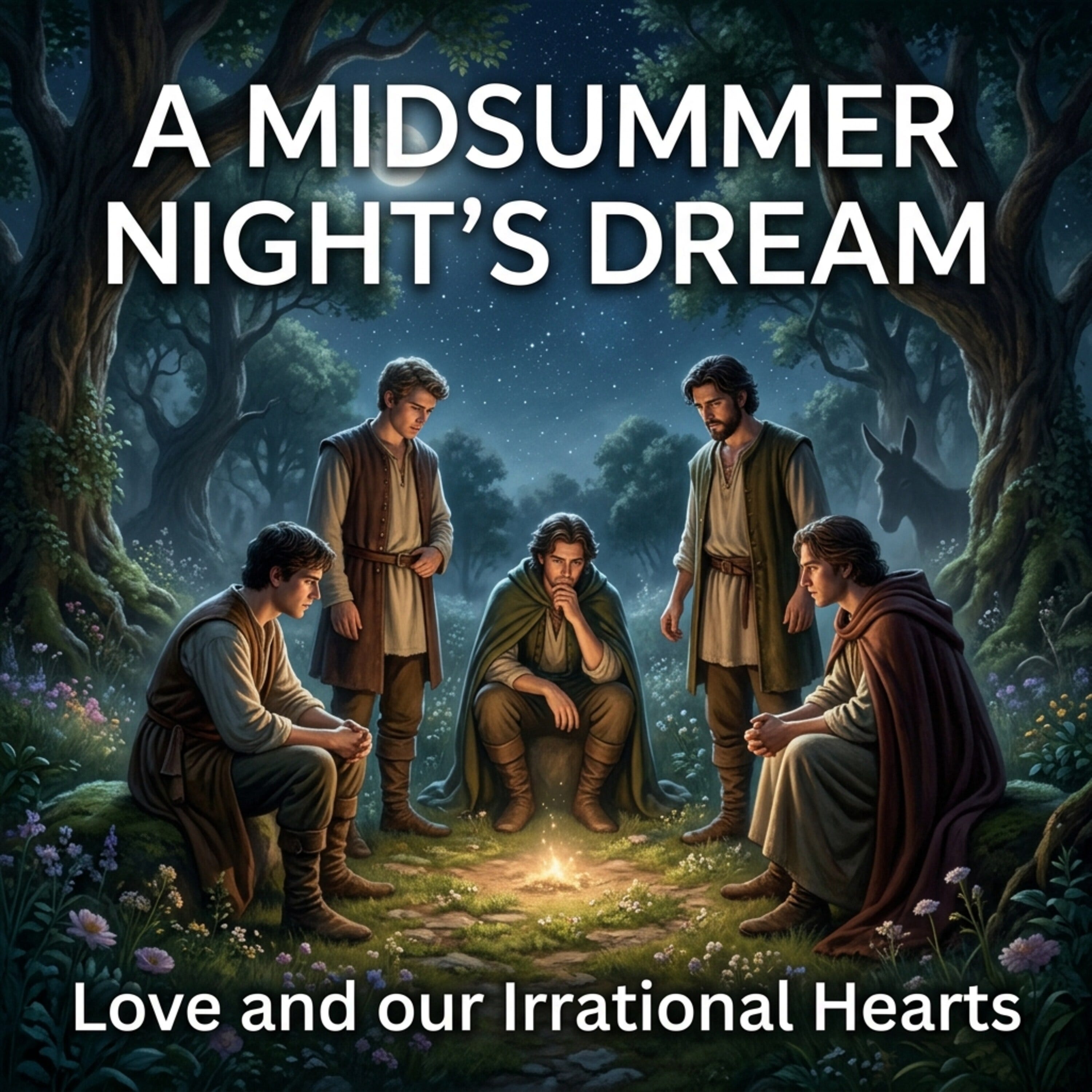
Shakespeare, A Midsummer Night's Dream
from Wisdom for the Present: Western Wisdom Literature Hosted by Kanu Emeruwa
Most of us remember A Midsummer Night’s Dream as a lighthearted romp through a forest filled with mischievous fairies and bumbling actors. But as we explore in this episode, Act 1 begins in a significantly darker place—a courtroom where a father demands the right to have his daughter executed because she refuses an arranged marriage. By stripping away the “fairy tale” gloss, we find a surgical dissection of human irrationality and the brutal tension between societal order and the unpredictable nature of desire. The play opens in Athens, which represents the height of Apollonian order: reason, daylight, and rigid hierarchy. It is a world where people are treated as property, or as Duke Theseus chillingly describes Hermia, a “form in wax”—material to be shaped, stamped, or discarded by those holding power. The episode moves from the rigid walls of the city into the chaotic, transformative woods. Here, we encounter the “love juice” of the fairy king Oberon—a brilliant metaphor for the transient, chemically-driven, and often irrational impulses that hijack human judgment. Just as the magic flower causes characters to wake up and obsess over the first creature they see, we explore how modern algorithms act as a digital “Puck,” dropping dopamine-laced content onto our screens to hijack our attention and override our rational goals. Perhaps the most challenging figure is Nick Bottom, the arrogant weaver who finds himself transformed with the head of a donkey. While he appears to be an insufferable narcissist, we find a surprising truth in his character: he is the only one who interacts with the sublime without the paralyzing grip of self-consciousness. Bottom does not have a “curated ego” to protect. He reminds us that our greatest modern terror—the fear of appearing foolish—is often the very thing preventing us from experiencing life beyond our rigid, controlled routines. We conclude by looking at how the “woods” represent the necessary, messy disorientation of the human experience. Whether through a career crisis, a deep relational rupture, or a personal failure, we must eventually step outside the “city limits” of our own certainty to discover who we actually are. This episode challenges listeners to apply “cognitive diffusion”—the ability to step back from our own drama, observe our “seething brains” with gentle humor, and realize that many of our fiercest, most agonizing vexations are, in the end, merely a midsummer night’s dream. In This Episode Why Act 1 of A Midsummer Night’s Dream begins as a dark legal drama, not a lighthearted comedy The “sharp Athenian law” and the violence hidden within protective, patriarchal authority The chilling image of a person as a form in wax—the refusal to grant others autonomy Love as a “winged cupid” that blinds us to reality, and how we rationalize our irrational impulses The algorithm as the modern “love juice”: how targeted content hijacks our attention and bypasses our rational goals Athens vs. The Woods: the psychological divide between our “optimized” lives and the messy, repressed shadow self Why Nick Bottom’s lack of self-consciousness is a bizarre, liberating “superpower” Moving from “merit” to “noble respect”: how to build a culture of psychological safety by valuing effort over flawless execution Using “cognitive diffusion” to step back from our personal conflicts and see our own foolishness with humor The power of “dream states” and the transcendent reality that exists beyond logical metrics Practical Reflection Where in your life are you treating someone as a form in wax—trying to shape them to your own plan rather than respecting their autonomy? When you are in a conflict, are you operating from your rational core, or are you “wandering in the woods,” blinded by the dopamine hit of your own ego and insecurity? Where might you be so terrified of looking like a “donkey” that you are stifling your own growth, creativity, or ability to experience the magic of the unexpected? Suggested Substack Excerpt Before the fairies arrive, A Midsummer Night’s Dream begins with a world of pressure, law, control, and fear. Act 1 shows Athens as a society where love is fragile, authority is coercive, and desire can make people morally blind. In this episode, we explore Shakespeare’s opening act as a study in power, obsession, the algorithmic nature of modern attention, and the dangerous, necessary freedom of stepping into the woods. AI Disclosure This episode was created using Google NotebookLM Audio Overview, based on human-curated source material, structured guidance, and editorial review. AI is used as a tool for clarity and delivery, not as a replacement for thoughtful study or engagement with the original texts. Copyright © 2026 Wisdom for the Present / Kamashcu Production Studios. All rights reserved. This is a public episode. If you would like to discuss this with other subscribers or get access to bonus episodes, visit wisdomforthepresent.substack.com
Embed this episode
No transcript yet.