Shakespeare, Coriolanus
from Wisdom for the Present: Western Wisdom Literature Hosted by Kanu Emeruwa
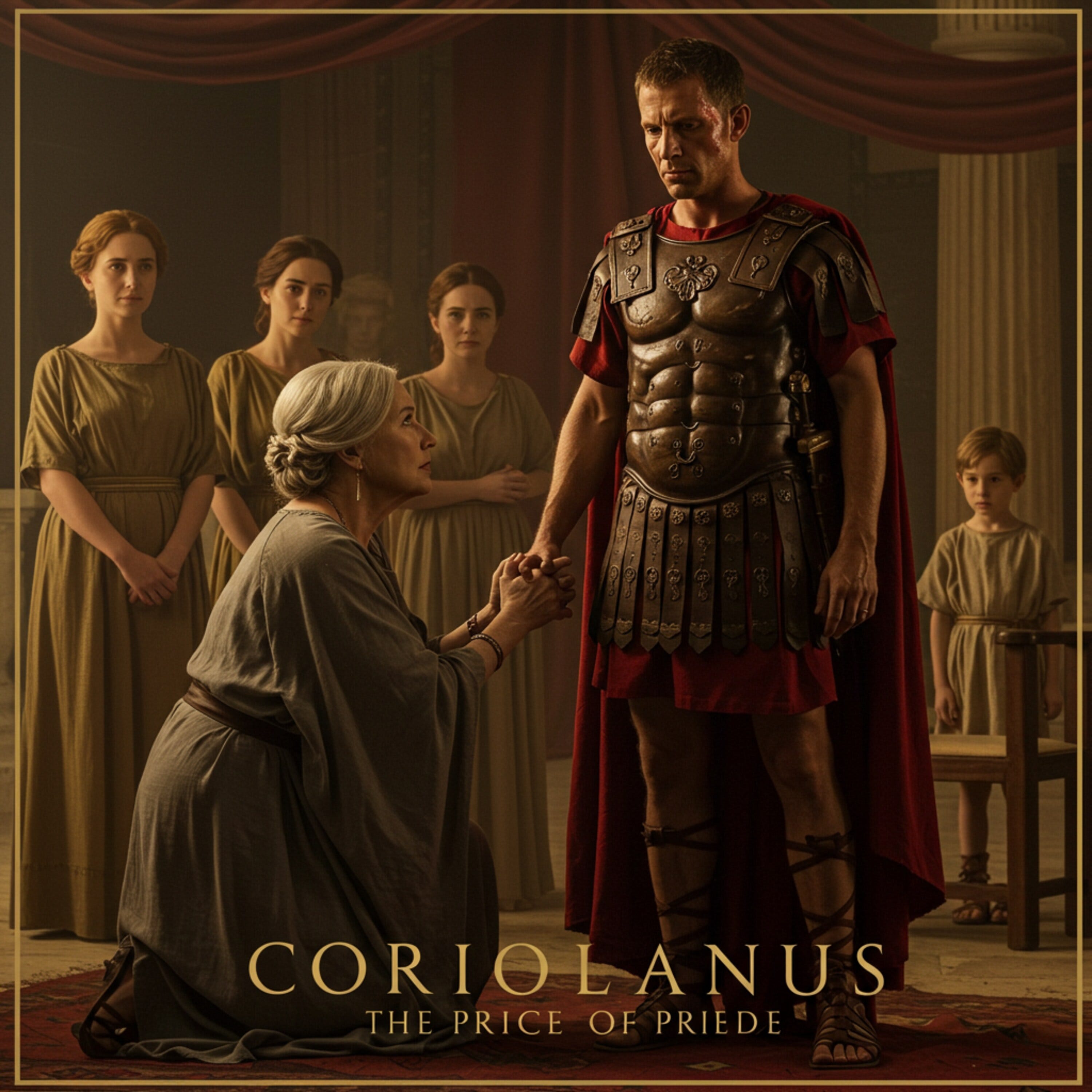
What if the singular trait that has saved you in your most difficult moments—whether a relentless work ethic, emotional detachment, or an unbending commitment to the truth—became the very mechanism that destroys your life? This terrifying psychological paradox lies at the heart of Shakespeare’s Coriolanus. Although set in ancient Rome, the play holds an incredibly sharp mirror to the leadership crises, self-made egos, and dangerous obsessions with “authenticity” that define our 21st-century lives . It challenges us to examine when our personal armor of survival becomes a suffocating prison of arrogance in times of peace. The story begins in a state of visceral, systemic crisis: Rome is starving, the plebeians are mutinous, and the social contract has completely snapped . To pacify the starving mob, the politician Menenius Agrippa delivers the famous “fable of the belly,” arguing that the Senate’s hoarding of wealth acts as a vital digestive system distributing nourishment to the entire state . Yet this smooth corporate PR is immediately shattered by our protagonist, Caius Marcius (later Coriolanus), who rejects diplomacy and viciously insults the starving citizens to their faces. While his absolute unyielding violence makes him a sociopath in the civil streets, it transforms him into an absolute god on the battlefield when the Volscians march on Rome, leaving him locked inside enemy gates to single-handedly conquer the city of Corioli . Once the war ends, Coriolanus faces a new, complex battleground: peace, which requires the very diplomacy, compromise, and “soft skills” he utterly despises . He refuses to participate in the traditional civic ritual of wearing the “gown of humility”—a potato sack-like garment—and humbly begging the common citizens for their votes, viewing it as a cheap prostitution of his honor. This psychological rigidity and absolute lack of emotional intelligence are quickly weaponized by the tribunes, Sicinius and Brutus, who act as the ancient equivalent of outrage-generating social media algorithms. Knowing he is easily triggered, they goad him in public and call him a “traitor,” causing him to lose his mind, draw his sword against his own citizens, and ultimately face lifelong banishment from Rome . Exiled from his homeland, Coriolanus reacts with the defiant, arrogant cry of “I banish you!” and seeks out his mortal enemy, Tullus Aufidius, to lead an invading army against Rome . This catastrophic turn exposes the core delusion of the play: the fantasy of the totally self-sufficient, “self-made” ego that believes it can operate independently of society . As his army prepares to burn Rome to the ground, Coriolanus attempts to maintain his cold, unyielding armor, turning away his closest allies and friends. The ultimate breaking point arrives only when his wife, son, and mother kneel in the dirt before him. This devastating visual shatters his illusion of independence, forcing him to recognize his deep human interconnectedness, though he yields to peace knowing it is a literal death sentence for breaking his vow to the Volscians . Ultimately, Coriolanus’s tragedy is that he recovers his humanity too late to survive it; upon returning to the Volscian city of Antium, Aufidius exploits the exact same psychological playbook to call him a “boy of tears,” triggering another fatal outburst . To avoid screaming in our own metaphorical marketplaces, we must reclaim our agency by mapping our emotional triggers and building a conscious pause between stimulus and response. True strength is not the stubborn refusal to compromise or the illusion of self-authorship, but the profound wisdom to know when to take off our armor, wear the gown of humility, and yield to the relationships that frame us [5, 43-45]. In This Episode * The Paradox of Strength: How the psychological armor we build to survive our hardest battles can become a suffocating prison in times of peace. * The Fable of the Belly: Analyzing Menenius Agrippa’s ancient “trickle-down” defense used to pacify starving citizens, and its modern corporate PR parallels. * Authenticity vs. Arrogance: Examining when our stubborn refusal to “play the game” or adapt our communication style is actually a shield for an unaccountable ego. * The Creator’s Trap: How Volumnia raised her son to be a brutal hammer, only to demand he magically act as a diplomatic scalpel when the political landscape shifted . * Algorithmic Outrage: How the tribunes Sicinius and Brutus function exactly like modern social media algorithms, finding Coriolanus’s exact emotional stress points to trigger his self-destruction. * The Delusion of Self-Authorship: Deconstructing the toxic fantasy of being the “author of oneself” and completely independent of the relationships and community that frame us. * The Boy of Tears Reflection: Learning to map our own emotional triggers in “peacetime” so we do not hand the remote control of our lives to our adversaries or algorithms. Practical Reflection What are your “trigger words” or insecurities? If you do not intimately map the accusations or tones of voice that bypass your intellect and make you lose control, how are you handing the remote control of your emotional state to others? Where in your life are you letting your ego block your advancement because you refuse to put on the “gown of humility”? Are you stubbornly refusing to do unglamorous but necessary tasks—such as networking or apologizing—under the guise of “just being authentic”? Who are the “makers” who helped frame you? When you actively inventory the mentors, parents, teachers, and friends who have supported and shaped you, how does that protect you from the isolating, toxic effects of pride? Suggested Substack Excerpt Explore the terrifying psychological paradox of William Shakespeare’s Coriolanus and discover how our greatest strengths can become our ultimate undoing. This episode unpacks the thin line between authenticity and arrogance, the traps of public outrage, and the vital practice of learning when to take off our armor. AI Disclosure This episode was created using Google NotebookLM Audio Overview, based on human-curated source material, structured guidance, and editorial review. AI is used as a tool for clarity and delivery, not as a replacement for thoughtful study or engagement with the original texts. Copyright © 2026 Wisdom for the Present / Kamashcu Production Studios. All rights reserved. This is a public episode. If you would like to discuss this with other subscribers or get access to bonus episodes, visit wisdomforthepresent.substack.com
Embed this episode
No transcript yet.