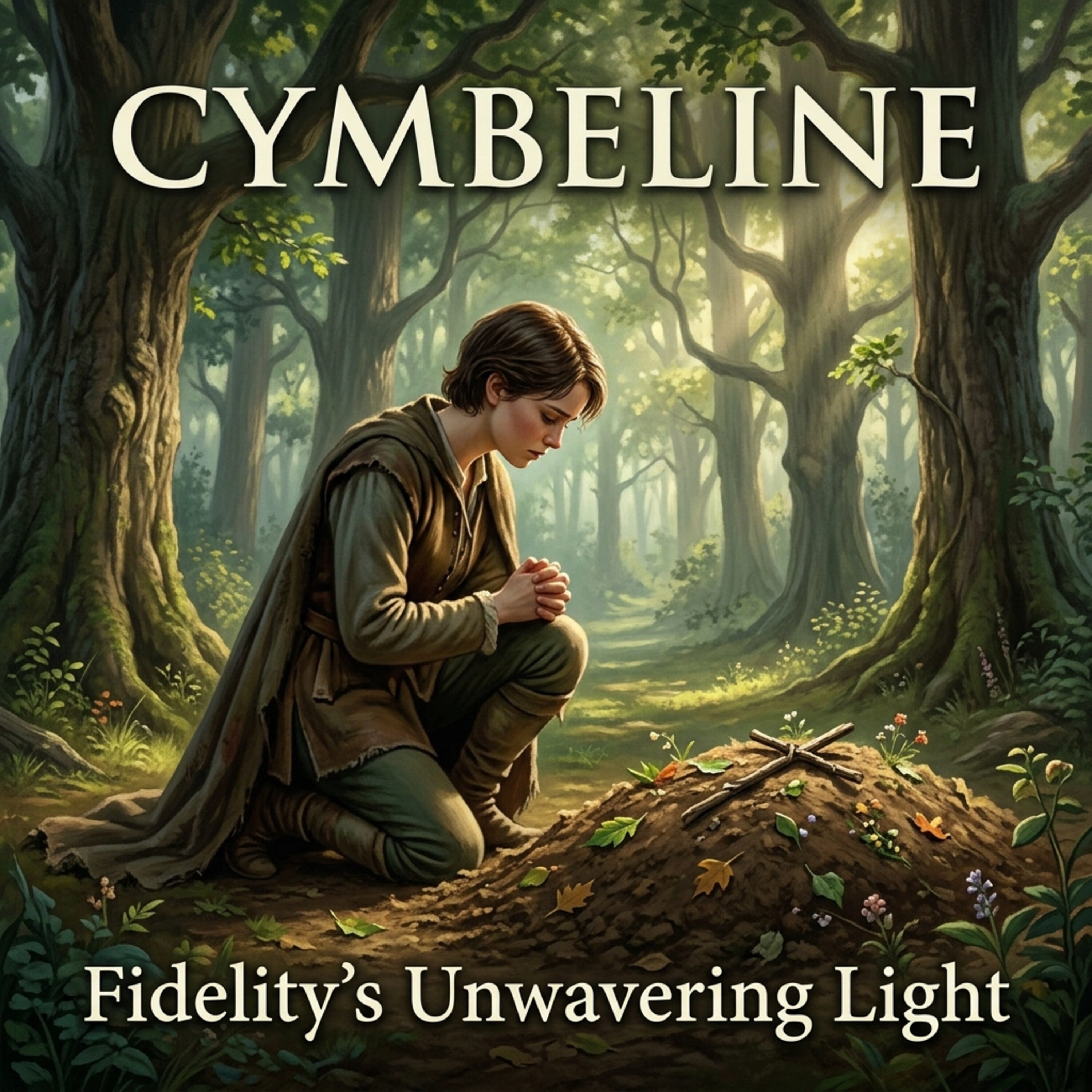
Shakespeare, Cymbeline
from Wisdom for the Present: Western Wisdom Literature Hosted by Kanu Emeruwa
Ever wonder how someone can be a strategic genius in the boardroom yet a complete disaster in their personal life? This episode dives deep into that very paradox, uncovering William Hazlitt’s startling analysis of Shakespeare’s 400-year-old play, Cymbeline. Prepare for a paradigm shift in how you understand intelligence, character, and the subtle, invisible choices that shape our human condition from the inside out. We’re going beyond surface-level historical drama to dissect a timeless psychological study. At the heart of Cymbeline‘s toxic ancient British court, ruled by a weak king and a manipulative queen, stands Princess Imogen. Hazlitt famously calls her “the very religion of love,” not as blind faith, but as an unwavering devotion to intrinsic truth and moral consistency. She refuses to play the game of appearances, relying instead on her deep character. This contrasts sharply with the “painted Jay” culture of superficiality, where outward beauty and status are constantly marketed and curated. Hazlitt shows us that while external attributes can be easily stolen or replicated, true internal worth is unhackable. This vulnerability of the external is brutally exposed through the character of Iachimo, who, after failing to seduce Imogen, resorts to stealing mere details of her bedroom to fake intimacy. This “trunk scene” is a chilling reminder that reputations can be manipulated, and brands destroyed by rumor, if one’s foundation is built on “painted feathers.” Conversely, we meet Cloten, a “booby lord” who is emotionally blind yet politically shrewd. Hazlitt’s profound insight? “Folly is as often owing to a want of proper sentiments as to a want of understanding,” revealing that destructive foolishness often stems from a disconnected heart, not a lack of cognitive power. The play further explores the tension between safety and experience through Belarius, who, in a misguided attempt to protect, traps the young princes in a cave. Hazlitt warns that “nothing can be an answer to hope or the passion of the mind for unknown good but experience,” highlighting the danger of stifling growth for the sake of artificial safety. Beyond individual characters, Hazlitt reveals Cymbeline‘s “principle of analogy,” arguing that the sprawling plot is actually “one single continuous feeling” – fidelity, loyalty, attachment – explored through different characters. This lens allows us to see chaotic life conflicts not as isolated incidents, but as different inflections of the same underlying melody. Ultimately, Cymbeline‘s resolution offers a shocking blueprint for reclaiming agency: radical transformation through forgiveness over retribution. In the face of immense suffering caused by Iachimo’s deceit, Posthumus declares, “The power that I have on you is to spare you,” redefining strength not as the ability to crush enemies, but as the grace to break cycles. King Cymbeline echoes this, choosing peace over pride even after victory, realizing that holding onto malice keeps us chained. The play’s final wisdom? “Stick to your journal course.” Amidst chaos, honoring daily commitments and fundamental routines can be the most profound act of moral compass and resilience. In This Episode * The “Smart but Stupid” Paradox: How emotional blindness can undermine even the most brilliant intellects. * The “Religion of Constancy”: Redefining intelligence as intrinsic truth and moral consistency, not blind faith. * The Hackable External vs. Unhackable Internal: Why superficial appearances and curated brands are vulnerable to manipulation, unlike deep character. * Folly as Emotional Blindness: Hazlitt’s insight that destructive foolishness often stems from a “want of proper sentiments,” not a lack of understanding. * The Danger of Toxic Protection: How avoiding all pain can mean avoiding all meaning, and the human “passion for unknown good.” * The Principle of Analogy: How seemingly chaotic life conflicts are often different inflections of a single underlying theme. * Forgiveness as Ultimate Power: Redefining strength as the ability to spare and break cycles of retribution. * “Stick to Your Journal Course”: The profound wisdom of honoring daily routines and commitments amidst chaos. Practical Reflection * What percentage of your daily effort goes into cultivating the “painted Jay” (external appearance or managing perceived status) versus quietly building “the religion of constancy” (internal architecture and intrinsic worth)? * In what area of your life are you currently playing the “charted beetle” (choosing safe, predictable routines) instead of risking the “unknown good” (pursuing growth, ambition, or new experiences)? * Identify one area in your life where you have “won the war” (have the absolute upper hand or feel justified in demanding retribution). What would it look like to consciously choose forgiveness and “pardons the word to all” in that specific situation? Suggested Substack Excerpt Unpack Hazlitt’s timeless analysis of Shakespeare’s Cymbeline to redefine intelligence, understand emotional blindness, and discover the transformative power of intrinsic worth and radical forgiveness. AI Disclosure This episode was created using Google NotebookLM Audio Overview, based on human-curated source material, structured guidance, and editorial review. AI is used as a tool for clarity and delivery, not as a replacement for thoughtful study or engagement with the original texts. Copyright © 2026 Wisdom for the Present / Kamashcu Production Studios. All rights reserved. This is a public episode. If you would like to discuss this with other subscribers or get access to bonus episodes, visit wisdomforthepresent.substack.com
Embed this episode
No transcript yet.