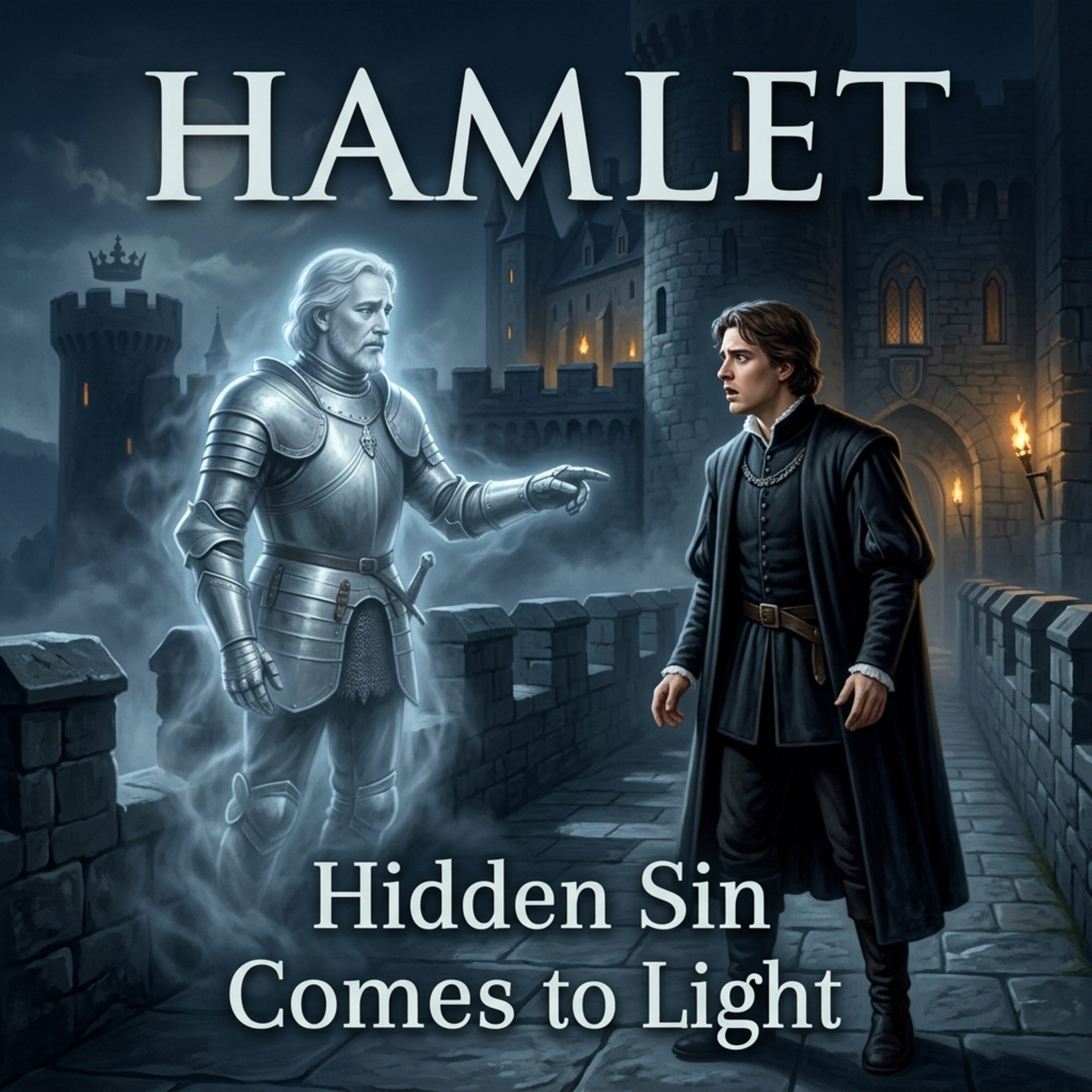
Shakespeare, Hamlet
from Wisdom for the Present: Western Wisdom Literature Hosted by Kanu Emeruwa
Most of us remember Hamlet as the quintessential tragedy of a man who cannot act. We imagine a prince wandering the battlements of Elsinore, lost in the fog of his own indecision, waiting for a ghost to tell him what to do next. But the actual psychological landscape of Shakespeare’s play is far more precise—and far more dangerous—than the cliché of the “brooding intellectual.” This episode opens by challenging the clinical comfort of our modern diagnostic age. We treat anxiety, grief, and existential stalling as problems to be mapped and cured, like a broken bone. But as we explore through the lens of 19th-century critic William Hazlitt, we realize that the true diagnostic machinery for the human psyche is not a medical textbook; it is a dramatic text that insists: “It is we who are Hamlet.” Hazlitt’s piercing insight shifts the focus from a fictional Danish prince to the reader’s own internal theater. Hamlet is not a man who has lost the ability to think; he is a man whose capacity for action has been completely cannibalized by his intellect. He is the master of the “intellectual pressure cooker,” most famously seen in his “mousetrap” play. He stages a theatrical sting operation to prove Claudius’s guilt, runs the experiment with scientific rigor, confirms the data—and then, in the chilling aftermath, does absolutely nothing. He rests satisfied with the knowledge of the truth, substituting the dopamine hit of being right for the terrifying necessity of doing what is right. This maps directly onto the “analysis paralysis” of our 21st-century knowledge economy. How many of us perform the digital equivalent of Hamlet’s mousetrap? We research the biomechanics of a new life path, optimize our schedules, and gather “empirical proof” that a change is necessary—all while using that research as a sophisticated shield against the vulnerability of actually stepping out the door. We treat research as momentum, when it is often just a high-functioning form of avoidance. The episode then interrogates the environment that forces this paralysis: a toxic, systemic corruption that turns Hamlet’s philosophical nature into a liability. Hamlet is not just grieving; he is tasked with performing radical surgery on a diseased state, surrounded by spies, sycophants, and the betrayal of those closest to him. When we translate this to modern leadership and community, it invites us to consider the burden of inheriting “generational debt”—whether emotional, institutional, or cultural—and the rational exhaustion that comes from trying to dismantle a system while being actively consumed by it. Finally, we turn to the “quintessence of dust”—the moment in the graveyard where Hamlet’s abstraction collapses against the physical reality of a skull. Confronted with Yorick’s bone, he realizes that even an Alexander the Great is eventually reduced to “utilitarian spackle” for a beer barrel. It is the ultimate equalizer, and it leads to an uncomfortable, vital question: If our grandest ambitions and deepest anxieties all eventually return to the same earth, what does it mean to live courageously today? In This Episode Why the diagnostic tools of clinical psychology often fail to capture the “dense topography” of existential anxiety The psychological claim: “It is we who are Hamlet,” and why the play’s true location is the reader’s own mind Hamlet’s “intellectual cannibalization”: How an overactive mind can atrophy the physical capacity for action The “mousetrap” experiment: Why proving the truth often feels identical to solving the problem, leading to moral paralysis Analysis paralysis as a 21st-century avoidance mechanism: Hiding behind research to shield oneself from the vulnerability of doing the work Polonius and the chasm between “Pinterest-worthy” moral advice and the manipulative habits required for survival The illusion of the “perfect action”: How we weaponize perfectionism to justify our cowardice and delay progress Ophelia as the victim of “intellectual narcissism”: The collateral damage caused when a brilliant mind is severed from grounded compassion The graveyard scene and memento mori: Confronting the brutal mathematics of biological decay The “unactable theater”: Why our most complex internal struggles may remain forever unknowable to others, making the effort of connection even more vital Practical Reflection Are you truly gathering necessary data to execute a goal, or are you utilizing relentless research as a sophisticated avoidance mechanism to shield yourself from the reality of doing the work? Where in your life is there a gap between your articulated values—the “elegant poetry” you offer others—and your actual, survival-driven habits? What does an audit of your last week reveal? Hamlet demands that his revenge be “perfectly balanced” to avoid taking any action at all. What conditions are you currently insisting must be met before you make a necessary move, and are those conditions actually illusions? Suggested Substack Excerpt We often treat overthinking as a simple character flaw, but in the tragedy of Hamlet, it is a structural paralysis. When we substitute knowing the truth for acting upon it, we do more than just stall our own progress—we cause collateral damage to the people in our immediate blast radius. In this episode, we explore how to move from the abstract theater of our own minds into the grounded, messy, and necessary work of being present. AI Disclosure This episode was created using Google NotebookLM Audio Overview, based on human-curated source material, structured guidance, and editorial review. AI is used as a tool for clarity and delivery, not as a replacement for thoughtful study or engagement with the original texts. Copyright © 2026 Wisdom for the Present / Kamashcu Production Studios. All rights reserved. This is a public episode. If you would like to discuss this with other subscribers or get access to bonus episodes, visit wisdomforthepresent.substack.com
Embed this episode
No transcript yet.