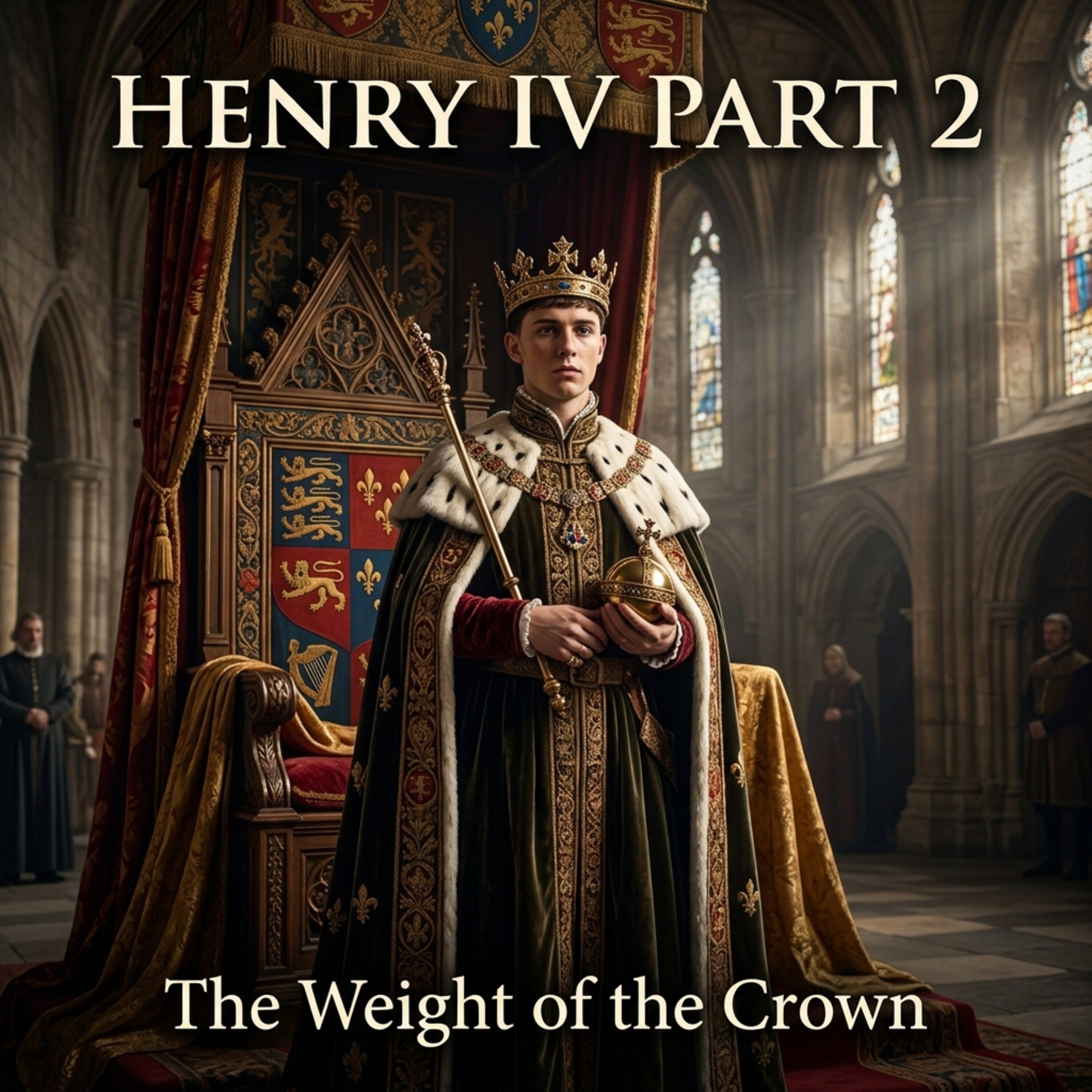
Shakespeare, Henry IV, Part 2
from Wisdom for the Present: Western Wisdom Literature Hosted by Kanu Emeruwa
Can a 400-year-old political drama accurately predict the mechanics of modern viral misinformation, public relations spin, and the psychological weight of public expectation? In this episode of Wisdom for the Present, we explore how William Shakespeare’s Henry IV, Part 2, when paired with the romantic literary analysis of 19th-century essayist William Hazlitt, serves as a stunningly relevant mirror for our present-day struggles. We witness a kingdom teetering on the edge of collapse, where political leaders view the public as a “blunt monster with uncounted heads” to be actively manipulated, and individuals must choose between the crushing demands of public duty and the seductive call of personal escapism. This play is not merely a historical chronicle; it is a profound psychological study of how we build cages out of our own reputations and what we are forced to sacrifice to achieve what society defines as success. The play opens in an England fractured by civil war, where King Henry IV lies dying, consumed by guilt for violently deposing Richard II to seize the crown. His heir, Prince Hal, is caught in an existential trap, intentionally hiding in London’s low-status taverns with his companion Poins and the colossal, rule-breaking knight Sir John Falstaff. Shakespeare immediately establishes a world governed not by stable truth, but by the personified force of “Rumor,” who enters the stage “painted full of tongues”. This system of rumor represents a structural force of nature that aggressively “stuffs the ears of men with false reports,” feeding off the underlying anxieties, surmises, and paranoia of the populace. It is within this fog of war and misinformation that every character must navigate their personal survival and political ambition. This dynamic of rumor and public manipulation maps flawlessly onto modern algorithms and the curation of ego. The “pipe” of rumor, which Shakespeare describes as being blown by surmises and jealousies, operates exactly like a modern engagement algorithm—it cares nothing for the truth, prioritizing only whatever reaction keeps the “wavering multitude” outraged and engaged. Prince Hal himself is a prisoner of this social architecture, trapped in a public relations cage of his own design. Although his allies argue he is merely performing an undercover sociological study of the common people to govern more effectively, Hal finds himself unable to express genuine grief for his dying father because the public would dismiss it as “princely hypocrisy”. He is surrounded by people, yet profoundly isolated, forced to maintain a cynical facade to survive the narrative already written for him. We see the devastating consequences of confirmation bias and sudden trauma play out when the rebel Earl of Northumberland receives conflicting reports of the Battle of Shrewsbury. Sincere messengers, infected by false reports, initially deliver a glowing narrative of total victory, which Northumberland eagerly accepts without skepticism. When the catastrophic truth arrives—that his son Hotspur is dead and their army is shattered—the sudden psychological whiplash triggers a systemic shock. Northumberland throws away his crutch, calls for a “scaly gauntlet of steel,” and actively prays for global annihilation, wishing to burn the entire universe down because his personal order has died. This destructive instinct is further mirrored in the high-stakes Machiavellian statecraft of Prince John at Gaultree Forest, who utilizes a chilling legalistic loophole to deceive and execute the rebel leaders, proving that the survival of the state requires a cold, calculating detachment from empathy and honor. Ultimately, the transition of power from the dying King Henry IV to the newly crowned King Henry V (Hal) forces us to confront what it means to reclaim agency and practice discernment. Henry IV’s parting advice to his son is a cynical tactic to “busy giddy minds with foreign quarrels” to unite a divided nation against an external enemy. To assume the “gorgeous garment of majesty,” Hal must perform a brutal amputation on his own soul, publicly banishing Falstaff—the vibrant embodiment of unrestrained joy, imagination, and his own youth. As Hazlitt’s commentary reminds us, while political survival might demand this cold, statuesque pragmatism, our humanity naturally rebels against it. We are left with the lingering question of what parts of our own former selves we must banish to achieve success, and whether true immortality is found in the conquest of power or in the warm, boundless laughter of the present moment. In This Episode * The Architecture of Misinformation: How Shakespeare’s personified figure of “Rumor” perfectly predicts the viral echo chambers and outrage-driven engagement algorithms of the 21st century. * Trapped by Public Relations: Prince Hal’s struggle with his self-constructed wild reputation, illustrating how we become prisoners of our own public personas and social narratives. * The Psychology of Confirmation Bias: Northumberland’s tragic acceptance of false victory reports and the devastating systemic shock of processing sudden, catastrophic reality. * Machiavellian Statecraft: The chilling deception orchestrated by Prince John of Lancaster at Gaultree Forest, where personal honor and trust are sacrificed for cold state efficiency. * The Parasite of Power: King Henry IV’s complex relationship with his crown on his deathbed, viewing it not as a prize but as a life-consuming burden. * The Banishment of Joy: The emotional devastation of King Henry V’s public rejection of Sir John Falstaff, illustrating the cold pragmatism required to uphold the social contract. * The Romantic Re-evaluation: William Hazlitt’s romantic perspective on Falstaff as the warm, boundless, and ultimate comic champion of the imagination over sterile authority. Practical Reflection * What parts of your own “former self”—your passions, humor, or spontaneous joy—have you had to banish or amputate to achieve your current definition of success? * How often do you act as the “blunt monster with uncounted heads,” accepting and spreading information that flatters your confirmation bias without verifying its actual truth? * Are you building a reputation that acts as an iron cage, preventing you from showing genuine vulnerability or expressing your authentic emotions to those around you? Suggested Substack Excerpt Explore how Shakespeare’s Henry IV, Part 2 serves as a stunningly accurate blueprint for modern algorithms, public relations spin, and the tragic psychological sacrifices required by the pursuit of power. AI Disclosure This episode was created using Google NotebookLM Audio Overview, based on human-curated source material, structured guidance, and editorial review. AI is used as a tool for clarity and delivery, not as a replacement for thoughtful study or engagement with the original texts. Copyright © 2026 Wisdom for the Present / Kamashcu Production Studios. All rights reserved. This is a public episode. If you would like to discuss this with other subscribers or get access to bonus episodes, visit wisdomforthepresent.substack.com
Embed this episode
No transcript yet.