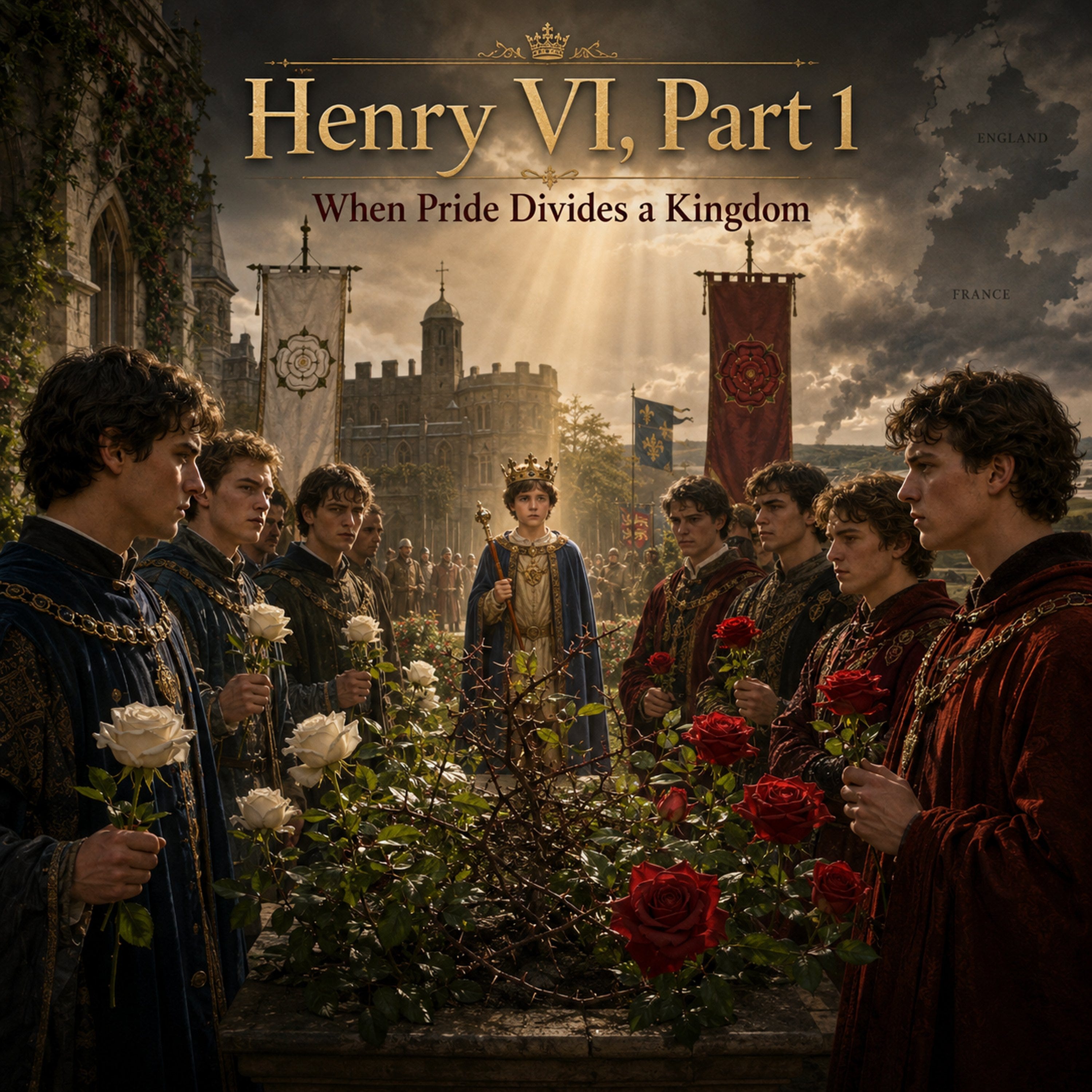
Shakespeare, Henry VI, Part 1
from Wisdom for the Present: Western Wisdom Literature Hosted by Kanu Emeruwa
Imagine a company going unexpectedly bankrupt, but instead of collaborating to survive, the board of directors erupts into a massive screaming match directly over the founder’s casket. This clinical study of organizational rot and the collapse of human unity is the starting point for William Shakespeare’s Henry VI, Part 1, which we explore alongside the insightful 19th-century commentary of William Hazlitt. By stripping away the historical armor and broadswords, we reveal a profound psychological study of groupthink, ego-driven blind spots, and the crushing weight of leadership. It is a narrative that holds a stark mirror to our modern organizations, highlighting how quickly leaders can mistake mere titles for actual power. The play plunges us into immediate crisis following the death of King Henry V, a legendary warrior who previously held the nation together through sheer charisma and unified purpose. With his passing, the crown falls to an infant king, leaving a massive power vacuum that nature—and the ambitious executive nobles—absolutely abhors. At the literal funeral, instead of managing statecraft, the Duke of Gloucester and the Bishop of Winchester trade petty personal insults over the casket. As breathless messengers arrive to report that England’s empire is actively evaporating, the leaders remain paralyzed by internal bickering. This failure of unity transforms the political landscape into what Hazlitt calls a “perfect bear garden”—a brutal, chaotic blood sport driven by base, violent instincts rather than high principles. This systemic failure is visually crystallized in the famous temple garden scene, where Plantagenet’s ego-driven manipulation flattens a complex legal dispute into a binary, high-stakes test of loyalty: plucking a red or white rose. This simple maneuver operates exactly like a toxic modern algorithm—such as those driving echo chambers—by reducing nuanced, professional debates into simplistic, high-visibility decisions that feed personal ego and demand absolute conformity. The cognitive ease of this “us versus them” alignment is deeply intoxicating, causing Somerset and Plantagenet to completely abandon the substance of their legal argument in favor of personal dominance. The infection spreads rapidly from the boardroom to the streets, showing how character manipulation and unchecked egos create tribal markers that override basic survival instincts. The devastating cost of this division is realized on the battlefield through the tragedy of Lord Talbot, England’s greatest operational leader. While Talbot represents the true substance of power—knowing that a leader alone is merely a shadow and that actual capacity resides entirely in the team executing the vision —the chaotic storm of political bickering in London creates a severe logic breakdown among executive ranks. Driven by confirmation bias and “worthless emulation,” the Duke of York and the Duke of Somerset become so entrenched in their mutual hatred that they refuse to coordinate, each blaming the other and withholding vital resources. Their primary goal is no longer defeating the French, but ensuring the rival English faction fails, leading directly to the death of Talbot and his son. To make sense of their self-inflicted chaos, the English resort to nationalistic propaganda to demonize the French leader Joan of Arc as a witch, illustrating how logic breaks down when organizations choose to scapegoat others rather than confront their own internal failures. Sitting at the center of this tragedy is King Henry VI, whose “passive goodness” and paralyzing fear of making the wrong choice represent the ultimate shadow side of detachment. Terrified of conflict, the King retreats to a molehill to fantasize about the peaceful life of a humble shepherd while his subjects bleed in a civil war fought in his name. Henry’s desperate desire to keep his hands clean creates a vacuum that allows corrupt factions to fester, eventually leading him to hand the keys of the kingdom to a manipulative actor just to avoid decision-making friction. This warning reminds us that true peace requires the active, authoritative use of power to restrain toxic elements. Ultimately, as Joan of Arc notes, glory and unchecked ambition expand like a “circle in the water” until they disperse to nothing; to survive, we must protect our organizations from vanity and passivity by empowering those who carry the actual load. In This Episode * The Power Vacuum Trap: The unexpected loss of a unifying leader creates a volatile power vacuum that quickly devolves into a chaotic “bear garden” if successors prioritize personal rivalry over organizational survival. * The Poison of Binary Tribalism: The picking of the red and white roses shows how complex strategic problems are easily flattened into destructive binary tests of loyalty, replacing critical thinking with blind factionalism. * Trickle-Down of Factional Rot: Boardroom and executive-level dysfunction cannot be contained; it inevitably trickles down to infect the entire culture, driving front-line employees to fight over symbols they do not understand. * The True Substance of Power: A leader standing alone is merely a shadow; the actual “substance,” strength, and capacity of any mission reside entirely in the alignment and loyalty of the team executing the vision. * Worthless Emulation Destroys Core Assets: Petty internal rivalries and games of “organizational chicken” lead to resource starvation, sacrificing top-performing operational talent to prevent rivals from getting credit. * The Trap of Passive Goodness: King Henry VI’s aversion to conflict and obsession with keeping his hands clean represent the shadow side of detachment, proving that passive leadership is a form of destructive negligence. * The Dilution of Ambition: Just as Joan of Arc notes that glory is like a “circle in the water” that eventually disperses to nothing, rapid expansion and vanity without a focused core substance will inevitably dissolve. Practical Reflection What is your “rose” in your workplace or community? Are you wearing a badge of loyalty to a specific silo or faction out of spite, or are you evaluating ideas based on their actual merit to solve problems? Are you treating your team as your “substance” or merely as pawns? How are you actively supporting the front-line “Talbots” in your organization to prevent them from burning out due to political starvation? Are you hiding on a “molehill” of passive goodness? In what ways might your avoidance of difficult decisions or dread of confrontation be creating a toxic vacuum that invites manipulation and harms those you lead? Suggested Substack Excerpt Discover why passive leadership and petty tribalism are more dangerous than external competitors. This episode unpacks Shakespeare’s Henry VI, Part 1 alongside William Hazlitt’s commentary to reveal how organizations rot from the inside out and how true leaders must reclaim their agency. AI Disclosure This episode was created using Google NotebookLM Audio Overview, based on human-curated source material, structured guidance, and editorial review. AI is used as a tool for clarity and delivery, not as a replacement for thoughtful study or engagement with the original texts. Copyright © 2026 Wisdom for the Present / Kamashcu Production Studios. All rights reserved. This is a public episode. If you would like to discuss this with other subscribers or get access to bonus episodes, visit wisdomforthepresent.substack.com
Embed this episode
No transcript yet.