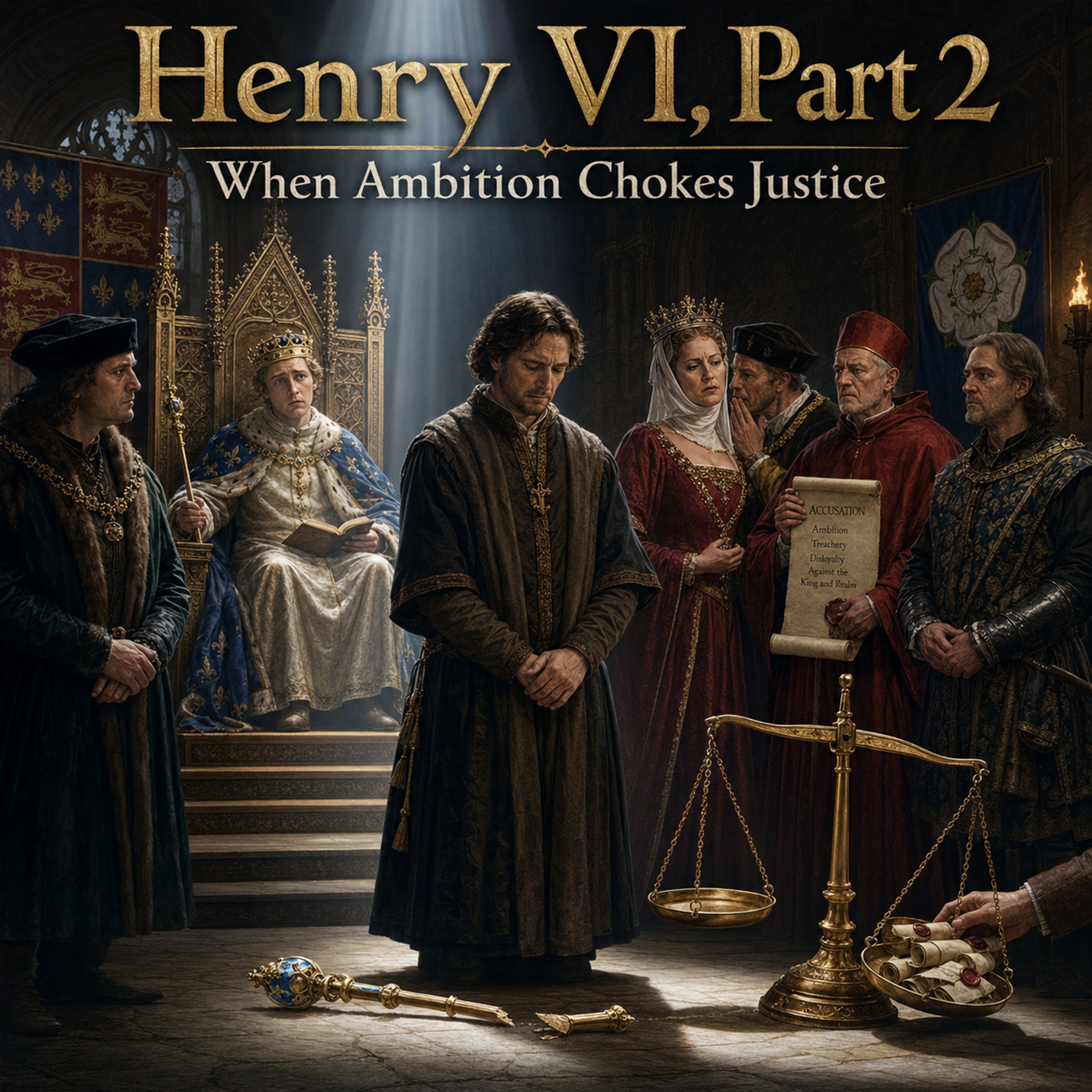
Shakespeare, Henry VI, Part 2
from Wisdom for the Present: Western Wisdom Literature Hosted by Kanu Emeruwa
In a Fortune 500 company where the CEO spends his days on mindfulness retreats while the company burns, and the highly competent COO is framed for treason by corrupt colleagues. This toxic corporate nightmare is not from today’s business headlines, but is the central conflict of Shakespeare’s Henry VI Part 2. Alongside the sharp commentary of 19th-century critic William Hazlitt, this play offers a masterclass in how power vacuums destroy organizations. It introduces the profound concept of the “tragedy of ineffective goodness,” showing how passive, well-meaning leadership can be more destructive than outright malice. Ultimately, this timeless work challenges us to judge leaders not by their internal intentions, but by their external impact. The drama begins in what Hazlitt calls a “perfect bear garden”—a brutal, chaotic environment completely defined by a lack of central unifying authority. King Henry VI is exceptionally pious but fundamentally uninterested in ruling, leading him to accept a disastrous royal marriage negotiated by the ambitious Duke of Suffolk. Henry surrenders the hard-won French territories of Anjou and Maine to Margaret of Anjou’s father without receiving a single coin of dowry in return. When the Lord Protector, the good Duke Humphrey of Gloucester, reads this peace treaty, he drops the paper in shock, signaling the collapse of national stability. This massive power vacuum at the top of government immediately opens the door for a toxic coalition of schemers, including Queen Margaret, Suffolk, and Cardinal Beaufort, to plot Gloucester’s absolute destruction. In a corrupt system, competent and principled individuals are often targeted not because they are failing, but because their integrity holds up a mirror to the insecurity of their colleagues. The schemers recognize that Gloucester is protected by his flawless record, so they exploit a vulnerability adjacent to him: his ambitious wife, Eleanor. By trapping Eleanor in a public scandal involving an occult seance, they politically cripple Gloucester and pave the way for fabricated treason charges. This classic smear campaign functions exactly like modern-day corporate takeovers, proving that integrity alone is not an impenetrable shield. Behind the scenes, we also witness the terrifyingly patient Duke of York, who calculates that letting the corrupt insiders destroy the king’s last competent defender will leave the crown wide open for him to seize. The weaponization of public perception peaks with the Jack Cade rebellion, which functions exactly like a modern viral disinformation campaign or internet troll army. Secretly funded by the Duke of York to test the government’s strength, Cade promises impossible economic miracles while whipping a ragged multitude into a violent frenzy. This rebellion unleashes a terrifying anti-intellectual storm, targeting the educated class and executing public servants for the simple crime of literacy. While the rebels have genuine working-class grievances, they are easily hijacked by an elite who views them as nothing more than a crowd to be discarded. Shakespeare’s study of crowd dynamics serves as a stark warning about how easily our righteous anger can be manipulated to serve someone else’s hidden agenda. To reclaim our agency and navigate these environments, we must learn the difference between private morality and public duty. Turning the other cheek may be a sign of private spiritual maturity, but for a leader, pacifism in the face of active evil is a dangerous dereliction of duty. When Henry VI refuses to enforce his authority, his passivity actively exposes Gloucester to wolves, proving that ignoring conflict to keep the peace is actually an act of harm. True leadership requires the moral courage to fight for the good, rather than hiding behind passive empathy. When the curtain falls, the play reminds us that the hollow crowns of status and wealth bring nothing but misery, and that the only real victory is maintaining a “heart untainted”. In This Episode * The Power Vacuum and the Bear Garden: How the lack of central authority opens a toxic vacuum that ruthless, self-serving actors will inevitably rush to fill. * The Tragedy of Ineffective Goodness: Why private piety and good intentions in a leader become actively dangerous when they are used to avoid necessary executive action. * The Anatomy of a Smear Campaign: How corrupt political factions target highly competent individuals by exploiting adjacent vulnerabilities in their personal lives. * Astroturfed Populism and Ignorance: Analyzing the Jack Cade rebellion and how elites covertly fund and hijack public anger to serve their own ambitions. * The Psychological Toll of Guilt: Shakespeare’s master stroke in depicting the deathbed madness of Cardinal Beaufort as his conscience collapses under the weight of his crimes. * Two Faces of Failed Leadership: Comparing the toxic ego of Richard II’s active abuse of power with the toxic passivity of Henry VI’s indifference. * The Armor of an Untainted Heart: Why internal integrity and a clean conscience are the only genuine armor we possess in a highly competitive, cutthroat world. Practical Reflection The Gloucester Check: Are you naively assuming that your good work and innocence will protect you from office politics, or are you actively seeing the board and protecting yourself? The Henry Trap: Where in your life are you passively allowing chaos to unfold or avoiding a hard, confrontational conversation under the guise of keeping the peace? The Cade Manipulation: When you feel intense anger about an issue, have you paused to ask: “Who stands to profit from my anger, and am I fighting a proxy war for someone else”? Suggested Substack Excerpt Is personal goodness enough to lead, or can passive virtue actually invite disaster? This episode explores Shakespeare’s Henry VI Part 2 to unpack the danger of power vacuums, the anatomy of smear campaigns, and why true integrity requires the strength to act. AI Disclosure This episode was created using Google NotebookLM Audio Overview, based on human-curated source material, structured guidance, and editorial review. AI is used as a tool for clarity and delivery, not as a replacement for thoughtful study or engagement with the original texts. Copyright © 2026 Wisdom for the Present / Kamashcu Production Studios. All rights reserved. This is a public episode. If you would like to discuss this with other subscribers or get access to bonus episodes, visit wisdomforthepresent.substack.com
Embed this episode
No transcript yet.