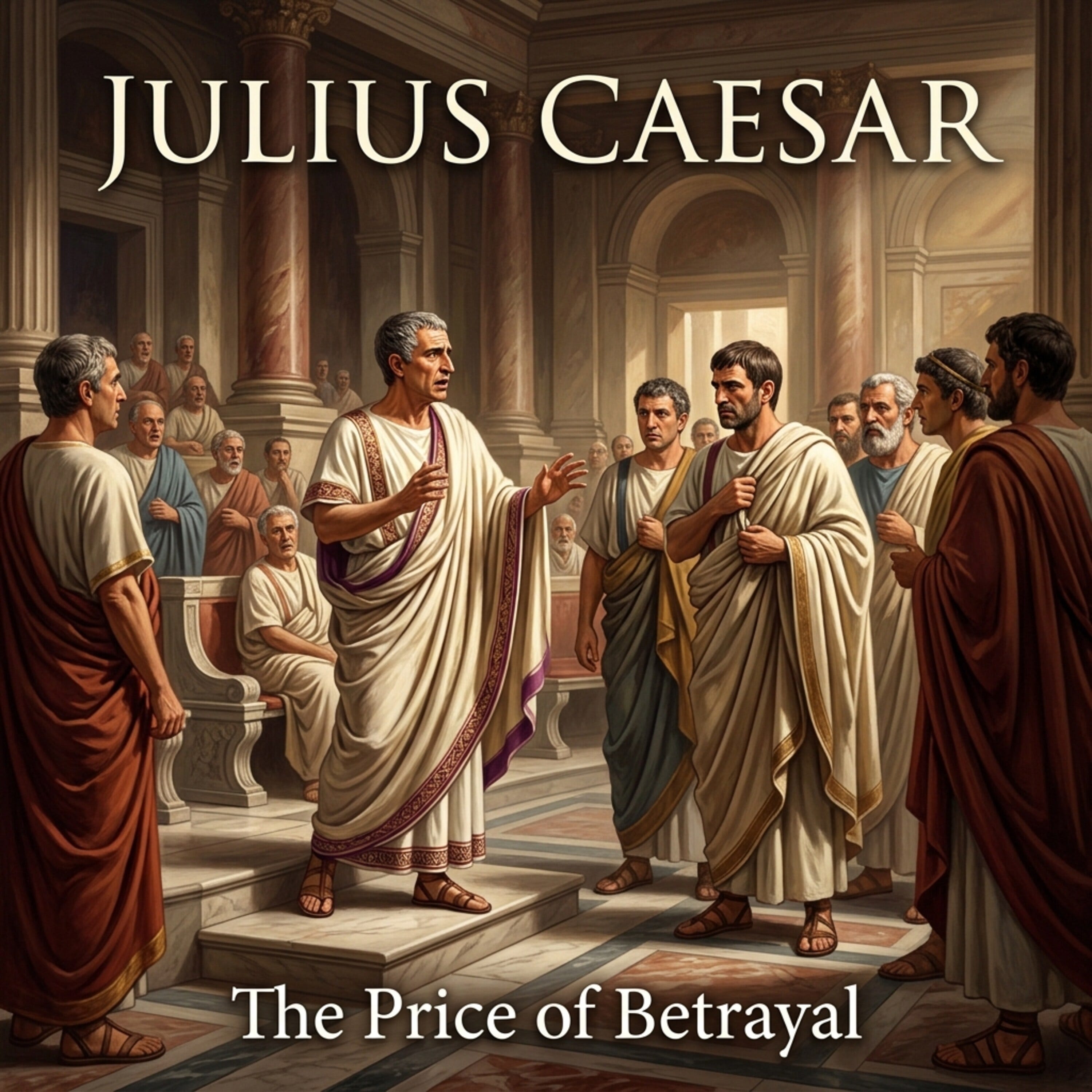
Shakespeare, Julius Caesar
from Wisdom for the Present: Western Wisdom Literature Hosted by Kanu Emeruwa
Imagine being tasked with the most impossible public relations nightmare in human history: you have just publicly and violently assassinated your close friend alongside colleagues, and now you must convince a crowd of millions who adored him that you did it out of profound patriotism. This is the core dilemma of William Shakespeare’s Julius Caesar, a play that serves not as a dusty historical chronicle, but as a surgical exploration of human ambition, the fragility of democratic institutions, and the elaborate stories we tell ourselves to justify our most questionable deeds. By translating this ancient Roman political crisis into the context of 21st-century realities, we can observe how modern echo chambers are engineered, how outrage is manufactured, and how high moral ideals can be twisted into absolute tyranny. It forces us to ask how we convince ourselves that we are the heroes of our own stories, even when our hands are metaphorically covered in blood. The narrative is driven by a deep cultural trauma and historical allergy to monarchy in Rome; centuries prior, the Romans overthrew the tyrannical Tarquin kings and swore a literal blood oath never to be ruled by a single man again. However, as the play opens, this fragile republican system is under immense strain because Julius Caesar has grown so wealthy and militarily powerful that the existing checks and balances can no longer contain him. Caesar’s triumphant return to Rome splits the city: he is celebrating a victory in a civil war against his former Roman ally Pompey rather than a foreign conquest. While the common people enjoy the holiday spectacle, the ruling elites look on with terror, comparing Caesar to a bird flying too high whose feathers must be plucked to prevent him from keeping the population in servile fearfulness. To initiate the conspiracy, Cassius masterfully exploits this collective fear of kingship, radicalizing the honorable Brutus by focusing not on political theory, but on Caesar’s physical, mortal frailties. Cassius paints Caesar as a fragile “colossus” who once cried for help while drowning and groaned like a sick girl during a fever, arguing that their subservience is not a matter of fate but of their own inaction. Meanwhile, Brutus represents a terrifying form of moral vulnerability: because he has no personal grievance against Caesar, he relies on a flawed preemptive logic, comparing Caesar to a “serpent in an egg” that must be killed before it hatches. Brutus attempts to aestheticize the impending violence, urging the conspirators to be “sacrificers, but not butchers,” naively believing that his pure intentions will insulate them from the messy, cascading chaos of a political vacuum. Conversely, Caesar is blinded by his massive ego, casually dismissing supernatural warnings, his wife Calernia’s prophetic nightmares of his bleeding statue, and heartless animal sacrifices. Decius expertly manipulates this ego and fear of looking weak, reinterpreting the bloody dream as a glorious vision of Caesar giving life to Rome and using the “fear of missing out” on a crown to lure him to his execution. The limits of intellectual idealism collapse entirely in the famous funeral orations. Brutus approaches the angry, rioting mob with cold, logical propositions (logos), assuming the public will rationally weigh his arguments about Caesar’s ambition and support the assassination. While they initially cheer, they do not understand his philosophy, immediately shouting, “Let him be Caesar”. Antony then takes the stage and unleashes an emotional thunderstorm (pathos), reverse-engineering a social media algorithm of human emotion by using heavy sarcasm (”honorable men”), physical props like Caesar’s torn cloak, and the enticing clickbait of Caesar’s will. By bypassing logic to feed the crowd’s visceral outrage and financial self-interest, Antony incites a violent riot, proving that emotional manipulation easily defeats intellectual appeals. This cognitive vulnerability is mirrored later in Cassius during the battle of Philippi; gripped by high stress and expecting defeat, Cassius falls prey to severe confirmation bias, misinterpreting a friendly celebration as his best friend’s capture and killing himself based on false information. Ultimately, the play reveals the tragic, cyclical nature of power: the violent destruction of Caesar to save the republic only accelerates its collapse, replacing him with a colder, far more ruthless triumvirate that casually trades family lives for political leverage. To reclaim our agency and discernment today, we must audit our own professional and personal circles. We need to evaluate whether we surround ourselves with “Decius” figures who flatter our egos, or “Calernias” who tell us the uncomfortable truths. We must interrogate whether we are acting out of the envious resentment of Cassius or the rigid, uncompromising self-righteousness of Brutus. Finally, we must examine how much of our internal emotional weather we project onto our surroundings, recognizing that when we carry internal anxiety or hidden guilt, we risk seeing conspiracies and disaster in every neutral interaction. In This Episode * The Anatomy of Spin: How the conspirators attempt the impossible task of rebranding a violent public assassination of a close friend as a noble act of patriotism. * The Poison of One-Man Rule: Rome’s deep cultural trauma from tyrannical kings, which created a constitutional allergy to the concept of monarchy and the word “Rex”. * The Preemptive Strike Fallacy: How Brutus’s moral purity becomes his fatal flaw when he justifies murder based on theoretical projections of Caesar’s future actions, comparing him to a serpent in an egg. * Ego as a Cognitive Vulnerability: How Caesar’s monumental success creates an impenetrable echo chamber, causing him to dismiss a barrage of external data, supernatural omens, and nightmares. * The Mechanics of Mass Manipulation: How Antony defeats Brutus’s logical appeal by utilizing pathos, weaponizing sarcasm, and deploying physical props to trigger the crowd’s outrage receptors. * The Hypocrisy of Clean Hands: The profound cognitive dissonance of Brutus, who condemns Cassius for corruption but demands a share of the extorted gold to pay his soldiers. * The Tyranny of the Void: Why violent revolutions aimed at destroying a tyrant often fail and merely pave a superhighway for a more systemic, ruthless regime when the underlying culture remains unchanged. Practical Reflection Evaluate Your Decius: Who in your inner circle is interpreting the “bleeding statues” of your life? Do you have people like Calernia who tell you uncomfortable truths, or have you incentivized Decius-like flatterers who spin your failures into stories of misunderstood genius? The Brutus vs. Cassius Audit: When you are in a high-stakes dispute or professional conflict, are you acting out of envious resentment to tear others down, or are you weaponizing your moral principles to demand that others do the dirty work while you keep your hands clean? Regulate Your Nervous System: In high-stress situations, how often do you make permanent, destructive decisions based on incomplete or catastrophized information, falling victim to the same confirmation bias that doomed Cassius at Philippi? Suggested Substack Excerpt Explore the timeless psychological mechanics of power, manipulation, and ego in Shakespeare’s Julius Caesar. Learn how noble language can be weaponized and how to run a critical audit on your own decision-making under pressure. AI Disclosure This episode was created using Google NotebookLM Audio Overview, based on human-curated source material, structured guidance, and editorial review. AI is used as a tool for clarity and delivery, not as a replacement for thoughtful study or engagement with the original texts. Copyright © 2026 Wisdom for the Present / Kamashcu Production Studios. All rights reserved. This is a public episode. If you would like to discuss this with other subscribers or get access to bonus episodes, visit wisdomforthepresent.substack.com
Embed this episode
No transcript yet.