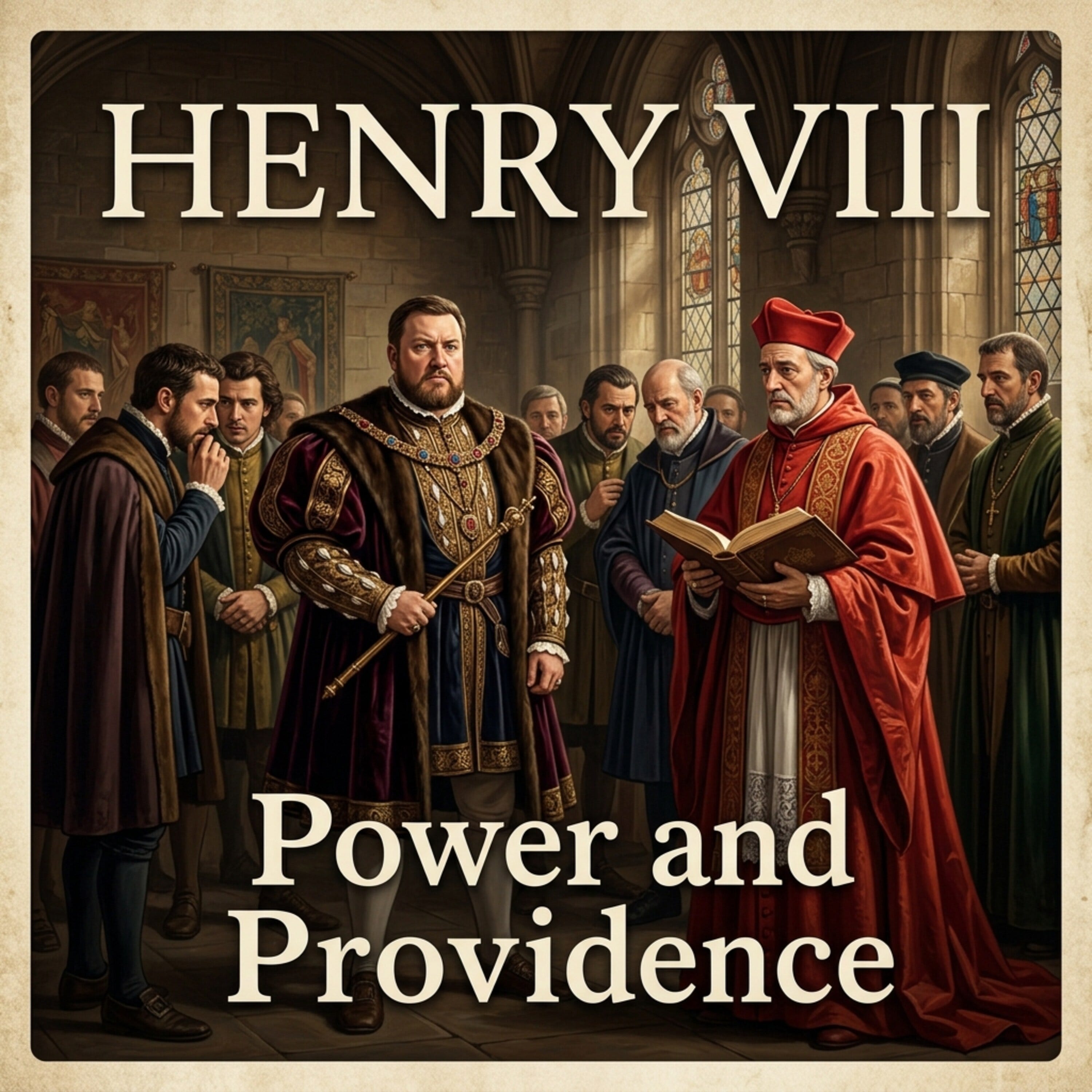
Shakespeare, King Henry VIII
from Wisdom for the Present: Western Wisdom Literature Hosted by Kanu Emeruwa
Imagine dedicating twenty years of your life to building an empire, managing every crisis flawlessly, and securing the entire foundation of an organization, only to be abruptly fired because the leader experiences a sudden, convenient “moral awakening”. While this dynamic sounds like a headline from a modern corporate scandal, it is actually the setting of the 16th-century court of King Henry VIII. In Shakespeare’s play Henry VIII, paired with the intellectual commentary of 19th-century essayist William Hazlitt, we are given a diagnostic manual for toxic power structures and institutional gaslighting. This deep dive explores the brutal collision between the pursuit of power and the demands of an individual’s conscience. Ultimately, the psychological mechanisms at play reveal how toxic systems operate and how individuals can survive when the entire game is rigged against them. The play establishes this core tension not with a quiet moral soliloquy, but with an overwhelming, aggressive display of wealth at the Field of the Cloth of Gold. Historically a diplomatic summit, this event is exposed as an arms race of sheer vanity that bankrupted the nobility while achieving absolutely nothing diplomatically. Shakespeare primes us for structural collapse from the very beginning, with a dark prologue warning that this blinding spectacle of earthly glory will instantaneously shatter into absolute ruin. Underneath all the glitter, gold, and velvet, we witness the physical and moral exhaustion of men forced to carry the weight of false pride. This dramatic opening reminds us that towering, gilded facades are often built on incredibly fragile foundations. At the heart of this system is Cardinal Wolsey, the ultimate manifestation of weaponized ambition who Norfolk compares to a spider spinning a self-drawing web out of his own cunning. As a man of low birth, Wolsey rises to power by manipulating foreign policy, orchestrating purges, and draining the kingdom’s liquidity to fund his ultimate dream of buying the papacy. His ego is matched only by King Henry’s volatile court, which operates like a high-frequency trading algorithm where one microscopic error in phrasing instantly liquidates a lifetime’s portfolio. Henry’s unpredictable authority is encapsulated by his sudden, barking catchphrase “Ha!”. Hazlitt compares this terrifying sound to the first startling clap of thunder breaking from a cloud, keeping everyone in a state of hyper-vigilant compliance. This climate of psychological terror fosters the weaponization of conscience, where leaders mask their raw lust and self-indulgence under a layer of religious piety. Henry claims a sudden, agonizing “scruple” of conscience regarding his marriage to Catherine—a convenient case of confirmation bias that miraculously coincides with his desire to marry the young, beautiful Anne Boleyn. When a leader demands infallibility while being entirely driven by appetite, the environment becomes impossible to navigate, forcing the mass production of sycophants where truth is treated as treason. The fragility of such an empire is exposed when Wolsey, under the cognitive overload of managing his complex web of deceptions, commits a catastrophic administrative error. In a rush, he accidentally slips a private inventory of his hoarded riches and a secret letter to the Pope into a routine packet of state papers, delivering them directly to the king and evaporating his own career in seconds. To survive such unsparing environments, we must look to Queen Catherine, who provides the ultimate blueprint for reclaiming agency, self-advocacy, and discernment. While Wolsey built a gilded skyscraper of ambition over the sinkhole of volatile royal favor, Catherine remains a modest stone fortress anchored to the bedrock of her spiritual integrity and inner truth. Her defense at the trial of Blackfriars is a masterclass: she states her true record calmly, calls out systemic bias directly, and physically walks away from the rigged court with her dignity intact. By refusing to engage in a corrupt process, Catherine demonstrates that retaining one’s moral center is the ultimate act of rebellion, even if it costs worldly status. Ultimately, her radical deathbed forgiveness of Wolsey detoxifies her soul and reclaims her inner peace, proving that we must judge institutions not by their glossy public relations, but by their actual human toll. In This Episode * The convenient moral awakening: How toxic leaders weaponize the language of virtue and higher moral duty to justify self-serving, cruel actions. * The arms race of vanity: The Field of the Cloth of Gold illustrates how systems spend massive capital on superficial posturing that achieves no real progress. * The spider vs. the fortress: Contrasting Wolsey’s fragile skyscraper of ambition, resting on the sinkhole of unpredictable favor, with Catherine’s stable fortress built on inner truth. * The high-frequency court algorithm: How operating under an infallible, appetite-driven leader creates an atmosphere of psychological terror where a single misstep can liquidate a career. * The administrative “reply all” of doom: Wolsey’s catastrophic fall reveals the inevitable cognitive overload and fragility of maintaining complex deceptions at scale. * Catherine’s three-step defense: A practical blueprint for professional self-advocacy in rigged systems—stating facts calmly, naming bias directly, and removing oneself from a corrupt process. * Radical forgiveness as self-defense: Catherine’s choice to forgive her destroyer, Wolsey, highlights how releasing bitterness is a necessary act to reclaim personal power. Practical Reflection What “bladders” of external validation (such as job titles, status, or specific relationships) are keeping you afloat, and how can you build more internal buoyancy? When faced with a toxic dynamic or a rigged evaluation process, are you implementing a disciplined self-advocacy response, or are you wasting your inner capital trying to “out-spider the spider”? Are you judging the organizations, leaders, and institutions in your life by their glossy press releases, or are you evaluating them by their actual human toll? Suggested Substack Excerpt Explore the timeless lessons of Shakespeare’s Henry VIII as we unpack the mechanics of institutional gaslighting, the psychological toll of weaponized ambition, and Queen Catherine’s masterclass in reclaiming personal sovereignty from toxic systems. AI Disclosure This episode was created using Google NotebookLM Audio Overview, based on human-curated source material, structured guidance, and editorial review. AI is used as a tool for clarity and delivery, not as a replacement for thoughtful study or engagement with the original texts. Copyright © 2026 Wisdom for the Present / Kamashcu Production Studios. All rights reserved. This is a public episode. If you would like to discuss this with other subscribers or get access to bonus episodes, visit wisdomforthepresent.substack.com
Embed this episode
No transcript yet.