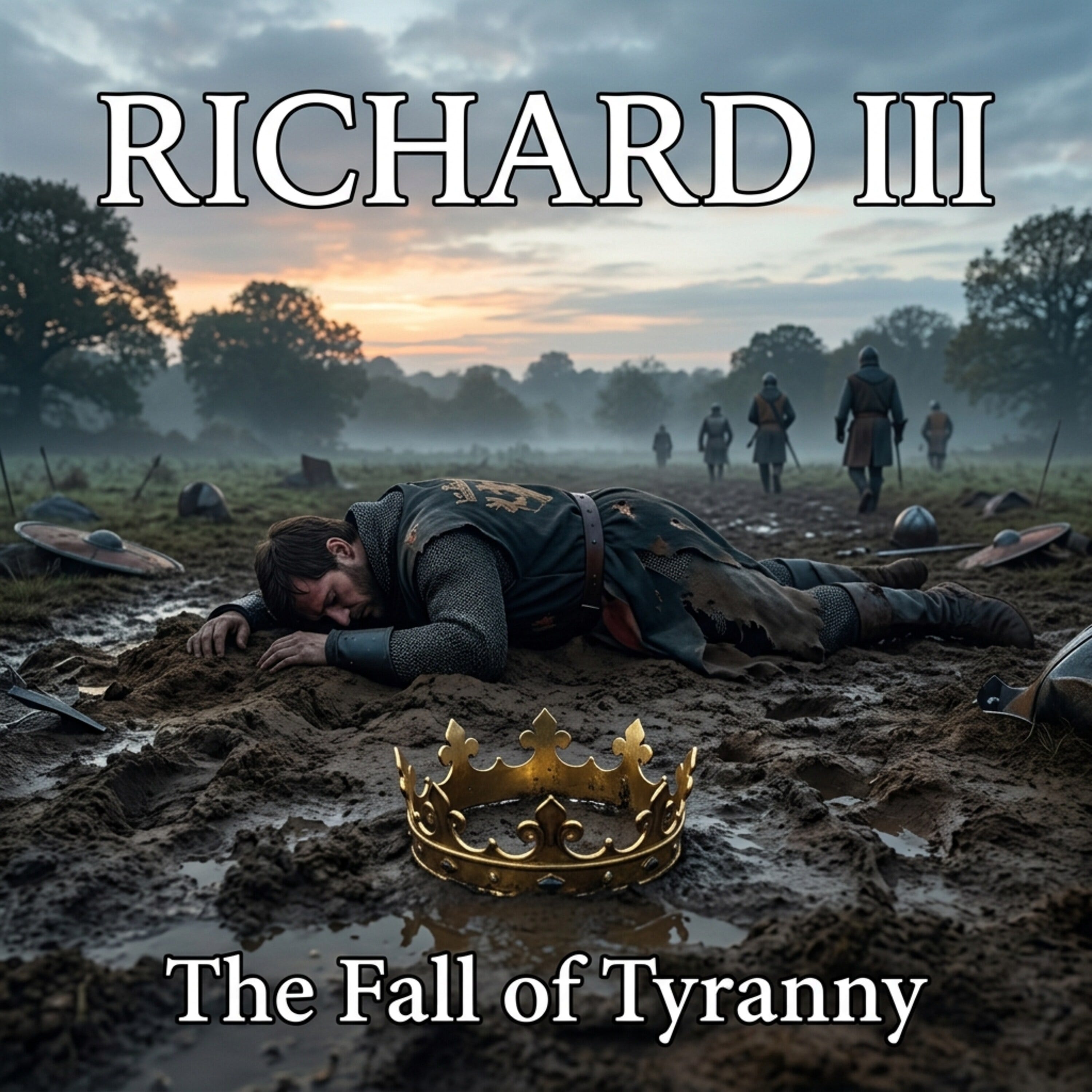
Shakespeare, King Richard III
from Wisdom for the Present: Western Wisdom Literature Hosted by Kanu Emeruwa
We are biologically wired to process risk when a threat is obvious and loud, like a roaring predator or a blaring fire alarm. However, the most dangerous threats in human society rarely announce themselves so clearly. Instead, they wear perfectly tailored suits in corner offices, flash charming smiles at dinner parties, or run polished grassroots campaigns that promise to fix everything wrong in our lives. We are easily disarmed by their confidence, intelligence, and absolute certainty, which makes the eventual destruction they cause far more devastating. In this episode of Wisdom for the Present, we explore William Shakespeare’s classic play, King Richard III, alongside William Hazlitt’s piercing 19th-century commentary to unpack the anatomy of a manipulator and the dark side of corrupted power. The play opens with Richard, Duke of Gloucester, standing alone on a London street during a newly won peacetime. While his family celebrates victory, Richard feels existentially bored because peace is not his natural habitat. He despises the frivolous dancing and courting of peacetime and describes his physical deformities in harsh, unforgiving detail, claiming that nature cheated him and that dogs bark at him as he limps past. While a modern psychologist might view this as classic overcompensation for deep-seated shame and a wounded ego , Hazlitt argues that Richard possesses a profound superiority complex. Richard is fully aware of his towering intellect and royal station; he uses his physical deformity as a convenient alibi to untether himself from moral constraints and prove that morality is just a fragile construct designed by the weak. Richard operates much like a brilliant, bored computer hacker who breaks into secure systems not for financial gain, but to make the architects his playthings and validate his own sovereignty. This transactional, performance-driven mindset is highly relevant today, especially as modern digital algorithms financially reward outrage, division, and the rapid shifting of reality. Richard is a masterful actor who employs rapid emotional whiplash—transitioning instantly from fierce rage to calm, familiar conversation—to shatter his victims’ reality testing and keep them walking on eggshells. Furthermore, he relies on DARVO (Deny, Attack, Reverse Victim and Offender), loudly playing the victim to put his actual targets on the defensive. He scales this up to the political arena through the “illusion of reluctance,” orchestrating fake grassroots movements and forcing the public to beg him to take the crown to position himself as a reluctant savior. Our vulnerability to such bold manipulation is highlighted by the shocking seduction of Lady Anne, whom Richard woos over the bleeding corpse of her husband, whom he personally murdered. Richard bypasses her factual arguments by weaponizing cognitive dissonance, claiming he committed the murders out of obsessive love for her beauty, thereby paralyzing her logic with sheer audacity. This trauma bonding operates alongside a systemic “complicity of silence”. As the Scrivener points out, everyone can clearly see the “palpable device” of the state’s corruption, yet everyone keeps their heads down and complies out of self-preservation. Insiders like Lord Hastings are lulled into false security, arrogant in their belief that they can read Richard’s heart by his face, only to find themselves instantly executed the moment they hesitate to follow his next dark impulse. Yet, building an empire on fear and transactional alliances has a fatal structural flaw: illegitimate power can never rest, and paranoia quickly sets in. The moment Richard achieves the crown, he freezes out his loyal co-conspirator, Buckingham, for showing a shred of independent conscience when asked to murder the young princes. This relentless shedding of allies leaves Richard entirely isolated and sets the stage for a devastating psychological breakdown, where his suppressed conscience splits his identity into perpetrator and victim. While Richard’s final rallying cry is a nihilistic “hand in hand to hell,” Shakespeare contrasts him with the Earl of Richmond, who unites his soldiers around shared values and the collective good. To navigate the modern world without becoming the monsters we try to outsmart, we must actively resist the smooth and smiling villains who believe the rules of humanity simply do not apply to them. In This Episode * The Fire Alarm Myth: Biological danger signals fail when we encounter social manipulation, as the most toxic threats often look like confidence, charm, and professional success. * Deformity as an Alibi: Richard utilizes his physical challenges not as a source of emotional deficit, but as a convenient alibi to untether himself from moral rules. * The Hacker Mindset: Manipulators view morality, loyalty, and empathy as weak “firewalls” built by lesser minds, taking pleasure in dismantling them to prove their superiority. * Emotional Whiplash: Rapid transitions from intense rage to calm normal conversation serve as a deliberate psychological tactic to destroy reality testing and keep victims off-balance. * Weaponized Gaslighting: Through DARVO, skilled deceivers play the aggrieved victim to control the emotional temperature of the room and force their targets to placate them. * The Reluctant Savior: Toxic leaders orchestrate fake grassroots movements and feign humility to force the public to beg them to lead, immunizing themselves from early criticism. * The Peril of the Insider: Proximity to power offers no protection; transactional alliances built on corruption have zero loyalty, and any independent conscience instantly turns a tool into a threat. Practical Reflection * Where in your life are you letting a sense of grievance, resentment, or being overlooked justify unethical behavior or compromised standards? * Are you mistaking intellectual capability, strategic cleverness, or cognitive speed for moral correctness in your relationships or professional choices? * How can you actively cultivate discernment and maintain your conscience in environments—such as corporate ladders or digital spaces—that financially or socially reward ruthless, Machiavellian behavior? Suggested Substack Excerpt In this deep dive, we unpack Shakespeare’s King Richard III alongside William Hazlitt’s commentary to expose the modern mechanics of manipulation, gaslighting, and the illusion of reluctance. Discover how to protect your conscience in a world that often rewards the smooth and smiling villain. AI Disclosure This episode was created using Google NotebookLM Audio Overview, based on human-curated source material, structured guidance, and editorial review. AI is used as a tool for clarity and delivery, not as a replacement for thoughtful study or engagement with the original texts. Copyright © 2026 Wisdom for the Present / Kamashcu Production Studios. All rights reserved. This is a public episode. If you would like to discuss this with other subscribers or get access to bonus episodes, visit wisdomforthepresent.substack.com
Embed this episode
No transcript yet.