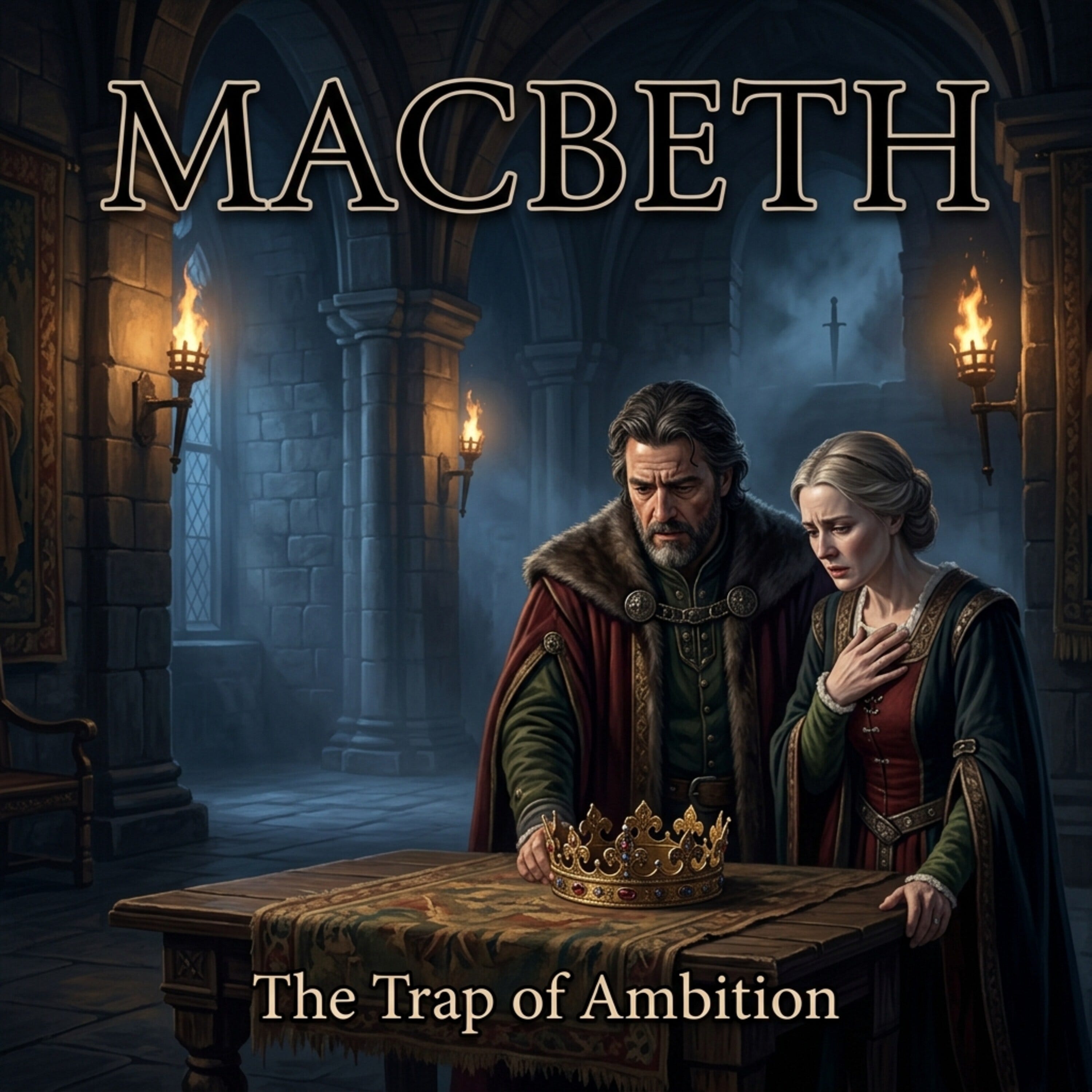
Shakespeare, Macbeth
from Wisdom for the Present: Western Wisdom Literature Hosted by Kanu Emeruwa
Most of us remember Macbeth as a story of witches and murder, and Julius Caesar as a political drama of betrayal. But to understand them, we must look past the plot and into the psychological machinery that drives them. In this episode, we explore the “taxonomy of tragedy”—a framework developed by 19th-century critic William Hazlitt—to understand how ambition and idealism can fracture the human soul. Hazlitt posits that Shakespeare’s tragedies are driven by different “engines.” Macbeth is the tragedy of the wildness of action—not a chaotic party, but action entirely unmoored from conscience. When ambition pairs with an overactive imagination, reality begins to fracture. The host observes, “An imaginative person doesn’t just desire the crown. They vividly hallucinate the steps required to get it... they suffer the consequences of the action before they even commit it.” Macbeth is not a predator by design; he is a vessel drifting in a storm, forced into a “doom loop” of escalating violence just to stay ahead of his own panic. Conversely, Julius Caesar presents the tragedy of good intentions. Brutus is a man of honor, but his goodness functions as a blinder. Because he is inherently trustworthy, he cannot conceive of a world governed by bad actors. He assumes his enemies share his moral framework—a fatal error of imagination. As the episode highlights, “If Macbeth has too much imagination and hallucinates threats, Brutus has zero imagination for evil.” The episode turns this ancient drama into a 21st-century mirror. We discuss the “modern Macbeth”—the fundamentally ethical professional pushed into unethical shortcuts by corporate pressure and “toxic hustle culture.” We compare the “lean and hungry” skepticism of Cassius to the fatal naivety of Brutus, asking if modern leadership requires an “organizational immune system” that our current management culture often tries to excise. We are left with the sobering realization that idealism without tactical teeth is merely a prey mechanism, yet maintaining our humanity is the only thing that distinguishes us from the systems we serve. In This Episode William Hazlitt’s “taxonomy of tragedy”: Categorizing the engine of human ruin Macbeth as a man whose imagination acts as a psychological accelerant The “fair and foul” dissonance: Why modern crises feel like thoughts “pitching and jostling in the dark” Why fundamental goodness can act as a psychological blinder in leadership Lady Macbeth as the patron saint of toxic hustle culture and the amputation of empathy The difference between Macbeth’s accidental corruption and Richard III’s clinical sociopathy Brutus and Cassius: The boardroom tension between idealistic founders and skeptical operators The distinction between petty malice (Middleton’s witches) and soul-altering cosmic evil (Shakespeare’s) Why we resist the idea that evil competence can be awe-inspiring The uncomfortable reality of “Realpolitik”: Is it possible to fight tyranny with clean hands? Practical Reflection The Soliciting Audit: Identify the “weird sisters” in your current work or life—the external metrics, algorithms, or colleagues whispering about “glory” that bypass your conscience. Are you moving forward from purpose, or are you reeling from the agitation of your mind? The Brutus Blind Spot: In your current conflicts, are you projecting your own sincerity onto someone who is fundamentally self-serving? Where do you need to temporarily borrow the “cynical eyes of Cassius” to see the reality of the incentives at play? Preserving the Sleeping Boy: Like Brutus in his tent, do you have pockets of life—relationships, tender moments, quiet habits—where you refuse to let your “busy care” enter? What is one way you can protect your humanity from the “crown” you are currently chasing? Suggested Substack Excerpt We often believe that goodness is armor—that pure intentions will protect us from ruin. But as we explore through the lens of Shakespeare and critic William Hazlitt, the most devastating tragedies often befall those who are too good to survive their own ambitions or too naive to see their enemies clearly. In this episode, we examine the architecture of human failure and the terrifying cost of trading our conscience for a seat at the table. AI Disclosure This episode was created using Google NotebookLM Audio Overview, based on human-curated source material, structured guidance, and editorial review. AI is used as a tool for clarity and delivery, not as a replacement for thoughtful study or engagement with the original texts. Copyright © 2026 Wisdom for the Present / Kamashcu Production Studios. All rights reserved. This is a public episode. If you would like to discuss this with other subscribers or get access to bonus episodes, visit wisdomforthepresent.substack.com
Embed this episode
No transcript yet.