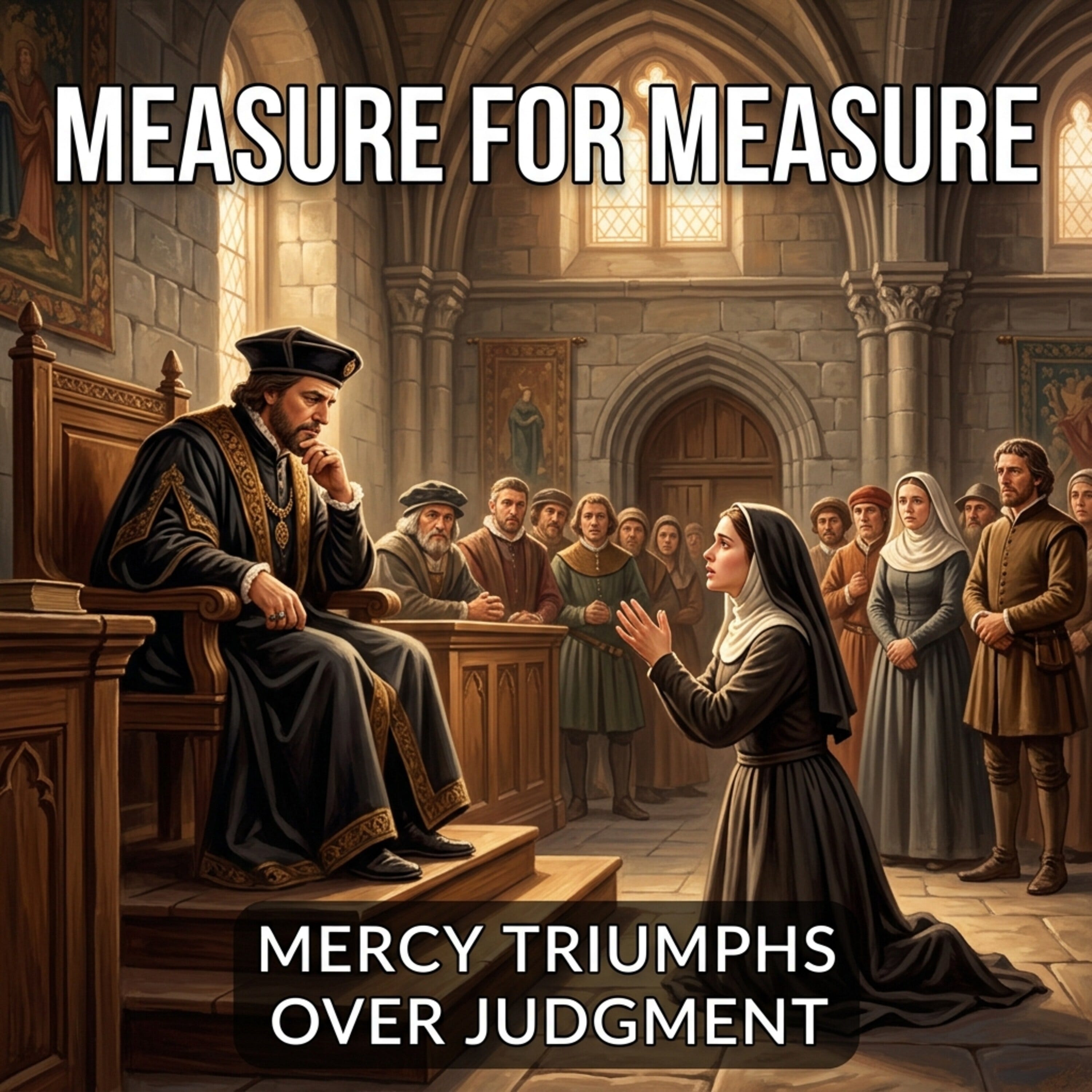
Shakespeare, Measure For Measure
from Wisdom for the Present: Western Wisdom Literature Hosted by Kanu Emeruwa
Have you ever worn a title, a uniform, or a digital persona so tightly that you forgot the flawed human underneath? It is a deeply recognizable modern affliction: wrapping ourselves in temporary, fragile authority and mistaking it for absolute, unbending moral righteousness. In this episode of Wisdom for the Present, we dive into William Shakespeare’s dark, psychological masterpiece Measure for Measure to explore the high-stakes collision between rigid, zero-tolerance policies and the messy reality of the human condition. It’s an ancient story that serves as an uncanny mirror for our 21st-century lives, showing us what happens when our systems try to operate like cold, unyielding algorithms, and what happens when the enforcers of those rules are forced to confront their own buried shadows. The conflict begins in the corrupt, permissive city of Vienna, where the Duke has spent 19 years letting the laws rust shut like neglected armor on a wall. Desperate to clean up the vice but terrified of ruining his personal “nice guy” brand, he abdicates his duty, faking a diplomatic trip and leaving a strict, puritanical deputy named Angelo in charge. This cowardly move is strikingly similar to a modern CEO who avoids hard, uncomfortable organizational corrections by bringing in a ruthless outside consultant to execute mass layoffs and take the heat. Angelo immediately revives long-dormant capital laws, sentencing young Claudio to death for getting his fiancée pregnant before their formal church wedding. It’s a terrifying world where zero-tolerance rules ignore all human context, treating an honest commitment like a clerical error worthy of decapitation. But the play’s true psychological tension explodes when Angelo’s unbending ego is forced to confront Isabella, Claudio’s sister and a deeply intellectual, fiercely articulate novice nun. Isabella brilliantly deconstructs Angelo’s absolute authority, warning him that possessing “a giant’s strength” does not make it moral to crush the weak, and reminding him that human power is merely temporary dress-up. Yet, her pure, unyielding virtue triggers an incredibly dark, repressed desire in Angelo, demonstrating the classic psychological mechanics of the shadow. Having violently shoved his desires to the bottom of his subconscious pool, Angelo has no healthy coping mechanisms when the beach ball of his humanity finally explodes to the surface. His resulting cognitive dissonance leads to a vile abuse of power: he offers Isabella a horrific ultimatum, demanding her bodily autonomy in exchange for her brother’s life. As this psychological storm rages, we witness a brutal breakdown of logic and a devastating display of existential dread when Isabella informs Claudio of the ultimatum. Facing the literal terror of death and the unknown, Claudio collapses from noble bravery to desperate begging, pleading with his sister to make the sacrifice for him. This agonizing conflict forces both siblings into a horrific, unsolvable ethical trolley problem where corrupt authority has pitted the victims against each other over their own survival. Even when the disguised Duke intervenes with the manipulative “bed trick”—swapping Angelo’s abandoned fiancée Mariana into the dark encounter—the system fails to heal. Angelo immediately reneges on his word, proving that absolute corruption eventually abandons all logic, seeking self-preservation through further violence and demanding Claudio’s immediate execution anyway. Yet, just when we expect the play to culminate in blood and retributive justice, Shakespeare subverts our expectations through a radical act of forgiveness. Confronted in a theatrical public reckoning by her exposed, begging abuser, Isabella chooses to kneel in the dirt, demanding grace over an eye-for-an-eye vengeance. By breaking the toxic cycle of retribution, she shows us how to reclaim our agency, move beyond black-and-white dogmatism, and practice true discernment. We close the episode by looking at “the Escalus check”—a practical, daily grounding tool that challenges us to pause, recognize our own potential for failure, and remember that our “little brief authority” should never blind us to our shared, messy humanity. In This Episode * The Rusted Armor of Law: Explore how long-term leniency in Vienna reduced the law to an unpolished, rusted suit of armor, leaving the city in a state of chaotic neglect. * The Nice Guy CEO Dilemma: Examine the Duke’s abdication of leadership, drawing a parallel to corporate bosses who hire ruthless outside consultants to enforce accountability while keeping their own hands clean. * The Trap of Zero-Tolerance: Analyze Claudio’s death sentence for a minor legal omission, illustrating how unyielding, black-and-white systems ignore the human element to cross into cruelty. * Dressed in Brief Authority: Unpack Isabella’s rhetorical dismantling of Angelo’s power, highlighting how institutional authority acts as a temporary costume that puffs up the ego. * The Danger of Repression: Trace Angelo’s sudden moral collapse, using Jung’s shadow psychology to show how violently repressing human desires causes them to mutate and eventually explode. * The Ethical Trolley Problem: Untangle the agonizing, impossible choices forced upon Claudio and Isabella by a corrupt authority that weaponizes their survival and values against one another. * Radical Grace Over Retribution: Highlight Isabella’s breathtaking choice to forgive her exposed abuser, proving that true societal healing requires mutual grace rather than retributive justice. Practical Reflection How would my actions change if I applied “the Escalus check” before harshly judging a colleague, family member, or public figure who has made a mistake? Where in my own life am I “dressed in a little brief authority”—whether as a manager, parent, or team leader—and how might that role be blinding me to my shared humanity? What “scarecrows of the law” do I loudly impose on others while quietly finding convenient moral loopholes for myself? Suggested Substack Excerpt What happens when unyielding, zero-tolerance justice collides with messy human reality? Join us as we dismantle Shakespeare’s Measure for Measure to uncover the dangers of repressed desire, the illusion of authority, and the radical grace needed to heal a broken community. AI Disclosure This episode was created using Google NotebookLM Audio Overview, based on human-curated source material, structured guidance, and editorial review. AI is used as a tool for clarity and delivery, not as a replacement for thoughtful study or engagement with the original texts. Copyright © 2026 Wisdom for the Present / Kamashcu Production Studios. All rights reserved. This is a public episode. If you would like to discuss this with other subscribers or get access to bonus episodes, visit wisdomforthepresent.substack.com
Embed this episode
No transcript yet.