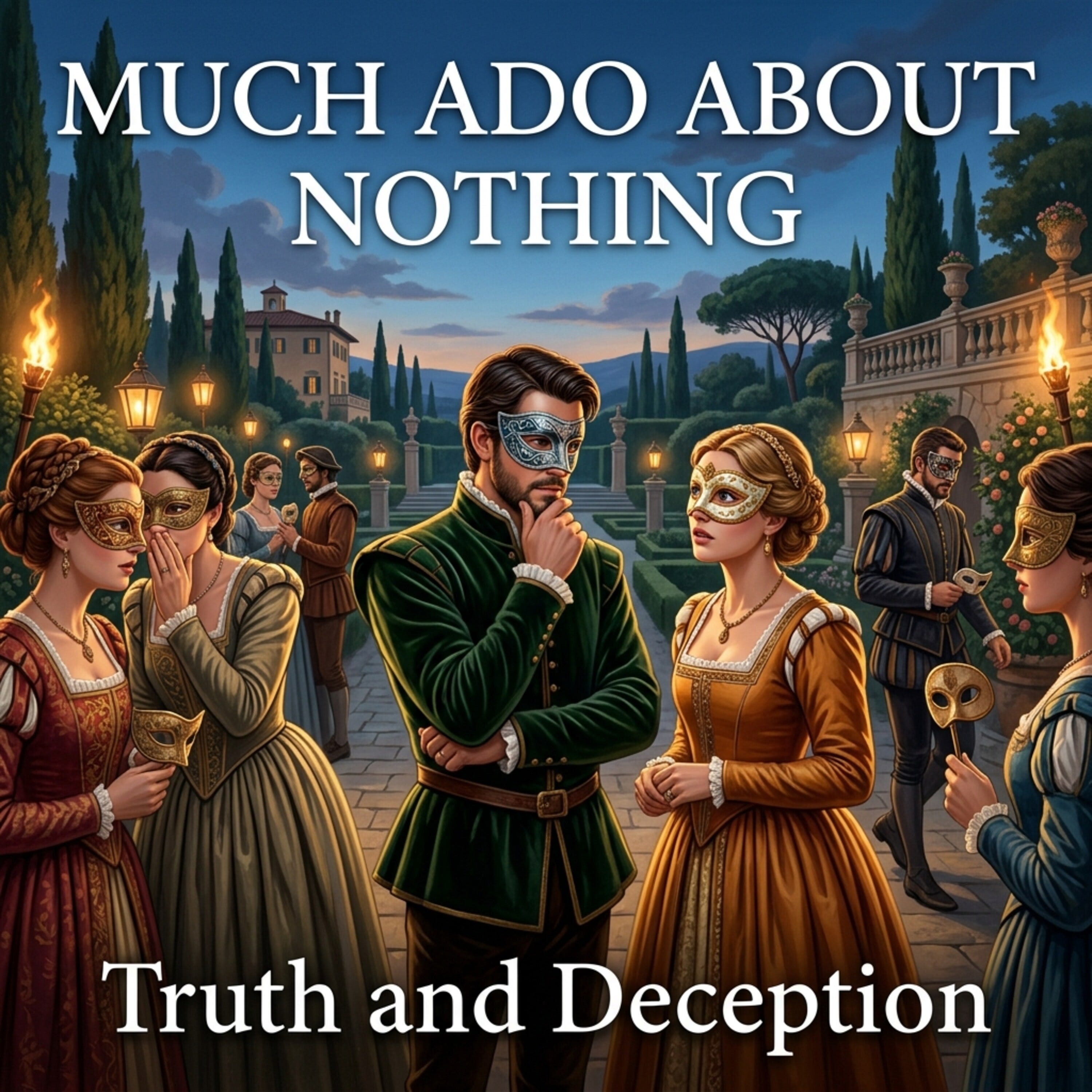
Shakespeare, Much Ado About Nothing
from Wisdom for the Present: Western Wisdom Literature Hosted by Kanu Emeruwa
Imagine watching a groom publicly humiliate his bride at the altar, stopping the wedding dead in its tracks and completely destroying her reputation because he saw a shadowy figure in a window the night before and assumed the absolute worst. While this sounds like a contemporary nightmare straight out of a viral social media scandal, it actually lies at the heart of William Shakespeare’s 400-year-old comedy, Much Ado About Nothing. In this episode of Wisdom for the Present, we strip away the 16th-century costumes to explore the bare psychological wiring of human perception. We discover that our eyes and ears are not objective, infallible recording devices; instead, our reality is frequently hijacked by our own deepest insecurities, social conditioning, and pride. The play’s conflict begins in the city of Messina, where a war has just ended and the victorious Prince Don Pedro arrives with his soldiers. Operating under a massive adrenaline crash, these young men are suddenly thrown from high-stakes binary survival into a peaceful psychological vacuum. This transition prompts the young decorated soldier Claudio to seek conventional milestones, quickly “checking the marriage box” with Leonato’s daughter, Hero, as a way to fill the void. Meanwhile, Beatrice and Benedict operate on the opposite end of the social spectrum, engaging in a “merry war of wits” and using cynical, sarcastic humor to shield themselves from the vulnerability of love. Both couples hide behind distinct masks—the mask of rigid convention and the mask of cynical intellect—to guard their fragile egos. These protective armor sets make the characters prime targets for deception, which serves as the central engine of the story. In a fascinating parallel, the episode highlights how easily these masks are exploited by two opposite types of manipulation. Don Pedro orchestrates a benevolent deception to trick Beatrice and Benedict into believing the other is secretly in love with them, successfully lowering their perceived risk of rejection to zero and allowing their defenses to melt. Conversely, the villainous Don John engineers a malicious trick by presenting Claudio with a midnight shadow in a window. This manipulation acts as a Renaissance-era “deep fake,” showing how easily our pride and fear of public humiliation can be exploited by bad actors seeking to construct damaging narratives. This malicious trick triggers a complete breakdown of logic, driven entirely by confirmation bias. Claudio immediately believes the worst about Hero because his patriarchal social conditioning has wired him to fear being cuckolded, making the ambiguity of trust feel far more uncomfortable than a confirmed fear. His brain eagerly seizes upon the shadowy evidence to resolve this vulnerability, prioritizing the “emotional relief” of being right over actual visual truth. The resulting public shaming of Hero at the altar exposes the raw, violent side of conventional society and demonstrates how quickly cancel culture can execute a viral public takedown of a person’s character based on a single piece of unverified, manipulated evidence. Reclaiming our psychological agency requires deep discernment and a willingness to embrace the “wisdom of the fool”. While the sophisticated nobles in Messina overthink themselves into self-deception, it is Constable Dogberry and the low-status night watchmen who uncover the truth simply by sitting quietly in the dark and listening without presumption. Alongside this humble approach, the Friar’s psychological strategy to fake Hero’s death reminds us of loss aversion—the human tendency to “rack the value” of what we have only after it is gone. By dropping our “paper bullets of the brain”—our sarcastic defenses and rigid assumptions—we can cultivate the humility to mend our detractions and appreciate the rich realities of our lives while they are still standing right in front of us. In This Episode * The Post-War Adrenaline Vacuum: How the transition from active warfare to civilian peace creates a psychological void that drives characters to seek new, sometimes reckless targets for displaced energy. * Masks of Convention vs. Intellect: A comparison of Claudio and Hero’s adherence to conventional social milestones against Beatrice and Benedict’s defense mechanism of cynical sarcasm. * Benevolent vs. Malicious Deception: Exploring how social manipulation can be used as a double-edged sword—either as a safe catalyst to spark love or as a toxic weapon of envy to destroy lives. * The Cognitive Mechanics of Confirmation Bias: Why Claudio’s brain preferred a devastating, realized fear over the vulnerable ambiguity of trusting his fiancee. * The 16th-Century “Deep Fake”: Parallel lessons between Don John’s midnight window deception and modern cancel culture’s viral public takedowns. * Loss Aversion and “Racking the Value”: The Friar’s acute observation that humans take blessings for granted as a baseline, only recognizing their true worth once they are lost. * The Paradox of the Holy Fool: How the bumbling, low-status watchmen solved the crime simply by hiding in the dark and listening, while the sophisticated, status-conscious nobles deceived themselves. Practical Reflection What “paper bullets of the brain”—such as cynical takes, sarcastic defenses, or intellectual arguments—do you fire off to keep others at a safe distance? Have you recently received difficult feedback or a detraction that stung, and can you, like Benedict, drop your ego and use the criticism to grow? How can you proactively “rack the value” of your relationships, health, or daily peace today without waiting for a tragedy to reveal their true worth? Suggested Substack Excerpt Explore how William Shakespeare’s Much Ado About Nothing serves as a piercing psychological case study in cancel culture, confirmation bias, and the defense mechanisms we use to avoid vulnerability. AI Disclosure This episode was created using Google NotebookLM Audio Overview, based on human-curated source material, structured guidance, and editorial review. AI is used as a tool for clarity and delivery, not as a replacement for thoughtful study or engagement with the original texts. Copyright © 2026 Wisdom for the Present / Kamashcu Production Studios. All rights reserved. This is a public episode. If you would like to discuss this with other subscribers or get access to bonus episodes, visit wisdomforthepresent.substack.com
Embed this episode
No transcript yet.