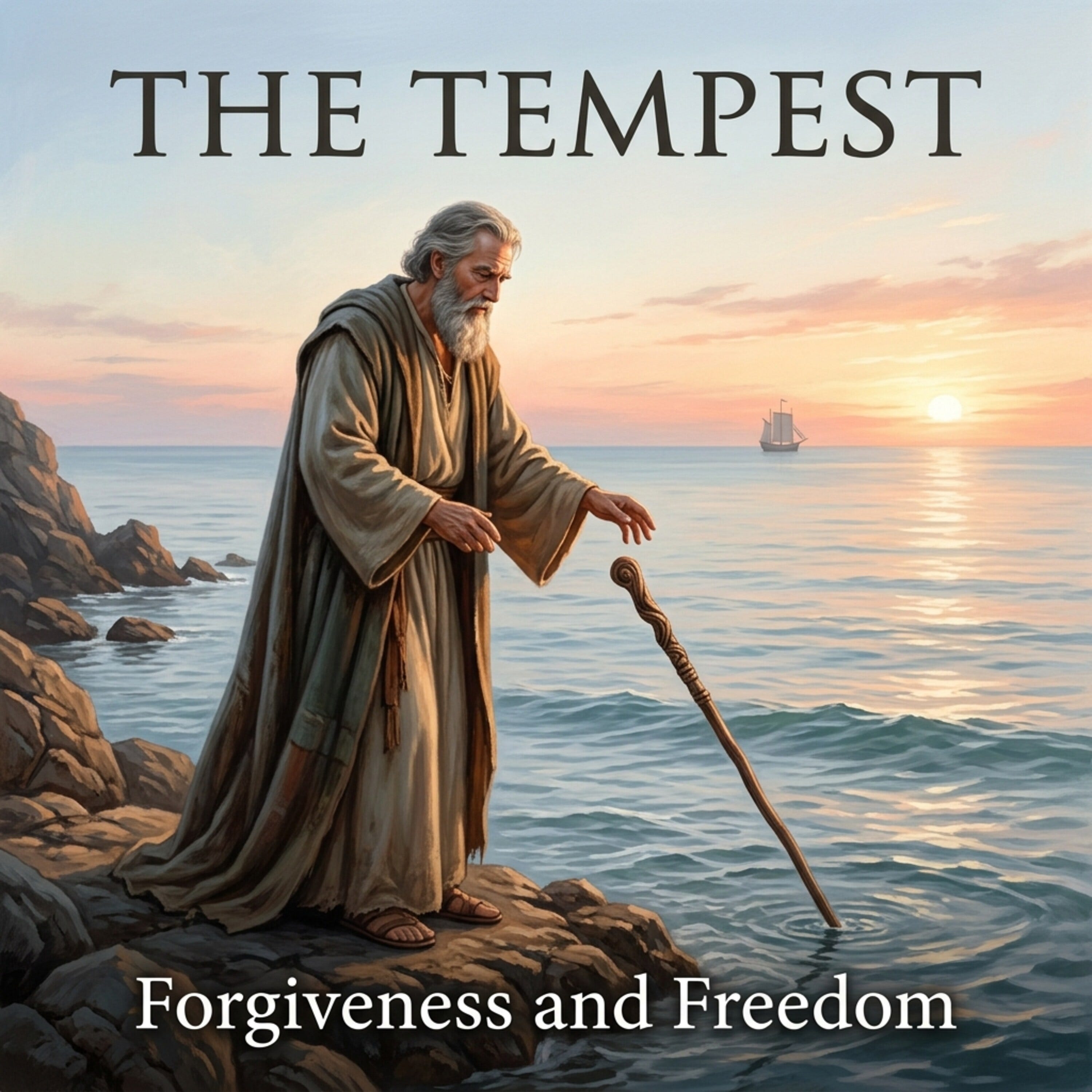
Shakespeare, The Tempest
from Wisdom for the Present: Western Wisdom Literature Hosted by Kanu Emeruwa
How do we handle betrayal when we have the absolute power to retaliate? In our modern, hyperconnected lives, the ability to cancel, expose, or publicly destroy others is often just a click away. This makes William Shakespeare’s The Tempest—a 17th-century fantasy of wizards, spirits, and shipwrecks —not an outdated relic, but an incredibly sharp psychological mirror for our digital age. Through the brilliant lens of 19th-century essayist William Hazlitt, this episode of Wisdom for the Present explores how an isolated island becomes a psychological laboratory for analyzing power, ego, and the human heart. Our exploration begins with Prospero, the usurped Duke of Milan, who retreats into the esoteric sciences and occult studies, neglecting his real-world responsibilities and handing over power to his treacherous brother, Antonio. When the ship carrying his enemies passes by, Prospero orchestrates a massive tempest to shipwreck them on his island. Yet, as the survivors wash ashore, we see a profound division: the honest old counselor Gonzalo dreams of a naive, weaponless utopian commonwealth , while the cold-blooded Antonio and Sebastian immediately plot political assassination. This stark contrast reveals how easily pure idealism collapses when forced to reckon with the cold, unyielding reality of sociopathic ambition. To control his captive audience, Prospero operates like an algorithmic mastermind, manipulating his subjects through elemental counterweights: the earthy, unrefined Caliban and the weightless, ethereal spirit Ariel. We dive deep into the fascinating distinction between “grossness” (Caliban’s raw, earth-bound nature) and “vulgarity” (the corrupt, learned behaviors of the drunken sailors Stephano and Trinculo). Even though Caliban is branded a monster, Shakespeare endows him with beautiful poetic verse, showing his deep, soulful connection to the natural world. In contrast, the low-born sailors quickly copy the corrupt power-hunger of the high-born nobles, showing that the greed to dominate and destroy runs from the absolute top of the social ladder to the bottom. As the psychological storm intensifies, the characters experience a breakdown of logic, where reality feels like a fever dream and magic feels like the only tangible reality. Despite his near-omnipotence, Prospero remains anxious, controlling, and deeply stressed—a poignant reminder that the burden of absolute control is ultimately exhausting and unsustainable. He is forced to confront the limits of his own illusions when a petty, drunken murder plot threatens to derail his grand spectacle. This leads to his iconic existential realization that our towers, palaces, and very lives are “such stuff as dreams are made on”. We also modernize Hazlitt’s classic critique of the physical stage, examining how passive consumption—whether through 19th-century theater or modern CGI—can cage our active imagination and flatten the infinite potential of the mind. The true climax of this psychological escape room is not an act of magic, but an act of profound human agency sparked by Ariel, a non-human spirit who teaches his master the meaning of empathy. Shamed and inspired by Ariel’s capacity for pity, Prospero chooses to reclaim his humanity, declaring that “the rarer action is in virtue than in vengeance”. He unilaterally forgives those who betrayed him without demanding their repentance, and—most profoundly—integrates his own shadow by acknowledging the monstrous Caliban as his own. By breaking his staff and drowning his book , Prospero challenges us to step back from our own modern battlegrounds, master our internal darkness, and find the strength to choose radical forgiveness. In This Episode * The Psychological Escape Room: How Shakespeare’s final masterpiece is actually a deep dive into the interior human landscape disguised as a fantasy. * Idealism vs. Sociopathy: Why Gonzalo’s naive utopian dreams stand no chance against the cold, conscience-free ambition of Antonio. * Grossness vs. Vulgarity: A crucial philosophical distinction using Caliban and the drunken sailors to understand raw nature versus societal decay. * The Soul of a Monster: Why Caliban’s elevated blank verse reveals a poetic, earth-rooted soul that far outshines his civilized captors. * The Exhaustion of Omnipotence: Why Prospero’s total control over the island’s elements only breeds anxiety, proving that maintaining illusions is a heavy burden. * The CGI Trap: Adapting William Hazlitt’s theater critique to understand how passive consumption of hyper-perfect visual effects cages active imagination. * Virtue over Vengeance: Analyzing the moral pivot of the play where Prospero surrenders his absolute power, integrates his shadow, and chooses unilateral forgiveness. Practical Reflection How do you handle your own “Antonio” when you hold the leverage? Are you tempted by the default setting of vengeance, or do you have the psychological strength to choose virtue? Are there areas in your life where, like Prospero, you are trying to maintain an exhausting illusion of absolute control over your environment or relationships? What does it mean for you to look at your own shortcomings, anger, or past mistakes and declare, “This thing of darkness I acknowledge mine”? Suggested Substack Excerpt Unpack the psychological laboratory of Shakespeare’s The Tempest to discover why true strength lies not in the magic of absolute control or vengeance, but in the radical, vulnerable act of self-integration and forgiveness. AI Disclosure This episode was created using Google NotebookLM Audio Overview, based on human-curated source material, structured guidance, and editorial review. AI is used as a tool for clarity and delivery, not as a replacement for thoughtful study or engagement with the original texts. Copyright © 2026 Wisdom for the Present / Kamashcu Production Studios. All rights reserved. This is a public episode. If you would like to discuss this with other subscribers or get access to bonus episodes, visit wisdomforthepresent.substack.com
Embed this episode
No transcript yet.