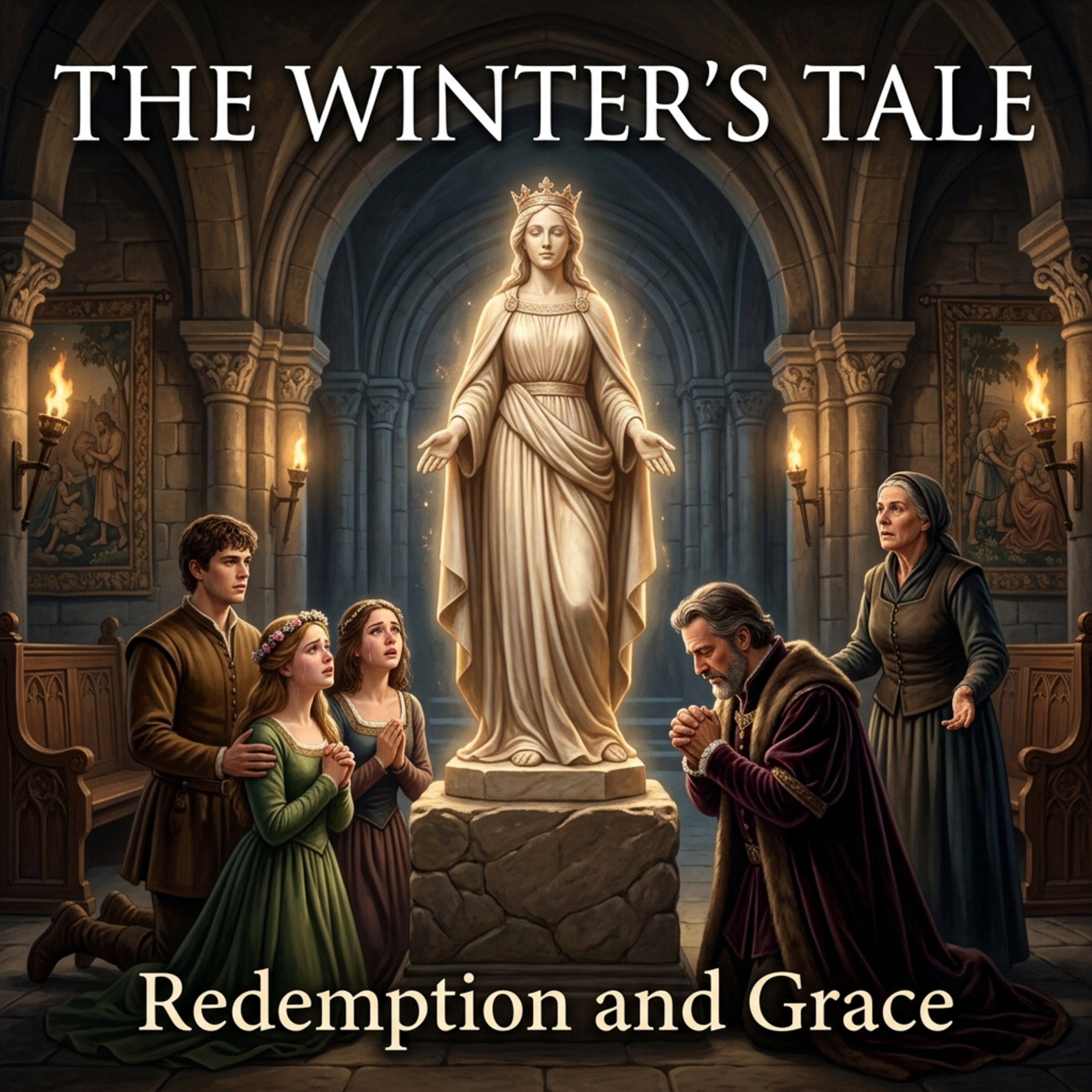
Shakespeare, The Winter's Tale
from Wisdom for the Present: Western Wisdom Literature Hosted by Kanu Emeruwa
Imagine the last time your anxiety completely hijacked your brain—whether you were spiraling over a frantic text message or convinced that a major romantic relationship or work project was completely collapsing. While we tend to think of these intense, panic-induced reactions as uniquely modern digital dilemmas, the most piercing psychological breakdown of this anxious state was actually penned over 200 years ago, analyzing plays written 400 years ago. In this episode of Wisdom for the Present, we look past the velvet theatrical costumes and Elizabethan staging to uncover the raw, enduring psychological truths that William Hazlitt managed to diagnose through his profound commentary on Shakespeare’s works. We begin with the tragic spiral of Leontes, the king in The Winter’s Tale, who destroys his own life by plunging into a thorny labyrinth of pure, unadulterated jealousy. Hazlitt brilliantly notes that Leontes’s speeches lack the sweeping, poetic eloquence we usually expect in high drama; instead, they are written in a crabbed, fragmented, and chaotic style. This capture of thoughts “almost strangled in the birth” perfectly reflects the physiological reality of intense anxiety and cognitive overload, where the weight of our passions completely collapses our capacity for reason. Leontes’s mind is forced to perform torturous gymnastics to rationalize a delusion that is fundamentally built on a flawed premise—the infidelity of his entirely innocent wife, Hermione. This self-inflicted prison becomes even more toxic because Leontes actively seeks out opposition from his advisor Camillo. Rather than deflating his paranoia, the friction of Camillo’s denial is exactly what Leontes needs to spark his unjust suspicions into a full, blazing rage. In a similar vein of ego and self-curation, we analyze the character of Parolles in All’s Well That Ends Well, a parasite and coward who represents the 17th-century embodiment of “fake it till you make it”. Parolles carries his soul in his clothes, maintaining a meticulously crafted avatar of military heroism until his comrades stage a brutal, blindfolded ambush to call his bluff. When his facade is utterly destroyed and he hits rock bottom, he experiences a bizarre somatic liberation, realizing that dropping the exhausting armor of a false self requires zero calories to maintain. The psychological feedback loops that drive Leontes are strikingly relevant to how we process ambiguous information in our hyperconnected world. Armed with endless data, we frequently take completely neutral data points—a quiet conversation at the office coffee machine, a brief email from a boss, or a delayed text response—and weave them into catastrophic narratives. Like Leontes asking “Is whispering nothing?” we actively seek out arguments or fall into online echo chambers that validate our paranoia, using resistance as proof of a conspiracy. We manufacture our own certainty simply by insisting upon our unjust suspicions loudly enough, forging a self-inflicted prison that operates independently of objective reality. To reclaim our agency and find our authentic baseline, we must apply rigorous discernment, a quality beautifully illustrated in the famous “flower debate” between Perdita and King Polixenes. While Polixenes argues for the legitimacy of artificial modifications, declaring that “the art itself is nature,” Perdita stands her ground to protect the integrity of her soul, refusing to wear the metaphorical makeup of artifice. In daily life, we can choose whether to live in the cortisol-drenched anxiety of a false persona or stand firm in our authenticity. By separating timeless psychological truths from historical prejudices—such as the classist assumptions surrounding Perdita’s royal lineage or the toxic persistence of Helen’s pursuit of Bertram—we can learn to navigate a chaotic world with absolute emotional sovereignty. In This Episode * The Physiology of Panic: How Shakespeare’s “crabbed and torturous” dialogue style captures the fragmented, chaotic nature of cognitive overload during intense anxiety. * The Trap of Confirmation Bias: How Leontes’s paranoia demonstrates our modern tendency to weave neutral data points into catastrophic conspiracies and use pushback to fuel our rage. * Emotional Sovereignty vs. Weakness: Reinterpreting Hermione’s patient forbearance not as passivity, but as an immense inner strength where the heart reposes entirely upon itself. * The Liberating Power of Exposure: How Parolles’s humiliating collapse shows the exhausting physical toll of maintaining a false self and the relief of dropping the act. * The Authenticity Debate: How the philosophical clash between Polixenes and Perdita over modified flowers mirrors our modern struggle with curated online personas and digital filters. * Embracing Life’s Rogues: Learning to accept a world without perfect karmic justice through the trickster archetype of Autolycus. * Discernment in Devotion: Why we must admire the proactive skill and tenacity of characters like Helen while remaining critical of the unworthy objects of our persistence. Practical Reflection Are you currently using someone else’s opposition or friction to validate your own anxiety or justify a toxic mood? In which areas of your life is your “soul in your clothes”—where are you maintaining an exhausting false persona or chasing a metaphorical drum? Are you choosing the cortisol-drenched path of pretense, or are you ready to embrace your authentic baseline and let the facade go? Suggested Substack Excerpt Explore the timeless psychological insights of Shakespeare’s plays through the eyes of William Hazlitt. Learn how ancient characters mirror our modern struggles with anxiety, confirmation bias, curated personas, and the exhausting burden of pretense. AI Disclosure This episode was created using Google NotebookLM Audio Overview, based on human-curated source material, structured guidance, and editorial review. AI is used as a tool for clarity and delivery, not as a replacement for thoughtful study or engagement with the original texts. Copyright © 2026 Wisdom for the Present / Kamashcu Production Studios. All rights reserved. This is a public episode. If you would like to discuss this with other subscribers or get access to bonus episodes, visit wisdomforthepresent.substack.com
Embed this episode
No transcript yet.