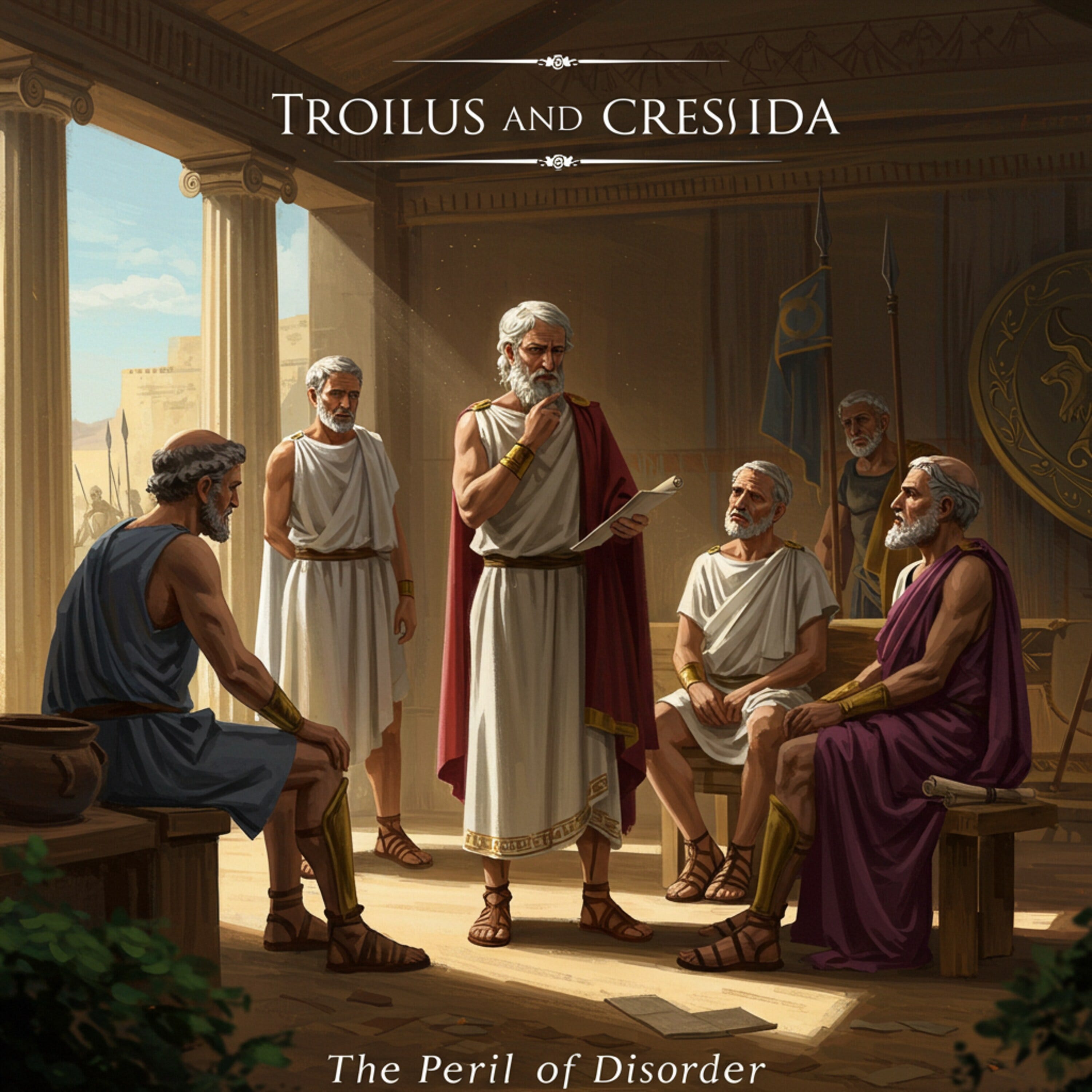
Shakespeare, Troilus and Cressida
from Wisdom for the Present: Western Wisdom Literature Hosted by Kanu Emeruwa
Imagine standing at the absolute pinnacle of your career, only to realize that the world has already moved on to the next shiny object . This creeping sense of obsolescence and the exhausting race to stay relevant in a fast-paced society might feel like a uniquely 21st-century anxiety, but it was perfectly diagnosed over 400 years ago. In William Shakespeare’s underappreciated play, Troilus and Cressida, we find a startlingly accurate map of the modern attention economy. Through the lens of William Hazlitt’s 19th-century commentary, this episode of Wisdom for the Present explores how a story about the ancient Trojan War serves as a profound psychological mirror for our digital age, stripping away romantic mythology to expose the raw mechanics of human ambition, burnout, and societal fragmentation. The play’s disjointed, rambling structure itself mirrors the psychological exhaustion of its characters, who have been trapped in a grinding, seven-year-long siege. With their initial glorious motivations long evaporated, the Greek leaders gather in their tents to diagnose why their superior forces are failing. The general Ulysses famously identifies this not as a military defeat, but as a structural collapse of “degree”—the invisible infrastructure of trust, mutual respect, and social contracts that keeps a community from flying apart. Shakespeare warns that when this delicate string is untuned, the resulting discord reduces society to a survival-of-the-fittest arena. Without shared rules, objective justice devolves into raw power, power degrades into personal will, and will collapses into pure appetite—depicted as a “universal wolf” that indiscriminately devours its own ecosystem until it eventually starves and consumes itself. This systemic degradation of values is masterfully mapped onto individual psychology in Ulysses’s confrontation with the sulking warrior Achilles. Achilles rests on his past laurels, believing his resume protects his status, but Ulysses dismantles this illusion with the chilling metaphor of Time’s wallet, which collects “alms for oblivion”—scraps of past deeds that are forgotten as soon as they are made. In a hyper-competitive space, honor must be renewed daily; if you pause to catch your breath, the “thousand sons of emulation” will instantly overrun and trample you. This claustrophobic race perfectly prefigures the endless treadmill of the digital age, where algorithms, content creation, and a relentless news cycle demand constant activity to prevent being cast into the dust. In this transactional environment, we find ourselves at the mercy of “one touch of nature”—our shared cognitive flaw of novelty bias, which drives us to praise “newborn gods” and superficial trends simply because they are in motion. When foundational boundaries crumble, chaos reigns, and our logical frameworks break down into self-justification and confirmation bias. This is brilliantly exposed in the Trojan debate over returning Helen, where Troilus uses soaring, romanticized rhetoric to argue for keeping her, framing her as a “theme of honor” rather than a human being—effectively turning her into a branding asset to justify continued bloodshed. We participate in this exact cognitive dissonance today, dressing up predatory actions in noble language to avoid facing our own inner Achilles. Just as Achilles abandons chivalry to execute a calculated mob hit on an unarmed, resting Hector, modern organizations often prioritize the “splendor of the achievement” over the “cruelty of the means,” utilizing beautiful mission statements to mask cutthroat, short-term appetites. Reclaiming our agency in such a chaotic world requires both emotional discernment and cognitive adaptability. By comparing Geoffrey Chaucer’s analytical, step-by-step Criseyde—who calculates risks with a spreadsheet-like focus—with Shakespeare’s giddy, impulsive Cressida, who reacts purely to the dopamine loop of the moment, we see the danger of living without grounded reasons. To navigate modern complexity, we must balance Chaucer’s consecutive, structured logic with Shakespeare’s lateral, “sociable faculties” that allow disparate ideas to cross-pollinate and mold reality like yielding glass. Ultimately, Hazlitt’s critique of Shakespeare’s own mind—which was so full to overflowing that its forward momentum could trample its own clarity—serves as a warning. In an information-saturated age where our cognitive armies charge on heaps, our ultimate competitive advantage is not collecting more data, but developing the discipline to edit, filter out the noise, and establish the internal degree needed to let genuine wisdom shine through. In This Episode * The Erosion of Degree: How losing the “invisible infrastructure of trust” and mutual respect causes societies, organizations, and relationships to collapse into raw power and self-devouring appetite. * The Tyranny of the Universal Wolf: Understanding the psychological devolution where unchecked greed and ambition consume the very ecosystems that sustain them, leading to modern burnout and systemic crashes. * Time’s Wallet and Oblivion: Why past achievements offer no permanent safety in a hyper-competitive, motion-driven environment where reputation is a lease that must be renewed daily. * The Treadmill of Emulation: How Shakespeare perfectly prefigured the algorithmic feeds of the digital age, where stopping to rest means being instantly overrun by a “thousand sons of emulation”. * The Novelty Bias Dopamine Loop: A deep dive into “one touch of nature”—our biological vulnerability to superficial trends, shiny objects, and things in motion over substance. * Cognitive Dissonance in War and Business: Analyzing how we romanticize harsh realities with noble rhetoric, prioritizing the “splendor of the achievement” over the cruelty of our actual methods. * Chaucerian Logic vs. Shakespearean Lateral Thinking: Why navigating a complex, interconnected world requires combining rigid, step-by-step analytical structures with fluid, cross-pollinating lateral insight. Practical Reflection Where in your life or career have you untuned the string of your own boundaries—such as rest, fairness, or mutual respect—and let a personal “universal wolf” of ambition or burnout begin to consume your ecosystem? Are you currently seeking validation and “remuneration” from the fickle “present eye” of your industry, and how can you shift your focus back to the intrinsic virtue of your work? When evaluating your professional or personal environments, where might you be using a “theme of honor” or polished rhetoric to justify actions that are fundamentally self-serving or predatory? Suggested Substack Excerpt Explore how William Shakespeare and 19th-century essayist William Hazlitt perfectly diagnosed the attention economy, algorithmic burnout, and cognitive dissonance centuries before the digital age. Learn how reclaiming internal “degree” and balancing analytical focus with lateral thinking can save us from losing distinction in a world of endless noise. AI Disclosure This episode was created using Google NotebookLM Audio Overview, based on human-curated source material, structured guidance, and editorial review. AI is used as a tool for clarity and delivery, not as a replacement for thoughtful study or engagement with the original texts. Copyright © 2026 Wisdom for the Present / Kamashcu Production Studios. All rights reserved. This is a public episode. If you would like to discuss this with other subscribers or get access to bonus episodes, visit wisdomforthepresent.substack.com
Embed this episode
No transcript yet.