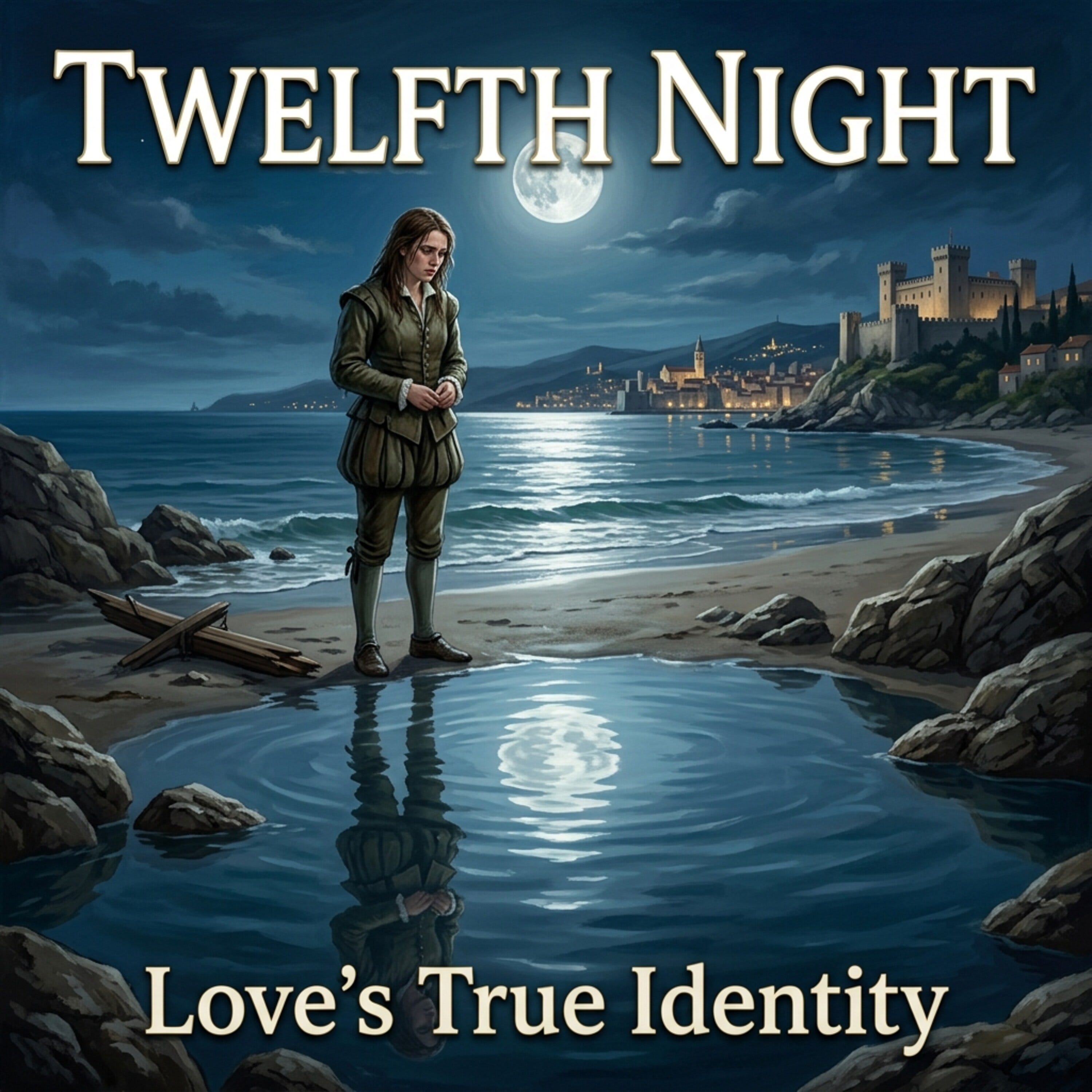
Shakespeare, Twelfth Night
from Wisdom for the Present: Western Wisdom Literature Hosted by Kanu Emeruwa
How often do we find ourselves more in love with the idea of something—a relationship, a tragedy, a career—than the messy, unpredictable reality of it? In this episode of Wisdom for the Present, we unpack William Shakespeare’s Twelfth Night, exposing it not as a superficial, fluffy romantic comedy, but as a ruthless 400-year-old masterclass on the psychological dangers of self-deception. Shakespeare places our modern coping mechanisms, curated personas, and fragile egos under a microscopic lens, revealing how easily we build beautiful emotional prisons and lock ourselves inside. By exploring the stagnant world of Illyria, we discover that the ancient struggles of performative identity map with uncomfortable precision onto our 21st-century lives. The play wastes no time demonstrating the paralysis that comes with performative identity through its main aristocratic characters. We meet Duke Orsino, who lounges in his court indulging in excess music to “sicken” his romantic appetite, revealing that he is not in love with Olivia, but with the aesthetic of being a tragic, rejected lover. Meanwhile, Countess Olivia performs her own role as the ultimate mourner, vowing a strict, seven-year daily crying schedule to “pickle” her grief. Even Malvolio, her head steward, performs a role of pure puritanical superiority and ambition, believing his own greatness is obvious to everyone. Together, these characters illustrate a society playing pretend, avoiding the vulnerabilities of actual human connection. When we translate these characters to the modern day, the parallels are startling. Orsino represents “main character syndrome,” where others are merely supporting NPCs in a curated, moody digital aesthetic. Olivia represents “performative trauma” or “competitive outrage,” using pain not as a bridge to others, but as a defensive wall to keep reality out. Malvolio is the ultimate “hustle bro,” a transactional social climber who memorizes intellectual buzzwords and thinks specific life hacks (or yellow stockings) can bypass genuine human friction. In our digital Illyria of social media and algorithms, we are constantly encouraged to curate our personal brands, trapping us in closed loops of self-indulgence and ego. To break this suffocating stagnation, Shakespeare introduces a literal storm and shipwreck in the character of Viola. Unlike the Illyrians, Viola operates with complete emotional authenticity despite wearing a physical disguise. She acts as a mirror, disrupting their scripts and refusing to validate their illusions. Additionally, Feste the clown acts as a “corruptor of words,” using sharp logic to pierce through Olivia’s performative grief by proving that mourning a brother in heaven is logically inconsistent. These disruptions show us that we cannot rely solely on our own self-awareness; we need a “Feste” in our lives—a trusted friend or therapist who is unimpressed by our titles and has permission to lovingly call us out. Yet, waking up from our illusions is a painful, threatening process, and the play shows how violently the ego resists reality. Orsino pivots to murderous rage when rejected, and Malvolio retreats into calcified bitterness after his humiliation. Feste reminds us that “there is no darkness but ignorance,” warning that staying in our comforting illusions is like living in a pitch-black room. But how we deliver truth also matters; the cruel gaslighting of Malvolio teaches us that truth without empathy is mere cruelty. Ultimately, as Feste sings alone in the rain at the play’s end, we learn that wisdom lies not in escaping the storms of life through performative defense mechanisms, but in finding the courage to stand vulnerable and authentic in the rain. In This Episode * The Performative Prison: How we fall in love with our own curated scripts and aesthetics rather than engaging with reality. * Orsino’s Black Hole: Understanding how narcissism disguises itself as romance, swallowing and devaluing actual connection. * Grief as a Moat: Analyzing how Countess Olivia uses competitive outrage and performative trauma to keep life’s uncertainties away. * The Modern Hustle Bro: Mapping Malvolio’s transactional arrogance and buzzword-reciting ambition to modern hustle culture. * Find Your Feste: The vital psychological necessity of having a trusted, candid truth-teller in your life. * The Darkness of Ignorance: Why choosing a safe, static illusion over messy reality is a form of self-imposed imprisonment. * Truth with Empathy: Recognizing that dismantling someone’s ego without empathy and care is simply destructive cruelty. Practical Reflection What performative identity or aesthetic are you currently curating online or offline to protect yourself from being truly vulnerable? Who is the “Feste” in your life—the person who sees through your smoke screens and has permission to tell you the unvarnished truth? Are you using a painful experience, trauma, or rigid routine as a “moat” to avoid facing the unpredictable demands of real relationship and growth? Suggested Substack Excerpt Are you in love with reality, or just your own curated illusion? Explore how Shakespeare’s Twelfth Night exposes our modern coping mechanisms, from main character syndrome to hustle culture, and how to reclaim authenticity. AI Disclosure This episode was created using Google NotebookLM Audio Overview, based on human-curated source material, structured guidance, and editorial review. AI is used as a tool for clarity and delivery, not as a replacement for thoughtful study or engagement with the original texts. Copyright © 2026 Wisdom for the Present / Kamashcu Production Studios. All rights reserved. This is a public episode. If you would like to discuss this with other subscribers or get access to bonus episodes, visit wisdomforthepresent.substack.com
Embed this episode
No transcript yet.