
EPISODE · Mar 22, 2026 · 1H 32M
Shaping expectations, losing flexibility (Majid Majzoubi et al., 2026) | FT50 SMJ
from Revise and Resubmit - The Mayukh Show · host Mayukh Mukhopadhyay
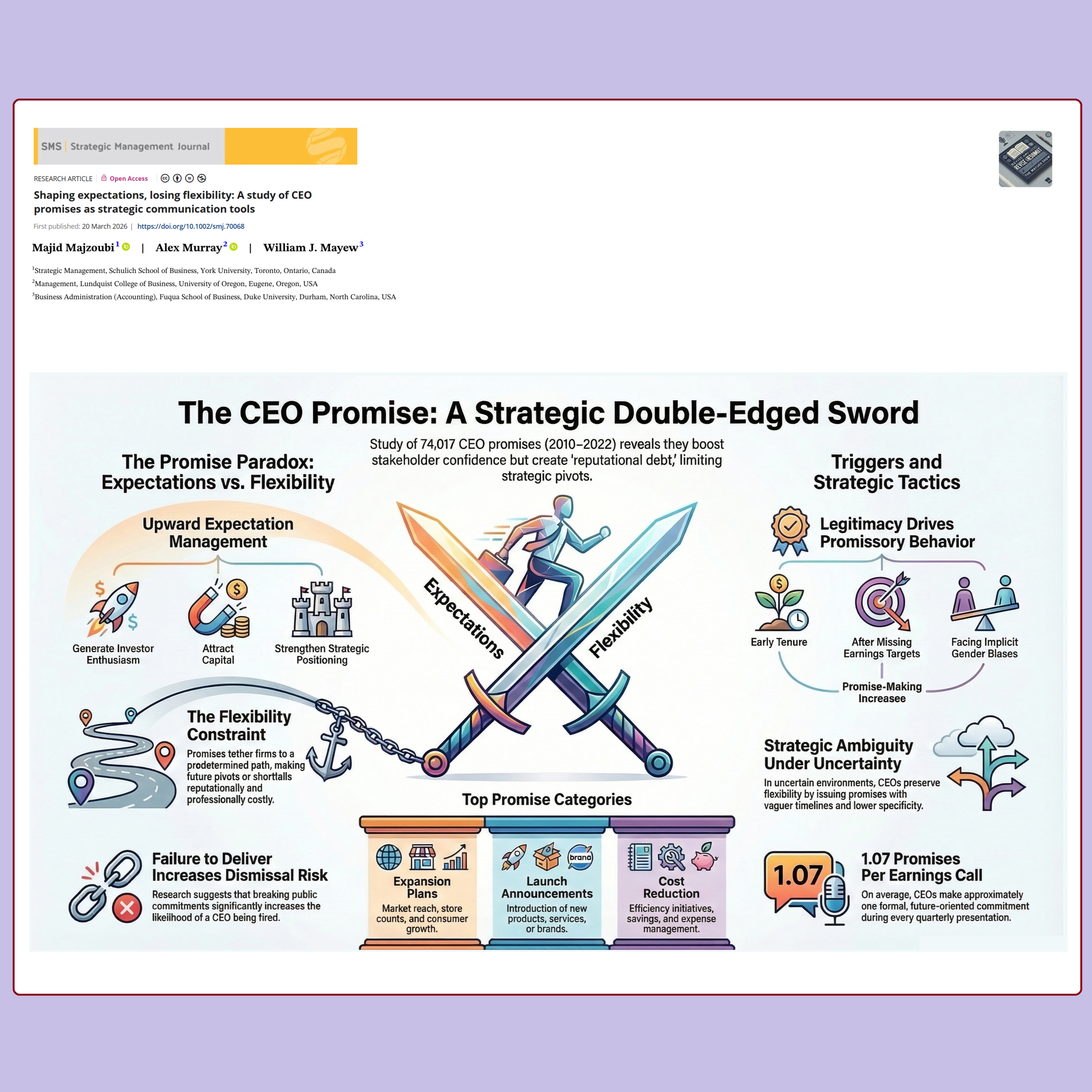
English Podcast Starts at 00:00:00Bengali Podcast Starts at 00:39:28Hindi Podcast Starts at 00:59:37Danish Podcast Starts at 01:12:22ReferenceMajid Majzoubi, Murray, A., & Mayew, W. J. (2026). Shaping expectations, losing flexibility: A study of CEO promises as strategic communication tools. Strategic Management Journal. https://doi.org/10.1002/smj.70068Youtube Channelhttps://www.youtube.com/@weekendresearcherConnect over linkedinhttps://www.linkedin.com/in/mayukhpsm/Welcome to Revise and Resubmit 🎙️✨, the podcast where big ideas from serious scholarship meet the messy, fascinating drama of real life.Today, we turn to a question that sounds simple until you sit with it for a while: what happens when a CEO makes a promise?Not a casual remark. Not corporate wallpaper. A promise. A public sentence aimed at the future, spoken into the charged air of an earnings call, where investors listen for confidence, analysts listen for signals, and the market listens for reasons to believe. 📈👂Our episode explores a striking new paper, Shaping expectations, losing flexibility: A study of CEO promises as strategic communication tools, by Majid Majzoubi, Alex Murray, and William J. Mayew, published online on 20 March 2026 in the Strategic Management Journal 🏛️, one of the most prestigious journals in management research and proudly part of the FT50 journal list.This is not just a study about talk. It is a study about the cost of saying what comes next.Using Large Language Models to examine more than 69,000 earnings-call transcripts from S&P 1500 firms between 2010 and 2022 🤖📚, the authors identify over 74,000 CEO promises and reveal something deeply human at the heart of executive communication. Promises can lift expectations. They can steady a room. They can make stakeholders feel that someone is holding the wheel. But every promise also closes a door. Every declaration about tomorrow makes tomorrow a little less open.That is the paradox this paper captures so elegantly. CEOs promise more when they need people to believe in them, especially early in their tenure, after poor performance, or when legitimacy feels fragile. But when uncertainty thickens, when resources tighten, when the future refuses to sit still, those same leaders begin to hedge. They grow vague. They stretch timelines. They protect maneuverability through ambiguity. 🎭⏳And the stakes here are not abstract. The paper finds that when these public pledges go unmet, the consequences can be career-defining, even dismissal-level serious. In other words, a promise is never merely rhetoric. It is strategy, theater, expectation, and risk, all packed into a few carefully chosen words. ⚖️What makes this article especially exciting is that it takes something we hear all the time in business language and asks us to hear it differently. A promise is not just a commitment. It is a negotiation between hope and constraint, between confidence and caution, between the need to inspire and the need to remain free.So as we begin, here is the question hanging in the air for all of us, whether we study organizations, lead them, or simply live inside systems built on credibility: when leaders promise the future out loud, are they creating strategy, or surrendering it? 🤔If you enjoy conversations like this, please subscribe to Revise and Resubmit on Spotify 🎧, follow the YouTube channel Weekend Researcher ▶️, and catch the show on Amazon Prime and Apple Podcasts 🍎📺.Our thanks to the authors, Majid Majzoubi, Alex Murray, and William J. Mayew, and to the publisher, John Wiley & Sons Ltd., for bringing this outstanding FT50 journal research into the world. 🙏📖
Embed this episode
Ready to play
Shaping expectations, losing flexibility (Majid Majzoubi et al., 2026) | FT50 SMJ
No transcript for this episode yet
Similar Episodes
No similar episodes found.
Similar Podcasts
No similar podcasts found.