
EPISODE · Feb 15, 2020 · 1H 44M
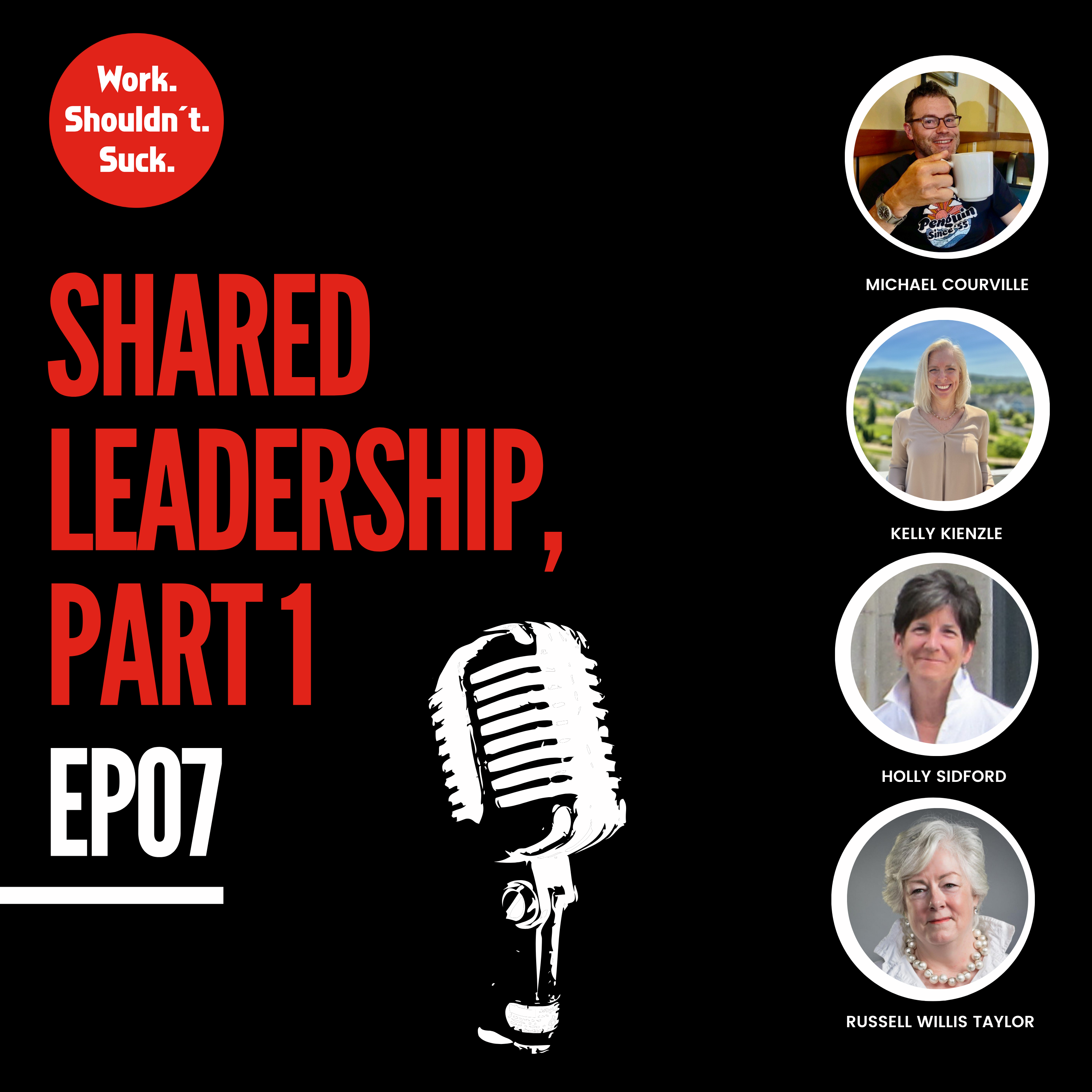
Shared Leadership, Part 1 (EP.07)
On this episode: "CEO Not *Necessarily* Required." We look at shared or distributed leadership models, what are they, what aren’t they, how they work, how you might evaluate different models, and might they be right for you and your organization.Mike Courville, Kelly Kienzle, Holly Sidford, and Russell Willis Taylor take us on an action-packed adventure. And, if after this episode you're still hungry for more about shared leadership, our next episode dives into part two of this adventure by chatting with the members of Fractured Atlas's four-person, shared, non-hierarchical leadership team.01:00 Mike Courville41:42 Kelly Kienzle1:11:08 Holly Sidford & Russell Willis TaylorMichael Courville is Founder and Principal of Open Mind, an independent consulting firm that combines research insights with direct social sector experience, to tackle problems that impact people and spiral out to organizations and into complex systems. Michael has deep experience with organizational capacity building, change management, applied social research, community development, and social sector strategy formation. His current research and client projects focus on workplace democratization and decision-making systems in nonprofits, understanding the role of arts and culture in community change, social policy under neoliberalism, and the political cost of inequality for civil society. Michael holds graduate degrees from the University of California-Berkeley in social welfare and comparative development policy. He is an associate member of the National Network of Consultants to Grantmakers and an affiliate of the RoadMap consulting network. He currently serves as adjunct faculty in the Department of Sociology at Sonoma State University. (The William & Flora Hewlett Foundation's case studies in Distributed Leadership can be found here.)Kelly Kienzle, founder of Open Circle Coaching, provides leadership coaching and professional development programs to individuals and teams to improve organizational performance in the private, public and nonprofit sectors. Kelly is a people development specialist with over 25 years of experience and is a certified coach of the International Coach Federation logging over 1,500 hours of coaching leaders. A description of her philosophy and approach to coaching can be found at www.opencirclecoaching.com.Holly Sidford is an expert systems thinker–seeing connections and making more than the sum of the parts. Her endless curiosity, penetrating intelligence and commitment to excellence underpins all of Helicon’s work. Holly draws on her training as an historian and her experiences as a program developer and funder to inform Helicon’s efforts to elevate the role of artists, recognize the full diversity of creative expression and make the arts and culture a more central part of community life. Holly has a knack for identifying the most important issue facing the field at the time, and her work is often a thought-provoking catalyst for change. Reports such as Bright Spot Leadership in the Pacific Northwest (Paul G. Allen Family Foundation, 2012) and Fusing Art, Culture and Social Change (National Committee for Responsive Philanthropy, 2011) have stimulated field-wide discussion. Earlier in her career, her work at the Lila Wallace-Reader’s Digest Fund helped shift national discourse and practice in the ways cultural organizations engage audiences and communities. In 2000, Holly’s work prompted unprecedented research on artists, Investing in Creativity (Urban Institute, 2003), and the creation of Leveraging Investments in Creativity (LINC), a unique ten-year initiative to expand support and recognition for artists nationwide. Holly serves on the board of Sadie Nash Leadership Project, an award-winning leadership program for young female leaders in metropolitan New York, and Fractured Atlas, a national organization pioneering technology-based ways to empower artists, cultural organizations and other creative enterprises.Russell Willis Taylor served as interim Vice President for arts and leadership at The Banff Centre in Canada from 2016 to 2018. Prior to that, she was President and CEO of National Arts Strategies from January 2001 to December 2014, and she has extensive senior experience in all areas of strategic, financial and operational management. Educated in England and America, she served as director of development for the Chicago Museum of Contemporary Art before returning to England in 1984 at the invitation of the English National Opera (ENO) to establish the Company's first fund-raising department. During this time, she also lectured extensively at graduate programs of arts and business management throughout Britain. From 1997 to 2001, she rejoined the ENO as executive director. Russell has held a wide range of managerial and Board posts in the commercial and nonprofit sectors including the advertising agency DMBB; head of corporate relations at Stoll Moss; director of The Arts Foundation; special advisor to the Heritage Board, Singapore; chief executive of Year of Opera and Music Theatre (1997); judge for Creative Britons and lecturer on business issues and arts administration. She received the Garrett Award for an outstanding contribution to the arts in Britain, the only American to be recognized in this way, and in 2013 was honored with the International Citation of Merit by the International Society for the Performing Arts, presented in recognition of her lifetime achievement and her distinguished service to the performing arts. She currently serves on the advisory boards of the British Council's Arts & Creative Economy Advisory Group, the Alyth Development Trust, the Salzburg Global Seminar, and is a Fellow of the Royal Society of Arts.
Embed this episode
What this episode covers
On this episode: CEO Not *Necessarily* Required. We look at shared or distributed leadership models, what are they, what aren’t they, how they work, how you might evaluate different models, and might they be right for you and your organization.
NOW PLAYING
Shared Leadership, Part 1 (EP.07)
No transcript for this episode yet
Similar Episodes
No similar episodes found.