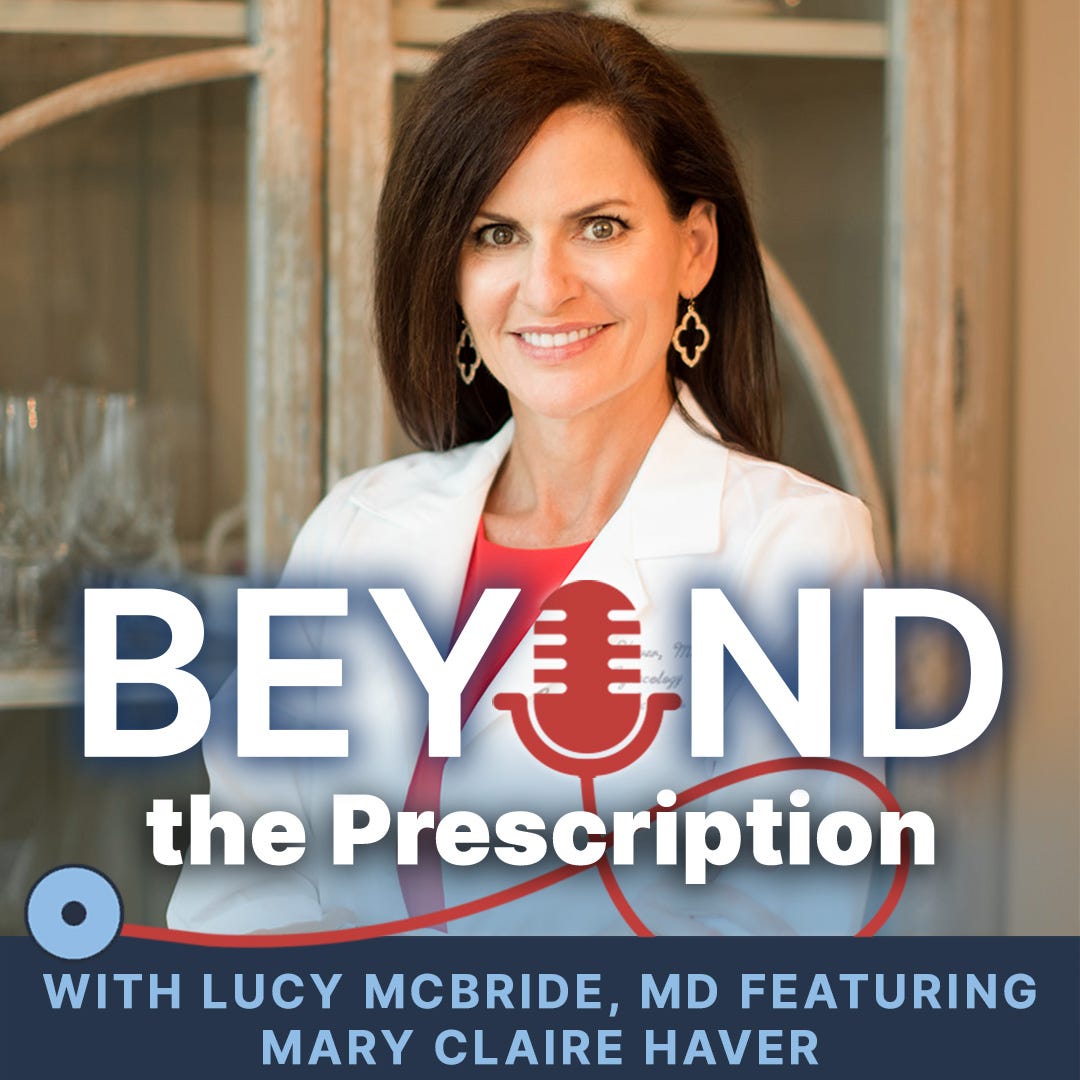
Should You Take Hormone Replacement Therapy?
from Beyond the Prescription Hosted by Dr. Lucy McBride
You can also check out this episode on Spotify! Dr. Mary Claire Haver is a board certified OBGYN and women’s health advocate who has helped thousands of women going through menopause actualize their health and wellness goals. Dr. Haver’s goal is to empower and educate women in their mid-lives, and help women advocate for themselves in the doctor’s office. On this episode of Beyond the Prescription, Dr. McBride and Dr. Haver break down the myths and facts about menopause and hormone therapy. They discuss the harms of fear-based narratives in medicine and the importance of balancing risk to help women live longer and healthier lives. So, should you or shouldn’t you take hormone replacement therapy? Dr. McBride wrote a longer piece about this decision-making process here. The upshot? * Menopause is defined as having gone a full calendar year without a menstrual period. A woman’s midlife decline in estrogen and progesterone levels can cause short-term symptoms (like hot flashes, vaginal dryness, and insomnia) and can increase the risk for long-term health problems (like cardiovascular disease and osteoporosis). * In general, menopausal hormone therapy (MHT) is considered safe for most healthy women when it is initiated within 10 years of menopause. * Estrogen itself does not seem to increase the risk of breast cancer for the vast majority of women. * Unless she has had a hysterectomy, a woman should take estrogen and progesterone together. * Micronized (aka “bioidentical”) progesterone does not increase the risk of breast cancer; synthetic progesterone does seem to increase the risk, but only slightly. * Dr. McBride recommends not panicking about the new Danish study suggesting an increased risk of dementia in women who take MHT. Why? It was an observational study (not a randomized controlled trial or RCT) therefore it cannot prove causation; the study population used oral estrogen and synthetic progesterone which are not the standard of care in the U.S.; myriad RCTs show the opposite finding: that MHT is likely protective against premature cognitive decline, especially when started early. * Too many women needlessly suffer through menopause because of false narratives about the safety of MHT and because discussions about quality of life often aren’t prioritized. * Don’t take it from her! Dr. McBride encourages you to share the latest expert statement from the North American Menopause Society with your own doctor to help guide your decision-making process. * Women are entitled to make their own decision about hormones, armed with the data, and with an understanding of their unique risks and benefits. Dr. McBride will answer your questions about menopause and HRT on Friday. Submit your question right here! Join Dr. McBride every Monday for a new episode of Beyond the Prescription. You can subscribe on Apple Podcasts, Spotify, or on her Substack at https://lucymcbride.substack.com/podcast. You can sign up for her free weekly newsletter at lucymcbride.substack.com/welcome. Please be sure to like, rate, and review the show! The transcript of the show is here! [00:00:00] Dr. McBride: Hello, and welcome to my office. I'm Dr. Lucy McBride, and this is Beyond the Prescription, the show where I talk with my guests like I do my patients, pulling the curtain back on what it means to be healthy, redefining health as more than the absence of disease. As a primary care doctor, I've realized that patients are more than their cholesterol and their weight. [00:00:31] We are the integrated sum of complex parts. Our stories live in our bodies. I'm here to help people tell their story, and for you to imagine and potentially get healthier from the inside out. You can subscribe to my free weekly newsletter at lucymcbride.substack.com and to the show on Apple Podcasts, Spotify, or wherever you get your podcasts. [00:00:57] So let's get into it and go Beyond The Prescription. Today on the podcast, I'm talking with the incredible Dr. Mary Claire Haver. She's a board certified OBGYN who has helped thousands of women who are going through perimenopause, menopause, and beyond actualize their health and wellness goals. She realized after decades of practice that she hadn't learned as much as she should have about the science of menopause, aging and inflammation. [00:01:27] She really took a deep dive into the science and has created an online course called The Galveston Diet with the goal of empowering and educating women in their mid lives. Mary Claire, thank you so much for joining me today on the podcast. [00:01:41] Dr. Haver: Thanks for having me. [00:01:42] Dr. McBride: Let's talk about the fact that women have been notoriously excluded from medical studies. Women have also been deprived in many ways of access to nuanced information about their own bodies and health. And so it's interesting right now that menopause is having this moment, right? [00:02:01] It's like Susan Dominus wrote this beautiful article about how women have been misled, and I think women around the country, around the world were like, “yes. Oh my gosh. Thank you for seeing me and hearing me.” And I think it's a historic moment where women are finally recognizing that they need to be seen and heard, and that their menopausal symptoms are not just in their head and that it's time to get the facts to put ourselves in the driver's seat. So let's just start with that article. So tell me what happened when that article in the New York Times came out, did that change increase the volume of phone calls coming to you? What? What did it mean to you? [00:02:39] Dr. Haver: I think it just validated and reinforced what I was already doing on social media and that really people were sending me the article by the thousands—I was getting tagged. I was getting, “why aren't you in this article?” I didn't even know it was being written, and I just felt like it was really well done and it really was the tip of the iceberg, but it was the first meaningful publication—in such a respected area—that really was drawing attention to the problem. But women have been screaming about this for years, and I'll tell you, so I finished my OBGYN training in 2002, which was also the year the WHI stopped the study on hormone replacement therapy and basically ended any meaningful research into menopause care for at least 20 years. [00:03:36] And when I graduated from that training program, I would've sworn on a stack of Bibles based on my board scores and my level of training that I was a world-class menopause doctor. And it wasn't until 20 years of clinical practice that I realized in going through my own menopause journey that I was not a good menopause doctor, that there were serious gaps in my own education and training. [00:04:03] So when you look at an OBGYN residency, and I know this because I was a former residency program director, and over half of what we do, probably 55 to 60% of what we do is obstetrics. All important stuff. Then everything else gets shoved in the box called gynecology. And in that gynecology box we have pediatric gynecology, we have GYN oncology, we have reproductive endocrinology, which is fertility. [00:04:29] We have everything, and menopause gets a tiny sliver of that time and education. There are only 20% of residents coming out today who feel that they had any clinical menopause training, meaning went to a clinic where they were specifically addressing a woman in menopause. When multiple surveys have been done, the doctors are realizing this is important, but they didn't get the training. [00:04:56] Nothing was really focused on that. Not to say that what we learned wasn't important. It's just menopause has never been prioritized. [00:05:03] Dr. McBride: Why do you think that is? [00:05:05] Dr. Haver: So I think it's a perfect storm of societal norms of medical education, how women have been treated through the years in medicine. I don't know about you, but we had a saying, if it walks like a duck, it talks like a duck… we love a differential diagnos… This is a public episode. If you'd like to discuss this with other subscribers or get access to bonus episodes, visit lucymcbride.substack.com/subscribe
Embed this episode
No transcript yet.