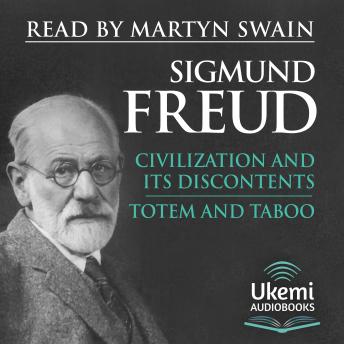
Sigmund Freud presents Civilization and Its Discontents, Totem and Taboo episode artwork

EPISODE · Jul 8, 2019 · 9H 19M

Sigmund Freud presents Civilization and Its Discontents, Totem and Taboo

from Access Best-Selling Digital Audiobooks for Your Library · host Sigmund Freud

Please visit https://thebookvoice.com/podcasts/1/audiobook/731466 to listen full audiobooks. Title: Civilization and Its Discontents, Totem and Taboo Author: Sigmund Freud Narrator: Martyn Swain Format: Unabridged Audiobook Length: 9 hours 19 minutes Release date: July 8, 2019 Ratings: Ratings of Book: 5 of Total 1 Genres: Mental Health & Psychology Publisher's Summary: Sigmund Freud (1856-1939) is remembered as the father of psychoanalysis. Civilization and Its Discontents (1930) is one of his key works. In it he considers the conflict between the needs of the individual acting both egotistically and altruistically in the pursuit of happiness and the myriad demands of civilised society and the ensuing tensions this clash of needs and demands generates. Consequently it remains a key text for anyone wishing to understand the breadth and depth of Freud's thinking on the human condition. His analysis of the modern human's situation, forced to repress and sublimate innate natural, sexual drives in order to satisfy society's seemingly endless requirements, and the conflicts and consequences for mental health inherent in this, make it as relevant today as when it was written. In Totem and Taboo (1913) Freud made what he called a first attempt at explaining problems of racial psychology and addressing neurotic symptoms as mental and emotional maladjustments to experience and environment. He hoped thereby to deepen the understanding of the mind by investigating its manifestations in primitive, noncivilised humans as documented by a range of writers and investigators in the scientific disciplines of sociology, anthropology and psychology. The work consists of four essays. This essential text is an ambitious undertaking because in it Freud seeks to unravel the mysteries of myth and religion by investigating the nature and qualities of sacrifice and the sacred, the primal myth and the parts these play in the generation of prohibitions, transgressions, guilt experience and expiation, as states and processes. Freud delves into the work of the great minds of his day, engaging with J. G. Frazer's The Golden Bough and Totemism and Exogamy, Reinach's Code du Totemisme, W. Wundt's Elements of the Psychology of Race and a host of others. He considers the nominalistic, sociological and psychological theories they postulated. This was the investigation that led him to conclude that 'the beginnings of religion, ethics, society and art meet in the Oedipus complex'. This work would accelerate the split with his longtime colleague C. J. Jung, partly as result of the states and processes he identifies in primitive religions, belief systems and thought processes which he traces from the earliest times through Greek tragedy and medieval Passion plays up to the 20th century. This led him to articulate the importance of the interplay of the individual psyche with the psyche of the mass, as well as to develop the notion of intergenerational psychic continuity and the linked processes of thinking, doing and inhibition. This would later be refined in Civilization and Its Discontents. Civilization and Its Discontents is translated by Joan Riviere. Totem and Taboo is translated by A. A. Brill.

Please visit https://thebookvoice.com/podcasts/1/audiobook/731466 to listen full audiobooks. Title: Civilization and Its Discontents, Totem and Taboo Author: Sigmund Freud Narrator: Martyn Swain Format: Unabridged Audiobook Length: 9 hours 19 minutes Release date: July 8, 2019 Ratings: Ratings of Book: 5 of Total 1 Genres: Mental Health & Psychology Publisher's Summary: Sigmund Freud (1856-1939) is remembered as the father of psychoanalysis. Civilization and Its Discontents (1930) is one of his key works. In it he considers the conflict between the needs of the individual acting both egotistically and altruistically in the pursuit of happiness and the myriad demands of civilised society and the ensuing tensions this clash of needs and demands generates. Consequently it remains a key text for anyone wishing to understand the breadth and depth of Freud's thinking on the human condition. His analysis of the modern human's situation, forced to repress and sublimate innate natural, sexual drives in order to satisfy society's seemingly endless requirements, and the conflicts and consequences for mental health inherent in this, make it as relevant today as when it was written. In Totem and Taboo (1913) Freud made what he called a first attempt at explaining problems of racial psychology and addressing neurotic symptoms as mental and emotional maladjustments to experience and environment. He hoped thereby to deepen the understanding of the mind by investigating its manifestations in primitive, noncivilised humans as documented by a range of writers and investigators in the scientific disciplines of sociology, anthropology and psychology. The work consists of four essays. This essential text is an ambitious undertaking because in it Freud seeks to unravel the mysteries of myth and religion by investigating the nature and qualities of sacrifice and the sacred, the primal myth and the parts these play in the generation of prohibitions, transgressions, guilt experience and expiation, as states and processes. Freud delves into the work of the great minds of his day, engaging with J. G. Frazer's The Golden Bough and Totemism and Exogamy, Reinach's Code du Totemisme, W. Wundt's Elements of the Psychology of Race and a host of others. He considers the nominalistic, sociological and psychological theories they postulated. This was the investigation that led him to conclude that 'the beginnings of religion, ethics, society and art meet in the Oedipus complex'. This work would accelerate the split with his longtime colleague C. J. Jung, partly as result of the states and processes he identifies in primitive religions, belief systems and thought processes which he traces from the earliest times through Greek tragedy and medieval Passion plays up to the 20th century. This led him to articulate the importance of the interplay of the individual psyche with the psyche of the mass, as well as to develop the notion of intergenerational psychic continuity and the linked processes of thinking, doing and inhibition. This would later be refined in Civilization and Its Discontents. Civilization and Its Discontents is translated by Joan Riviere. Totem and Taboo is translated by A. A. Brill.

NOW PLAYING

Sigmund Freud presents Civilization and Its Discontents, Totem and Taboo

0:00 9:19:00

No transcript for this episode yet

We transcribe on demand. Request one and we'll notify you when it's ready — usually under 10 minutes.

Eat to Live Jenna Fuhrman, Dr. Fuhrman Our health is our most precious gift and smart nutrition can change your life. Each month, join Dr. Fuhrman and his daughter, Jenna Fuhrman as they discuss important topics in the world of nutrition. Eat to Live will change the way you eat and think about food. French Your Way Jessica: Native French teacher founder of French Your Way Boost your French listening skills and test your comprehension with this one of a kind series of podcasts. Get the chance to listen to a real conversation between native speakers talking at normal speed AND customise your learning experience through carefully designed sets of questions (2 levels of difficulty) available for download at www.frenchvoicespodcast.com. All interviews also come with the transcript. French teacher Jessica interviews native speakers of French from around the world who share a bit of their life and passion. Where else would you meet in one same place a French yoga teacher based in Melbourne, a soap manufacturer from Provence, or a couple cycling around the world? That Hoarder: Overcome Compulsive Hoarding That Hoarder Hoarding disorder is stigmatised and people who hoard feel vast amounts of shame. This podcast began life as an audio diary, an anonymous outlet for somebody with this weird condition. That Hoarder speaks about her experiences living with compulsive hoarding, she interviews therapists, academics, researchers, children of hoarders, professional organisers and influencers, and she shares insight and tips for others with the problem. Listened to by people who hoard as well as those who love them and those who work with them, Overcome Compulsive Hoarding with That Hoarder aims to shatter the stigma, share the truth and speak openly and honestly to improve lives. The Small Business Startup School – Business Notes | Financial Literacy | Retail Psychology – For Professionals & Entrepreneurs The Small Business Startup School Inc. Starting or buying a small business? While personal circumstances may vary, business patterns remain timeless. On The Small Business Startup School, we explore strategies, insights, and practical solutions to help entrepreneurs confidently navigate their journey.Hosted by Ola Williams—a retail entrepreneur, fintech founder, and financial coach with over two decades of experience—this podcast marries financial awareness and retail psychology with optimism to deliver actionable takeaways.Join us to learn, grow, and connect as we uncover the keys to business success.Let’s continue to learn together and be encouraged to keep on connecting!

Frequently Asked Questions

How long is this episode of Access Best-Selling Digital Audiobooks for Your Library?

This episode is 9 hours and 19 minutes long.

When was this Access Best-Selling Digital Audiobooks for Your Library episode published?

This episode was published on July 8, 2019.

What is this episode about?

Please visit https://thebookvoice.com/podcasts/1/audiobook/731466 to listen full audiobooks. Title: Civilization and Its Discontents, Totem and Taboo Author: Sigmund Freud Narrator: Martyn Swain Format: Unabridged Audiobook Length: 9 hours...

Can I download this Access Best-Selling Digital Audiobooks for Your Library episode?

Yes, you can download this episode by clicking the download button on the episode player, or subscribe to the podcast in your preferred podcast app for automatic downloads.
URL copied to clipboard!