
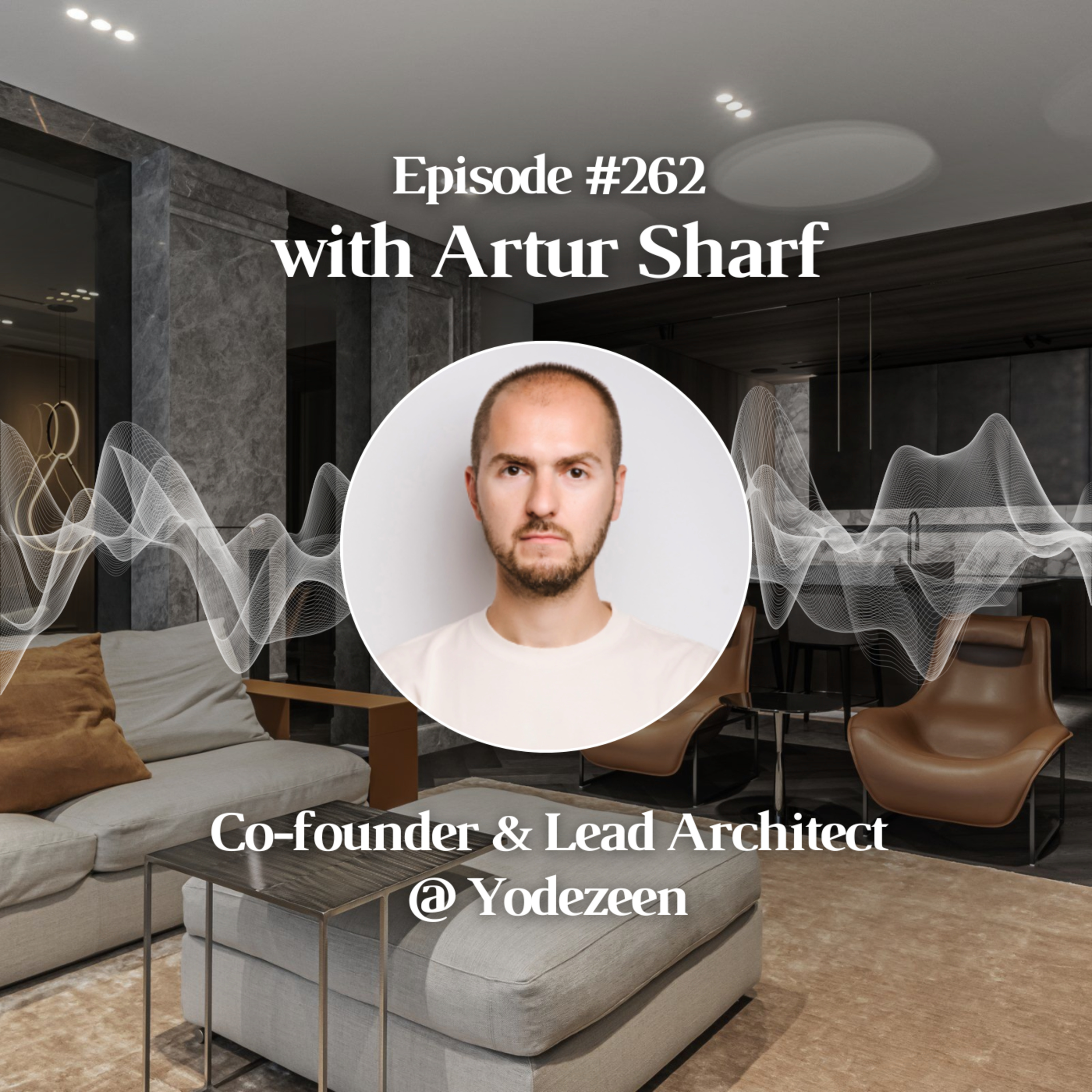
Ladies and gentlemen, welcome back to another SLD Meetup, your host, Avar Nune to bring you another successful and interesting guest in the luxury space. Today we have with us a co-founder of Jossy Dean. His name is Artur Sharf and he's going to tell us about how his architecture and interior design studio has been taking all over the world with some of the most incredible products. There he is.
What's going on, Artur? How are you doing? Very good, very good. Thank you for having me.
Absolutely, it's a pleasure. And let's start with the obvious, right? Like what's this story? What's that name coming from Jossy Dean?
The idea was, you know, like your design, design for you, design for your family, and it can be like an architectural design or a interior design. Like when we start this, we never want to have our name or surname because of the company and everything that we create is for the client. And we think we will have some architect and designer in our team. And I think it's the most cooler when you have a name.
What everybody can be inside of this name, and it's how we create the name, like to be a help for all clients, and to make the best design for them and to make nice home and a nice space. I love that. Now, what's the specific moment where you decided, huh, I want to shake out the architecture world? You know, it was like, when it was like, we was 20.
I think it was in the second course of university. And we started with interior design. And maybe like, first, maybe I think eight years, almost maybe seven years. We worked mostly with design because like nobody gave like a young voice like to make some architect projects.
And after this, we start to be like architects, projects to and last seven years already. And when we start first, we do it now, both projects and architect and design. And my favorite project, and we do both because we can make an inside and outside all materials and all idea come from outside to inside. I think it's the best for the architect design group.
No, I love that. And obviously now you've expanded worldwide. You have done projects in some of the most incredible cities. You have offices everywhere.
But what's the core, right? Like when we go back to what differentiates just sitting from any other studio, let's go about the design philosophy. Like, what's the soul behind just the designs. You know, like, I think the biggest challenge was to come from the small town from from Ukraine.
Yeah. And we work like a very hard. It was like 2019 2009 2010 approximately start. And it was like a crisis, like everything small, you know, like every start little by little.
And the biggest challenge was, you know, to come from the small town to like execute some project in Europe, some project. In the US, some project in the Middle East, it was like, it's the biggest challenge that we have. But we start to do this like a first time, maybe, I think 10 years ago. And little by little project project is start to grow.
But this was like a long way. It's like a not like one two years, like a 10 years away. And like a lot of flights, a lot of meetings, a lot of back and forth. It's like a very long way.
Only up, up and up a little belly. I think like the last like first role was like maybe seven years ago. And the biggest goal was I think three years ago. Like, well, that's like it's spent a lot.
That's interesting, right? Because is that saying of consistency compounds, a lot of people don't have the patience to stay for so many years without seeing that big growth. But then as you mentioned, it takes like those five, six, seven years of constant work to all this other boom, see the big results. But as we're talking about philosophy, I wanted to also go back into the values like when it comes to the type of emotions that you're trying to evoke on a client, is there anything in particular that you're trying to arise from the feelings of one of the people you work with?
You know, I think what is the goal and our success is because like we always try to be and to use like a natural materials and everything like very, every same maximum, every same maximum, like a real, no fake, you know, it's the first goal, what we, why we grew about is the philosophy. And the second one, I think we always try to make the best solution and to find the best result with all problems and situations you always have. I cannot do this, I cannot do that. It's not possible, it's not work, you know, and we try to push a lot and to make the best what we can with exactly this or that situation.
And I think it's what I can suggest for a lot of actually like a design in the world, they need to fight for the success. Right. Right. How do you maintain the balance between the forum, the art and the functionality, because that's one of the things that I always see studio struggle with.
You know, like, I think it was a base what we have like in the beginning, like from university, I think, you know, a lot of people say university don't give us nothing, but I think it's give us, you know, there's a main, the main like a proportion, the main like architectural like where you need to have like a living space, dining kitchen, how you need to connect with the garage, how you to connect with the main, how you to connect with the technical staff area, how you need to be kids, how guess bedroom work, all of this, it's like, it's like, it's like how you start this project. It's a good, it's a good plan. It's like a first success, like the best plan to fly out. The second one, it's about materials, how you connect materials is each other.
It's like a use, like when you have a corner, you always need to have like a one materials in the corner. You never do open corner with the different materials. You always try to make more architectural design and come to the line and reveals time to the reveals and everything connects with each other. Nothing like, I think our design more architect surely, we're not like a decorate decorator designer, you know, like some people make decoration design with some people's colors, we more about line connection, floor plan, doors, you know, more about this one.
It's why, and it's how we work, I think. It's interesting. And you know, I always have this question to any architect or your designer, anybody in the creative space, what do you find this creation for? The best inspiration you can find in new hotels and new new showroom for clothes, because like, like you can come for the best hotel, and they can afford the best design in the world.
And they're always one step up. You need to go for the best hotel, you need to go in a new showroom, I need for all a source, but open for the new clothes in the world. And you can see the details, you can see the ideas and of course, then you travel and everything is together. But I think it's the biggest inspiration.
If you want to know that what will be great today, what will be great tomorrow, just looking at what new construction do in the hotel and in the stores or the clothes. I like that. That's a good point. I mean, myself, when I'm traveling and I go to National Tails, I'm like, always inspiring, even though I don't design or build any homes.
Another inspiration, like for example, for us, it's not easy because we have a project in different countries, but for like, trying to give us out of inspiration to, for example, client in Miami, client in Austin, client in the Middle East, in Dubai, Saudi, they give some inputs, you know, and then you can use some idea for client from Dubai to Miami, from Miami to Dubai. All of the clients share interesting inputs. And then these inputs come to your mind and then mine start to generate some nice idea because you like have different project in different country and all of this is a mix together. And then it's giving you idea.
You know, because some architects, they start to work like a one style in one area. And yeah, maybe there can be the best in this side on this area. But if you want to be open book, if you want to be open mind, if you want to, like, like thinking something future generate more idea, you need to have like a lot of a lot of inputs for different country. And I think it's another, I will give our inspiration to us.
It's interesting that you're talking about your clients and the conversations you're having with them. When it comes to the creative side, when you're trying to put a project into reality, how much do you let the client guide versus you implementing what you think is right. We always sell this as a client and we try to implement a lot of ideas that he wants, but of course with our experience. Yes.
You mean you got to have that balance right at the end of the day. What are some of the biggest challenges would you say that you face when you're coming up with new projects. The biggest challenge I think is to, is to find the right solution, you know, like it's to check the two, it's to study is to study the land and the found the best solution for exactly this land and how how some car how car arrives, how entrance can be, you know, like all of this. It's very important.
And then when you figure out all of transitions and and like proportions and where all floor plan layouts can like works, then it's more easy to work with the colors and just concept. Are there any design rules that you like to break? You know, like how I say before, like we like to mix the style, like we don't have a particular style. If you come to the website and you check like what's what we do for the last couple of years.
We work in more modern, like a flat roof, we make like a more barn house to have like some more than barn house. What we do in like, I mean, coral gables area or in Ospon, or right now we do in the Tel Aviv in Israel, we do a big project is like a modern barn house. And then we and then we do more classic style to we have a project was a arch project was a travertine was, you know, like a more French style. And I think it's cool, you know, like, because like, yeah, you can have like a particular style and you can have work on this, but I like a mix.
And I think it's it's it's nice when you when you can mix and make some connection with a different styles of architect and design. Right. Well, tell me also about the evolution because right now we see technology at that. So quickly and then also maintaining the sustainability.
So how does that play a role in your project right now. You know, we use a lot of for me, for example, yeah, you know, the journey and AI for some reference pictures need to play with some facade details and colors. As I was, we have a sketch and then we need to have like a, you know, five, ten options of different colors and solutions. We can put our facade and then they play.
Okay, let's fix this to work with the materials, but we use we use a lot of creativity process of reference teachers process. And we use for for some, you know, like a, if you need the rules analysis, like a zoning analysis. And that's what I'm trying to help a lot. I think I think the technology is very important for architect and dear design company.
And it's a bit, it's a more who start as responsible. They will be more quicker and more better tomorrow. Yeah. Yeah, for sure.
So what what excites you the most with the future approach in an architecture and computer design world. Is there anything that excites you the most? We did a lot of single family houses, like some apartments right now. We did some restaurant.
We did a lot of some offices. We want to focus right now to make some resorts. We want to do like a smaller condo like a middle size from door. We want to do some like a big scale project, but very interesting to us.
And it's what we look at like a mixed use space when we can work with with like apartments, then condor, maybe hotels and restaurant and then retail space together. It's what we're looking for. But for sure. But for sure.
Like right now we have maybe 70% of our project is still residential, but we want to be like more bigger scale residential with a little bit commercial projects. Very good. I mean, I've seen your portfolio. It's impressive.
So congratulations. Well, I always ask all our guests about the definition of luxury. So what does that mean to you? I think actually for me, it's still minimalistic.
It's very natural. And when you can patch and feel, you know, like for me, the law says not luxury for me. Well, actually, it's like when you feel like a root or when you feel the soul when you can patch when you have some rough finish. When you, for example, if it's a brass, it's like some brass when you it's not straight when you can patch and feel the brass.
Like I like to see materials and I have to feel materials. I think this is a luxury for me. Really like that. That's a good answer.
All right, we're going to come in towards the end. We're going to ask you a couple of rapid questions. I want you to answer quick and see what's best in here. Favorite city for architecture.
Favorite city for architectural. It's very hard to question. It's going to be New York. It's going to be Paris.
It's going to be London. Like Madrid, very nice. Like Dubai. Yeah, like a lot of modern, how I will start to work right now in Bombay, India.
It's crazy. Like I can look a lot of city in the world amazing, you know, and you can have little touch for every single. You can study some of them. I love that.
Concrete or wood? Food? Ha ha. Minimalism or maximalism?
Minimalism. Dream location to design a home. Miami. Ah, there you go.
What's one design trend that should disappear forever? I think like how I say before, I think forever will be like natural materials forever. Natural materials forever. There you go.
Okay, so that's it. I just want to ask one last question, which is with all these years of experience with all the success that you've amassed. I'm sure you've also been through lots of different difficulties. So what is one of the biggest lessons that you've learned through this journey that you will share with somebody that is trying to level up in their business?
You know, like you need to work hard, like, and don't look at the time. Just make everything the best that you can and try to find the best solution. And everything happened. Like it's what I can say and just work, work, work.
And you know, like architect interior design, it's very hard to build first portfolio. But when you build this portfolio and when you start when you realize some project, it's a little bit easy, easy and easy later. And it's why I want to just give a suggestion to work a lot and everything will be the best. Well, thank you so much.
I appreciate you for everybody that is going to be watching this later. Please, Tounine, check what they're doing, amazing projects. And well, I look forward to seeing you very soon, my friend. Thank you.
Nice to see you and thank you for having me. Take care. Bye-bye. Bye-bye.
And thanks again for everybody tuning in today. We hope you enjoyed it. And remember, embrace it's beautiful success in life. My name is Alvaro and I'll see you next time.