At Desjardins Insurance, we know that your retail store requires insurance that matches your unique business needs. That's why we can help you save more when you secure your store with a centrally monitored alarm system. So you can spend less time managing expenses and more time expanding your business. Get insurance that matches your business. Request a quote today at Desjardins.com slash business dash insurance. Certain conditions apply.
Welcome to Scott Sigler Slices. I am Scott Sigler, a sci-fi, horror, and sports fiction author. On this cast, we do a few different things. Sometimes we have brand new fiction, written by me and read by me. Sometimes we talk about topics in the changing world of entertainment. Sometimes we geek out and talk about the books, movies, and TV shows that we love. And sometimes we explain interesting things in the world of sports ball. We don't talk about scores and standings as much as we talk about novel events, changes in technology that affect sports, and complicated stuff we sometimes take for granted, like...
What's the math behind how NFL schedules are set each year? Why do they wear weird hats at the Kentucky Derby? And did you know that bipedal autonomous robots run marathons faster than humans, and they're also going to kill us all? And sometimes, like this time, we have on guests to talk about the things that they do and make. We call each episode, we call each episode's topic a slice. As in, a slice of the NFL, a slice of story, or in this case, a slice of the writing world. With our guest, novelist Andrew Givler. We did have a small technical issue with this episode, so you may hear a slight change in audio quality. Let's get into it.
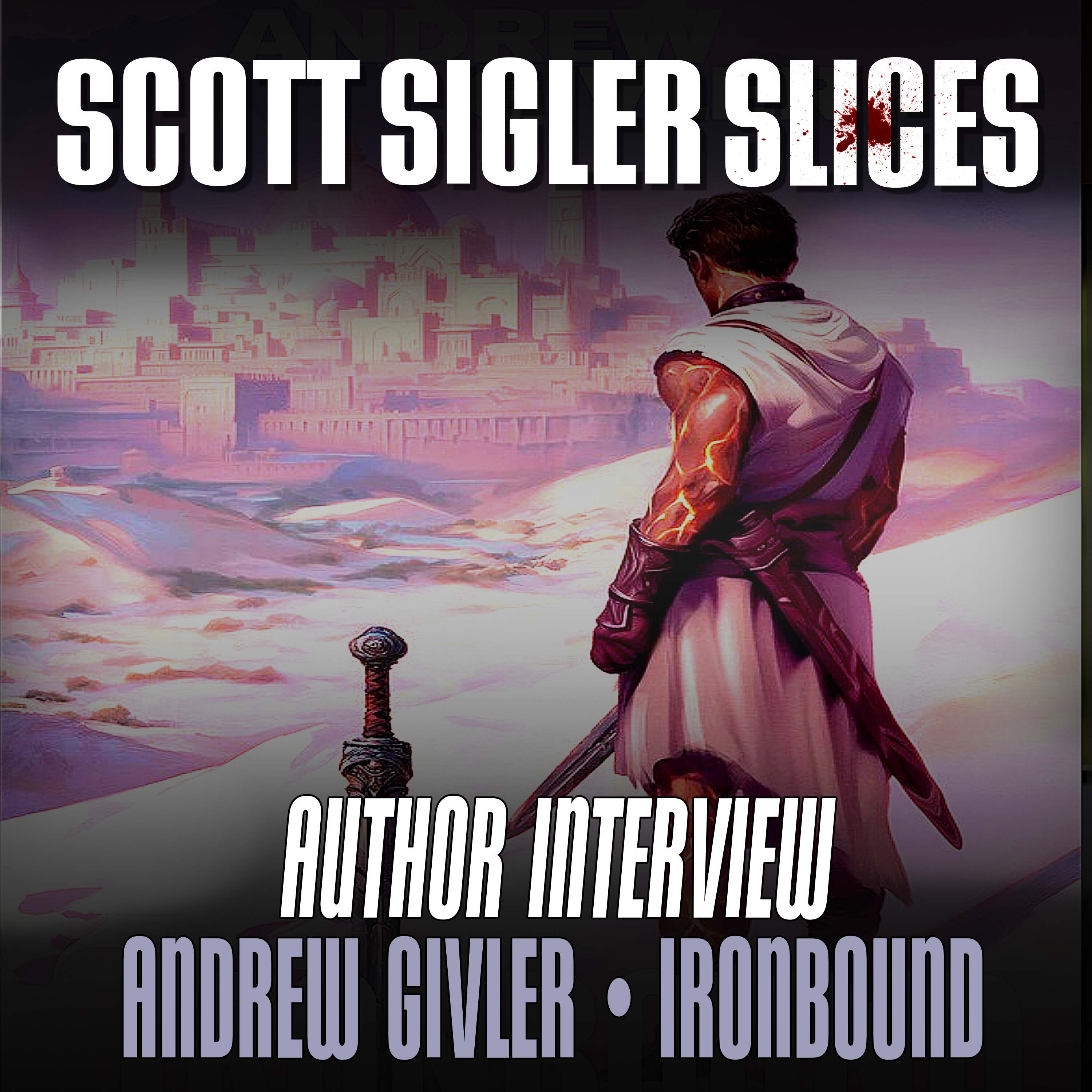
Let me introduce today's guest, y'all. Today's guest is Andrew Givler. He is the author of Ironbound, which I have recently read and really enjoyed. And I'm super pumped for book two, Cold Wind, which drops next week, which means this is a very timely interview for those of you watching live or shortly after the fact. Andrew is also the creator of the Sigils YouTube channel, which has over 1.5 million subscribers. So this is somebody who already knows how to entertain an audience before he ever published a novel. One of the reasons I want to have him on is because Ironbound feels very different from the fantasy genre that I normally read. And we're going to be talking about...
progression fantasy and lit RPG just a little bit. His story is far more immersive and character-driven. And so first off, Andrew, welcome to the show. Hey, thank you so much for having me. It's good to be here. Glad to have you on the show. Now, real quick, let's talk about just an introduction to your channel Sigils on YouTube. As we mentioned, 1.5 million viewers. Tell us about what that channel is. So that is a gaming channel that I've been running for about 12 years or something like that at this point. I play a lot of Minecraft. I play a lot of like Fortnite, a lot of things that are like very popular with the younger generation. I've been a big gamer my whole life. And so that's just been a huge part of it. I started doing it right after college, like as video games are sort of becoming more mainstream.
it just slowly took off and became a full-blown career. I've been doing it full-time for about almost 10 years now. Oh my gosh, that's great. Maybe like nine, I might be adding a year. It all kind of blurs together. It does. And so that's been the day job for a tremendously long amount of time. And did you ever expect a gaming channel to get this big?
I don't, I expected something, you know, I don't know exactly what it was. You know, I didn't have like a sort of prescient, like this is my future. But as YouTube was beginning and there was all that hype around it, I thought either it would be a resume into some sort of other creative profession or something like that. You know, like there was too much excitement around it. I couldn't have predicted, you know, people having tens of millions of followers, you know, like the place that it's gone. But I did think that it was an interesting and emerging space and it was cool to be a part of. So you've been doing this full time for, you know, you said almost a decade now.
When did you start writing a book specifically to publish this after you started the YouTube channel? No, it was it was before. Well, I always say that I sort of became a YouTuber on accident. I grew up my whole life being like a voracious reader. I wanted to be a writer. That was my childhood dream. I started writing. I wrote several books, but the soul fraud that my very first debut novel, I started writing when I was 25. So I was doing YouTube a little bit, but it was not a job. It wasn't anything. It was just two different interests of mine.
Um, and then YouTube sort of took off. I ended up moving to LA to work on content full-time and it sort of fell by the wayside. So I'd written, I think about two thirds of it, maybe even three quarters. Um, and then I just got busy and I was sort of like, I'll get to that. And then during the pandemic, I was like turning 30 and I was like, you know, why have I never written a book? You know, I wrote almost all the book that I actually liked. Uh, why didn't I finish it? That was like my childhood dream. So I sat down and I finished it. Um, and then I was like, okay, well now I gotta figure out how to publish it. And that, as you know, spirals once you start really diving. Totally. Totally. And, and so you.
you already had a significant audience. I don't know if it was 1.5 million when you self-published the first book. I think I just had a million. Just a million. Somewhere right around there. Yeah. Great, great. So that had to help give you a boost out of the gate, did it not? Like to have this large audience already in place, an advantage most self-published authors don't have. Yes and no. I mean, it had a whole lot of interesting, like if you're a nerd about how all of these kinds of audiences work like I am, it's really fascinating. The short answer is that like the Venn diagram of people who like to play video games and people who like to read is not as overlappy as you would think. Yep, okay.
And also, you know, there's a bunch of other things that go into like what really works well for indie publishers where like digital tends to be where indies really get discovered. But most of my viewers being not like heavy readers, but wanting to support me, they bought physical copies, which, you know, if you're not familiar, Amazon actually silos the different ladders. So a Kindle sale and a paper book sale contribute to different rankings of your books on the website. So instead of selling a lot of Kindles and getting into a thing where I could get a lot of exposure to people who are looking for more new urban fantasy, I sold a lot of paperbacks, which meant I was just competing with the heavyweight publishers, which I can't compare to that. So yes, yes and no. And it was a really, really interesting experience. And then when I wrote the second book, there was a huge part of the audience that was like, well, you did it again? We got one, bro, because we believe in you. And so there was a lot of funny, they don't always necessarily line up as much as you expect or things like that, but they were super supportive and they absolutely have helped.
open the doors and begin the process for sure. That's great. That's great. And so that's an advantage a lot of people don't have. I did free podcasts of my books before I got published. So when one finally got published, a book called Ancestor, I sold more than people would have expected me. Now, not to date my, to make myself sound old, but this is before eBooks were even in the Amazon store. So a damn long time ago. Yeah. Having that existing audience definitely gives you a leg up. We'll talk about Ironbound here in a second, but before we do.
we're going to discuss the concept of the progression fantasy genre. Okay. A lot of people in my audience already know this because of Dungeon Crawler Carl, which it's obviously absolutely exploded. And Ironbound, sort of in the same camp, but it feels different from DCC. So I'm very new to the genre myself. I've read Dungeon Crawler Carl. I've got to start the latest book soon. Brand of the Blood Air by Jamie Castle and CJ Aaron and Ironbound. And that is the extent of my reading in that area. So progression fantasy is a sub-genre of lit RPG. Other way around. It's the other way around. Okay. Yes. I would say, and again, these are...
Like all genres, no one agrees, truly, right? But generally speaking, I would say that pretty much all lit RPGs are progression fantasies, but not all progression fantasies are lit RPGs. Got it. Okay. Okay. That helps a little bit. So for the benefit of those who have no idea what all this stuff is, can you define the two for us?
Sure. And again, these are sort of loose definitions and they're not fully agreed upon by anybody, right? But essentially, progression fantasy at its core is a story that has usually a hard magic system to some degree. I don't actually feel like Iron Bounds is that hard, but it's harder than Sun, right? So like it has magic with clearly defined rules where when you achieve something, you can then do something. And then the story revolves around the character needing to acquire more power for some reason. And so it basically gives you these real big like mini goals of like, he's not strong enough to do this, but if he can improve himself to that thing, he'll be able to do this, which will then allow him to do whatever.
Lit RPG takes that idea and then usually has like an even more video game aspect applied to it. So that can be an isekai where you're pulled into a video game or a dungeon crawler Carl where you are in sort of like a, you know, game that has been attached on top of the world or you're in a world for some reason that has menu systems or something. Usually the like mostly accepted rule is like once you start having numbers and stats screens, it's lit RPG and before that's progression fantasy. Okay. That's where it gets fuzzy.
Now, when I first got, when I was first exposed to lit RPG, Progressive Fantasy, it's Dungeon Crawler Carl. And I had not read He Hunts Monsters or anything like that. And I was like, I heard about it. I'm like, what do you mean they actually have stats? Actually, I got to correct myself. I don't remember the series, but I started reading a series that was very popular on Amazon. I'll try this. And the characters were doing stuff. And at one point, a character like froze in place while the other characters were operating around them. And then when that character unfroze later, they had new powers. And I was like, is this a fucking video game? This is crazy. And you mentioned earlier about the growth of video games and how that fueled your YouTube career. It seems to me.
that as more people grown up with video games, progressing up levels and doing all the bosses to the final boss, that is what has driven its way into actual print paper. Would you say that's a pretty good grip on it? Yeah, I think that there's just more people in the populace willing to accept the conceit. A lot of it comes from anime and a lot of Eastern storytelling, right? Isekai is a very common type of anime where somebody literally gets sucked into a video game and then they have to play by that world's rules. And so in a lot of ways, lit RPG and progression is a merging of Western fantasy telling with a lot of Eastern storytelling ideas and putting them together. So it's sort of an emerging fusion genre in some regards along those lines. But I also think to your point that you're correct that it's also, there's just more people who are of age to read who are fine with video games as a concept. One of my friends, James Hunter, who writes a bunch of very successful lit RPGs, he told me one of the reasons...
he loves to read it is he was a huge D&D guy growing up, but now he's a father. He's a business owner. He doesn't have time to do in-depth campaigns, but he loves reading a story about somebody going on that sort of like perfect D&D adventure. It gives him like the same sort of like feeling, but in a manageable amount of time. Yeah. So a couple of questions in the chat room about Dungeons and Dragons. So they're echoing the same thing that you have said.
I'm pretty used to having read all of the D&D books when I was a kid, when they started to come out with the Dragonlance, etc. But this is different because you're actually seeing stats, stat sheets. You're seeing people actually level up, literally level up within the text of the book itself, not kind of conceptually leveling up like we see in Ironbound. So that's always been a, that's kind of the different twist. Do you have any idea when LitRPG started?
I do, but I'm going to get it wrong. But I think it's been within like the last like 15-ish years. And it, you know, it started like on the internet, it started in very like serial writing spaces. A lot of people just really, you know, writing their weekly chapters, going to a lot of like, you know, almost like fan fiction type origin stories, right? People being like, this is a cool concept. Nobody's doing it. I'm going to try it out.
And so it's, I know it started, some of the early guys were Russian as well. And that like is a little bit before my time. So like, I don't know all the deep, dark knowledge, but that's what I've been told is like within the last 15 to 20 years. Yeah, it's relatively new. And now it's finally forcing its way into bookstores and becoming its own whole categories, bringing a lot of people into reading books. So that's always a good thing. All right, so.
we've given people a basic primer on that. Now we've got to get to the good stuff. The reason that we are here, we are going to talk about Ironbound. So can you give us the elevator pitch for Ironbound? Sure. Ironbound is a Roman Empire-inspired progression fantasy. And it is set in a world where magic is limited. The way that you gain access to magic is through bonding with a metal that falls from the sky, from like space, that's very quicksilvery in nature, that fuses with your body in a parasitic relationship and gives you access to magic. This means you're not born with it, you have to earn it. And so...
one of the main paths to like social status, power and things like that in the nation is, you know, proving your worth to be one of the people worth having this thing. And then once you do, you get sort of an elemental magic, although it can really be anything can be an element for the most part. And this is a story about a boy who's coming of age, who's going through his trial where he's trying to earn his core heart, as they are called, and things go wrong. And then there, you know, there's a betrayal, there's intrigue and that kind of thing. And he gets put on a path needing revenge. You know, his life choices sort of get taken away from him. And he learns a lot about how bureaucracy and corruption work.
And people looking at that, looking at the cover, and they're Googling it online now, they're like, ooh, Roman influence. It's very cool. Was Roman history itself the inspiration? Did you draw inspiration from somewhere else to kind of get the gist of the series? I mean, yeah, Roman inspiration is definitely a huge part. You know, there was the internet meme that was going around a few years ago that was like women asking their boyfriends how often they thought about the Roman Empire and all of that. And every man was like, every day. I was writing Ironbound while that happened. And one of my good friends texted me and she was like, how often do you think about the Roman Empire? And I was like, um...
Constantly? I don't, you know, she was like, I don't believe you. And then she read Iron Bastards. Okay, maybe I believe you. But it, you know, Gladiator came out at a very formative age for me. I spent a lot of time as a child reading Greek and Latin literature, learning Greek and Latin. I'm very steeped in that sort of tradition in that regard. And then also I've read a lot of really cool fantasy that merged the two together. Jim Butcher's Codex Alera came out when I was about 14 or 15. And the story I always tell is that, you know, I went to my local public library religiously. Like every week I was there, I had a stack of books. They took it. I would, you know, leave with another stack of books. And one day I came in and the head librarian pulled.
me aside and she said, Hey, this book just came out. It's from a really popular author, but this series is more in line with what I think you'd like to read. I reserved it for you. Here you go. And it was Furies of Calderon, which is a very like Roman empire fantasy. You know, I read it and I was like, this is awesome. I didn't know you were allowed to do this. And so I've always wanted to play with those kinds of things. And this is sort of my, my version of that now. And you, was this always been an idea that's been percolating in your head or like, okay, I've done a series now.
I want to get into progression fantasy is a hot thing. It's cool. I like it. I want to get into that. And then you like went back into your past and said, Oh, what if I do this? Was it always percolating or did you come up with it specifically for this format? It, a bunch of the puzzle pieces were always there. Um, but kind of like to your point, yeah, I knew that progression fantasy is a very good spot for indies right now. My first series is urban fantasy, not a good spot for indies as I have learned. Um, and so, you know, a lot of advice that I was getting from other indie authors and things is like, if you want to, uh, you know, get people to check you out, people, people are looking for is more in the genre. I'd read a bunch. I liked it.
And so the puzzle pieces sort of slowly started to fit together. I had tried to write a Roman Empire fantasy novel when I was like in high school. It was really bad. But it had a couple of these vibes that I reused. But yeah, it was sort of like, okay, if I would write a progression fantasy, what are the things I like about progression? And I took those pieces and then I took like, you know, a lot of progression fantasy is written where it's like people who are really, really big fans of anime. I enjoy anime, but I am not like deep.
deep into it. So I was like, well, what's what's like a culture that I could attach it to that I am knowledgeable about that I could do? And I was like, well, I know lots about Roman Empire. And so, you know, it was it was piecing all those pieces together. And that's kind of like how it came. So yes and no. And it follows some sort of traditional formats. This is it's the classic hero's journey is definitely reflected in this. And being a small town kid myself, I did like the aspect of this is a the hero is a small town kid thrown into big world problems.
And, you know, they become a leader along the way. And that part of the arc is done extremely well, in my opinion. It really was really cool. So there's a lot of things that will feel very familiar to people. You know, the hero's journey echoes the small, small town kid gradually percolating up and becoming stronger, becoming more influential. Was that in your mind when you saw this? Was it the magic progression, the magic system, progression fantasy first? Or did you start out with a character and be like, no, this is more like, this feels more like these things I've read. I'm now going to adapt it to this current hot format.
It was a little bit of both. I come from like the things that I read are much more like trad fantasy oriented. That's like, you know, where my roots are. Those are the kinds of stories I know and I love. And then there are a lot of elements of lit RPG and progression that I find fascinating, but almost as like literary devices. Like I almost see lit RPG and progression as we're treating that as a genre, but they're also kind of literary devices because you could make a lit RPG romantic. You could make a lit RPG anything, right? Because it's just about like the system and the tools used to tell the story. And so I did, I wanted to try something a little bit different.
than what the genre was doing at the moment. So I was deliberately kind of mixing in the things that I love from high fantasy, but then giving it like the high octane and the sense of structure that the progression fantasy and things bring into it. But I'm also very much a discovery writer. So I had, you know, I had sort of a beginning point and I had the kind of vibe and the kind of story that I wanted to tell. But a lot of the decisions and the way that they pieced together surprised me as we went.
Progression fantasy fits very well into the discovery model. Or as we've talked about in prior episodes here, there's the architect who starts out with a blueprint and knows exactly how the building will finish. Then there's the gardener who plants a seed and follows the lines wherever they go, like George R. R. Martin, for example. So you're more discovery gardener with this series? Yeah, I usually, I have like a direction that I think I'm going. You know, I kind of think of them as like mile markers, but I'll get to a fork in the road and I'll be like, I know that eventually I want to be east. And which of these roads do I think will give me the most interesting journey to get east? And then I'll take it. And then sometimes I'm wrong, right? You don't have to be willing to kind of throw things away. And sometimes I find out that the journey I'm on is...
better than the one I thought I had. So Ironbound, especially, a bunch of things happened that surprised me, but ultimately I ended up liking better than my original idea. So I kept them and the series idea mutated as it went. Speaking of surprises, you finish that first book as you're going through it. When it finally comes out, was there anything about the audience reaction to the book that surprised you? Yeah, I mean...
I liked it, right? So I'm, I don't know if I would say I'm surprised people liked it, but I was concerned that I was doing some things different than the genre. And so I was just hopeful that people would read it and not feel like I wasn't endemic, you know? Like, oh, this is just some guy coming in here and taking our thing and doing something different. I was hopeful that I was being faithful to the idea of it without, while giving it my own twist. But for the most part, I think people have really enjoyed it. I think perhaps the most polarizing thing is progression fantasy actually really has a high expectation of like, almost like romance, where like the good guy always wins. And Ironbound is not that kind of story.
And so I would say that maybe it's the most common, like negative, one of the most common negative feedbacks is people who are like, This guy just, it's like, I'm miserable reading this. Like, that's not what I want progression. I want to watch somebody become strong and protect themselves. And you know, like there's a power fantasy element of it. And my main character is getting stronger, but he is not having a good time on that journey. Not at all. And when you, that kind of the grueling journey to overcome obstacles and grow better and the Roman influence. Anybody who's a fan of Red Rising would be a fan of this book. I think they're kind of two halves of the same, two sides of the same coin in some regards. Are you a fan of that series by chance? Oh, absolutely. I mean, you know, and Will of the Many as well. To me, you know, like.
Jim Butcher's, to me, like the foundational of this is like Jim Butcher's Codex Alera and Will White's Cradle. Like those are like the two pieces that put together. They're both written in third person though. And I am a first person writer. That's my preference. I like to read it more, you know, because I like the limiting of the narrator in that. And so I always knew I was going to write the story in first person. I started writing it in first person past, but I thought, you know, Red Rising and Will the Many both do such a good job. First person present makes everything so like active in the action. And I thought for progression fantasy where...
It's really about the power. It gives you like a really unique tool to show off the power, which is not very common in the genre at the moment. Most of the genre is third person. Occasionally it's first person pass. So I felt like it was something different. I was kind of putting a whole bunch of ingredients into the smoothie to see what would happen. And I tried a couple chapters first person pass. I tried a couple chapters first person present. I went, oh, we're doing this. We're staying first person present. And it became really, really addicting. But yes, Red Rising and Willamette are both phenomenal series. I enjoy them a lot.
Getting into the different persons is I'm almost always third person past. And I did one series called The Generation Strology, which was a first person present. And man, it was really weird for me to get used to it. But once I did, it was pretty fun. We did a question from the chat room. And if you guys listen to this podcast, remember we do this live every Wednesday, 6 p.m. Pacific, 9 p.m. Eastern. You can join us in the chat room at youtube.com slash scottsickler, twitch.tv slash scottsickler, and facebook.com slash scottsickler. Sean Dyer says, so Andrew said he's not big into anime, but I gotta know if he's seen or read Berserk.
I am familiar with it. I have not seen or read it. My list of anime is very short. And so I've seen My Hero Academia, Promise Neverland, and there's one other one. But it's very short. And I've enjoyed all of them. It's just never been my primary medium.
In the chat room, we have Brendan who says, I can only say that the grueling element makes it just that much more rewarding when Caster does get a breakthrough moment. I have to agree with that 100%. Because this book, Ironbound, you know this dude's on the cover of the book for a reason. You know he's going to be there at the end, like the whole long Jim Butcher series. You know Harry's going to make it. But the ordeals you put them through make it very satisfying when they finally do persevere. And that, of course, is something that you structured into the story, I imagine. Yeah, well, it's funny you mentioned Dresden. I'm a huge fan of Jim and his work, but one of the things I love about him is that like...
he really excels at characters are having like the worst day imaginable and then it gets worse. Right? Like problem solving is never linear, which a lot of progression fantasy does. And that's like that like sticking point I was talking about. But for me, like the solution is never just, oh, if I hit it harder, now we have succeeded. So I tried to make Ironbound always be like, okay, I want to take a left turn. Oh, there's a wall. All right. So you have to like figure out not just like, can I overcome this physically, but can I subvert it, get around it, you know, catch it off guard. And what happens when you're, when you have no good options? How do you, how do you live? Like, what does a hero look like who can't make good choices because there are none in front of him?
Yep, it doesn't have a lot of options. And that's something I try to get into in my work as well. And maybe that's why I'm, you know, set up well as soon as I read your book. I'm like, this feels very much at home to me. And all the stuff I like was pretty much present right in that book. But that brings us to lessons learned from Ironbound that led into Cold Wind. What do you got for us? Lessons learned from Ironbound that led into Cold Wind. You know, it's funny. I don't know if you've experienced this. I think book twos are maybe the hardest to write, period. Because, and this may also be a symptom of being a discovery writer.
because book one is a lot of like vibe and promise and questions. And then book two, you have to make it real. You have to zoom out, you have to show more and you have to advance all of the like fun little, it's really easy to ask questions, right? Oh man, what happened if he'd be betrayed and he was powerful and he had all this stuff, wouldn't that be cool? And then book two is like, and then what? And so book two was really fun because this is the first time this has happened to me. Originally Ironbound was going to be a trilogy. It is now going to be a quartet. And that is because in Cold Wind,
I don't outline, but I generally write like a little blurb of like, this is what I think is going to happen in the book. It's like three paragraphs, which I guess is a three act structure, but I really, it's not how I think about it. It's just sort of like, these are the three big things I think is going to happen. And I'm usually right about two of them. The third one, I'm usually wrong. I got halfway through that in cold wind and went.
oh, it's longer than Ironbound. And I think I just wrote a whole book. And so I had to go to Athan and say, hey, could I have one more book? Because I really like this book. I just didn't get to where I thought I was going in this book. I had too much to do. And they were very gracious and said yes. And so that's great. But it was, I really, I think the, you know, Ironbound has sort of a breakneck pace and Coleman does too. And so that made me overestimate. I was like, well, we'll get all the way there. And then it was like, no, we won't actually. Like you need a minute. You need to slow down a little and live and do some stuff. And so I think that was a really big lesson of just about like.
There is a limit to how fast you can go. Definitely. Well, we're going to take a quick break for a possible sponsor, insert, or it'll just be a sound for you listening on the podcast. We'll be right back to talk about Cold Wind after this. At Desjardins Insurance, we know that your real estate business requires coverage that matches your unique needs. That's why we can help you save more when you insure multiple buildings under one policy, so you can spend less time managing insurance and more time with your clients. Get insurance that matches your business. Request a quote today at Desjardins.com slash business dash insurance. Certain conditions apply.
Hi, this is Rob Benedict. And I am Richard Spate. We were both on a little show you might know called Supernatural. It had a pretty good run. 15 seasons, 327 episodes. And though we have seen, of course, every episode many times, we figured, hey, now that we're wrapped, let's watch it all again. And we can't do that alone. So we're inviting the cast and crew that made the show along for the ride. We've got writers, producers, composers, directors, and we'll of course have some actors on as well, including some certain guys that played some certain pretty iconic brothers. It was kind of a little bit of a left field.
choice in the best way possible. The note from Kripke was, he's great, we love him, but we're looking for like a really intelligent Duchovny type. With 15 seasons to explore, it's going to be the road trip of several lifetimes. So please join us and subscribe to Supernatural then and now. Welcome back to Scott Sigler Slices. This episode, we are interviewing guest Andrew Gibler, the author of Ironbound and the author of Cold Wind. Before we jump into non-spoiler issues in Cold Wind, because I don't want any damn spoilers, people who listen to me and listen to all my audiobooks, read all my books, you mentioned that you meant this series as a trilogy and now it winds up being a quartet for now. Let you know like that is people are very used to that. I have a series called the Galactic Football League, which was supposed to be five books and it will be nine before it's done. Oh, man.
And my urban fantasy story, Slay, was supposed to be five. We've already split book three into two books. And all you listening home, I'll have an announcement about that very soon. So everybody's very used to that. So I think my fans would also dig running the gamut, running gambling in your series that maybe it won't be four books. Maybe it will wind up being more. Frankly, I hope it will wind up being more. But let's talk about book two. It's out May 19th, 2026, if you're listening to this. And I'm excited for it. What can readers of Ironbound expect from Cold Wind?
It's a different world. Not world, sorry, but it's a different story. I will say, oh man, one of the reasons that Ironbound does as much as it did is I didn't want people to think that that was the only facet of the main character, right? Without giving any spoilers, but if you've read it, the things that he goes through, those are not the only thing that he's going to have to do. because that would be a different kind of story. And so this is him being pulled into a new arena with new types of enemies, zooming out to see the world on a bigger scale, upping the stakes, and giving you a little bit more hint of what's going on behind the curtain, while also getting stronger and unlocking more of the mysteries around his power and what he's trying to accomplish. All those small things at once. Yeah, I'm pretty excited for it. My experience with Ironbound was once things get rolling and you understand the...
You understand the difficulty this character has in having to keep a very, very big secret away from everybody. And the secret is the power. But if the secret gets out, he will be in a lot of trouble with a lot of people. And I'm excited to see where that goes with Cold Wind. The Cold Wind cover is awesome. You guys, if you listen to the podcast, just Google Andrew Givler Cold Wind. It's really cool. And is book cover one? No, never mind. Never mind. I was confusing myself for something that might happen in the future. Okay. And finally, as we close up on this, what lessons from Ironbound changed the way you wrote in Cold Wind, if any?
That's a great question. I think some of it was getting comfortable with first-person presence. Like, this is like super... insider baseball, but just your little words to make sure that things feel active, right? I think I felt like I got more comfortable with it. I got better at letting things flow without getting in my own head about saying, this is happening. It is happening, I promise. And things like that. I think I got technically a lot better, a lot more comfortable with the style. The other thing I think is because he's in a different situation, I get to let the side characters breathe a little bit more. They get to be a little bit more individual, a little more nuanced, a little more varied, which was a lot of fun. Ironbound had some sort of limitations about the things that he goes through where the kinds of characters that were present were sort of
similar in a lot of ways. And so this one was a chance where I got to explore more variety. And I was excited for that. But that's also a challenge, right? Because you have to start thinking bigger and different. And so putting myself in the heads of all these different characters that have much more varied goals now.
took a little extra work. The relationship between the secondary characters between themselves and the secondary and the primary character, another thing that you did, did really well. Those are things that changed, for me as a reader, those interactions changed the stakes of the game, brought in some stuff that you really don't expect was going to happen. And it was emotionally cringey at times. Not the bad cringey, like, oh, no. Oh, my gosh. I can't believe this is happening to these people now with all this other stuff going on. Now they've got this. And none of it felt contrived. None of it felt forced. It wasn't like, sometimes I read a book and an issue will pop up with a secondary character. I'm like, oh, come on, dude. I can see you're trying to do this.
It was very smooth. It was basically flawless, all of those elements that were going in there. So you've talked a little bit about the writers that have influenced you in the genre. Give me a couple of progression fantasy books that you think people should check out if they're just not familiar with the genre. If you're looking at progression fantasy, the king, the introduction to the genre that was my introduction to the genre is Will White's Cradle, which was an indie absolute runaway freight train. It's phenomenal. It is, I think there's 13 books, but it is completed. And it is really, really, really, really well done. One of my other big favorites is Bryce O'Connor's Iron Prince, which has a little bit of a sci-fi bent to it, but it's also super phenomenal. Really shows you a lot of the power of the genre, what you can do with really fun systems and magic and structure to just make it really addicting and engaging. Otherwise, I would say Phil Tucker's Bastion is another.
a really fun exploration. All of them are moving to different paces and things like that to give you sort of a wide variety. We did have a question from the chat. Brendan says, question for Andrew. When, if ever, does Valentina get a role again in Ironbound? That was always a major question I had. I can't answer that question. I assumed as much, but having done this for a lot of years, I'm like, oh, we'll definitely be seeing that person come back again. So let's now talk about what are you reading right now?
I just finished Jim Butcher's Outlaw, the novella that dropped for Dresden Files. And then I cracked open immediately Dungeon Crawler Carl 8, but I'm only a few pages in. Okay. So no thoughts yet. I'm just excited to get into it because Matt is always a fun time. Now you read those in print or you listen to the audiobooks? I read them in print.
I am a distracted listener. I really, I love audiobooks, but I can only do them if I have like a commute or something that's occupying my hands. Otherwise, I end up just, all of a sudden, I'm like, I haven't been listening for an hour. So yeah, I do read, well, I read on my Kindle usually, but yeah, I prefer reading over listening. I may have to go back and read at least book one. I do almost all audiobooks. I have a very difficult time getting through a print or an e-book these days, but Jeff Long's performances in the audiobook are extraordinary. It's just, I think the combination with two is- Oh, incredible. Absolutely incredible. So I'm not going to lie. I don't know how-
how gripping it would be to me in print, but I haven't tried it in print, so I might not know what the hell I am talking about. But yes, I'm very excited to get into that one as well. All right, you're doing book eight. And anything else you would like to tell people about either your first series or about Ironbound Cold Wind and what is coming up next? Yeah, let's see.
My other series is an urban fantasy series that's really funny that we both also have urban fantasy in the backlog, right? I think it's like a rite of passage. You have to. It's an urban fantasy series about a guy who is like a normal, just regular guy. He's kind of a loser. And on his 25th birthday, a demon appears and offers him a perfect life for 10 years in exchange for his soul.
And the main character is like, hey man, my life sucks, but I've seen that TV show. I'm good. Even I know better. And the demon has a little bit of a breakdown. He's a really poor salesman. He's behind on his quota. He's under a lot of pressure. And he forges the main character's signature on the contract and then scurries off into the night. And the first book is called Soul Fraud, and that sets him on a course where he has to figure out how to get his soul back before time runs out. And as he goes, he makes a lot of friends and enemies and has other sort of things that he's uncovering and dealing with as he goes. So the fifth book for that just came out in February, which was called Sleep Debt. And then, yes, Coleman comes out next week. And then I am currently writing book six of the urban fantasy series, which is called Present Day.
And book three of Ironbound, which is Bloody Sands, will be coming out in November. And that is written and in editing. And then at some point, I need to write the fourth Ironbound later this year. We'll have it hopefully coming out sometime in 2027. And the Soul Fraud series sounds a little bit along the lines of Richard Cadry's Sandman Slim series. Have you read that one? I have not read Sandman Slim, but I know I need to. It is high on my list. It is a little irreverent, but it's like high stakes, but comedy at the same point. Sort of how everything in Ironbound, when it goes wrong, it goes wrong in the worst way possible.
In the debt collection, when it goes wrong, it goes wrong in the dumbest way possible. So if he's trying to figure out how to get his soul back, there's one point where he tries to do a little summoning to get to hell, and he gets like, your call is important to us. The magic operates in the dumbest way possible, but the stakes are very real. Urban fantasy really lends itself to that irreverent humor. My Slay series is very similar, except most of that humor is very dirty, but you won't find that in some of my other work, that kind of humor. Pancakes asks, if Andrew has time for another question, how do you differentiate the change to Caster's personality?
from his symbols versus the change to his personality from his own experiences. And remember, most people listening to this haven't read book one, so you gotta answer that as best you can about spoilers. Yeah, yeah, yeah. I'll do that as vaguely as possible. I would say that it's hard to do, but that usually the extremities would be, you know, everything that he's doing is not out of character, it's just more. It exaggerates things. Cool, cool. All right, so we're gonna finish up here and thank you so much for being on the show. Thank you for having me. I hope everybody listening to this picks up Ironbound. It's probably my top 10 books this year for sure. I really loved it. Very excited for Cold Wind.
That might sneak out of Dungeon Car or Carl 8. I'm not sure. So there's high praise for you right there. Did you do the audiobook for that as well? Oh, yeah. I did the audiobook for Iron Bound, and it's really, really, really well done. Ralph Lister is a legend. Yeah, he's fantastic. They were like, hey, we want to get this guy. And I was like, oh, I haven't heard of him. He's like, well, he reads Shogun and Malazan. I was like, cool. That's really all I need to know. That's why I've heard him. I listen to Shogun, and I'm like, I know I've heard this guy do something before. Okay, so where can people find out more about you? What should they follow? What are your social media handles? Just tell them where to get you.
Absolutely. So for the gaming YouTube, it is Sigils, S-I-G-I-L-S. That is also my handle on Instagram. Unhelpfully, my handle on TikTok is Giv Reads, like my last name, G-I-V-R-E-A-D-S. Otherwise, you can go to andrewgivler.com. You can find all of my books. You can sign up for my newsletter. And all my books are available on Amazon or wherever books are sold, Audible, et cetera. Awesome. Thank you for being on the show, bud. Nice to meet you. Thank you so much for having me. I really appreciate it. It was a great time. That was great. Can't send any more praise about the book. The book, I actually was turned on this book from Athan, the publisher of Ironbound. And they are also the publisher of the Crypt series.
I was saying, hey, I've got a gap in my reading. I don't have anything to listen to right now. I mean, anything lined up. And asked the editors over at Athan what I should listen to. They gave me one. I listened to a chapter. I'm like, that's not really my jam. And then they said, well, based on what you've told us, we think you love this one. And they were 100% right. All right, guys, I think that is going to be it for us for this week. We'll be back next week. And again, next episode is probably going to be news about two things in the world of books, my books in particular. So we're going to try and get clearance to cover those two things for you next week. If we get...
clearance on both of those all of next week's episode as we talk about Scott's books and all the cool stuff that is that is coming up. But that is it for us. I will talk to you all next week. A will be back on with me next week. And until then, you all smell an awful lot like flowers. You've got your favorite blanket, a freshly poured drink and a cold case burning a hole in your streaming queue. You're not just watching true crime. You're running the investigation from the comfort of your couch. Welcome to Murder, She Watched, the podcast where we recap, dissect and slightly overanalyze some of the best and craziest.
True crime documentaries on our favorite streamers. Did the spouse do it? Why is the shady neighbor wearing leather gloves in July? Why did this guy agree to be interviewed in this documentary? We ask the tough questions that you're often just screaming at your TV. So every week we break down the twists, red herrings, and absurd documentaries that have kept you up all night. It's high drama, cozy vibes, and absolute couch detective energy. Grab your throw blanket and hit subscribe. Search Murder She Watched wherever you listen to podcasts, and let's solve this thing together.
Do you ever watch a TV show set in a historical time period and think, how accurate is this really? But also, does it matter if it's accurate or not? NeverTV is a new podcast about shows set in ancient times. This season, we're recapping every episode of the show Spartacus, Blood and Sand. I'm Anne Foster, and I have never seen this show before. And I'm Gina Berry, and I've watched this show maybe too many times. Join us every other Monday on the NeverTV podcast as we discuss the real history behind Spartacus, Blood and Sand. Follow NeverTV, that's N-E-F-E-R-T-V, wherever you get your podcasts.
Hi, I'm Whitney. And I'm Katie. And we're the hosts of True Crime Campfire. We set out to make a true crime podcast we'd want to listen to. We get right to the story. We don't do a lot of extra talking, and when we do, it's usually to roast the short hairs off of some loser, murderer, or scammer. You'll laugh, but only at the people who deserve it. Like, which serial killer would you most like to shove into a locker? BTK and his awful poetry. Dude got caught because he didn't understand what a floppy disk was. We look for the stranger-than-fiction stories, like the case of Patty James, a killer catfish before the internet was even a thing.
Or Howard Walmsley, a sentient wad of damp laundry who convinced his town he'd won the lottery, fleeced local businesses out of thousands, and then became a romance scammer. We've covered tons of cases you've never heard of. Cults, scammers, killers. So come find your next great binge. Listen to True Crime Campfire on Apple Podcasts, Spotify, or wherever you get your podcasts. New episodes every Friday.