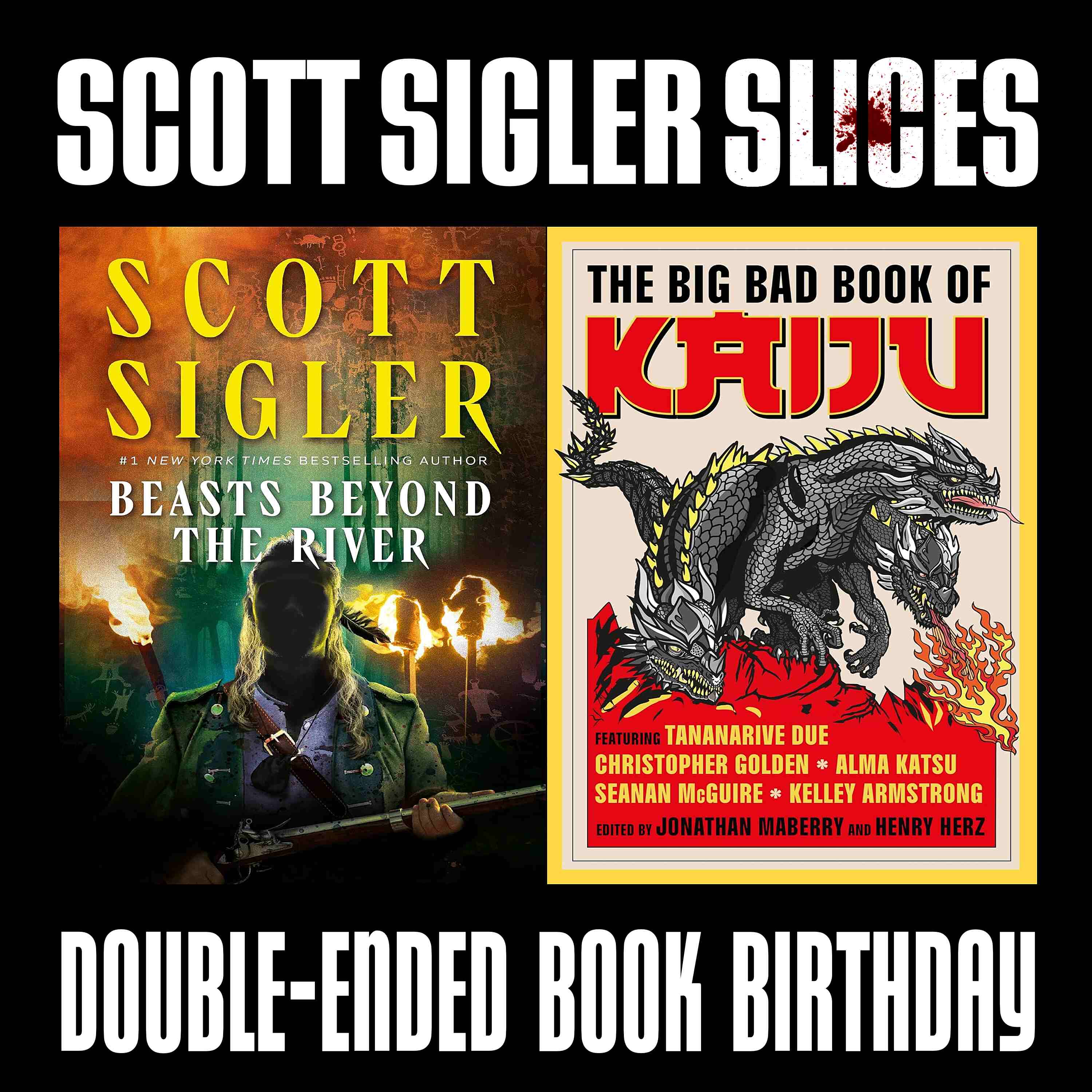
Good morning, people who read books. Welcome to Scott Sigler Slices. I've got two books out today. As many as one, two, uno, dos books out today. If I knew other languages, I would count to two and other languages. But I, what's that? Unda. Unda. We'll be back with some unda celebration for having two books out. Beasts Beyond the River, a riveting horror novel. And Big Book of Kaiju, we'll be back right after this. Do not skip the commercial, you son of a bitch. We gotta get paid. We'll be right back. God damn it.
Welcome to Scott Sigler Slices. I am Scott Sigler, also known as the Future Dark Overlord, and I'm a writer of sci-fi, horror, and sports fiction. And I am A.B. Sigler. I'm an audiobook narrator and a publisher at MTSet Entertainment, where we make cool stuff for cool people just like you. And today, we are celebrating a dual book birthday for my partner in crime. Well, my partner in not crime. My business partner. My absolute love of my life, Scott Sigler. There's two books out today. Not one. Not just one. Which is fucking rarefied I don't even have one book out. Even if you do your own book. It doesn't matter.
It doesn't matter. If you get one book out ever in your life, that's a big deal. Absolutely. But we have two books out. Wait. Now, if you have one book out as an e-book, congratulations. You're a Stone Cold pimp. If you have one book out in e-book and audio book, double congratulations. You are a super pimp. If you have a book out and it's in hardcover, like this one is, you are a triple pimp. Ladies and gentlemen, brothers and sisters, if you have...
Two hardcovers out. Because you've got so much girth in you that the hardness just has to, has to, has to spring out. That's a quadruple pimp action. Look at it. Put it up, baby. Put it up. Yeah, look at this. Those of you listening after the fact, right now we are showing on the screen, we're whipping out our hardness. Whipping it out. And we have two hardcover books out. Excuse me while I whips this out. Excuse me while I whips this out. Two hardcovers out today. And today is September 22nd, 2026. A banner bumper year for NBC Entertainment, for us, and hopefully for you guys, if you like these books. All right, Pumpkin, I'm going to...
wax ecstatic about this book eventually, but do we want to explain what each of these books are? Sure. I'll start with The Big Bad Book of Kaiju. This is an anthology. If you can't guess by the title, I'll tell you for free. It's all about kaiju. It's different short stories about kaijus. I think probably around 15 to 20 of them. Something like that, yeah. What's important for you guys to know, and you guys will love this if you don't already know, is Scott's short story in The Big Bad Book of Kaiju. Very serious, serious horror novel, ladies and gentlemen. Called? Kaiju Poo Poo.
No, I do want to tell you guys this. I want to tell you guys that when Scott was approached by Henry and Jonathan to be part of this anthology, I want to say maybe two years ago, maybe 18 months ago, something like that, he said, hey, this sounds so fun for me. I would love to do this. I don't have a lot of bandwidth because he was right in the deep of writing Slay and The Crypt at the same time. We were in Tennessee with Rob, right? Yeah, but you were still dual writing, two different series, Slay and The Crypt. And they were like, that's great. If you can't do it, that's fine. We would just love to have you. And then he said, I can. I'm going to give you three.
ideas for short stories that I think can be actually short stories. Correct. And they said, great. And then he submitted two. I can't remember. Like he and Rob and I. I think I submitted like five, to be honest with you. No, I think they were. Well, even so, like he and Rob and I kind of talked, like kind of talked him through some of the ideas that he was having. And then the last one that he submitted was, or I could do kaiju poopoo. And quite literally, that was the entire pitch for kaiju poopoo was like, I could do kaiju poopoo. It would definitely be a bubble. Mayberry was like, I don't give a crap what that is.
I want to see Scott Ziegler's kaiju poo-poo. That's exactly what they wrote back. Jonathan and Henry wrote back like, whatever that is, please kaiju poo-poo. Yes. And I'll tell you guys all about it in a second. Right now, we're trying to get the kaiju poo-poo. There it is. Trying to get this up on the screen because you guys know what? We do this show every Tuesday night. Every Tuesday night, 9 p.m. Eastern, 6 p.m. Pacific. We're all about all of this business. That's the squeaks. So you guys can join us in the chat room at youtube.com slash Scott Ziegler, twitch.tv slash Scott Ziegler, or facebook.com slash Scott Ziegler. You're going to have a goddamn good time. It's just...
Don't worry about it. I replaced the graphic. Okay. Yes. So continue, babe. Tell me more about that. There are many, many sci-fi authors that you adore in this book. Tannery Du is in this. Christopher Golden is this. Shannon McGuire is in this. Stoker Award winner Tannery Du, who just won for the Reformatory. Well, I mean, it was a year ago, but she won that shit. Henry Hertz has a story. He's absolutely fantastic. He's also an editor of this anthology. Jeremy Robinson, of course, Scott does. Oh, hell, my boy. Yeah. Jonathan Mayberry, of course, always has a story in this book. We got to get Robinson on the show. Jesus. We really do. Yeah. Yeah, yeah, yeah.
Super fun. And everybody got to have a little bit of fun with this. And this is the thing that I will tell you as you guys, you guys, if you're watching us live right now, you watch us because you love us. And we appreciate that so much. But I want to tell you, this was such an interesting and fun thing because it was all of these.
sci-fi slash horror slash fantasy writers writing fun stories. You know, last year you did the Marie Curie anthology. And that's a little heavier. There's a lot heavierness in that. And you did with Hugh Howey a while back. You did The End Is Near, The End Is Nigh, The End Is Now. And that was the Deer Camp stories, if you guys remember those. Those are kind of heavy. And now he was sleeping on his giant pile of money from his great show Wool. But...
The Big Bang Book of Kaiju? Kind of what they reached out and said was like, can you write something fun? And so I know your story is super fun. I've only read one other story, which was Jonathan's, and it is also super fun. So we're going to get into the non-fun, the good but not fun book in a moment. But right now, so this is, let's go through the inside flap.
Ever since Godzilla emerged from the oceans in the aftermath of World War II, Kaiju have fascinated and terrified us in equal measure. With their incarnations of Mother Nature's fury, creatures return from an ancient world, or monsters invading from beyond, they are our greatest hopes and worst fears given titantic form. This anthology of all original stories introduces 24 legends to usher in a new era of Kaiju. See strange beasts rise from the depths of ocean. Humanity is colonized. Colossal spiders trapped in slavery. Men become gods striding across continents. Secret government research projects out of control. And much, much more. Notice that I didn't make the fucking inside flat. Let's talk about why. No, no, no. Are you a secret government project? No, because it's not a secret. I tell you what, now I'm pissed. Here we are, table of contents, page 155. We're going to talk a moment about the kaiju poo-poo.
I might get arrested for this, but we're just going to go ahead and read. Yeah, okay. We're going to read just a tiny bit from this. If this gets a shutdown on YouTube, I don't know what to do. Just join us on Facebook. Also, now that I've been so far, I wrote this a couple of years ago, so now it's very funny for me to read it. Let's go ahead and go to Kaiju Poo Poo by Scott Sigler. Chapter one. Intruder. They'll tell you a colonoscopy is no big deal. Most times, they're right.
For a person-sized colon, which is about 1.5 meters long or so, there's really not that much to it. When the colon in question is estimated at 50 times that length, though, and the patient spends its entire life in the air, yeah, that's a big deal. With the emphasis on big. I'll tell you what, Sandy said. I never once in a million years thought my doctorate would lead to me flying off the poop chute of the biggest creature on the planet. Hendrick Jensen grimaced. His mother's coarse way of speaking had always annoyed him.
He and Sandy were half the crew that would soon try to save the Minneapolis funnel from running out of power and going dark. Going dark. Forever. I'm not gonna lie. I've dealt with bigger assholes, said Stunt Blackstone, the third member of the crew. Right, Hendrick? You get it? Bigger assholes? Also, Stunt Hendricks. Hendrick tried to ignore the pathetic attempt at a jibe. Good jokes. Didn't need the teller to explain them.
Stunt was the pilot for this desperate mission. He looked the part of the hero. Square shoulders, even square jaw, and sharp eyes that missed nothing. They all wore flight suits, but Stunt's fit perfectly while Hendrick's was a bit too large. He had known Stunt his whole life. Best friends for most of that time, until Stunt crossed a line that should have never been crossed. Now, Hendrick despised the man. Knock it off, Hunbun, Sandy said to Stunt. This isn't the time for poking at him. And besides, just look at what we built. Hunbun.
Hendrik tried to ignore how hearing his mother say that word made him feel. Instead, he focused on the air bay's lone craft, the intruder. The culmination of a month's worth of sleepless nights, intense design sessions, grueling management of the modification crew, and oh, just a wee bit of stress. Because the failure of this mission meant the extinction of the human race. Yeah, I'll give him that, babe, Stunt said. This bird's impressive. If there was one thing in this world Hendrik hated more than hearing his mother call Stunt Hun Bun, it was hearing Stunt call her Babe.
Air Bay 6 was at the base of the funnel neck, a relatively short distance from the surface. Minneapolis was one of the few cities that remained, an inverted funnel that widened the deeper it went, ending in a sprawling circle that held factories, the power plant, algae tanks, and the beef slug ranches. as far as we're going to go. Okay. You guys, I do think if I didn't have you at beef slug ranches, there's nothing I can do. You're beyond repair. I mean, also, if he did have you at beef slugs, probably there's nothing we can do. Either way. No, what we can do is we can entertain them because they're intelligent. If they understand that the beef slug, the word beef slug, B-E-F-S-L-U-G, and I say that even though, as we said in the text, we don't need to explain a joke, the beef slug is a central part of this because the beef slugs produce the loo. Steven Bloomfield.
Stephen Bloomfield in the chat room on YouTube says, that's beautiful. It is. Come on now. It is. How dare you. It's absolutely beautiful. Todd Cunningham says he's in. Absolutely says he's in. Okay. So, I'm so glad you guys are joining us. All we're doing today is celebrating Scott's two-book birthday today. In case you didn't catch it from the context of that intro, Hendrix's best friend stunt is banging Hendrix's mom. That's what's happening in the story right now. Now, please continue. I think you definitely buried the lead and should have left it. Well, stunt left it buried. Hey-oh!
What's up? I don't need to explain that joke, Sandra. I walked right into that, you guys. I walked right into that. Todd's in. Brian, how much fiber? Brian, we actually do discuss fiber in the story. Oh, no. Because a properly regulated digestive tract is important to a long and constructive life. Oh, you guys. I fight for my life every day in the fiction minds. Every day.
Every day. Okay. Like you guys have seen, like there are memes on the internet that this is what it's like living with a writer, right? And living with a writer sometimes can be, hey, I need another word for desiccation. Easy peasy. You know what, I gotta say, I gotta jump into the chat room for a second. I gotta say, we got a couple of good comments. We had, Brian Lee says that too much fiber. Stephen Bloomfield says, he's my stunt man.
And Gary Lindros has no fucking idea what he walks in. He walks in. He's like, hi folks. We're talking about friends banging friends, moms and other stuff like that. He's absolutely. And then Zach Parrish, who's like, hot guys in spacesuits, mama banging and giant monster rectums. I'm in. In so many words, in deep. Also, make a note, that's going in the fucking website. We're putting that on the website to promote this goddamn story for sure. Let's go. Zach. Let's go. Zach. So, we're going to finish up talking about the big bad book of Kaiju by simply, got the guess, simply reading the list of authors that are in this bad man pajama.
And then we're going to take a break. I did do that. No, I got the whole thing right here. Okay, the whole thing? The whole thing. The whole colon. I got the whole... Oh, Lord. I got the colon hole right here. And then we're going to take a wee little commercial break, pay some bills, and then we're going to talk about Beast Beyond the River, which is a... That's the headline. Beastly. That's the headline. An explosive... See now, when you think about my story, Kaiju Poo Poo, this tagline takes on a different meaning. An explosive collection of monster terror featuring 24 original tales of creatures the size of skycrapers. Sky...
Creatures the size of sky crappers. See cities shattered and worlds ended as strange beasts rise from the deep. Featuring the work of... What's up, bitches? Jeremy Robinson. Scott Sigler. Our buddy, Benjamin Spada.
And Ann Walsh. That is a murderer's row of effing talent. Let's go. So we'll be back in just a moment to talk about Beast Beyond the River. And we'll be back in just a moment to talk about Beast Beyond the River. Be right back. You've got your favorite blanket, a freshly poured drink, and a cold case burning a hole in your streaming queue. You're not just watching true crime. You're running the investigation from the comfort of your couch. Welcome to Murder, She Watched, the podcast where we recap, dissect, and slightly overanalyze some of the best and craziest.
True crime documentaries on our favorite streamers. Did the spouse do it? Why is the shady neighbor wearing leather gloves in July? Why did this guy agree to be interviewed in this documentary? We ask the tough questions that you're often just screaming at your TV. So every week we break down the twists, red herrings, and absurd documentaries that have kept you up all night. It's high drama, cozy vibes, and absolute couch detective energy. Grab your throat blanket and hit subscribe. Search Murder She Watched wherever you listen to podcasts, and let's solve this thing together.
Hi, this is Rob Benedict. And I am Richard Spate. We were both on a little show you might know called Supernatural. It had a pretty good run. 15 seasons, 327 episodes. And though we have seen, of course, every episode many times, we figured, hey, now that we're wrapped, let's watch it all again. And we can't do that alone. So we're inviting the cast and crew that made the show along for the ride. We've got writers, producers, composers, directors, and we'll, of course, have some actors on as well, including some certain guys that played some certain pretty iconic brothers. It was kind of a little bit of a left field.
choice in the best way possible. The note from Kripke was, he's great, we love him, but we're looking for like a really intelligent Duchovny type. With 15 seasons to explore, it's going to be the road trip of several lifetimes, so please join us and subscribe to Supernatural Then and Now. Welcome back to Scott Sigler Slices. We're here celebrating a dual book birthday today. We have Kaiju Poo Poo out today in The Big Bad Book of Kaiju. Kaiju Poo Poo is Scott's short story. We also have a singular author book out today that you have worked so hard on. Oh my God, we're going to bitch about this book in a second, but not right now. Let's go. Let's go. So I do want to ask you about Kaiju Poo Poo is the name of your short story. That's correct.
How much real science is in that? First of all, let's admit one thing, ladies and gentlemen. There's one author in all the world who could write a story called Kaiju Pupu and make it a riveting, if not constipating, story that clenches your attention and calls for some form of laxative storytelling relief to allow you to ease your way out of the story. There's a lot of science in this story, which is insane when you think about it. You want to know about the science in Kaiju Pupu?
There's a lot of science, ladies and gentlemen, about the digestive process across the mammalians, also the reptiles, also the arachnids, and whatever genus species and kingdom phylum might be in this particular story. It is important to note that of the two people on your screen right now, one of us has a science degree. That is you. That is you. One of us did all the science for this.
So the air gods that are in the story produce a little thing called a sky loaf. The sky loaf is the lone source of power in this post-apocalyptic kaiju story. Because everything is gone, I won't give any spoilers, but the only way that people can survive is to go underground in these inverted funnel cities. A very narrow opening, you go down, it opens up, you've got the beef slugs, you've got a lot of sludge and slime. That narrow opening, is it anything like a Spanish? No, no, it's a locked-in opening. But the Spanish is the opening that is my Crip series. That's a separate orifice set of fiction. And if you don't, if you're not able to harvest Skyloafs from the air gods...
then everything will go dark and you'll be forced to the surface where you will be predated upon by all of the kaiju that walk the surface. So we get into a lot of science about the digestive tract, about the tension and turdor of an anus. And we also get into the fact... Turgidity is... The turgidity. The worst word. We get into the turgidity. The worst word. This is why I'm fucking patting myself on the back or slapping myself on the behind, if you will, because the time lock and the option lock in the story is, if they don't, let's call it loosen up.
the kaiju, there will be no more sky loaves, there will be no more power, and all of humanity will perish. Therefore, solving the laxative problem is the central premise of the plot in Kaiju Poo Poo. Now, I'm not gonna lie, I feel like... The ability to let go of your shit has been an absolute moment in human history for many, many, many, many iterations. It's been a suppository plot line for sure. Yeah, it's right there. Yeah, yeah, yeah. So we do have to celebrate you, though, because that is just one of two books you have out today. You have been working so hard. Working like a dog. Working like a consummated dog. Well, not anymore because you have a spidness. Well, because of the next book we're going to talk about, I am not crouching and rubbing my butt on the carpets or on the bed.
which we have one dog that loves to do. We're like, everybody's hanging out. It's family time. There's two humans, two canines in the bed. And all of a sudden, one of those canines will be like, I'm now going to scooch my butthole across the place where you guys sleep. It's a separate plot. It's just his pillow. And it's my dog. Sorry. Which is all perfect. But now we're going to move on to, now that the campiness of the science is out of the way, we're going to move into some serious, hardcore history. And this book, ladies and gentlemen,
that I've been working on for five goddamn years is called Beasts Beyond the River. And we're going to have a love-hate session about this book in just a moment. But this is, let's see, with appendices, 436 girthy pages, 2.1 girthons of just brutal, brutal fiction, brutal from... the historical aspect, because this book is set in 1760 during the French-Ninian War. And war is always a very, very difficult, brutal thing. But back in the day, son, 250-odd years ago, it was a different slice of life entirely. And then, also, we've got the plot and all the horrible things that happened within this book, all of which will make your colon tighten up and make you question whether, should I have really read this book? Because I'm a little bit scared. My belly's doing things now that I don't, it's not normal. Do I need a Pepto? That's what this book is. That's the tagline. Do I need a Pepto? Ready? But we, A and I,
I'm going to try and summarize this. We'll talk about it later. We've been working on this book for five years. And I cannot begin to estimate how much money we have lost. due to the iterations of this book and not being able to focus on the books that we own or write a book for A Penguin Random House or Simon & Schuster. And we are, as of this day, done. Done, son. Son, this book is over. Thank you for the lovely bouquet. We are out. We're fucking done. We are out. And I've already got the social media for this book because I have to promo. I'm an author. I've got a week's worth social media queued up. It's already scheduled. As of tomorrow morning, I never have to worry about this kind of pretty awesome fucking book. I mean, it's really fucking awesome. It just was such a long road. However,
Today is the end of that long road, and it is such a rarity in the publishing world for any author. to get a hardcover book published. And that happened today for Scott for what I think is the 20th time? Something like that, yeah. And that means, because we at Empty Set Entertainment, who make cool things for cool people, we celebrate the wins. We celebrate the wins. Turn it around and succeed the label. We celebrate the wins. Champagne, bitches. This is Prosecco and it's Papa's favorite, so we're going to pour that. Also, in the chat room, David Lamb has cursed himself to an eternal hell by asking when book two of Beast Beyond the Roars will be out. And I assure you, David Lamb, there will probably be a Beast... I firmly believe that Alcon Entertainment, the company that...
contracted me to write this book is going to eventually, within three to five years, if not less, they're going to turn this book into an absolute fucking banger of a movie. It's an affordable movie. It's not a micro budget. It's a mid-budget movie. You can get a Chris Hemsworth to play the lead role. It's going to be on fucking Netflix. I am 100% convinced of that. And it will do well.
And they will come back to me and say, hey, how about a sequel? And I'll say, hey, how about you read Kaiju Poo Poo? So let me do this. Give me a moment. Indulge me for one second. I would like to say to you, congratulations. This is a hardcover release, two hardcover releases on the same day. I don't think you've ever had that happen before. No, never. Not one time. And it's a beautiful, rare thing that doesn't happen a lot to authors and happens less and less. It doesn't happen to anybody. And it happens less and less as physical bookstores go away. So congratulations to you. Thank you for doing it for us, your fans and readers. I really, I'm excited about, I love the Kaiju Poo Poo story. I am just now.
into Beast Beyond the River reading the final manuscript. But goodness, gosh, you worked so hard on this for so, so long. A big shout out to the whole team at Titan Books who has been working very hard to promote this book. And we bought them bagels at Comic-Con and love them all. Hannah and the crew, great job. A big shout out to the guys at Alcon, Jeff Connor and Carl Rogers. Jeff was the editor for this book. Carl was kind of the idea guy for this book. And now the baton passes.
to Carl to see if Carl can turn this into a movie, which is the objective of Alcon. So should we tell them about the whole business plan right now? Yeah, we can. But I first want to mention, I think it was David Lamb, our good friend David Lamb in the chat room says a cameo by Scott Sigler is warranted in the movie. Listen. No, it's mandatory, bro. This is one of, we have tilted at movies for more than a decade. And this is one of our things that we do every single time. Like we got to have one little walk on. We just got to, we just got to. So yeah, I hope so. I hope so. And in the chat room, a great question. Brian Leach asked, are there any crossovers to the Siglerverse?
And that's a difficult answer because there are crossovers, thanks to Rob Otto, co-author of the Slay series. There are crossovers to Slay. And Slay is tangentially Siglerverse because of some crossovers to, well, I guess the ancestor. Small crossovers to ancestor. So Slay is the linchpin because Slay is not Siglerverse. But Slay does have a tiny Venn diagram overlap with Siglerverse. And Beast Beyond the River is a tiny Venn diagram overlap with Slay. So there you go. Brian Gregory, so lovely to see you out there in the chat room on Facebook. I love that. So did I miss a question? I think we had a question. What was the question? No, I was just saying that you need to have a cameo in the movie.
Okay, so we're going to talk about the business model of Beast Beyond the River and Alcon Entertainment. We're going to try and make that as concise as we can because it's a really cool fucking thing. And then we're going to talk about the story. And then I'm going to fucking jizz all over my author self and just read the quotes in the back of the book. Yeah, those are charming, though, because that was not a thing that we did. Titan went out and got blurbs and stuff. And it was really lovely. And we're going to share that with you because we were kind of...
charmed when the books came in, the author copies came in, and we saw those for the first time. So we want to share those with you because they're special. And, you know, there's a thing where, like, there's things that A and I do very well and publishers do not do well. And there are things, and we work very, very fucking hard and keep asking the publisher, can you do this? Can you do this? Can you do this? And they're like, yes, I can do this. Then they don't do those things. And we're left holding the bag of, like, we could have done those things if you just told us you couldn't do those things. And now it's too late. So this is a very, very common thing. But then every now and then, a publisher does something without telling you or informing you or asking you, and you're like, holy fuck, did you guys get this shit done?
And it's fucking great. Also for con season this year, there were, the first few chapters, they made it into a little zine kind of, a little booklet. And it was lovely. And bookmarks and the five minutes of audio from Ray. All of that was a surprise. That was, I'm sorry, I shouldn't say a surprise. No, it was absolutely, it was a surprise to us. Right. It was a surprise to us that they got these things done. So Titan went out and got some great blurbs from some very significant.
historical horror authors, Almakatsu in particular. And when I saw it, I was like, are you fucking shitting me? Did Almakatsu blur my fucking... Dude, I've been doing this for 20 years. I've been doing this for 20 fucking years. And that was a wonderful fucking surprise. So that was great. So we're gonna talk about the business model. Wait, before we do that, I would like to buy someone in this audience who is watching live tonight, I personally will buy, not empty set, I will buy a copy of this book for you if you don't already have it in whatever format you would like, but I need you to tell me.
in this chat room who your favorite scott sigler character is it can be anybody i have a particular one you guys probably know i'm not going to tell you right now but i would like to buy a couple of books for people tonight so if you guys want to tell me who your favorite scott sigler character is and why i will pick a couple of them and uh send you guys books to tonight before i go to sleep here we go so this is the blurb that was from al makatsu who is um awesome awesome author Titan set this up. I knew nothing about it. It's great. Alma Katsu, which is A-L-M-A-K-A-T-S-U, said, With rich historical detail surpassed only by the supernatural dread at the heart of a novel, Beasts Beyond the River is sure to become a classic of historical horror. You guys, that is fucking, that is, so shout out to Titan, Hannah, and the gang for getting that done. It's lovely and it's surprising because I complain a lot. I'm not going to lie because I'm always, I'm always, I'm an entrepreneur.
There's nothing you can do to fully please me with an effort on anything. We can always do more. We can always go farther. It's the Kevin Hart principle that we can always do more. And there are certain elements of this business where we are handcuffed and we are not the ones doing it. So shout out to Titan for getting that done. Now, let's talk about Alcon. Alcon. Alcon Entertainment is... Before we move on, I would just like to say, if you haven't, if you're unfamiliar with Amakatsu and you haven't read or heard about The Hunger, consider looking that up. Because if you like Scott's work...
you might like this work. If you like Beast Beyond the River, you will absolutely like The Hunger. And if anybody is in the chat room telling me who their favorite character is, you also have to tell me why. Yes. All right. So now let's, we're going to succinctly cover the story of how Beast Beyond the River came to be. But when I say succinctly, if I stick to the facts, ma'am, it's still a good 10 minute story. So.
We are pals with Jonathan Mayberry, author of the Joe Ledger series and many other wonderful, wonderful tales. And Jonathan Mayberry happens to be the person who introduced me to Ray Porter. And Ray, who did the audiobook for Beast Beyond the River, which is so flattering and humbling to me as a creator to have a fucking A-list superstar like Ray narrate my books, is I still can't get over it that this is my real fucking life. He's the guy who did Project Hail Mary. He does the Bobiverse. He was the 2015 Audible narrator of the year. He's a pimp, super cool cat, and so fucking good at what he does, right? So.
This is all, it all comes full circle. So Jonathan introduces me to the gang at Alcon Entertainment, which is Carl Rogers and Jeff. And they're like, hey, they're looking for somebody to do this kind of thing. I'm too busy. Can you talk to them? Of course I can talk to them. Because at that point in our lives, A and I, we're still hot and heavy. We're going to get into the Hollywood business. This is before COVID. This is before all the problems in LA and everyone moving out of LA who's in the screenwriting business. So we were still very much into it trying to do our own original shit. Talk to Alcon. Alcon, in a nutshell, Carl's last name is Rogers. Carl is black.
Robert Rogers, the founder of Rogers Rangers, this history-changing military unit in the French and Indian War, Carl Rogers is like, oh, Rogers Rangers. Let's see if I'm, maybe I'm related to him. And it turns out, no, because a lot of people blame Rogers. And but he's like, but then he got Carl got into it. And Carl was like, you know, it'd be really cool. Really cool. We could like do Rogers Rangers, kind of a predator kind of thing. So I want you to stop right here and talk a little bit about how Rogers Rangers was unique, was unique at the time because it was, I think, a mercenary, not mercenary. It's not that's not right. Talk about Rogers Rangers. Rogers Rangers was a small unit.
reconnoitering tactical force in the French and Indian War. So 1754 to 1756, 1760. Integral in this. And what Robert Rogers did, and he's an amazing historical figure with a lot of pros and cons, a huge arc. But for this particular conflict, what he did was he was a white man born in North America. He was a Virginian.
And he grew up interacting with Native American tribes and also all the English imports and the immigrants, etc. And because he, his family and where he grew up kind of lived off the land and were farmers and hunters, etc. When he got to the age of military service and he joined the British. His idea was, why do we all line up in a big old single file line and let people shoot at us? Why don't we hide behind trees like the Native Americans do? Why don't we take cover and work from darkness? So Robert Rogers was, I said mercenary, that was wrong, but it's special forces. He was one of the first kind of bespoke built teams. They were one of the first special forces. In a nutshell, Robert Rogers was one, not the, but one of the first people to take the technological prowess of Western Europe and the discipline training of Western Europe and combine that with common sense.
tactical applications that the Native Americans have been doing for centuries. Sneak up on people, shoot people, fade away, hide behind trees, don't let them see you, use camouflage. I know this sounds insane. These were not things that were done in Western Europe. From before Napoleonic times all the way through to the French Indian War, these were very revolutionary concepts. So the other thing Robert Rogers did, which is super fucking dope, is he was one of the first people, one of the first white guys, anyways, to be like, I don't give a fuck where you're from. I don't care. I don't care where your parents are. I don't care the color of your skin.
Can you endure massive hardship? Can you shoot straight? And will you kill everyone we tell you to kill? It's a very simple recipe that basically is where we get our current special forces mentality, particularly the U.S. Rangers, which still have Robert's Rules of Ranging in their training manual in 2026. Robert Rogers wrote that in 1754, and that is still a primary document that trains current warfighters on how to do their job.
This still blows my mind. But Carl Rogers is the one who thought this would be a cool idea. Gotta point out, gotta point out, this is two years before Prey came out. And a long time, it was even before Dan Trachtenberg, his name started to percolate that he wanted to do some kind of North American pre-revolutionary Predator thing. So Carl was prescient. It was a great idea. Carl, we wind up, thanks to Jonathan Mayberry, Carl calls us. We have a conversation with Carl. And the second Carl said, yeah, I mean, I don't really know, but what I want is, the Rogers Rangers were cool and I want to do a sci-fi horror thing with it. It's a sort of Rogers Rangers meets Predator. And I remember being on the phone. At that point, I'm like,
Everybody shut up. there is no one in the world who can write this book for you that would be better than me writing this book for you. This is my gig. This is what I do. Why don't we just start talking about money and stop talking about who are the people who are going to do the thing? Because if you get anybody else, it's just not going to be as good. It was very swaggery. It was very cocky. But I also believe, like, I'm literally wrong. I wasn't wrong. And also, Carl Rogers has a history in my town, Sheboygan, Michigan. There is a panorama in Gordon Turner Park in Sheboygan, Michigan that kind of covers the timeline of the town. And panel one is Robert Rogers, who was the commander of Fort Michelin-Mackinac. And so I go way back, wind up going way back with this cat.
So we get that done, we come to an agreement, and that is how we wound up writing the book. And Al Kahn's business strategy is... if they're going to have a unique idea and hire a screenwriter to write that at SAG rates, at union rates, that's $110,000, $120,000 to write a screenplay. That's a lot of, even if you're a very profitable company, you're rich, that's a lot of money. So their idea was, hey, what if we get novel writers to write a novel about this for a whole lot less than we would have to pay a screenwriter? And then we'll use the novel to see if we can get the funding to make the movie. And they partnered with Titan Books, which is a UK company.
to make the book and then Titan is partnered with Penguin Random House for U.S. and global distribution. It's a really fucking cool process and they're really smart guys and that is how we wound up coming out with the basic premise of how it was called Warpath. That was Carl's idea of Warpath and now it's called Beast Beyond the Rivers. Yeah. And we will talk non-spoilery about this when we get back from this short break that we're about to take but I do want to say Don and Michael and whoever Scott the fuck pond. What's up? Oh Scott pond. Hello.
Oh, and Dark, I don't know what your screen name is, but Dawn, I'm going to send a book to you. Michael, I'm going to send a book to you. Dawn in Portland. Michael in Las Vegas. And whoever Dark something is, I don't know who you are, but will you email me? Because I'd like to send a book to you too. Email info at mtset.com. I think I might know you. You're from Vegas, but in case I don't do that, we will be right back right after this.
to talk about the rest of Beasts Beyond the River. How this shit actually fucking went, why we have spent five years on this, and we love them guys, but also there was a lot of fucking problems, and we're gonna let you peek behind the curtain under the dress right after this. Welcome back to Scott Sigler Slices. We are talking about Beasts Beyond the River, which is a new hardcover horror novel out from me. Bitches out.
Today, literally the day we are recording this episode, and we have sung the praises of Alcon Entertainment for the brilliant idea and mind-bending business model that is probably going to change how Hollywood works. We've sung the praises of Titan Books, the publisher of this book. We've sung the praises of Ray Porter, who is a god descended from the heavens to lend his voice to my work. All of this has been very good. And now we're going to talk about the not good part of all of this shit.
So here's the thing. I want to start by saying this. You guys are, especially the people who are connected to this live stream and our website and all that, you guys know we're a mom and pop shop. We are quite literally two people and trying to do all the things, right? And one of the things that often happen is we kind of talk to each other and choose what we're going to do and research, look at options and stuff like that and make the best decision we can at the time. We are often not.
privy to all the information. So, A&I, I would say we stopped about two years ago, a year and a half ago. Before that, A&I were hell-bent on breaking into Hollywood. And that could be an adaptation of one of our books, which we had four shots at. Four things were optioned, and we got paid, they didn't get made. We were also like, we got the gist of how it works. If we get in, meet some people, network, we have all these super cool original ideas, I've got original screenplays, let's get into the movie business. Or the TV business. And this story we're about to tell you now is the end of that business. So,
Yeah, go ahead. No, you go ahead. So, Alcon contacts us, and we have the discussion that I am the only one who can write Warpath, which is now Beast Beyond the River, as good as it can be. I am literally made for this job. And they offer X amount to write it. And I'm like, gosh, I really want to do this, you guys, but we have a business to run, and there's no way I can spend, literally, I said, 18 months on this for that amount of money. This is why I thought it would take 18 months to write the book. I can't spend 18 months.
five years ago. And they're like, oh, that's too bad. And I'm like, I'm sorry we couldn't work this out. You guys sound awesome. I love this IP. It's brilliant. I want to do it. Can't do it.
A couple weeks go by, get a call. Let's get on the phone. I'm like, okay. And they call and they're like, okay, we're now, it's X times two. And I'm like, trying to be polite to be like, you guys, A and I run a business. We publish books. That's still not even in the ballpark of how much it will cost us to take the time to write this book for you that we're not writing books for our fans who are waiting to buy books. That's the thing. Yeah, that's the thing. It's what else is he not doing? It's the opportunity cost of this whole thing.
So I tell you that to tell you this. So A and I are still very much hell-bent on Hollywood. And I talk to a couple of my screenwriter pals and explain what's going on. And they're like, here's an idea. Why don't you do this? Why don't you tell them, you'll do the book for X. But if the story goes into principal production and they have to hire a screenwriter, you get to write the screenplay. Principal photography. No, no. Screenplay comes for principal photography. Oh, okay. Sorry, I had that wrong. If the book goes into production, they have to hire a screenwriter. If you're the screenwriter and you get the original and one revision, that's X amount of money.
And I'm like, well, that makes a lot of sense. That'd be worth the whole thing. I'm still thinking in the two-year term, right? 18 months, yeah. 18 months, but then the screenplay, that's two years, two and a half years. That's going to be worth it. And Hollywood is like being a coach in the NFL. Once you've been a head coach in the NFL or an offensive defensive coordinator, you're never unemployed. Somebody's always hiring you to do the thing. You've got to get on the scoreboard. First, you've got to do the thing, and then other people hire you for the thing. Totally true in Hollywood before the COVID pandemic, where so many people were put out of work because you couldn't.
shoot. You couldn't meet to shoot. So same thing. Yeah. We did all this. We started this before the pandemic came in. Yeah. So we do this and then I come back to Alcon and I'm like, hey, listen, here's the deal. I'll do it for this 2X that you offered. But if it goes into pre-production, you are contractually obligated to hire me to write the screenplay in one revision because everything you've seen in Hollywood, it's never the original screenplay. There's 10 revisions. And after the first version you want me, cool. Kick me out. We got paid. Movie's moving along. We want you to be happy. We want us to be happy. Everything's good.
they were like, no one's ever asked this before. I'm like, I mean, your business model is kind of new. You guys put out three books, so of course it's new. So they talk to their managers and whatever, and their bosses are like, you know what? Let's do it. A couple of things happened over there. Number one, I spent two months coming up with a detailed 72-page single-spaced outline for the things that they wanted when we sat down to talk.
And Rob Otto and I were working on the screenplay for this because we're like, we use the screenplay as an outline because I'm girthy and I write long. So we did the screenplay first, use the screenplay to come up with the outline. This all makes perfect sense for Hollywood. I sit down with them and they're like, oh yeah, okay, that sounds great. Love it. Okay, great. Love it. We're going to go back and talk. I'm like, dude, got this nailed first time out. Very naive. A lot of hubris in my storytelling talent.
While this is happening, we get the contract goes through and I'm so busy at this point for the first time in my professional life, I do not read every single word in the contract. UTA is my agent. UTA handle it. Get the contract back. Yes. I have to take a break here. If you guys are not part of the book world or the entertainment world, UTA is United Talent Agency. They are.
If not the biggest, the second biggest. They're the big three. They're in the top three of the biggest agencies in the world for creative talent to connect with people who want to make their creations. They're a for real player. And the person at UTA is my agent, Bird Level, who we have been with since 2007. And we adore. He's the best.
But Byrd has also percolated up in the world because he's very talented, and now he's got a staff of 13 under him, and some of his staff are handling the contract management for this whole deal. And Byrd possibly didn't look at the contract because he has contract lawyers underneath him looking at it. Long story short, Alcon's lawyers ran a train on UTA's lawyers. Alcon's lawyers are fucking fantastic. So I get the contract back, I finally get a moment to look at it, and we are like, this has been going on for a long time, we gotta get this contract signed. I finally look at the contract like two days before the deadline is due to sign a thing, and I'm like, they have...
Alcon lawyers have 10 outs where I don't get to write the screenplay, including things like, well, if we hire a director and he doesn't meet with you within seven days of being hired, this part of the contract will invite you. You don't get to write the first draft of the screenplay. I'm like, so basically you hire a guy and tell him, don't talk to me. And then I don't get paid at all. This, a lot of things like that were in there. I was able to give it five of those things, but five still stand. So at this point, if Beast Beyond the River goes into pre-production.
if I'm lucky, I get to write the screenplay. But Ian and I have realized it's probably not going to happen. Alcon covered their shit. They know what they're doing. Much respect. That's the way things are. So we get that part done and then we have to move forward. And then I told you that I and Rob worked on this screenplay slash outline, sat down with Alcon. And it was, you guys, it's the sickest fucking book in the fucking world. It's so fucking awesome. And sit down with them. I go to LA on my dime. Sit down with them. Give them the whole thing. Carl, they're doing it. Jeff, they're great. Get a call two days later. Like, you know what?
let's just call it, let's call it, let's call it, I'm going to throw in a word, it's the taxi plot. Now, there's no taxis in 1760. They're like, you know what? We thought about it and the whole taxi thing. Yeah, we don't like that. What else you got? And I, being the noob that I am, was like, what the fuck do you mean what else I got? I spent months on this fucking outline. I did everything you asked me to do. What do you mean? What else do I got? This is where...
It finally, and A&I have experienced it before, it finally came home to roost. That working in the literary world with literary editors, literary publishers, is one thing. They're trying to craft your idea and make it better for the marketplace, but they're still focusing on your idea. Hollywood is focused on their idea. And if they don't like what they hear, they're just like, you know what? Why don't you, let's do this. How about the main character? How about you bring in his kid?
And his kid is a telepath. And also his kid, you know, his kid lost an arm before, but now he's got a bionic arm and the bionic arm amplifies his telepathy. And like, like, and I'm being, I'm exaggerating, but not so much because this is how Hollywood works. People walk in a room. If you guys have ever seen the Ghostbusters 2 bit from Key and Peele, that is literally how Hollywood absolutely works. And A&I experienced this two years and three months into this process where we thought we'd already be done. We find out that like, I have to rewrite the outline and I had to rewrite the outline. Not once.
twice, not three times, not four times, five completely different concepts of how to bring Rogers Rangers into this sci-fi world. That was three years into the process. So here's the thing. It takes Scott... somewhere between two weeks and two months to outline a book. Much closer to two months. No, no. It depends on the book, right? Two weeks to two months. If it's part of a series, he kind of knows what's happening. He knows what steps are going to happen there. If it's novel, it might be two months. It never takes 16 months ever because his job is writing books, right? So it never takes 16 months. And this one took 17 months to get an outline.
This was, I'm pretty sure for the rest of my life, this will be the most single befuddling moment of my professional career. And there's been a lot of befuddling moments, which was for the third time, I've given, this is fucking, this shit is awesome, you guys. If you guys make this book and make a movie, millions of people will buy this shit on fucking DVD. It'll be streamed. Everyone will love it. They'll save it. It's so fucking baller. And this is educational information about North Americans. You know, like we are the movie making seat that they are in because they're in Hollywood. This has a big, big audience.
We love historical fiction. But in a nutshell, Carl Rogers is the big wig at Alcon. And Carl Rogers hired me to write this thing. So if Carl Rogers doesn't like the thing I outlined, Carl Rogers gets to say, let's do another revision of this. Let's do something different. And that is how Hollywood works. I have no problem with that. Now I know. That's why we're out of fucking Hollywood. And this is one of three experiences A and I've had of people like, what do you mean you changed your fucking mind? Dude, I've worked on this for three years. Are you serious? And I've had meetings where I've literally threatened people's lives. I'm like, you need to get off the fucking cocaine. I'm going to fucking choke you the fuck out right now.
Now A&I are much happier. We do what we do. And if Holly wants to come knocking, like, great, you guys do your thing. Give us money and make whatever you want. We'll help as much as you want us to help. But you do your thing because we don't do what you do. So when is Beasts Beyond the River set?
in the timeline of the Earth. Beast Beyond the River is set in 1760. 1760. 1760, the tail end of the French and Indian War. Scott Sigler. Yes. Can you tell me how old germ theory is? Germ theory... Or is it as old as Beast Beyond the River? Germ theory is one of the Prussian War... No, it's before Beast Beyond the River. No, it's not. No, I'm sorry. Beast Beyond the River is before germ theory. So here's the thing that happened. They said to Scott... Scott Pond says, great year. Historically accurate. Historically accurate. Historically accurate. Historically accurate. We want this to be historically accurate. As much as possible, yeah.
And then questioned him why they weren't boiling water when somebody got injured in the fucking camp or whatever. And Scott was like, because germ theory didn't exist until 18-something. And this is set in 1760. So they didn't know. And they're like, you got to boil water. That is a true story. So 1760, French and Indian War. And if you get Beast Beyond the River, and I hope you do, and you can find those links at scottsigler.com slash B-E-A-S-T-S, Beast. I fought tooth and nail. Alcon and Titan both be like, there has to be.
and authors know the beginning of this, to explain to people, there's no dynamite. There's no TNT. There's no explosives. There's no revolvers. There's no fucking rifle cartridge. It is the primitive era of firearms. And I had to explain this to let people know that you need to understand when you read this book, the things you assume characters would do, they're not going to do, including boiling water and cleaning things. So Beast Beyond the River, set in the 1760s.
The people who hired him to write it, please be as historically accurate as you can be. He writes an entire draft after 13 months, 16 months, whatever, of outlining. And they're like, oh, why aren't they boiling water when somebody gets stabbed or shot with musket balls? And Scott is like, because the germ theory of disease happened in the 1860s. And this is set in the 1760s. And they're like, please do it. No, I'm like, no, I'm not going to do that. I'm not going to. Now, keep in mind, this is a work of speculative fiction.
And you have liberties. If there's supernatural elements, sci-fi elements, you have a lot of liberties. But at the same time, I'm like, where I absolutely fucking drew the line was, I will not insinuate that a Western European, Eastern European, or Native American culture had knowledge of fucking bacteria and infection in 1760. And if you will not let me do it historically accurate to this, because the science is what fucking matters to me, then you need to fucking pay me and hire somebody else to finish this goddamn book. There was a second thing that mattered a lot to him as an American, which was...
He did not want to skate off of Native American culture or a Native American language. And he wanted to create a fictional sort of... side-by-side strata of this fictional culture that looked and felt and smelled a lot like Native Americans in the 1700s. And they pushed back a little bit on that, too, but then they eventually let him just create the Cappanoga. But to be fair, at the same time, when Carl Rogers of Alcon brought this up, he's like, look, man, I love a strong female character. I love a strong female protagonist. I love aliens. But this did not exist at that time. So, Scott, I don't want you to try and do this thing that didn't exist at the time. I'm like, I can knock that out if you do. I can absolutely do that.
as we're telling these stories, don't think that these were a bunch of fucking buffoons. They also came to the table with, they wanted historical accuracy. When it came to the germ theory thing, they were as surprised as I was. Right. And when I said, like, why aren't they cleaning the wound? And I'm like, because that didn't exist. They're like, well, do it anyway. I'm like, no. They're like, oh, okay. They got the concept. They also did that with the Native American, the created Kapanoka that Scott created because Scott would not. I'm not going to rise to Blackfoot or Cherokee, bro. I'm not doing it.
Look at how pale I am. No. Look at Scott. He's not creating a Native American culture for you. As long as it's fictional, he'll do that with respect and protective readers and things like that to help him. But he's not co-opting an existing culture. And they were like, no, no, no. It can be so much easier. Just make them Cree or something. He was like, no, no. There's no way I'm making them fucking Chippewa, which is the main tribe where I'm from. It's not going to fucking happen. Ryan Minto says, throw a leech on it. Ryan?
I'm not sure, like that, and he's being tongue-in-cheek. Yeah, of course. I'm not sure throwing a leech on it was a thing in 1760. And there's no way- In North America. There's no way to know, because remember, the first time I experienced a writer using maggots to clean a wound, because they only eat the dead flesh, was Bernard Cornwell's The Sharp series. That's a hundred years after this book. A century after this book. So, it's-
We don't know what the Native Americans are doing for these things because there's no written record, which is another part of the process. I do want to take a moment and talk about the chat room on the YouTube video or on the YouTube chat room. Quintessis, I believe you said you were from Sweden. I don't know how many people are here tonight from European countries or Australia or New Zealand, but we frequently have, I'd say, probably 60, 70, 30. Handful. You know, we have a handful of folks because the timing is so hard. But we're super glad that you're here. Thank you so much for being here, especially from today. All right. So let me see if I can sum this up.
And I am complaining a little bit. But overall, this is a complex plot, a complex historical situation, complexities and accurate representation of Native American cultures, which were experiencing an absolute... tragedy. It is estimated that 70 to 80 to 90 percent of the human beings who lived in North America prior to the Europeans' arrival died from just disease. Yeah, because we didn't understand germ theory. Didn't understand germ theory. It is a staggering concept of the apocalypse that happened upon the shores and the land in which we live. And most people watching this right now, it is genocide. And some was intentional, but far more was...
no one understood what germs and bugs and viruses were. So this is a context in which I'm trying to create a story for Alcon, because they want to write a book that will turn into a movie. But I also have to be honest and true to what actually happened here. And if you read Beasts Beyond the Rivers... My hope is that you will see this is a responsible, accurate, unapologetic portrayal of what actually went down. Another key element of this was, and this is my favorite part of the book, my favorite part of the whole book is as a child, as an American child growing up in the 80s, I saw all the 60s and 70s Indian movies. Cowboys, Indian movies, Somal. I saw everything. All right. And the concept of the savage redskin scalping and doing all this horrible shit was a constant portrayal.
Even in the 80s, that was starting to shift, right? But I'm from a small town. We had a bunch of old movies and shit. And what was the most fucking fascinating thing to me is that the scalping of human beings, the killing of a human being and taking their scalp, completely giving them no honor in their death, that was not a uniquely Native American thing. And if you read Beast Beyond the Rivers, you will learn, which was news to me, that...
Rogers Rangers, English soldiers, colonial soldiers, colonists were also paid big money to bring home Native American scalps. So if you were just a colonist from Virginia and you could scalp a couple of very long, straight, black-haired people, you got paid a lot of fucking money by the government. If that was curly black hair, French hair, Italian hair, you didn't get any money for it. So this, the book is fascinating to me as a creator in that the brutality, the inhumanity, and the savagery was spread all across the battlefront. And that was the...
It sounds horrible to say that it was the coolest thing I learned in all of that was everybody was a shithole in this French and Indian War. It was fucking a galaxy of shitholes, man. They're terrible people. Right. And you say that was one of the most interesting things to learn. But that is a true thing because this is the thing that humanity goes through over and over and over and over again. We other each other. And then we have to accept and realize that we are all the others. We are all as.
Savage, uneducated, smart, brilliant, beautiful. All the things exist in all the cultures on this planet. And because we are Americans, we learned a history. That said, only Native Americans got scalped. But no. No, of course not. Because if it's dehumanizing, and that's what your job is, then you do that no matter where you're from. But we now know this, and we're going to be better people. You can't scalp anyone for the rest of your life. You know what? I'm going to be honest with you guys. I'm a hardworking person. I will put in the physical time to do the thing. Scalping looks like a lot of work, dude. It doesn't come right off. You've really got to slice it and rip it, and there's blood. You've got to clean that up. I'm just like, before we even get to the moralistic concepts, which are significant,
It's a lot of work. I just want to hang out with my wife, dude. I want to hang out with my wife and watch fucking YouTube clips. We want to be good and gracious and make red beans and rice for anybody who needs them. Things like that. We want to share the goodness of our lives with other people. But that's not everybody on Earth. So in the chat room, Michael Moore brings up 1763 was the blanket with smallpox and warfare. Great point. The early concepts of germ theory.
weren't, hey, there might be these microorganisms that hurt everybody. It was like, hey, man, these guys get sick from this shit. We get a cough, they die. Let's get a bunch of blankets and give them to the fucking Indians, which is an absolutely reprehensible war crime. There's no exception. And it doesn't matter, like, if the Native Americans have done this to us, it's a war crime. But yes, that was the earliest, as far as I know, in my limited historical knowledge. The first experiments in germ warfare were British allies sending products of comfort.
to Native Americans because they knew those products of comfort would kill enormous amounts of those Native Americans. And from a scientific perspective, that's fucking fascinating. That is like fascinating. That's the nascent ascendance of understanding. There are things that we don't understand. We got to figure them out. But from a warfare perspective, just fucking ridiculous. Yeah, and ridiculous because because the reality is if we're not doing something.
industrially, I'll say, or nationally, I'll say. We are all people who want to protect the people who are just like us, who are struggling, who are hungry, who are sick, who are whatever. And it's such an interesting lesson because at least me growing up, what I learned about Native Americans and the invention of America was a lot rosier than it probably existed. You know, and your book kind of really talks about some of, from the perspective of it being historical fiction, you get to introduce a couple of things, especially natural things, nature things, I'll say, that kind of put a glancing light, a glancing spotlight on some of the foibles of the humans. And I love that. You know, this is...
200 years, two centuries before the Geneva Convention. So the first point that humanity started to be like, listen, we're going to kill each other. This is what we fucking do. This is what we do. Can we codify this a little bit so the people who aren't fighting don't get a couple of rules, you know, a couple of D&D levels. What's going on? This is two centuries before that. A huge amount of time in a time in which what we would now call brutality or savagery was Tuesday.
It's really hard to get our modern heads around the concept that sending blankets full of disease to women and children and old people to kill them was not a normal, acceptable, tactical advantage. We do that digitally now. The United States does that digitally now with misinformation. I think we're going to finish up, but a great thing that somebody brought up in the chat room was the concept of... these cultures, the Europeans discovered sort of a Tolkien-esque fantasy culture. And this was a huge element for me as not just as a creator, but as a person who grew up in Northern Michigan and having more exposure to Native American culture than not white American culture, but then Western European feudalistic culture. So I started to write this book and I really started getting into it. I really went to bat to write this book was, I'm...
fifth and seventh generation American. We fucking go way, way, way, way back, right? And the fifth generation, those are people who fled the Nazis to come over here. And when I started to look at this, and it takes a bit for me to iterate this to you, when I started to look at this, I'm like, I've grown up on knights, you know, George R. R. Martin, fucking Tolkien, all of these.
fake cultures that are based on existing Western European cultures. Eastern European, Arabic, African cultures in fantasy fiction are all within the last 20 years, if not the last 10 years. It's sort of a newish thing to be like, everybody's got a medieval culture. Let's write about this shit. All we saw was Western Europe, English analogs, French analogs, Italian, Portuguese, et cetera. So when I started to, when I started getting this book, I'm like,
This has been done a thousand times and done very well 500 times. I'm a huge fan of Joe Abercrombie, for example. A huge fan of Joe Abercrombie. It's all Western European analogs. Tolkien, all Western European. I was like, why don't we have...
fantasy cultures that are based on Native American cultures. Because one of the things that Alcon wanted was like, what if the Rogers Rangers go from Fort Pontchartrain to Detroit, which is Detroit now, all the way to Western Kentucky and they find a Viking settlement? And I was like, no. Viking settlement? I'm like, what? First of all, I am not going to write a book where the white people move from this area to find a bunch of fucking super-powered white people in this other area. Like, let's create... Yeah, we are not writing the history that you want.
That's not happening. And it wasn't that I was angry with them or thinking social justice. I'm like, we are leaving so much storytelling glory on the table. Why don't we create a fictitious culture that is analogous to the land in which the story takes place? Now, I don't want to write Blackfeet. I don't want to write Cherokee because that's a bridge too far. It's a bridge to Stephen Graham Jones who wrote anything he wants because that's his business. Of course. I'm like, let's invent a new thing. But instead of inventing a Western European thing, let's invent a North American thing.
And that, that Alcon was finally like, that sounds pretty fucking cool. They're like, that sounds fucking dope. And that's what we wrote. Then that's Beast Beyond the Rivers. Okay. So we are going to get off this internet tonight because we've just been chatting the whole time. I want to say Ryan Minto says now the Indians got their reparations at the blackjack table. And I appreciate that a little bit. I do think that they should get theirs. Absolutely. Well, they get theirs in this book. I'll tell you that. Well, actually nobody gets reparations in this book. Everybody gets fucked in Beast Beyond the River. It's equality and brutality and nobody fucking wins, bros. But before we end up for this night, I just want to say again, for my spouse, my best friend, my business partner.
It has been such a long road for Beast Beyond the River for you. You were in it every single minute to bring the best story you could into the world. To you motherfuckers. And to you. Apparently you motherfuckers. And you fought back a thousand times against things like germ theory, blah, blah, blah, blah, blah. All that. Like, do you want it historically accurate? Or do you want it made up bullshit? And to be fair, and I...
conceded when these people brought, they brought great points. I'm like, you're fucking right about that. Absolutely. But he went toe to toe every single time. And that's the thing that I love so much. I love you. I love how hard you love your fans. I love how hard you love making the best book. And I love how hard you go for your fans. I'm a junkie. I've always been a junkie. That's how we met. That's true. I am very grateful for you.
And as Michael Moore said, two hardcover books in one day. Let's fucking go, bro. Let's fucking go. All of you, I will order those books tonight. If you haven't told me how you'd like to get that book, please do. Last thing I'll say is, in a really constructive, combative, creative process, nobody sits on their hands. Everybody's like, this is the right thing to do. And then you fucking discuss it. You go toe to toe and you argue. And at the end of the day, Titan won a bunch. Alcon won a bunch. I won a bunch. A won a bunch.
And this is not great for my ego, I won't lie. But there are significant elements of Beast Beyond the Rivers that Jeff brought in, that Carl brought in, that Titan brought in, that I bristled against and argued. chew the fucking mattresses. There is no fucking way we'll do that fucking thing. And at the end of the day, I'm like, God damn it. God damn it. That's a fucking better idea. And I hate to lose. I fucking hate to lose. You also did the other part of that where you were like, no, I will the fuck not. I will the fuck not. As a white dude, I will the fuck not. Let's fucking go. Also, as the storyteller I am, I'm like, you need to shut your fucking case. I got you, Michael. Because I, dude, I'm telling you. I got you, Don. But I would say. Dark Knight, I know you email me. This is.
I don't think I'll ever go through an experience like this again because A and I, we're going to write, we're going to do our own thing from here on out and we're going to write great shit and we're going to take care of you guys and make sure that every second you spend with us and every penny you spend with us is time you would have given more time or more money to get that same product. That is our goal. That if you spend $30 on a book, you'd be like, shit, I spent fucking $300 on the book. That's what we do. But this book, for all of my turmoil, travails, and difficulties, is I would not have written this book on my own.
without fucking Carl, without Jeff, without Titan, and it's a really interesting thing. Without a lot of your military advisors, too. And Rob. Chris Grawl and Rob Otto. Yeah, for sure. And Joe, I think. No, this is a Chris Grawl. Chris Grawl's the only military consultant on this. Because he's the best. But those, like, Chris is always part of the creative process, right? For sure. Dealing with Titan and Alcon was a unique experience, and I am so, this book is fucking titties and beer. It's fucking nails. And if you read this shit and you don't like it, fuck you, I'll pay for the book. I will pay for the guy. It's great. Here's the thing.
We're done. But I do want to let you all know, who are still watching right now or still listening on Sunday, that on Tuesday of next week, Chris Grawl, integral to the process of Beasts Beyond the River, will be on to talk about his new book, Schrodinger's Glass. It's the glass by Schrodinger. It's great. And I cannot wait. It's brilliant. He's brilliant. He's brilliant. He's such a good man. He's such a graceful good man. He's worked so hard on, so long and so hard on this book. It's going to be fucking, Chris, I've got to be hard on. I can't wait. Look at it. Can you see it?
Look at the nips. Fucking poking out. So what we're doing right now is you're raising your glass. And I'm going to say one more time, thank you so much as a junkie. I'm saying this as a junkie. Thank you so much for adding yet another hardcover to my collection. And for the three of you that I'm sending books to, to their collection, I love to add a gracious good nut.
knowledge increasing Scott Singler book to my bookshelf every single time I get that opportunity. You're trying to get me into bed because it's working. It's fucking working, bro. I just, I love, listen, you know I adore you, but I love, you are my favorite author and I am so grateful for you. Jesus Christ. Okay, so cheers. Empty Set Entertainment. Cheers, you guys. We love you. Especially in this day with two of them. Wait, ready? Empty Set Entertainment. We're always hard. Oh, oh. Yeah.
That is it for this episode of Scott Sigler Slices. You absolutely must buy Beast Beyond the River in hardcover, in audiobook narrated by Ray Porter, or e-book. And if you don't, you will probably die of smallpox and or consumption. You can find all the links at scottsigler.com slash beast. Until then, you all smell an awful lot like a giant kaiju's constipation poo-poo. Oh, please, not that music. That music gives me nightmares from my childhood. Could we get something a little bit lighter? Some lighter music here.
And every Monday, you can listen to our True Crime Rundown, where we go over the top true crime headlines of the week. So come and join us wherever you listen to your podcast. you Speaking of the Oscars,
talking about what I call beginner's luck, the actors and actresses who won an Oscar on their very first film. Get your fix of old Hollywood from Steve and Nan on the podcast from Beneath the Hollywood Side. What if the imaginary world you created as a child became real and wanted you back? That's the mystery at the heart of Sagas of Sundry, Darkling Gate, a cinematic Call of Cthulhu actual play series where Jane Austen's social drama collides with cosmic horror. The year is 1816, the year without a summer. Three siblings and their companion are drawn to a gloomy country estate beside an ancient forest in the English countryside.
In its darkened halls, memories of the fanciful wonderland created by their dead brother begin manifesting in increasingly terrifying ways. Expect ballroom courtships, dangerous family secrets, strange relics, occult rituals, and horrors no human mind was ever meant to comprehend. If you like gothic mysteries, regency romance, immersive role-playing, horror that follows you long after the story ends, step through the Darkling Gate. Watch on Geek & Sundry's YouTube channel or listen on Apple Podcasts, Spotify, and wherever you get your podcasts.