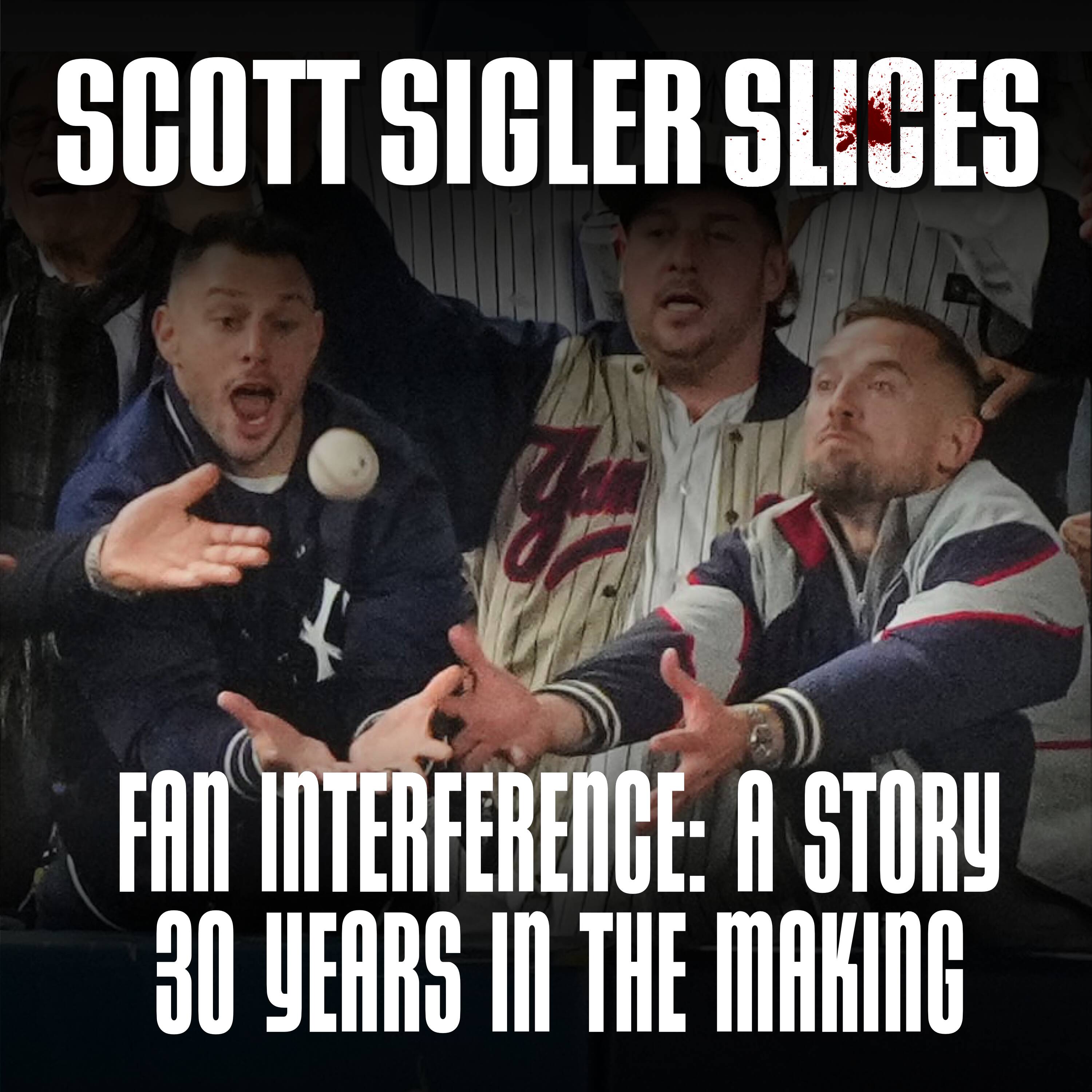
30 years ago, a kid reached over a wall and helped the New York Yankees win a playoff game, and that kid, he became a legend. Now, in 2026, another Yankees fan does almost exactly the same thing and helps end the Yankees season. 30 years of baseball karma delivered by one guy in the cheap seats. Stay tuned. We've got this unbelievable story right after this quick break.
And enjoy. Via Rail. Love the way. Welcome to Scott Sigler Slices. I am Scott Sigler, a sci-fi, horror, and sports fiction author. And I am A.B. Sigler, audiobook narrator and publisher at Empty Set Entertainment, where we make cool stuff for cool people. In this episode of Slices, recorded October 13th, 2026, we are talking about one of the strangest coincidences in the baseball playoff history. Two games, two fans, two baseballs, and almost exactly 30 years separating them. On October 7th of this year, the New York Yankees were facing elimination from Major League Baseball's playoffs. They were losing to the Tampa Bay Rays.
Then Yankee shortstop Anthony Volpe hit what appeared to be a game-tying home run. Yankee Stadium exploded. Fans were celebrating. Volpe's rounding the bases. But there's a problem. A fan had reached over the outfield wall and touched the ball before it left the field of play. The umpires reviewed the play. They overturned the home run. And the Yankees eventually lost the game 4-3 and were eliminated from the playoffs. And here's where the story gets incredible. On October 9, 1996, almost exactly.
30 years earlier, a 12-year-old Yankees fan named Jeffrey Meyer did essentially the exact same thing. He reached over the outfield wall and interfered with a ball hit by a Yankee player. Video replay, way back when, shows the controversial 1996 ball would have been caught for an out. And if that happened, no home run for you, Jeets! But back in 1996, umpires allowed the home run, which tied the game for the Yankees, who eventually won that game and went on to win the World Series. Jeffrey Meyer became one of the most famous fans in baseball history.
Poor 12-year-old kid, my goodness. Well, happy 12-year-old kid. I mean, but still. So 30 years ago, a Yankees fan interferes with a play in baseball and becomes an absolute hero, a legend, a stud, a stalwart. This year, 2026, another Yankees fan interferes with a baseball. And what was an absolute home run got taken away from the Yanks. So I think the most interesting part of this entire story is that the same interference rule.
exists in both eras. It's the same rule. But what changed was baseball's ability to review what actually happened. Back in 1996, no video replay. 2026, hello, video replay. A and I are not experts on this. We love these stories that involve strange things that happen when human beings play competitive sports. And this one, this one's got everything. Yeah, this one's great. History, heartbreak, technology, and a 30-year coincidence. That sounds like something I would write in a book and you would all say I'm not, I don't believe you, Scott. That's unbelievable.
I think we've got the gist here, but we are going to explain exactly what happened this year, take you back to the famous incident in 1996, and look at how Major League Baseball's rules handling fan interference have or haven't changed with the game. Because sometimes the difference between becoming a sports legend and becoming a sports villain is just a few inches beyond the outfield wall. Before we get to interference, let's explain why this particular game mattered so much. Major League Baseball has 30 teams. 15 play in the American League, 15 play in the National League. And after the regular season, 12 teams qualify for the playoffs. Those teams compete through several rounds until one American League team and one National League team meet in the World Series. The first round of the playoffs is the Wild Card Series. Two teams play a best of three series. Win two games, you move on. The second round is the Divisional Series. This is the best of five games. You win three games, you move on. The third round...
is the American League Championship Series, the ALCS, and the National League Championship Series, the NLCS. Those are best of seven games. You win four, and you move on to the big prize, the World Series, which is also a best of seven. And the World Series determines baseball's champion. So this year, in 26, Yankees were playing the Tampa Bay Rays in the American League Division Series. That is, as Gacha said, a best of five series. The first team to win three games advances to the American League Championships, and the loser goes home. So Tampa Bay had already won two games in this five-game series, and on October 7th.
The New York Yankees were facing elimination. If they lost just one more game, their season was over. I do appreciate the announcer voice, especially. But we are talking about the New York Yankees, so I appreciate it. They are one of the most famous sports franchises in the whole world. They have 27 World Series championships, more than any other baseball major league team. But they haven't won a championship since 2009. Now, as a Detroit Lions fan, this is going to sound ridiculous that I say this, but I'm going to put all the gravitas I can upon this. 17 years without a title. For most franchises, that's disappointing.
For the New York Yankees, whose identity is built around winning title after title after title, it is beyond frustrating. Yankees fans expect the team to compete for a World Series every single year. And on this particular night in October, the Yankees were playing at home in the Bronx, thousands of their own fans at home, hoping against hope that their team could avoid elimination and keep the season alive. By the sixth inning, the Rays were at 4-2. There were two outs.
That's when Anthony Volpe stepped up to the plate with a runner on first base. Volpe is the Yanks' young Golden Glove winning shortstop. That means he's very good on defense when the other team is at bat. But Volpe is not known as a power hitter. He's not expected to bang out souring home runs. So for folks like me who are not really, don't really follow baseball, this is why this at bat matters. A home run with a runner on base scores two runs. If the batter scores, then the runner already on base scores the two runs. So if Volpe hits a home run, the game gets tied right there at that moment. Four to four.
The Yankees were one swing away from a racing Tampa Bay's lead in Anthony Volpe, who I, by the way, was born in New York City in bats. 312 at night games against left-handed pitchers from the Western Hemisphere. He's a lifelong Yankees fan. He absolutely delivered for the Yanks. That swing hits a deep fly ball toward the left field wall. Race outfield. Race back toward the fence. That ball is coming down near the top of the wall. Okay. Just beyond that wall.
Still Yankees fans. People who paid to be there, hoping to see their team pull off the comeback. And one of those Yankees fans reached forward to catch that baseball. Fans hands extended on the wall in the field to play. The ball made contact with the fan and the ball ended up beyond the fence. The initial ruling was a home run. Yankee Stadium, I would imagine, exploded. Absolutely. You can imagine. And then Volpe, Yankee fan himself, rounds the bases ties in Game 3 where they otherwise would have been eliminated. No, Game 4 from the World Series.
and appears to tie the game. Imagine this young man born in New York City himself. Imagine being there. Your team is facing elimination. You're down by two games to zero. Your shortstop hits a massive fly ball. Suddenly, the entire stadium thinks the Yankees are back in the game.
But Tampa Bay's outfielder immediately protested. You can watch this if you look up this video. You can watch this happen. Victor Mesa Jr. believes the fan had interfered with his opportunity to make a play, and the umpires decided to review what happened. I've always wanted to be a sports announcer. I'm going to come out of that voice right now. You don't say. Yes, I do say. The young man from Sheboygan, Michigan. We're going to say, so for you noobs, this is where you need to understand a critical distinction. Therein lies the deep drama of this, even if not a sports fan. It's very fucking cool. Catching a baseball in the stands is generally considered...
legal, it's fine, but reaching over the outfield wall and interfering with a ball that's still in the field of play is prohibited by baseball's playing rules. In the chat room on YouTube, Dr. T suggests that any fan interfering with a ball in play should be ejected from every MLB stadium for life. I'm not going to say that's a bad decision, yeah. I mean, here's the thing.
This doesn't automatically mean that that fan committed a crime or deliberately cheated the system. He didn't. It means that the fans' actions interfered with live play and that the umpires then have to go in and apply the appropriate baseball rule. And in this case, that distinction came down to inches. It gets very deep. Major League Baseball's replay officials examined the video. They determined that the fan had interfered with the ball while it was still in the field of play. But there's an important part. Fan interference does not automatically mean that a home run is going to be overturned.
So the officials had to figure out what would happen if the fan had not touched the ball. If they believe it would have cleared the fence, they could have awarded Volpe a home run. Instead, they ruled that the ball would not have cleared the fence. So instead, they awarded Volpe an RBI double. A runs batted in double if you're not. A runs batted in double. Very good, very good. So that means that the runner who was already in first base was allowed to score, counted as a score. The Yankees get one run instead of two. Now they are losing four to three. And Volpe is standing on second base instead of celebrating a game-tying home run.
So the next Yankee gets up to bat. This is Spencer Jones, and he strikes out. The inning ends, and the Yankees do not score again. Spencer Jones is spurned forever in the New York culture, and people hate him with all their heart. So Tampa Bay wins the game 4-3. The Rays sweat the series. Embarrassing for the Yankees. Three games, two none, and the Yankee season is over. No title for you. We do know that the fan who interfered with the ball was escorted out of the stadium.
Angry fans threw debris onto the field, basically delaying the game when that happened. And the incident immediately became one of the biggest stories in baseball postseason this year, for sure. We have to point out, the interference did not automatically end the game. The Yankees still had opportunities to score, but they could not capitalize. Yeah, even Yankees manager Aaron Boone acknowledged that the replay officials got this call right. He believes that they got this call right. And that's going to become very important when we come back from this quick break after we jump back into the Wayback Machine and travel 30 years into the past.
Welcome aboard Via Rail. Please sit and enjoy. Please sit and stretch. Steep. Flip.
Or that, and enjoy. Via Rail. Love the way. Introducing a festival of flavors sponsored by PC Holiday Insider's Report. The lineup is stacked, featuring beef welly bites as a savory opening act. Then, the light and airy vibes of Black Label Pizza. On the main stage, the juicy glory of buttermilk brined young turkey. And closing with a bold new act, our ultimate butter tart pie with Canadian cranberries. No wristbands required. Discover the full flavor lineup in the PC Insider's Report.
Welcome back to Scott Sigler Slices. Today we're talking about an interesting coincidence that happened to the New York Yankees in 1996 and this year in 2026. So let's go back to 1996. The day is October 9th, 1996. The Yankees are playing against the Baltimore Orioles in Game 1 of the American League Championship Series. The winner of that series would advance to the World Series. The Yankees are trying to reach the World Series for the first time since 1981. They have a young rookie shortstop by the name of Derek Jeter.
Jeter would eventually play 20 seasons. He would win five World Series championships and he would enter the Baseball Hall of Fame. Jets! Jets! Exactly. But...
In October 1996, he was a rookie. It's game one of the series. Bottom of the eighth. One out. The Yankees are training the Orioles four to three. Cheats steps up to bat. He has a deep fly ball toward right field. Orioles outfielder Tony Tarasco moved backwards to the wall. And sitting in the front row was 12-year-old Jeffrey Meyer. He's from New Jersey. He's in the eighth grade. He's studying chemistry. He'd come near Yankee Stadium with his fam to watch his favorite team. And when Cheater's fly ball approaches the wall, Mayer reaches out with his little tiny baseball glove. He reaches over the fence into the field of play and deflects the baseball into the stands.
Almost exactly what happened this year. Except in 1996, the umpire ruled that a home run. The Yankees die the game. Four to four. The exact same score. It would have been 30 years later had that homer been allowed. I'm not saying aliens involved, but aliens might have been involved. Jeets circles the bases. Orioles outfielder Tony Tarasco. Hair was furious. Tarasco had positioned himself to catch that ball. Myers' glove came down in front of him, and the ball bounced off his glove up and over the wall. Instead of getting the opportunity to actually catch or attempt to catch the ball, Tarasco watched it disappear into the stands.
Tarasco, he immediately protests. He points toward his stands. He's arguing the fan had reached in the field of play, which is not allowed. Television replays support his complaints. But umpire, Rich Garcia, we don't know if he's on the take or not. We'll never know. He ruled it a home run. Orioles manager, Davey Johnson, came out to argue. The confrontation became heated. Johnson was eventually ejected from the game. Yep. But the ruling stood. And here's where it became so unbelievably frustrating for Baltimore. Television viewers could see that little 12-year-old mayor.
had reached over the wall, and they could see that the ball would have been caught, and Jeets would have been out. The evidence, the evidence was right there, but baseball did not have a system at the time allowing the umpires to use that footage to overturn the call. That game eventually went into extra innings. In the 11th inning, Yankees outfielder Bernie Williams hit a walk-off home run, and the Yankees won 5-4. Yanks eventually defeat Baltimore in the series. Then they went on to beat the Atlanta Braves in the World Series, and little Jeffrey Meyer, the chemistry student from New Jersey, became an overnight celebrity. Now.
I'm going to put myself in his shoes for a minute. So is Jeffrey Meyer a hero or a villain? He's everywhere. His name is absolutely everywhere. Yep. And Yankees fans are celebrating the young lad. He's on television. He's invited on talk shows, Late Night with Conan O'Brien, and he becomes a symbol of the Yankees' dramatic...
postseason run to a title. I know it comes as no surprise. Baltimore's reaction was very, very different. Orioles fans believed that their team had been robbed of a crucial out, which the television replay does support, and they had good reason to be upset about that ruling. So we've got to be clear about this. The Yankees didn't automatically win because a precocious 12-year-old chemistry student knocked the ball aside. They still had to win the game in extra innings, and then they had to win three more games against Baltimore, and then win four games against the very talented Atlanta Braves with Chipper Jones. But 12-year-old Jeffrey's interference.
absolutely helped create the tying run in game one. And that helped the Yankees go on to win that game. So his name became part of the story of their championship season, of course. And interestingly enough, A, you may not know this. 12-year-old Pekotius Meyer, the chemistry kid with the ball glove from New Jersey, he didn't disappear from baseball. He went on to play college baseball at Wesleyan University. He became an accomplished college player and continued his connection to the sport. That's a pretty remarkable footnote when you think about it. So.
30 years apart, we have those two Yankees moments when a Yankees fan reached over the outfield wall and the comparison was absolutely immediate. We will talk about the rule that connects these two plays, I think, right? Yeah, we'll talk about, we'll take one more quick break, short break, and we'll come back, we'll explain the math behind the rule and the architecture and structure of why these two things are exactly the same except for one key difference right after this quick break. Welcome back to Scott Sigler Slices. We are talking about the incredible coincidence, or is it, be separating 30 years of Yankees baseball success with Yankees baseball dismal failure, all under the sign of Sagittarius in the month of October. Okay. Let me explain the rule that connects these two plays. Baseball didn't change anything. They did not change anything about the basic spectator interference rule that they had in 1996.
to this year in 2026. So 96, spectator interference is absolutely prohibited. It's absolutely prohibited in 2026. The difference in this conspiracy is how those plays were officiated. In baseball, the outfield wall separates the playing field from the spectator area. Fans can generally catch baseballs that have entered the stands, but they can't reach over the wall into the field of play and interfere with a ball that's still in play, which is exactly what happened. Imagine you're sitting courtside at an NBA game. You can catch a basketball that flies into the crowd, but you can't reach.
onto the court and grab the ball when players are still trying to play. This is the same basic principle. But I do understand why a baseball field, if you're in the stands at a baseball stadium, this is especially tricky because often fans are sitting directly at or next to the outfield wall. They're just 15 feet in the air compared to the field. So it doesn't look like 15 feet up is the field to play. A ball might come towards the fence, an outfielder might leap to catch it, and a fan...
Might reach out accidentally for a souvenir. Correct. So you got fan, fielder, baseball. All three converge in an instant. Whether the fan's glove is on one side of the illegal boundary or the other, that's what can determine this ruling. There is another actual important distinction. Spectator interference doesn't always mean the batter is out. Correct. The umpires must determine what would have most likely happened in the event of that, or if the interference had never happened. It's pretty complicated. If the outfielder would have caught the ball, the batter might be ruled out.
If the ball would have bounced off the wall, the batter might be awarded bases, and the umpires have to decide where the runners should be placed. So this year, in 26, the officials determined that Volpe's ball would not have cleared the wall. But they also determined that the outfielder would not have caught the ball. So Volpe was awarded a double. One run from that double scored. So why did the same basic situation produce such a different outcome? Because baseball changed how officials could review the call. This is where it gets pretty cool and pretty deep. In 1996...
the far away, the long ago time. Umpires had to make the call based on what they saw in real time. They made a decision and stick with it. Whereas television viewers could watch the replays and see the facts, but the umpires were not allowed to use those replays to overturn a home run ruling. And then back in 2008, Major League Baseball introduces limited instant replay. So initially it just focused on certain home run decisions. But then in 2014, they expanded the replay system again.
So that today, managers can challenge many types of calls. Major League Baseball has Replay Operations Center in New York, where officials can examine video from different camera angles. Yeah. So spectator interference is one of the situations that can be reviewed. So when this fan reaches over the wall in 2026, replay officials examine exactly where the ball was and where the fans hands were. They also evaluated the outfield position, outfielder's position, where the ball would have cleared the fence. And I admit the first time I saw the replay, I'm like, that's a home run. Upon watching multiple takes this replay, I realized I was wrong. And this is information that those umps in 96 could not review, which raises an important question. What would have happened in 1996 if the umpires then had access to modern replay? This is so interesting to me.
Jeter's apparent home run absolutely would have been reviewed. The footage very clearly shows that Meyer did reach into the field of play and the officials would have had the opportunity to correct that call. Yeah, Meyer in 2026, Jeter back in 96. So we can't know how the rest of the 96 game would have played out. Maybe the Yankees would have scored anyway. Maybe Baltimore would have won. Maybe the entire series would have changed. But that's the beauty of sports in general, right?
change one moment and absolutely everything could become uncertain. Or certain. And that's why you have to play the games. There's yet another part of the story that I find very, very interesting. It's the fans themselves. Because people go to baseball games to have a good time to have fun. Yeah, and I can totally see that catching baseball at a major league game would be a huge deal. And I know people bring gloves for this purpose. They book tickets and seats and sit near the outfield while hoping for a home run ball that comes their way. And some of those fans keep those baseballs for the rest of their lives. For sure. And this is another part of what...
A and I both enjoy about this particular story. You don't have to be a sports fan to understand the talismanic nature of what's going on right now. So this story is about two ordinary people who attend a sporting event 30 years apart. Both have forever become part of baseball history because they reached out, because they reacted, reached out to grab a ball. It's part of why sports are so compelling. You can study the stats, you can analyze the matchups, you can predict what should happen, but there's also crazy shit. Yeah, and until they play the game, you can't know how that story will end. And sometimes the most memorable part of a story involves something or someone.
who wasn't even supposed to be playing. Wasn't supposed to be involved in the story at all. The 1996 Yankees went on to win the World Series and achieve immortality. The 2026 Yankees went home with their asses red from being slapped and swept. 30 years of baseball history can be connected by two fans reaching over an outfield wall. That is a remarkable coincidence and a reminder that even with all the technology in modern sports, the unexpected is always waiting for you to watch. So, ladies and gentlemen, you're hearing the sound of my mellifluous voice.
If you're lucky enough to sit in the front row at a Major League Baseball game, enjoy yourself. Cheer for your team. Scarf down a couple of dogs, pound a beer, maybe even catch a baseball. Just when you do, make sure that the ball has actually reached the stands. Because the last thing that you want, little one, is to become a subject of a Scott Ziegler Slices episode 30 years from now. I mean, unless you're here for a good reason, like your team wins the World Series. I would say that is worth it. Then apparently you're a legend. Until the next episode of Scott Ziegler Slices, take me out to the ballpark. Take me out to the game. Buy me some peanuts and candy that's sour.
because you all smell an awful lot like flowers. Holiday is here at PetSmart, and it's time to shop great gifts and stocking stuffers. Bring on the joy with toys, treats, apparel, and more for every pet. Get ready to get merry all season long in stores and online at PetSmart.ca. Hold music. Not what you want to hear when a pipe just burst and your basement is flooding. That's why Intact Insurance answers 2 million claim calls per year within 20 seconds. So instead of hearing this lovely track, you'll hear this in seconds. Hello, Intact Insurance. For most of the history of professional sports, there was a wall between the game and gambling. Then suddenly it was everywhere. Ontario is all in on sports betting. Make every moment more with FanDuel. But that wasn't supposed to include the players themselves. For after sport, Jonte Porter is under NBA investigation. Athletes are the perfect gamblers. Understood. The Big Bet. Available now on Spotify.