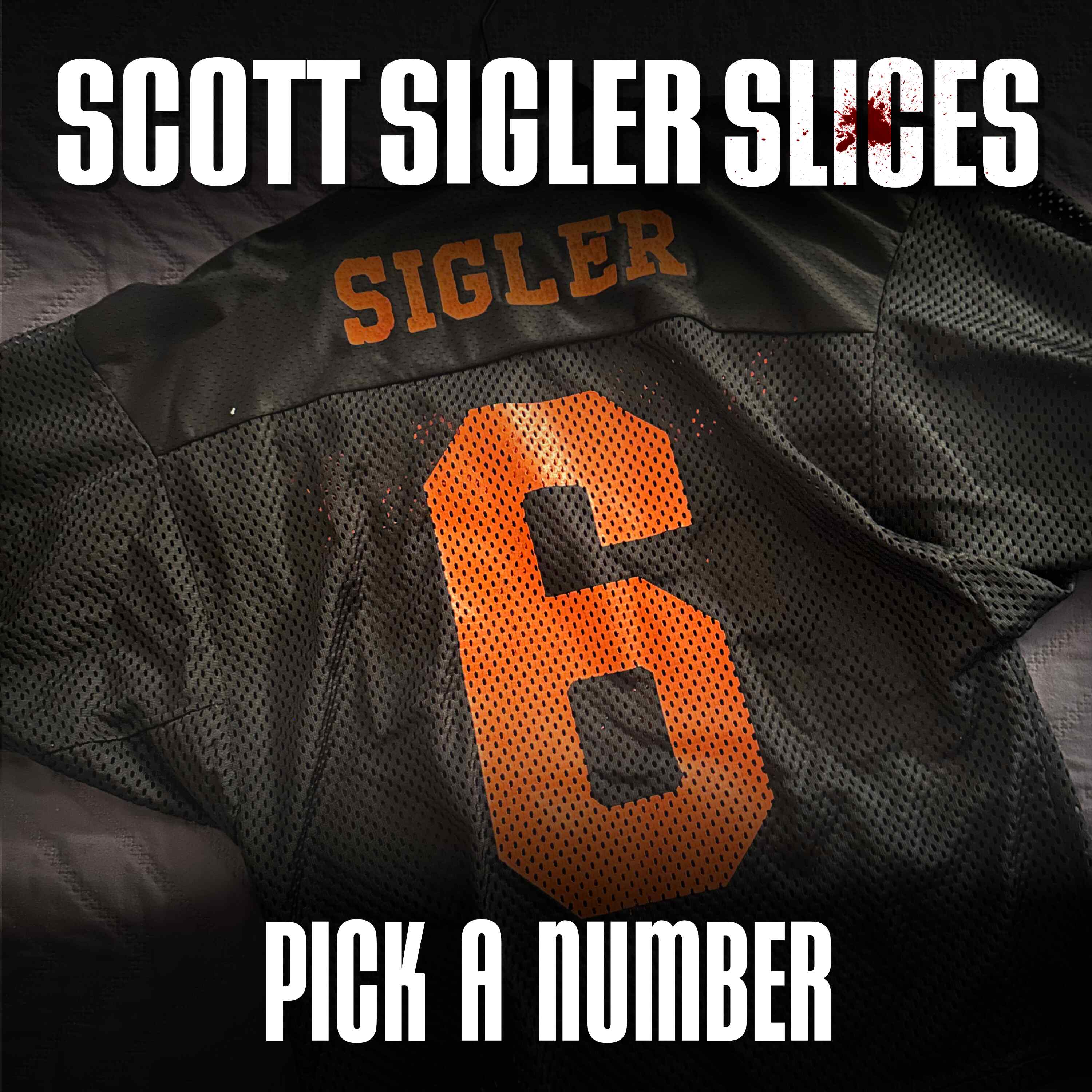
Welcome to Scott Sigler Slices. I am Scott Sigler, a writer of sci-fi, horror, and sports. You may know me by the trail of dead I leave in my wake, or simply as the future dark overlord. I am A.B. Sigler, audiobook narrator and publisher at MTSet Entertainment, where we make cool things for cool people just like you. A, I know we have different backgrounds in the world of sports, but you want to know something? I do. Athletes are completely rational human beings who would never assign mystical significance to a number printed on a shirt.
Is that really true? No, it's an absolute boldface lie. Athletes can be deeply, emotionally attached to their numbers. A number can mean family. It can mean an athlete you idolize as a kid and you've worked your whole life to follow in their path. It can mean superstition. It can become part of your identity. And sometimes it becomes an actual commodity that you can sell to your new teammate. Wait, sell? Like you mean sell? Like in, you want my number? Bitch, pay me. Exactly. And the prices can get wonderfully stupid. There's vacations. There's tens of thousands of dollars. There's Rolexes. There's autographed baseball. It's outdoor.
And in one case, in one case of a deal gone horribly wrong, an ice cream cone. Wait. Wait, an ice cream cone? We're going to get there. Yes, we're going to get there. Because today, we're talking about jersey numbers, the strange traditions around them, and why a number can become so important that an athlete doesn't simply feel like themselves without it. And for all of Scott Sigler junkies or sports fans, new sports fans who are new to all of this, jersey numbers do have a very practical purpose. They tell us who the players are. There is absolutely no woo involved at all. I have so much move in my head, I can't even tell you. But it's absolutely correct. That's why numbers wound up in uniforms in the first place. It's identification, mostly for the officials.
who are handling the game. It's hard to see names on the backs of jerseys, but numbers are big and easy to track. Holding, number 76, offense. Like, that is how the whole thing works. Uniform numbers are how the officials assign penalties to a particular player. And also, a number can determine what a player can legally do within the rules of the game. For example, in the NFL, players wearing numbers 50 through 79 are not normally allowed to catch a pass. A thing like that would be impossible to enforce with just names. For sure. So uniform numbers play an important rule in the letter of the law.
of the sports. But humans are humans. Athletes are crazy. And you give us something practical and we will immediately start attaching feelings to it. Numbers become personal. Okay. This I get because when things become personal, they become personal. They can get a little chippy. They can get a little frustrating. So before we move on, I have to ask, did or do you have a number? I do. You do actively have a number. Yeah. I have perhaps two dozen jerseys in my closet right now. They all have the number six. So that's your number. That is my number. Yes. Why six?
Okay. Roll up your sleeves, people. Get yourself a beverage. Sit down. I'm so excited to learn this. Sit down. We're going to talk about an unformed, immature little brain deciding on something that is carried through to my still immature but fully formed big brain. I got the number six for my Little League team in Sheboygan. Spare time lanes, buddy. Spare time lanes. So you just got assigned number six. I got assigned number six. In Little League for baseball. Yeah. Also, by the way, 1980 Little League champ spot. What's up? Champion. So being on a team, second base. That was awesome. Being on a team as a kid.
Love getting to second base. I like it. Being like when you're first on a team as a little kid, it is indescribably exciting because it's one of the first things that you're doing on your own. You know, I'm sure parents might be involved, but when you are on that field, it's just you, you and your teammates. Your teammates are relying on you. So you get this incredible burst of responsibility that you've never had before. So it's about discovery. It's about bonding. It's about developing as a person.
There's lots of emotions and feels and thrills and there's lots of disappointments. So I had number six. And when I got to high school, I was able to ask for that when I played freshman football at Sheboygan High School. And the Sheboygan High School football experience was amazing. It was seminal in my life and formative and it's helped make me who I am. So freshman year goes by and I keep the number for JV football. And I was not really great in freshman JV. I did a little better, smart enough to know what was going on and use my brains to apply my lack of physicality. But then when I played varsity football as a junior.
and everybody has brains, and your physicality comes to play. If you don't have it, fortunately, no senior had the number. So if I was a junior and a senior had number six, they would have been able to keep number six. So I was lucky enough to keep my number six, my beloved number six, for all four years of football. So I have a question right here. So if the JV team has...
different team than the varsity team. So junior varsity, if you were the number six and there was a six on the team, the varsity team, you knew going as you matriculated, you couldn't keep it. Right. So on JV, I'm a sophomore. And on the varsity team, the person who come back next year is a junior. So when we go up, I'm a junior, they're a senior. They already have the number. They've got it. And they get to keep it. Okay, got it, got it.
For that period of my life, particularly football, the number six, it became part of my identity. The jersey was an absolute source of pride. A lot of kids relish their high school number in all sports, not just football, never close, because how good they did on the field. It's glory days, right? And the fields that go with, you know, reminiscing about the days when things were just plain simpler. But also back to the thing you were saying about this is one of the things you did for yourself and by yourself. You also get to relish that. You're doing work that you're proud of in a new way. In a new way. And you're finding things that you never expected. Because I, let's be honest, I was not a good football player.
I played varsity football at 120 pounds, and I was also very slow on top of that, and also very short. I got to be the prep quarterback. Thank you, thank you. I was the quarterback for our starting defense. I pretended to be the quarterback for the other team. That I was good at because I learned the plays and gave them a good look. However, I got the living shit kicked out of me on a regular basis my junior and senior seasons. I got blasted by people that weighed me by 100 pounds, but I, my source of pride was I always got back up, got back to the huddle, and then when I had my shot, I gave as good as I got. If you weren't paying attention to me...
and I'm playing prep defense for the starting offense, I was going to get my licks in. I was going to get them in, and I was going to pay for it later, but I got them in. I took pride in my toughness. I found out who I was on that football field. And looking at that jersey number every day before practice and before games, for me, it came to represent my hard work, and it's a source of joy and pride. Now, that's my little story, but something similar holds true for a lot of people. A jersey number isn't just a number. It's memory and its identity. I absolutely appreciate that. I have never heard you talk about that before.
Even off, you know, even just one on one. And I also have never had a number on my back. I have never got to do that. So that's a really beautiful. Oh, I get that. Why? Why you identify with that number? And I get it. Therefore, why you understand what these you understand these athletes who are sort of.
attached and trying to keep their numbers. So if a senior, like we just discussed, already had the number six when you were junior, would you have paid that person to give a number six? I would say paid them with what? My lawn mowing money? Sheboygan, Michigan, bro. I'm not coming from a pedigree family. I didn't have any money. But if I did have money, yes, I would have fucking made the offer. I'd be like, hey, why don't you come on? I got someone to talk to you about. Stephen, come here for a second. Listen, you know, I got something here you might be interested in. I would have made the offer. So I understand the attachment.
Whether I understand somebody buying someone else an outdoor kitchen is another question, but this does make the whole thing more interesting. The number, it doesn't make you faster, doesn't make you stronger, doesn't improve your jump shot. Doesn't. However, tell that to a young lad by the name of Michael Jordan. Oh, yeah, exactly. This is so interesting. This, I'm so glad you mentioned Michael Jordan here because this brings us to some of the wildest stories about grownups pining away from one certain number. I have understood from you.
When you're on a team, you keep your number most of the time. We just talked about that. If a senior has your number that you want coming in, you have to pick a different number, all that. But when you get traded to a different team, odds are somebody already has the number that was your number on your first team. For example, almost everyone associates Michael Jordan with the number 23. The Air Jordan, one of the most famous athlete number combinations in history. But when Jordan returned to the Chicago Bulls in 1995, after his first retirement, he wore number 45.
He had worn 45 when he played baseball. He'd also worn in basketball when he was younger, because again, we go back to his formative years. Number 45 identified with him, even though he was a huge superstar with 23. So, he's wearing 45. But then came the 1995 NBA playoffs against the Orlando Magic. Yes, it's game one. The score was 91-90 in favor of the Bulls. 18 seconds, 18 seconds left. The ball is in Jordan's hands where it should be because he's the guy who hits the game-winning shots. There is no shot clock. There is no shot clock. All Jordan has to do is hold on to the ball and the Bulls win. And then...
Orlando's Nick Anderson stole the ball from Jordan. Orlando scores, wins the game 94-91, taking a 1-0 lead in those finals. And afterward, young Mr. Anderson screwed up. He basically said, out loud with words, that number 45 apparently wasn't the same guy number 23 had been. Oh, tiny. No, Nicholas. Oh, sweet summer child. Nicholas, Nicholas.
You have angered the basketball gods, and in particular, the literal god of basketball, the greatest player of all time. So Jordan, you know, being the completely rational and not superstitious or vindictive fellow that we all know he is, shows up for game two, and he's wearing number 23. It's so good. And he drops 38 points on the Magic, and the Bulls tie the series. So listen, I'm going to tell you all and you, Scott, I think you already know, but the NBA was not thrilled about the surprise wardrobe change, we'll call it. That's correct.
There are rules. There are rules, man. Jordan was fined $25,000 for switching numbers without properly reporting it. And then the Bulls organization got hit with additional fines as the number situation continued. And Jordan at that point basically decided, I'm not 45. I'm 23. And those of you who know the sports world, he said, and I took that personally. And apparently being Michael Jordan costs extra. But to him, the number mattered. And it mattered on the sport of basketball's biggest stage. Absolutely. So listen, we are talking about players of any ilk, of any sport.
Coming in and needing the numbers so they can do their game, so they can front and do the thing they're meant to do. And there is, in my opinion, as a New Yorker, no better example of this than the main character, I believe, of this episode, which is NFL punter Jeff Fegels, the shakedown king of New York. That's a good title. We're going to talk about the Shakedown King of New York when we come back from this quick break, but I swear to all that is holy and to the God of basketball who will strike down upon thee with furious anger that the stories we're going to tell after this quick commercial break, you guys want to hear them. We'll be back in a second.
Hi, this is Rob Benedict. And I am Richard Spate. We were both on a little show you might know called Supernatural. It had a pretty good run. 15 seasons, 327 episodes. And though we have seen, of course, every episode many times, we figured, hey, now that we're wrapped, let's watch it all again. And we can't do that alone. So we're inviting the cast and crew that made the show along for the ride. We've got writers, producers, composers, directors, and we'll, of course, have some actors on as well, including some certain guys that played some certain pretty iconic brothers. It was kind of a little bit of a left field.
choice in the best way possible. The note from Kripke was, he's great, we love him, but we're looking for like a really intelligent Duchovny type. With 15 seasons to explore, it's going to be the road trip of several lifetimes. So please join us and subscribe to Supernatural then and now. You've got your favorite blanket, a freshly poured drink, and a cold case burning a hole in your streaming queue. You're not just watching true crime, you're running the investigation from the comfort of your couch. Welcome to Murder, She Watched, the podcast where we recap, dissect, and slightly overanalyze some of the best and craziest
True crime documentaries on our favorite streamers. Did the spouse do it? Why is the shady neighbor wearing leather gloves in July? Why did this guy agree to be interviewed in this documentary? We ask the tough questions that you're often just screaming at your TV. So every week we break down the twists, red herrings, and absurd documentaries that have kept you up all night. It's high drama, cozy vibes, and absolute couch detective energy. Grab your throw blanket and hit subscribe. Search Murder She Watched wherever you listen to podcasts, and let's solve this thing together.
Welcome back to Scott Sigler Slices. In this episode, we're talking about the crazy superstitions involved in a player's number, professional player, college player's number, and the feels that go along with it, and the crazy things that people will do to hold on to their number. And the next story we're telling right now, the year is 2004. The New York Giants acquire rookie quarterback Eli Manning. Jeff Beagles is already on the team. He's on the team. And Eli Manning, ladies and gentlemen, would go on to win two Super Bowls. Eli Manning had worn number 10 at Ole Miss, and he wanted to keep wearing it.
With the Giants, there was just one problem. Jeff Fegels already had it. Now, listen, there are pathways. There are rules that allow a team to redo their roster. So a key player can get a specific number, but it is almost never done because I think it contributes to sort of locker room poison or back and forth or whatever. So we don't do that. So a player on a team sort of has an unspoken right and privilege to his number. So Eli Manning, good guy that he is, asked Jeff Fegels just to give it up.
And you know the guy in charge, Don Fegels. Jeff Fegels? Well, his name is Jeff Fegels, but he's the Don. He's the shakedown king of New York. He is. And he's willing to negotiate. Let's talk about it. We're both civilized men. We'll settle this. They decide on a price. In that price. And all expenses paid Florida vacation to Disneyland for the Fegels family, Jeff, his wife, and their four kids. Forget about it. So listen, if you guys who are listening to our podcast now think...
that that was fiction. It isn't. Manning agreed to exactly that. A Florida Disney World vacation for Jeff Fegels and his family. Fegels gave up number 10. Manning got number 10.
The Fegels got a family vacation. Everybody won. Everybody won. Fegel switches to number 17 because he is entering his 17th NFL season. Makes sense. Right. And that's when Eli Manning asked him to give that up. And no one on the roster has that number, so it's safe. It turns out for Mr. Fegels, number 17 was lucky the next season. It's so good. How come? Well.
The following year, the Giants acquire wide receiver Plaxico Burrus. I mean, what a beast. One of the most fun players to watch in the history of the NFL. What a beautiful man. But here's where it gets weird, A. Sigler. Here's where it gets weird. Eli Manning wore number 10 college, wore number 10 the pros. Makes sense. Yeah, it does. Plaxico Burrus wore number four when he played for Michigan State University. And then when he got drafted by the Steelers, he wore number 80 for the Steelers. What?
And now he wants number 17 for the Giants. I'll tell you why. This is insane shit. Because he signed with the Giants on March 17th. So he wanted 17. And you know what that means? That means that the shakedown king of New York, he's back in business. Yes, yes. Jeff Beagle's my man, my man. He's like, fine. I'm so in demand, I'm asking for a trade. Apparently. Not a trade for another team. Right, not. A trade for the number. A trade for the number. I don't need your money. I don't need a vacation to Disneyland. I already got there. Listen, Plaxico Burris, what I need.
is an outdoor kitchen for my home in Arizona. Such swagger. Here's the thing. Classical Burris agreed. Okay. Burris got 17. Yep. Fiegel's would get the tricked out outdoor kitchen, which he can only enjoy for 27 seconds every fucking year in Arizona. Goddamn. Yeah, that's a good point. And Fiegel's wore 18 that year because it was his 18th season. It's the second time. He gets a number that's significant to him. There's just one problem. Burris didn't pay.
According to Fegels, he did not. The shakedown king of New York got shaken down. Years later, Fegels said he wound up paying. Oh, you know what? Oh, oh, oh, oh. I mean, it's true. The shakedown king of New York, you know what he had to do? He had to pay for the outdoor kitchen himself. Oh, listen, he wasn't. OK, listen, Fegels wasn't doing anything illegal or anything untoward. And it had happened already and worked out. It turns out that. But here's the thing. Now, Fegels, this is where we told you we had the tea license, gentlemen. We got the receipts. Fegels later claimed that Burris had basically stolen.
his number. Remember when I told you that athletes were very logical and not superstitious at all? Yeah. He accused an old man of stealing a number. Go ahead. Also, you sometimes call them athletes. Sometimes you call them athletes. Sometimes you call them athletes. So he did say that Burr's had basically stolen his number because he had a handshake agreement, which teaches us an important lesson. And that lesson is, ladies and gentlemen, as in all things in the world of business, get the jersey number transaction in writing.
Now, we will meet the NFL players who actually did that, got it in writing, and yet it ended in an actual lawsuit. A lawsuit over a jersey number, like actual litigation and law books and stuff like that. In 2004, running back Clinton Portis arrived in Washington after a blockbuster trade from the Denver Broncos. And Portis wanted his number. He wanted number 26. But safety, Ifaini Ojolete, already had it. And this time, the players did not rely on a simple handshake. They made an agreement.
A one paragraph contract, A. Sigler, not only signed by both men, but witnessed in writing by Redskins equipment manager, Brad Berlin. They got a witness. It's so insane. The deal, the deal they signed, $40,000 for number 26. Portis had paid 20, Portis actually paid $20,000 up front. Then.
Washington released Ojolete. Okay. And Portis puts on his Jeff Fiegel's hat. Portis figures, hey, he's gone. I don't need to pay the rest. He's gone. He can't use the number. He got released. He's thinking, you know what he's doing? He's thinking like he's the shakedown king of New York, right? Well, right. He's not Fiegel's though. Maybe he is. I don't know. So from Portis' perspective, Ojolete wasn't on the team anymore. So therefore, number 26 becomes naturally available. Let's recap. He gives him 20 grand up front for a 40 grand deal, but then Ojolete is no longer on the team, so it's available. So Portis says,
Why am I going to pay another 20 grand for something I can have for free? Because there was a contract. Olete sued him, and eventually they settled. And I got to give props to Portis for this. Portis, who's making, I'm going to guess, $7 to $12 million a year at that point, because it was 20 years ago, so I'm not really sure what running back's got. But it's a $40,000 deal. Portis, wheels and deals, gets it down.
$2,000 less. He pays the second half. He pays another $18,000 because it's the pride. Fucking with him. So Portis eventually ultimately pays $38,000 for number 26. But he did save that $2,000. That's my man, Portis. Do your thing. Go to town. This is an actual economy. We do this on Facebook Marketplace. We used to do it on Craigslist. We do it all the time. This is important to me. My shit is stuff. Your stuff is shit. We're doing it. Props to George Carlin for that joke. It's completely unofficial. This is absolutely real. The basic premise of this economy is you have something I want.
How much do you want for it? And money isn't always the currency. Oh, I'm here for this. Give us some of the stranger trades because you know all of these. What are some of the stranger trades? Okay, listen, guys, the trades that are coming up, the Jersey economy, it gets even more bonkers. We just told you it's bonkers, but we got to pay some bills. So listen, we're going to toss in one ad, maybe two tops. We'll be right back with some of the coolest shit involving some of the biggest names in the fucking history of sports right after this.
The world of Sonic the Hedgehog has been thrust into a not-so-dark, not-so-stormy, hard-boiled detective story that probably nobody saw coming. Follow Sonic and the intrepid Chaotix Detective Agency as they take on their biggest case yet. This high-flying, action-packed adventure will take them across the world, fighting for every quill they can fight. It's one heck of a tale, which is good, because this story might be the only thing that can save their lives. Well, if that's all, I can just dispose of you. Wait, what?
All will be revealed in Sonic the Hedgehog presents the Chaotix Case Files. Listen now, wherever you get your podcasts. The Chaotix are on the case. Do you love Disney? Do you love top ten lists? Then you're going to love our podcast, Disney Countdown. Hi, I'm Megan the Magical Millennial. And Biscuits, I'm Jeremy, a.k.a. Jared Dell, and we are the hosts of the hit Disney podcast, Disney Countdown. On every episode of our fun and family-friendly show, we count down our top ten lists of all things Disney. The parks, the movies, the music, the food, the lore. There is nothing we don't cover on our show. Right, Jeremy? Ooh, girl, you know we are famous for rabbit holes, Disney-themed games, and fun facts you didn't know you needed, but you definitely need in your life. So if you are looking for a healthy dose of Disney magic, check out Disney Countdown wherever you get your podcasts.
We are back. This is Scott Sigler Slices. I am A.B. Sigler, audiobook narrative publisher for cool people who want cool stuff. And I am with Scott Sigler. Yeah, the future dark overlord. I got a story for you. Okay. Hang on. The only stories I want to hear about weird trades. Weird trades for numbers, weird trades for names, things like that. I thought you were talking about weird trades for gremlins, but that's all separate. That's a movie, actually. We'll watch that later. So in 2014, pitcher John Lackey was traded to the St. Louis Cardinals, and Lackey wants number 41. But pitcher Pat Neshek already has it. Lackey gave Neshek an autographed Babe Ruth.
baseball for the number. This is actually so classy. And also, I kind of love that it's a sports for sports. And also, it's a segue for you and I because we're going to talk about Babe Ruth a little bit later in the episode. It's great. So therefore, I love this one. So it's a piece of sports identity traded for a piece of sports history. But we can get even weirder, ma'am. We can get weirder. 2011 is the year. Donovan McNabb has joined the Minnesota Vikings. Skol! McNabb had worn number five for years with Eagles Vikings punter Chris Cluey already had number five. I do love Chris Cluey. Yeah. I do. What did Clue want?
The reported deal included a $5,000 charitable donation. Love it. He's a good guy. Yeah, you're right. It's Cluey. You're right. It's Cluey. Don't give it to me. Give it to these people who are needy. He's a good man. He's a good man. And then, as a musician in a band. Also in then. Also in then. The one thing I like the most about this guy, McNabb had to promote Cluey's band, Tripping Icarus. Yes! And the closing clause in his contract.
Cluey wanted an ice cream cone. I love this. This is just like Van Halen wanting brown M&Ms. This is true. Yeah, I know. And it's the same thing. He just wanted brown M&Ms to make sure we're reading all the things. I don't want everything. I'm not trying to take you to the big house. I'm just trying. You just got to do the things, right? So did he get it? Did he get his ice cream cone? And this is where Donovan McNabb is one of the baddest ass gangsters of the NFL in the history of the NFL. Cluey later complained that McNabb never delivered the ice cream. Imagine earning millions of dollars playing professional football and getting called out because you stiffed the punter on a cone. But you said this is why McNabb...
is one of the baddest asses in the game. Isn't it Cluey who's calling him out? No, McNabb, like Portis. Portis held onto that $2,000, that 5% discount. He held onto that shit. And McNabb's like, you know what? Here's a charity. I'll put my band. Fuck you on that ice cream cone. Fuck you on that ice cream cone. That's the smallest little petty bullshit thing, right? It's so bullshit. I love the petty bullshit. I think we can do better than that. I think we can top that. Fine, fine, fine. 2026. Hockey star, Artemy Panarin, joins the Los Angeles Kings. Panarin won at number 72. And it wasn't another Kings player wearing number 72. Oh, this is my favorite. There was. There was, however. Get this.
A lion. An actual roar before the movie, let's eat a gazelle together lion, and that lion wore number 72. Okay, to be fair, it's actually not an actual real MGM lion. Not a real lion. But the king's mascot is a dude in a lion suit called Bailey the Lion. Bailey the Lion, his number was 72 because it's always 72 degrees in Los Angeles. I mean, I'm just saying, it would have been a lot cooler if it had been a real lion. I'm just saying. Fair enough, fair enough. But to get the number from Bailey the Lion, Panarin gave Bailey a Rolex watch.
And they agreed together to share the number. Like adults. Like adults. And we've seen this happen in the Olympics a handful of times where people who have the exact same time in a time sport agree to share the number or things like that. Yeah, because the mascot isn't on the actual roster. So they can both wear the number. It's not going to be confusion for the refs or anything like that. A professional athlete literally negotiated jersey rights with a mascot.
in a lion suit. It's sports. Sports are, this is why I love sports. Magnificent shit like this. Also, fuck you, Chris Cluey. You ain't get that goddamn ice cream cone. You ain't gonna get it. I will buy Chris Cluey all the ice cream he wants. It's fantastic. But you know what? Donovan McNabb said, you ain't get no goddamn ice cream cone. So that is, it's time now for a great, great story. Somebody would call this story The Great One.
Okay, it's a story about Wayne Gretzky, and you absolutely don't fucking want to hear this shit. Okay, wait, wait, wait, wait. Okay, yes, we definitely need to just finish up this episode about a grown-ass man throwing a hissy fit over Jersey numbers with some famous numbers. happening kind of by accident. The greatest example. The greatest. Happens to be the greatest one, the Wayne, the Gretzky. He originally wanted number nine. Yep. Wanted number nine because he idolized hockey legend Gordie Howe. I got that. Red Wing was still at Detroit, but when Gretzky joined the Sault Ste. Marie Greyhounds as a teenager at the age of 16, number nine belonged to another player. So Gretzky, being the great one that he is or was going to become, says, you know, you know what? I'll take number 99 because I just don't want any trouble. I just want to score goals and contribute to the team. Which absolutely.
For me, Gretzky, this is the thing. Before I knew anything about sports, anything at all about sports, I knew that Gretzky was number 99 and he was the great one. Yes. I absolutely, it became one of the most famous numbers of all time in all sports. I would say that Gretzky and Jordan are sort of tied in the cultural consciousness for a player who's associated with a number and will be forever. Tom Brady.
Despite his seven rings and his 10 Super Bowls and that number 12, he does take a backseat to these two guys. For sure, because he didn't have to fight for it. Well, it's just that Gretzky and Jordan were so transcendent in their particular sport and both changed the game forever that while Tom Brady is the GOAT of American football, I think these two guys are on top of him. So Gretzky rewrites the NHL record book. Number 99 becomes inseparable from Gretzky. And in 2000, the NHL retires the number 99 league wide, which means...
He was so great. Nobody in the NHL gets to wear his great number for the rest of goddamn time. It's such an interesting thing to me, somebody who never wore a number. No one ever gets to wear that number again. But it is not the number that Gretzky wanted when he first joined the league. His literal immortal number is a replacement number that becomes immortal. That's why I love sports. That's why I love sports. Which brings us...
We're almost finished, guys. Strangest transformation, Paul. Sometimes a number becomes so closely connected to an athlete that the sport decides the number no longer belongs to anyone, like Gretzky. And one sport came up with an even more powerful way to honor what I consider to be, personally, the greatest number in the history of sports. A number that influenced my Galactic Football League series dramatically that helped me write that series. And instead of nobody wearing this number, everybody wears this number.
We should explain retired numbers a little bit for our newer sports fans. Yes. All right. So retiring a number is one of the biggest honors a franchise can give to an athlete. The team essentially is saying this player meant so much to us, did such fucking good work for us. We loved him that nobody else on this team will ever wear that number. Again, it's a huge honor. It is a nice thing to do. By the way, if you have not heard our episode about NFL quarterback Jaden Daniels for the Washington Redskins and the controversy over his number not being retired, search for this podcast feed and find it. I think you guys would really like it. It's great stuff. And when it comes to retiring a number, three, three.
Major North American leagues have gone even further than just retiring a number four franchise. So I know Wayne Gretzky's number 99 in the National Hockey League. I know... Bill Russell's number six in the NBA. Who's the third one? Jackie Robinson's number 42 in Major League Baseball. So this is really interesting to me because Bill Russell's number in the NBA is still, for me, is interesting because that's your jersey number as well. Yes. And I literally, the top of my head might be at Bill Russell's hip. He's a very, very tall man and I'm not the tallest of men. Bill Russell won 11 NBA championships with the Boston Celtics. Jordan, of course, famous for winning six. Kobe's won five. Bill Russell won...
He was also a hugely important figure in the civil rights movement. He was a giant. He was a giant, a literal physical giant of man and a giant of a spirit. So after Russell dies in 2022, and you guys may not know this, but most of the players in the NBA are black. So you may not know this, but so therefore a civil rights icon who happens to be an all time player in the top five of all time.
When he died, the NBA permanently retired his number six across the league. Such a gross. No new NBA player is allowed to choose it. Jalen Williams, vocal in City Thunder, has it because he wore it before the league retired. And for the same reason, so does DeAndre Jordan and the Northern Pelicans. But those two young men will be the last people to wear number six in the league. Oh, I thought it was only Jaden Williams. I believe DeAndre Jordan. You guys can Google it. You can Google it when I think that's what I found. Yeah, of course. But Major League Baseball, I know you're less of a baseball fan, but Major League Baseball also did the same thing with Jackie Robinson's number. They retired Robinson's number 42 throughout the Major League in 1997. By the way, if you've not seen the movie 42,
I highly, highly, highly, highly recommend it. As an American, it's an absolute tearjerker of a movie. And this is a man, this is a man who changed the world with his own perseverance and endurance and tolerance that has benefited hundreds of thousands of other people that followed him. So Robinson broke Major League Baseball's modern color barrier when he played with the Brooklyn Dodgers on April 15th, 1947. Again.
Huge moment. That's the reason the Galactic Football League series exists. One of the reasons is that moment. So baseball eventually came up with an incredible twist on the idea of retiring his number. Absolutely. I will also mention, if you guys are movie fans and not necessarily sports fans, watching the movie 42 also gives you an absolutely masterclass performance by Chadwick Boseman, who eventually became Black Panther as Jackie Robinson in the movie 42. But baseball did eventually come up with an... You know who's fucking also spectacular in that role as a fucking villain? Who's the guy who was the alien and also the pilot in Serenity?
We're going to look at this. Alan Tudor. Yeah, Alan Tudor. Oh, yes, Ben. Yes, yes. And Harrison Ford's in it. Just fucking watch 42. Alan, everyone loves me because I'm a nice fucking guy, Tudor. Yes, good point. It's such a fucking prick in this movie. Good point. You are watching a cadre of actors at the peak of their talent. Good point, babe. But let's get back to this. So you are right. Baseball eventually comes up with a great twist on retiring Jackie Robinson's number, which is. That is why April 15th. Jackie Robinson Day. Jackie Robinson Day. Every single.
April 15th. Players throughout Major League Baseball wear the number 42. Come the fuck up. Think about that. Retiring a number usually means no one will ever wear this again. Jackie Robinson's legacy became today.
Everyone on the field wears the same number. That is an honorarium. That is a celebration. As a sports guy, it's hard to fucking even fathom. I think it's beautiful. It's beautiful. And it is a beautiful denouement for that season of professional sports where there was a color line that doesn't exist anymore. And you want to acknowledge that Jackie Robinson persevered through that. And that's a beautiful way to do that. That's a beautiful way to kind of say, hey, I appreciate that. There were people who were great. One of the people who were great.
we'll talk about in a second. I do want to say this is a long way from where Jersey's numbers existed in the first place, right? That's the point of this episode. Jersey numbers originally existed so the official could castigate the person who made the foul. Right. And now we're talking about...
We're talking about associating a number on a jersey with people who have literally changed the course of history and literally improved life for thousands that followed them. So it's great shit. Now we're going to need some speed round. Speed round, baby. Here we go. Here's my favorite example of how ordinary these things can start. In 1929, almost 100 years ago, the Yankees began regularly wearing uniform numbers. Still relatively new, right? And their system, it's incredibly practical. It's the New York Yankees. It's simple. It's logical. The numbers corresponded to where the players generally hit in the batting order. I know where you're going with this.
Babe Ruth, mystical figure, mythical, mystical figure in baseball. He's the Bambino. It is the house that Babe built, right? Yankee Stadium is the house that Babe built. He's a Hall of Famer power hitter. He is so famous in his moment. He got the number three. Because he batted third in the lineup. Lou Gehrig. Lou Gehrig got the number four. Yeah, because Lou Gehrig, which if you guys don't know that name.
All I can tell you is he is the Tolkien of fucking baseball. He's on a completely different level. Great guy. Actually, it was autographed. Did you know that? I got his autograph. I did know that. Yes, I did. Congratulations. That's so fun. I was fucking six. I didn't know what it was. I hope I still have the goddamn picture. He's another titan of the sport. He batted fourth. So got number four. And that's it. But these are two of the most iconic numbers in baseball history. Basically started as lineup information. And I don't know if you know this, but Gehrig's number eventually becomes the very first number retired by a major league baseball team ever. That's crazy. So, ladies and gentlemen, that is the whole story of jersey numbers in miniature identification.
becomes tradition. Tradition becomes identity. And identity becomes legend. So, you guys, listening right now, here is the question for this episode. What's your... Not your favorite athlete's number! Your number. Maybe it was your first Little League jersey. It was your high school number. It could be your party birthday. It could be your favorite player. Maybe you have absolutely no rational explanation for it. It's just your number. But you know what? Go to scottsigler.com, find this episode, share it with us in the comments, or you can hit us on all the social medias, at scottsigler. Do you hear this? Whatever the reason for your number, share it with us. So...
If you became a professional athlete tomorrow and somebody else had your number, we want to hear that. You know what? Now we find out how much you really love a thing. Would you pay $1,000? Would you pay $10,000? Would you pay $40,000? Would you trade an autographed Babe Ruth baseball? Would you buy a dude in a lion suit, a fucking Rolex? Would you send a punter?
To the happiest place on earth? Would you buy me an outdoor kitchen? Only after I get that shit in writing. An ice cream cone? Fuck you. You don't get the ice cream cone because I am a monster. Oh, so what have we learned here today? My love, we have learned jersey numbers start out as a simple way to identify players on the field. But that's not all it is.
In our culture, always turn into something much bigger. Numbers can represent childhood heroes. It can be your found family. It can be superstition, personal identity. It can be money. It can be legacy. And sometimes a number becomes so connected to one athlete that an entire league decides no one else can have it. Except Jackie Robinson's 42. Because one day, every year, everybody gets to be number 42. I knew it. I knew you. So tell us your number and why it belongs to you. And remember, whatever number you're wearing.
You all smell an awful lot like flowers. Number six. I love you. I love you too, baby. We gotta get you a number, girl. We gotta get you a number. I do have a jersey number, but I never played on a team other than the empty set team, so I'm not sure if it counts. You know who I think it should be? Who's who I think it should be? Infinity? Number one. Ah, come on. I'll tell you why. Number one. First of all, you're my number one. Second of all, you were an archer. You know what archers do? Don't have numbers. One arrow at a time, baby. It's one arrow at a time. Bye, guys.
It's the feeling of escapism, the call of glory, that drives us to build fantastic worlds, yet some grow darker than others. Dark Dice is the improvised horror podcast diving into the depths of madness and the corrupt divine in the fantasy realm of terror. Wayward souls who dare risk their characters at our table bring our stories to crawling life. Enhanced with award-winning soundscapes and music, Dark Dice mixes the role of the dice with the drive to survive. So join us and hear the horrors of Dark Dice wherever you listen to podcasts. The world is ending. You just don't know it yet. But you feel it. Deep down in your bones. Don't you?
Some call it the Great Undoing, as it seeps in at the edges of forgotten places, where crumbling, abandoned ruins slowly fade away. And in their fading, these places wear thin the fabric of reality, their rot creeping outward. It calls to you, and to the others. Edge of the Forgotten is a supernatural horror hybrid podcast, with Season 1 totaling 13 narrated episodes and 10 full-cast audio drama episodes. Now running on the Realm Network and all popular podcast platforms, with new episodes every Tuesday through the end of November.
Welcome to the Undoing. Welcome to Edge of the Forgotten. Grace, thank God. Operator, tell Dr. B that Grace is awake. I... Don't talk yet. The doctor thinks you had a seizure while Iris and I were out. With something like your pituitary tumor, it's quite possible that the peripheral vision loss is permanent, but we may be able to slow or even reverse your central vision damage. It's getting worse. Maybe... Maybe I got you close to the car, or maybe someone snuck some technology into the town. We have to find it, or report it, and get rid of it, or something. Please don't go looking for anything else that will hurt you.
who's there get scared with how i died the carrington event how i died the carrington event is available now on all podcast apps