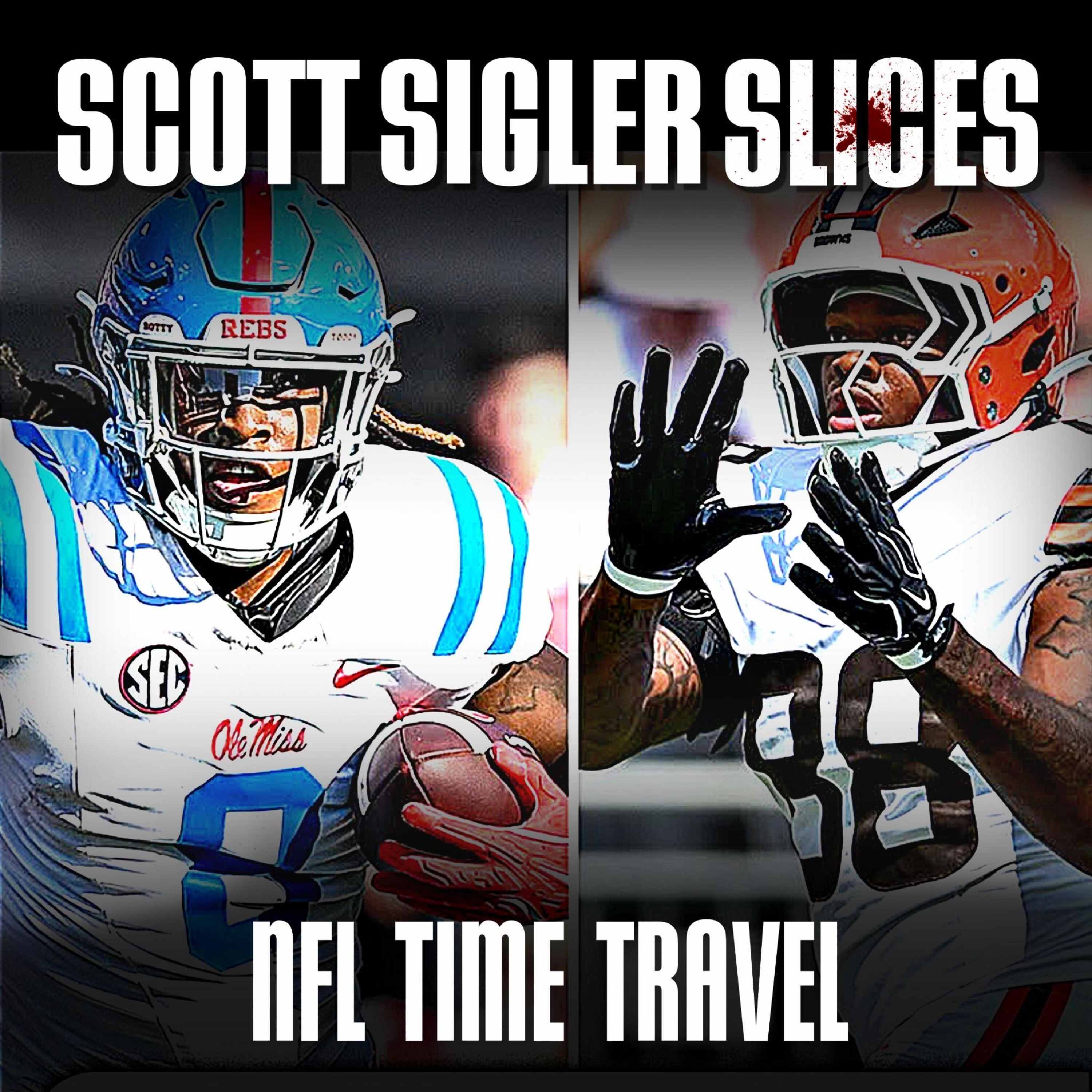
You guys, we've got a story about time travel. Even if you're not a football fan, you're going to find this quite interesting. For all of Written Eternity, all of Written Eternity, the pro football career path was simple. You play high school ball, you play college ball, then the pros. But somebody's put a magic phone booth into the game of Gridiron, and now professional players are going back in time and suiting up for college teams. Is this legal? And if it is, is this fair? We're going to discuss all of that right after this. Hold on a second. We recorded this episode.
on August 26th. The next day, crazy stuff started to happen in this story. So what we're going to do is just play you the episode that A&I recorded because it's crazy, wild, fascinating stuff. Then at the end, I'll jump back on and give you all the new information that has happened since the day we recorded this episode. So check it out. Hope you dig it. We'll be back with the episode right after this quick break. Welcome aboard Via Rail. Please sit and enjoy. Please sit and sip. Play. Post. Taste. View. And enjoy. Via Rail. Love the way.
Welcome to Scott Sigler Slices. I am Scott Sigler, a sci-fi whore and sports fiction author, otherwise known as the future dark overlord. And I am A.B. Sigler, audiobook narrator and publisher at Empty Set Entertainment, where we make cool stuff for cool people. Listen, this episode isn't really about time travel, but the natural order of football has changed in a very big way. Scott Sigler, what happened? In the olden times, in the before times, as in before 2026, college players normally had four seasons of competition with a five-year eligibility window. So an underclassman who still had eligibility left.
could declare early for the NFL draft before they graduated college or after being out of high school for at least three years. Now, once that player gave up his remaining college eligibility and entered the NFL draft, that decision was effectively permanent. If he was drafted, signed an NFL contract, went to camp, made a practice squad, or otherwise became a professional, he could not later say, that didn't work out, I'm gonna go back to college. The NCAA specifically prohibited players who had signed professional contracts from returning to college competition. So the traditional path was basically college. Declare for the NFL draft.
And now you are a professional football player. And there was no going backward. It was a line in the sand, a line in the sand. Even if the draft finished and your name wasn't called, you still couldn't go back to school. Which is crazy because in so many places, you go back to school to give yourself more skill sets to do the job you want to do. And now that's actually occurring. So what in the Rodney Dangerfield is happening here? What has changed? The NCAA eligibility rules are being challenged in federal courts. Courts have questioned whether the NCAA can automatically bar former pros from college sports, especially players.
who still have unused seasons of NCAA eligibility. So the recent rulings have allowed some former NFL players to reclaim that eligibility, including players who declared for the NFL draft and went undrafted. And in some cases, players who signed NFL contracts or, and this is the big one, spent time with NFL teams as an employee. The NCAA has responded with these new eligibility policies and waivers. The result, the sum total of the whole thing is, NFL experience no longer automatically means your college career is over. But this is not a simple blanket rule.
It's not like every former NFL player can just jog on back to the quad. Eligibility depends on the player's history and the rules or court orders applying to his case. 2026 is the first season where we're seeing this play out in a significant, highly visible way. Yeah, things are really changing. Can you give us an example of somebody who this year, in 2026, kind of went back in time from the pros back to college? Daquan Wright is an example. He played for Lane Kiffin at Ole Miss. Lane Kiffin was the head coach of Ole Miss. And Daquan declared for the draft. He went undrafted, which means no team drafted him. But he's still able to go apply to other teams. He signs a free agent with the Philadelphia Eagles. The Eagles cut him.
So he signed with the Cleveland Browns. He played an NFL preseason game. Pay attention, people. This gets important later on. Then he was cut by the Browns. So he has finished his college career, went to the NFL, signed with the Philadelphia Eagles, was waived, signed with the Cleveland Browns. And now he's been waived by Cleveland and has an agreement to play for LSU, which is now coached by Lane Kiffin. His old coach at the new school is his new coach at the new school. Wright is poised to become the first player ever to actually play college football after appearing in an NFL preseason game. OK, OK, OK, wait. So.
He not only can play college ball again, he switched schools? Yeah, that's exactly. And the switching schools thing needs to be a whole different episode because college players can now basically switch every year if they want to. It's another thing that, along with NIL money, which we'll discuss a little bit in a moment, is really blurring the lines between college and pro sports. Is anyone else doing the time warp again? Yes, yes, yes, there is, Frank. And further, there's defensive lineman Zavian Harris, another former Ole Miss player who played for Lane Kiffin. Lane Kiffin is taking over our whole cast. It seems to be. Zavian declared for the draft at the Combine, where NFL scouts evaluate most of the players.
who have declared for the draft. A foot injury was discovered, and it was significant enough that Xavier went undrafted. People want to waste a draft back on an injured guy, but that might heal. So he signed to the New Orleans Saints as an undrafted free agent. They knew he was hurt, but thought he might recover. He was still hurt when training camp opened, and he did not actually practice with the team. So he was caught on August 8th. And now he's going back to school, and guess where he's going, eh? I assume...
Even though he was Ole Miss, he's going to LSU to play for Lane Kiffin. Exactamundo, honey bunny. There may be a pattern here. But there's other non-LSU players involved as well as a bunch. Safety Miles Rouser played for Arizona State, went undrafted, participated in the Seattle Seahawks rookie minicamp. He didn't make that cut. Now he's off to Houston University for another college season. Then there's a few NFL players who won the legal right to potentially return.
but they haven't committed to a college yet. Wydat Williams, do ends up back, was on the Arizona Cardinals roster. Anthony Hankerson, running back, was with the CLC Hawks and Jack Pyburn, an edge rusher, and he was on the Tampa Bay Buccaneers roster and is covered by the Louisiana litigation, which we're going to get into in a second. All of these guys now have the right to play college ball again. I got so confused right there because you said Houston University and I went to the University of Houston first semester and they're the same thing. But the question I actually have, are any of these guys going to pledge Lambda Epsilon Omega? What is that? That's the fraternity from the movie Old School. You're my boy, Blue. Try to keep up.
I like you. You're crazy, but I like you. And also, go Cougars! Okay, so I assume all the big-time football schools are hoping to find ex-NFL players. Is that true? Apparently not all schools. The day we recorded this very episode, the Big Ten adopted a rule intended to prevent players like these from playing at their schools. Currently, the Big Ten feels it isn't fair for NFL players to return or join Big Ten rosters after entering the pros. I understand that, and the times they are changing. I get all that, but why is it happening, right? It's like how the Olympics used to be only for amateurs, but that changed because we needed to include pros. Now it's happening in college football. We're including pros. How did these court cases come about?
It is an absolute soap opera. Is it a soap opera about time-traveling football players? You know what? Now that you bring that up, I believe that is exactly what it's about. Let's go. I'm going to cover the order of events or how this happened right after this quick break. So don't go anywhere, people. The business of college football is fascinating. We'll be right back. Welcome aboard Via Rail. Please sit and enjoy. Please sit and stretch. Steve, flip.
More that and enjoy. Via Rail. Love the way. The new Subaru Crosstrek Hybrid is the most fuel-efficient Crosstrek yet. That means less time filling your tank and more time filling your day. More court time. More ride time. More lake time. More camp time. More go time. The new 2027 Subaru Crosstrek Hybrid. Consumer Reports top-rated subcompact SUV. Stop by your local Subaru dealership or visit Subaru.ca to learn more. Consumer Reports is not endorsed products or services.
Welcome back to Scott Sigler Slices. This episode, we're talking about the crazy new world of college football. It used to be, used to be, once you go pro, you never go back. You can't go back. But that's all changed. It used to be the way. It used to be the gospel. It used to be sacrosanct. And now, human sacrifice, dogs and cats living together, mass hysteria. Yes, I would say that gospel quote sums up quite nicely. I recognize that reference, by the way. But you did, before the break, you said you'd share the timeline of how this change came to be. So what in the name of Better Call Saul happened? Okay.
for decades, four seasons of college competition within a five-year window. That is what was allowed. So if you had a, if you didn't play your freshman year, you could play four more years and be graduated super senior, or see a hotshot sophomore when you got hurt and couldn't play that season. They give you five years to complete four seasons of eligibility. Signing a professional contract used to end your NCAA eligibility. Three years, two years, four years, doesn't fucking matter what you signed up. You're out! Declaring for the NFL draft and then staying in the NFL draft until it happened also closed the door. You could declare and then undeclared before the draft and then you would be okay. Now we get into the timeline of how this crazy shit happened. 2024. Vanderbilt quarterback Diego Pavia had previously played junior college football, which for those of you who don't know, it's exactly what it sounds like. Junior college, it's sort of like a minor league college program. It's where guys who have grades that don't...
make the cut at, say, the University of Nebraska, can go play JUCO, junior college ball, get their grades up, then join a team, continue their football and athletic career. The NCAA counted his JUCO season against his four seasons of eligibility. He sued. Before you do that, can I ask a question? So a junior college football player is not, he's not...
in any kind of contention for anything, right? Like he's not a D1, D2. None of that exists, right? Well, it's kind of its own ecosystem. Yeah, that's kind of what I'm asking. Like it exists outside of the other ecosystem. It exists outside of D1, D2, D3, etc. In effect, in the world of football, Juco is like a minor league for the major league. The major league was D1 football. Got that. So you were saying Pavia sued, right? Yeah, he sued. His argument was NCA eligibility restrictions were an illegal restraint on trade. And this is important. It's part of the changes.
The NIL, which means name, image, and likeness. So if you're going to put a player's face on the cover of NCAA football in 2028, he should have the option to get paid for that. So the NIL allows college players to get paid by sponsors like Nike or Gatorade, also by the school itself. It's a relatively new thing. The NIL makes another college season potentially worth millions of dollars for a big-time player like Diego was. And Diego, he wanted that cake. He wanted that cake. And a federal judge granted him an injunction.
against the NCAA for 2025. So while that injunction was in play, he got to play another college season while his lawsuit continued and he got to have that NIL money. Which I love because that means he got his cake and he got to eat it too. He did, he did get to eat it. Yes. But while this man's munching on, you know, the bunt cake, that sets a precedent. And in December 2024, the NCAA reacts, the NCAA creates the Pavia waiver. And that means certain former Juco players receive another season in 2025. And that means other players begin challenging NCAA eligibility restrictions in court.
Then 2025, 2026, the lawsuits, like triples, begin to multiply. Players challenge the NCAA's four season five-year rules around the country. Results vary from court to court, right? But the central argument keeps resurfacing. NCAA eligibility now controls access to the substantial NIL income. It does look that way, right? This is where the game has changed. So the NCAA is on the bad side of saying, this kid has the right to earn money. And you are saying, this kid can't earn money at a job. Because we don't want him to. Because we don't want him to earn money. So they're absolutely the bad guys. Because we'd rather earn his money. Yes. Yeah.
Yeah, exactly. We'd rather earn his money. 2026. NCA changes eligibility rules, moves toward a five seasons in five years system. But the change does not treat every player equally. Here's where it gets interesting. It's players from 2023 who enter college and on, which means the players from 2022 recruiting in high school class become a major problem because while they're playing with the kids from 2023 and on, many would be out of eligibility while younger players would get the five seasons. More lawsuits follow because lawyers love money. August 2026. Just so recently, it's crazy. The, quote, Louisiana case.
End quote. Blows the door open. A group of affected athletes sues the NCAA in Louisiana State Court. And here's the thing, Steve. It's not just football players. 33 athletes from multiple sports wanted that extra year of eligibility. Now, 16 were football players. So you've got volleyball players. You've got softball players. You've got baseball players who could be getting a big check. They could be getting a big check. Little less than half. Almost exactly half. Louisiana judge issues a temporary restraining order against the NCAA. Gives the plaintiffs a path to a fifth college season. And the most important thing for our story is...
The NCAA can't enforce its professional contract restriction against the covered players while the order is in effect. Urgo procto ipso facto. Some plaintiffs have already signed with NFL teams, and that creates the NFL back to college pathway that we're dealing with right now. I mean, listen, you've already said it, but we absolutely need to talk about name image likeness in its own episode sometime in the future. But I have also read that there are big time college players like Arch Manning of Texas and Dante Moore, the big one this year, Dante Moore at Oregon, both quarterbacks. They didn't declare for the draft, even though each could have been
One of the first or second players picked, I think Dante Moore was definitely going, like, was going at number two until he decided that he was staying in school. And they could have gotten NFL contracts worth $50 million. Talk about cake, baby. Right? But it's cake they didn't get to eat because they didn't enter the draft. They got another year of eligibility at their college where they do get to eat all that name image likeness money, right? So cake, it's just not as big of a serving, but I don't think it takes a serving away, does it? No, because they have the option to get that serving later on. But there's a whole lot to that whole story of Arch and what's going on there. And it really deserves its own episode. It's a lot of detail.
Division I college football has always been a very big business for the colleges and especially for the NCAA as an organization, an extremely greedy and immoral organization. But now this labor that they had free access to, some of those kids who bring in millions of dollars to the universities are getting financially rewarded for their efforts while they are in school, bringing millions of dollars to the universities. And these rewards, it's not just scholarships. Thanks to NIL, Moore, the aforementioned Oregon quarterback, he could make over $5 million this year as a college football quarterback. Yeah, we absolutely have to talk more about that, but we're not going to talk about it right now. Okay, this is Scott again. This is the after the fact bit. So I told you before the episode, I would kind of get you guys caught up on where the story is. So now I'm recording this note on August 31st, 2026. I'll just walk you through this.
The day after we recorded, all four power conferences banned NFL to college returnees. As we told you in the episode, the Big Ten had already acted. The SEC reacted very quickly after. Big 12 followed. The ACC followed on August 27th. So those are some of the biggest football conferences, college sports conferences, if you're not familiar. The Big Ten is sort of Midwestern with Ohio State and Michigan. The Big 12 is another huge one. The ACC, the Atlantic Coast Conference. Of course, the SEC is one of the big conferences of all alongside the Big Ten. So now, those major conferences are all aligned. But...
On August 27th, the courts immediately started blocking those conference rules. Texas judge issues another temporary restraining order that applied to the NCAA and specifically the SEC. The lawsuit protects 41 athletes, includes athletes who had already been on NFL rosters. And on August 28th, a Louisiana judge expands the original order. Original order restrained the NCAA. The new order also restrains the SEC and Commissioner Greg Sankey. SEC didn't punish LSU for using the protected players while the order remains in force.
So the SEC's attempted fix lasted roughly two days before being blocked for these plaintiffs. The SEC ruled that former NFL players can't come back. The courts said, for these protected players, you can't enforce that just yet. Then the NFL clarified its position. If you leave the NFL for college, you cannot return to the NFL during the 2026 season. You would instead become available as a free agent in 2027.
Another NFL player just entered the picture, Jack Pyburn, who we talked about in the episode. Former LSU defensive end, he signed with Tampa Bay. He was a plaintiff in the Louisiana case. The Buccaneers waived him on Sunday, August 30th. He now potentially has the same NFL to college time travel route as Wright and Harris do. LSU is the obvious destination if he returns. So it would be in yet another player for Lane Kiffin. As for Daquan Wright and Xavier Harris, they're still headed toward LSU despite the SEC rule. Court protection currently keeps their path open. Neither has actually played a college game yet this season. But important clarification on Wright.
Reports now establish that he did not play in an NFL preseason game, as was previously claimed and reported on this very podcast. He practiced with Cleveland and was on the roster. So if he plays for LSU this football season, 2026, he'd still be an NFL roster back to college precedent, but not an NFL game to college precedent. The next big date is September 3rd, 2026. Louisiana hearing on whether the temporary protection should become a longer lasting preliminary injunction. And LSU opens their season against Clemson on September 5th. So we will have to see.
If LSU coach Lane Kiffin pulls off this coup and has three or more players who were on NFL rosters playing for him when LSU, when the Tigers kick off against Clemson on September 5th. It's going to be very interesting to watch. That's it for this episode. And you know what? You all smell an awful lot like flowers.
Pulled music, not what you want to hear when a pipe just burst and your basement is flooding. That's why Intact Insurance answers 2 million claim calls per year within 20 seconds. So instead of hearing this lovely track, you'll hear this in seconds. Hello, Intact Insurance. For most of the history of professional sports, there was a wall between the game and gambling. Then suddenly it was everywhere. Ontario is all in on sports betting. Make every moment more with FanDuel. But that wasn't supposed to include the players themselves. For after sport, Jontay Porter is under NBA investigation. Athletes are the perfect gamblers. Understood. The Big Bet. Available now on Spotify.
What's your karaoke song? Classic rock? K-pop? Norwegian disco pop? Medieval trap? Post-apocalyptic polka? Or just acapella? Whatever you sing, it's up to you. Just like it's up to you to ask your doctor about Wagovi.