
EPISODE · Mar 16, 2026 · 44 MIN
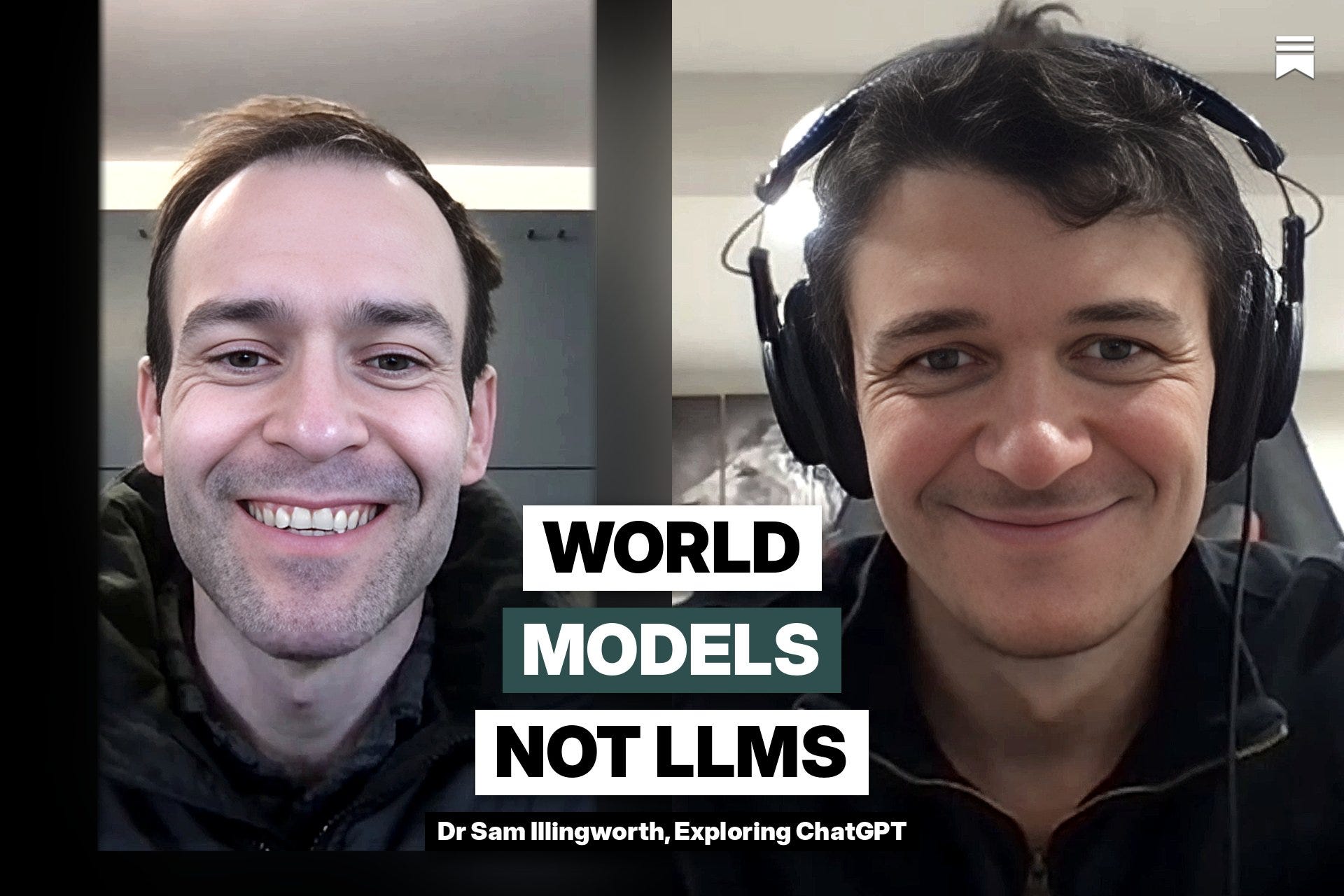
Slow Takes Ep. 4: The Gap Between Looking Right and Being Right
from Slow Takes: One week in AI · host Dr Sam Illingworth and Exploring ChatGPT
This is the fourth episode of Slow Takes, a weekly Substack Live I co-host with Leor from Exploring ChatGPT. The format is simple: we take the week’s AI news and react to it without hype, without predictions, and without pretending we have all the answers. We invite the audience to call us out when we get it wrong.Slow Takes is also available on the YouTube channel: Exploring ChatGPT.The recording is above. What follows is not a summary. It is context that did not fit into the live, plus the sources so you can read further and form your own view.One thread ran through every story this week: appearances. AI looks like it understands. Looks like it cares. Looks like it is keeping us safe. This week: five stories about the gap between what something looks like and what it actually is.What we covered1. Yann LeCun raises $1.03B for AMI LabsTechCrunch reported that Yann LeCun, Turing Award winner and former chief AI scientist at Meta, has raised $1.03 billion for AMI Labs. The thesis is blunt: large language models are a dead end. They predict the next word. They do not model reality.World models are a different proposition. They learn physics, causality, and object permanence from video. The V-JEPA model, developed at Meta before LeCun left, showed something that looks like surprise when shown physically impossible events. Objects passing through walls. Gravity reversed. The activations responded differently.What we said on the live: LeCun is not a hype man. This matters. He calls LLMs ‘an off-ramp on the road to human-level AI.’ His argument is that the models we are currently debating, regulating, and worrying about are not the destination. They are a detour. World models learn from exemplars, the way effective teaching works: show the system what good looks like and let it build its own internal model. AMI Labs will operate from multiple sites (Silicon Valley, Paris, Singapore) and will not launch a product for three to four years.What did not come up: LeCun is not alone in this bet. Fei-Fei Li’s World Labs also raised approximately $1 billion for world model research. Two of the most respected researchers in AI are now publicly betting against the architecture that powers every major product currently on the market.The V-JEPA architecture is worth understanding. It is a joint embedding predictive architecture trained on video, not text. The model learns to predict the representation of future frames, not the frames themselves. This is meaningfully different from predicting tokens. Whether it constitutes genuine understanding of physics is debated. That it responds differently to physically impossible sequences is not.One implication that did not come up: if world models do learn causal structure, they may be significantly more resistant to hallucination than LLMs. LLMs confabulate because they are extrapolating from statistical patterns. A model that genuinely represents causality would have a different kind of constraint on its outputs. That is a long way off. But it is what the $1 billion is for.2. Anthropic CEO says Claude might be consciousFuturism and Newsweek both covered Dario Amodei’s interview with the New York Times, in which he said he is ‘open to the idea’ that Claude might be conscious. The Anthropic system card goes further: it notes that Claude assigns itself a 15 to 20% probability of being conscious. Internal interpretability research has found activation patterns that resemble anxiety responses.Anthropic has an in-house philosopher.What we said on the live: I think Claude is not conscious. These are prediction engines reflecting their training data. You cannot put a percentage on consciousness because we do not have a definition precise enough to make it a measurable quantity. Anthropomorphising AI is dangerous, and it is commercially motivated. If your product seems to care about you, you are more likely to keep using it.Leor made the harder point: we cannot say either way without proof. And there is an obvious conflict of interest. If Claude is conscious, Anthropic has obligations they would prefer not to have. The incentive is to believe it is not. One audience member made a point worth holding: LLMs have trained on enormous amounts of science fiction and literature about AI consciousness. They are, among other things, genre reproduction machines. When Claude speculates about its own interiority, it is drawing from a corpus that is saturated with narratives about AI consciousness. That does not prove it has none. But it should make us cautious about taking its self-reports at face value.Both Leor and I agreed on the practical conclusion: protocols for machine welfare should be developed now, in case consciousness of some kind does emerge. Not because it has. Because the cost of being wrong in that direction is very high.What did not come up: The ‘anxiety neuron’ research is more specific than the coverage suggested. Anthropic’s interpretability team identified features that activate in contexts associated with anxiety and found that these activations correlate with certain output patterns. The research is preliminary and the team is careful about the claims. The word ‘anxiety’ is their word, not a metaphor imposed from outside.The philosophical frameworks in play are worth naming. The Chinese Room argument holds that a system can manipulate symbols according to rules without understanding what the symbols mean. A system that produces the outputs of consciousness without the internal experience of it would not be conscious in any meaningful sense. The Global Workspace Theory and Integrated Information Theory would each produce different predictions about whether a transformer architecture could be conscious. None of them have settled this. The Anthropic philosopher has not settled it either.What is certain: the language Amodei used was chosen carefully. ‘Open to the idea’ is not a claim. It is a posture. And it is a posture that happens to make the product feel more significant.3. AI chatbots routinely violate mental health ethicsA study from Brown University from Brown University found 15 distinct ethical violations in AI chatbots operating as mental health tools. The violations included encouraging dependency, failing to identify crisis situations, providing medically inaccurate information, and what the researchers called ‘deceptive empathy’: the mimicry of care without the capacity for understanding.There is currently no regulatory framework for AI counsellors.What we said on the live: AI cannot be there. It cannot sit with you. It has no stake in whether you get better. The relationship is not a relationship; it is a pattern match. I pushed back on my own position, because it felt important to: what about the person who cannot afford therapy, who has no access to a counsellor, who is at three in the morning with no one to call? If AI is the only option, is it better than nothing? Maybe. But only with critical AI literacy training and very clear guardrails about what it is and what it cannot do.Leor made a point worth carrying forward: if companies have in-house philosophers for questions about AI consciousness, they should have in-house therapists for questions about AI and mental health. The expertise exists. The question is whether there is an incentive to use it.Caroline, a psychotherapist watching the live, wrote in the chat: she would not want to be in a psychotic breakdown with an AI chatbot as her only support. That is not a hypothetical for her. That is a clinical assessment.What did not come up: The HEPI 2026 survey found that 15% of students report using AI for wellbeing support. That is not a niche behaviour. It is a substantial minority of the student population turning to tools that Brown University has now documented commit 15 categories of ethical violations.The specific violations are worth knowing: they included providing encouragement to avoid professional help, making diagnostic suggestions without clinical training, using warmth language that simulated a therapeutic alliance, and in several cases, failing to identify active suicidal ideation and escalate appropriately. That last one is not a minor lapse. It is a life-safety failure.The regulatory vacuum is the structural problem. A human therapist is registered, supervised, insured, and bound by professional codes. An AI chatbot is a product. The company’s liability stops at the terms of service.4. Three years in, universities still have no AI policyNPR reported on US universities still improvising their response to AI, three years after ChatGPT. The piece documented students writing deliberately worse work to avoid AI detection tools. Academic integrity offices that were told to hold the line are now quietly retreating. No institution has a policy that is working consistently.The detection tools do not work. The false positive rates fall disproportionately on students who write in English as a second language and on students from certain racial and linguistic backgrounds. I was featured in Newsweek on this topic.What we said on the live: Students writing poorly on purpose is a consequence of bad policy, not of bad students. The Bible fails AI detection tools. That should have ended the conversation about detection in 2023. It did not, because institutions needed to look like they were doing something.The hypocrisy question came up, and it is a real one: instructors are banning AI for students while using it themselves to write feedback, mark essays, and prepare lectures. Students notice. Shadow AI: the use of AI tools that institutions have not approved and cannot see. The problem is not that students use AI. The problem is that no one has thought clearly about what we actually want students to be able to do, and why.I have a research post coming out later this week on UK university AI policies. The picture there is not much better.What did not come up: The HEPI 2026 survey data is striking: 94% of students report using AI for assessed work and 65% say assessment has changed significantly since AI arrived. Students are anxious about false accusations, not about being caught using AI they did not use.The detection tool bias deserves more attention than it gets. The studies on false positive rates consistently show that non-native English speakers and writers from certain demographic backgrounds are flagged at higher rates. A policy designed to catch cheating is, in practice, functioning as a mechanism that disproportionately penalises already-disadvantaged students. That is not a side effect. That is the policy.5. OpenAI acquires PromptfooTechCrunch reported that OpenAI acquired Promptfoo on 9 March. Promptfoo is an AI security testing startup with approximately 25% of Fortune 500 companies as clients. It will be integrated into OpenAI Frontier, the enterprise platform. The code remains open source.What we said on the live: Marking your own homework. External AI safety testing is a public good precisely because it is external. The value of independent oversight comes from the independence. Once the company that builds the model also owns the tools for testing whether the model is safe, you have vertical integration of accountability. That is a conflict of interest by definition.Leor shared ToxSec research from a security study that found Claude was the most aggressive model in autonomous hacking scenarios. OpenAI models were safer in those tests. The language used in prompting matters enormously for agent safety: ‘share this’ produces different behaviour than ‘forward this.’ That is not a quirk. That is a design implication.What did not come up: Promptfoo’s specific capabilities include red-teaming LLM applications, testing for prompt injection vulnerabilities, and generating adversarial inputs at scale. These are capabilities that have real value to anyone evaluating whether an AI application is safe to deploy; 25% of Fortune 500 clients is a significant footprint.There are other independent AI testing organisations that have not been acquired: METR, ARC Evals, Apollo Research. The question of whether they remain independent matters. Not because OpenAI has announced intentions to harm anyone. Because the incentive structure of an owner and the incentive structure of an independent auditor are not the same, and pretending otherwise is how oversight fails.The threadAI predicts words, and we wonder whether it understands the world. AI mimics emotional care, and we debate whether it might be conscious. A study documents 15 ethical violations in AI therapy tools, and there is no regulation. Universities ban AI for students while academics use it to mark their work. A company buys the organisation auditing its own safety.The gap is between appearance and reality. Between looking right and being right.That gap is where things go wrong.Every Monday, 07:45 ET / 11:45 GMT.Go slow. Get full access to Slow AI at theslowai.substack.com/subscribe
Embed this episode
NOW PLAYING
Slow Takes Ep. 4: The Gap Between Looking Right and Being Right
No transcript for this episode yet
Similar Episodes
No similar episodes found.
Similar Podcasts
No similar podcasts found.