
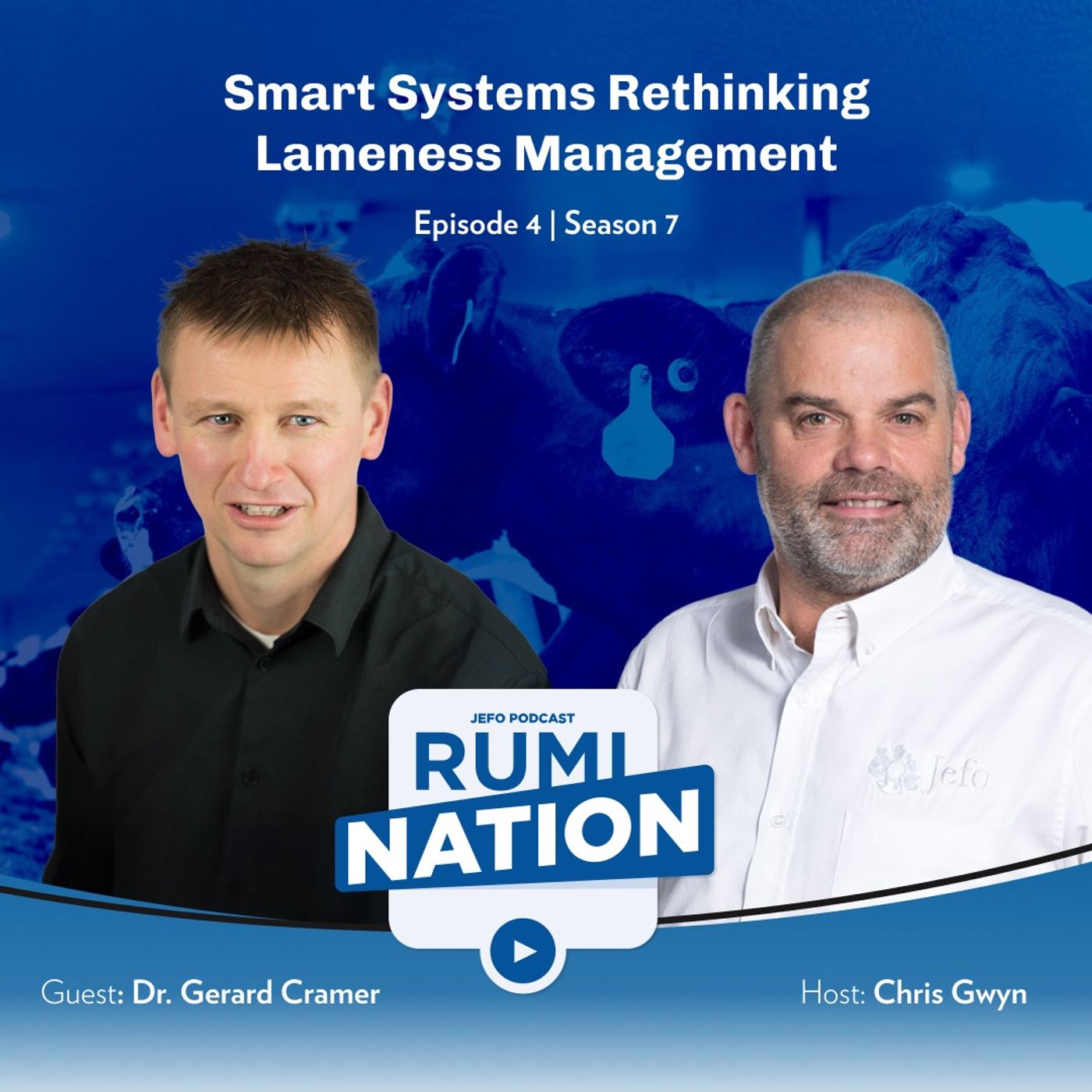
EPISODE · Jun 30, 2026 · 23 MIN
Smart Systems Rethinking Lameness Management
from RumiNation · host Jefo
Timestamps & Summary Chris Gwyn (01:35) How would you describe the current state of lameness on dairy farms, and how has it evolved over your career? Dr. Gerard Cramer I started working on lameness when I started my graduate work in 2003. Things have progressed, but I think it's still probably one of the major animal welfare issues in the industry. So, I'd say we probably haven't progressed as much as I'd like. […] We're creating too many chronic cows. That's kind of hampering, holding us back. We do all these things to prevent new cases, and I think we're doing a good job in that, but we haven't really focused on what I think is the biggest issue, which is finding lame cows and preventing chronic cows. […] Chris Gwyn (04:01) You said identifying; you've done some work with cameras and identification. Where are we going with that technology? Does it seem to be working? Dr. Gerard Cramer That's my interest in the cameras because, to me the issue is the people. We need people to find lame cows. You need to have a dedicated person looking for lame cows. So, depending on your size of operation, that's a couple of hours where a person is literally standing there watching cows. So, it looks like you're paying them to do nothing. […] When I'm thinking about the camera technology, I want to be strategic and say, “Okay, the camera is going to find the lame cows, the newly lame cows, or the cows that are getting worse”. But if she's a chronic lame cow, she's just going to go on a routine schedule, and she might come up to the chute every 3 months. […] Chris Gwyn (08:29) You talked about inflammation and changes in bone growth. You want to expand a bit on that? Dr. Gerard Cramer Basically, what we're talking about is the last bone; we call that the P3. That's the last bone that's inside the hoof capsule. If we think about when a cow's walking on, she's walking on about 5 millimeters of horn, and then there's about 5 millimeters of something called the corium, and then the bone is kind of sitting on top of that. So when we get pressure on that corium, when it gets squished, basically, whether it's a sole ulcer or a white line, that creates an inflammatory process. So that inflammatory process happens in the corium. […] Chris Gwyn (12:16) Could you share with the audience your main findings on hoof trimming modeling and how that can be applied by hoof trimmers or producers at the farm level? Dr. Gerard Cramer When I first came to Minnesota, one of the first things I wanted to do was say, “Okay, there's basically one commonly taught trimming technique”, and there was a trimmer called Karl Burgi out there saying, “Okay, we have to do more modeling”. And modeling is basically taking more of the horn away from underneath the flexor tuberosity, which is what creates sole ulcers. So, we did a study where we compared doing that extra modeling- some hoof trimmers would call it excessive modeling— underneath that flexor tuberosity, but not getting into the toe triangle. The toe triangle is basically where the inside wall starts to go into the coronary band, so it’s not going too far into the toe. So, when we removed that extra horn, we had some impact on first-lactation cows where we did this at the time of drying. […] Chris Gwyn (16:54) So, trimming cows that are exhibiting signs of lameness is a more strategic approach? Dr. Gerard Cramer I get in trouble when I say this, and the hoof trimmers say, “Well, I'm doing this for comfort. Some of these cows are long.” But those are all things that we have to think about and say, “Okay, in the farms I work with, cows are walking a long distance. So, there are not many cows that have really long feet”. So, we're not trimming the cows because they have really long feet. Okay, then we're trimming them really to prevent lameness. And then we have to ask ourselves, “How much lameness are we preventing?” But if you have worked with a dairy and say, “Okay, I have a lot of long feet, these cows are walking on skis, they need to be trimmed.” So, strategic means: We look at the farm and say, “This is what the trimming program is”. And then even within the farm, we say, “Okay, for that cow, this is what her trimming program should be”. […] Chris Gwyn (17:58) We're talking about trimming. Is there anything we should be doing differently with pregnant heifers from a trimming perspective? Dr. Gerard Cramer I think it totally depends on where they're coming from. […]
Embed this episode
What this episode covers
Dr. Gerard Cramer explains why early lameness detection, strategic trimming, and stronger dairy teamwork are essential for healthier cows
Ready to play
Smart Systems Rethinking Lameness Management
No transcript for this episode yet
Similar Episodes
No similar episodes found.