
EPISODE · Sep 23, 2025 · 30 MIN
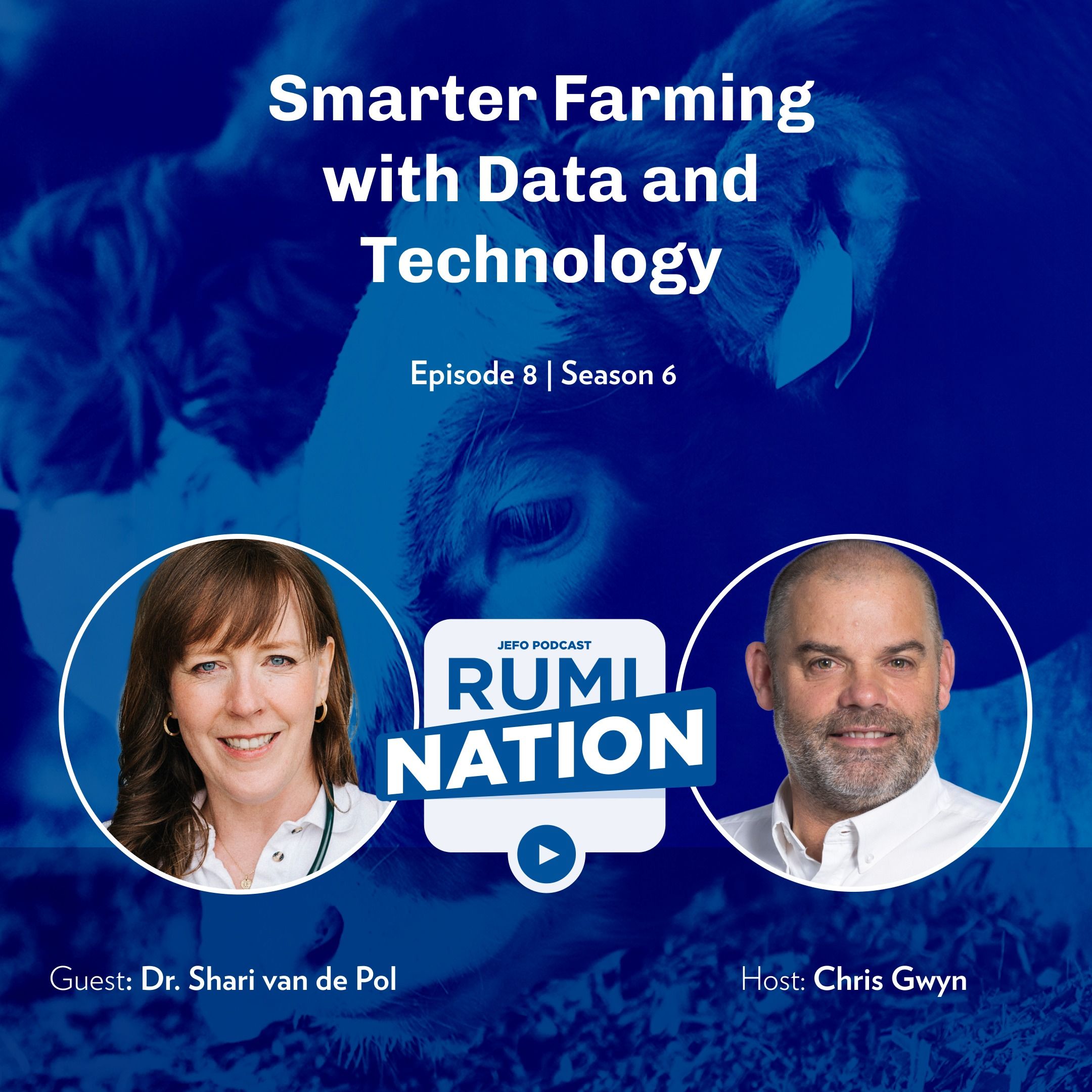
Smarter Farming with Data and Technology
from RumiNation · host Jefo
Timestamps & Summary Chris Gwyn (00:02:56.23)Dr. Van de Pol, would you share with the listening audience your journey in AG and in data, and how this journey has brought you to establishing CATTLEytics?Dr. Shari van de PolSimilar to a lot of listeners of your show, what really resonates with me is everything tied to agriculture, being outdoors, and the biological systems. I just found it was so interesting and fascinating.[…]I actually did a minor in fine art at the time, and I ended up working for IBM and found myself at a very interesting, challenging job, but something that really didn't connect with any of the things that I really held dear. I had this moment where I decided, after a few years of spending a day a week with a large animal vet, that I was going to go back to school to become a large animal veterinarian. And that is really what kicked off this path. I always knew when I was in vet school that what I wanted to really focus on was the systems. And that's what I ended up doing. While I was at the Summer Dairy Institute down at Cornell. I met with some really interesting professors and some interesting industry experts. […]In 2014, that's when CATTLEytics was formally started. We've been in this for over 10 years, and we have a strong history now in the industry of really pairing technology and veterinary expertise. […]Chris Gwyn (00:06:00.11)Are there areas in livestock production that we're missing out on by not either having accurate data or not being able to make timely decisions based on the analysis or accurate analysis of data?Dr. Shari van de PolI mean, there obviously are, but we really take a person-first approach to the way that we do our business. We look at dairy farms and dairy cows like athletes. So, if you have a whole bunch of Olympic athletes, it depends on how far you want to go. If you're happy with their performance and you're getting your milk check and you don't want to do anything further than that, then, yeah, there’s a lot of potential, but you're not motivated to really dive into that potential. […]Chris Gwyn (00:09:24.12)Tell me about the impact of farm size in those types of decision-making processes.Dr. Shari van de PolYou manage a farm differently depending on size. Part of that is due to even just staffing. Because I find people can do things when they are a solo dairy farmer and they have 50 cows, they can keep a lot in their head. They know what's going on. They can assess the situation as it goes. As soon as you start to grow beyond that, you start to involve, often family members, but additional staff. When you get to that point, then you need to start to streamline an operation. […]Chris Gwyn (00:13:35.02)How can systems today work to enhance or utilize that data to be more predictive and more preventable?Dr. Shari van de PolWhat we've seen is when I started, for instance, looking at production data, and I was looking at production data both north and south of the border here in North America, and I was finding that, for instance, there were similar environmental effects affecting milk production in given years. A lot of it could be potentially environmental as opposed to what that farmer is doing. The producer could be doing the exact same thing year after year, performing to that top level, but if the environmental effect is strong, they're going to see a worse return on their efforts. […]Chris Gwyn (00:15:52.11)And machine learning, we hear that bounced around. What are we actually talking about here?Dr. Shari van de Pol (00:15:58.18)When we talk about machine learning, we're often talking about things like neural networks or random forests, which, again, don't give you much information. […]The classic example was looking at pictures of dogs and cats. You could look at a picture of a dog and immediately say: “Hey, that's a dog, that's a chihuahua, that's a domestic shorthair.” But computers couldn't do this. They would take this image, break it into pixels, see the dark... They just had a really hard time with problems like that. What that meant is that computer science could only go so far. It could only go up to really mathematical-specific problems. But when you start to go into those areas where it's simple for us but hard for them, they hit a wall, and they couldn't help us out with those other problems. Basically, jumping over this wall means that it opens up what computers can do. Now what happens is a computer looks at an image and it would apply something called a neural network, which means it's like a series of filters on that image. […]Chris Gwyn (00:21:01.20)I guess bringing some of those different systems together and talking together is also important, right?Dr. Shari van de PolAbsolutely. I mean, it’s one of those things where I was down at a conference and hearing people on a panel say: “If only there was a company that would bring data streams together and do this”, and it's like, we're doing this. It is a tough problem. One of the reasons why it's a tough problem is because there's not necessarily an obvious big motivation for players in the industry to share their data other than the fact that is beneficial to the dairy farmers they are serving. […]Chris Gwyn (00:23:43.09)I wanted to bring in the topic about data security, ownership, at he farm level. I was wondering if you could share some thoughts on that.Dr. Shari van de PolWhen we talk about things like data security, it definitely goes to protecting the assets on farm, making sure that your backups aren't just set and forget. You have to test those systems out and have a plan to test them out, quarterly, for instance. You also need to work with a provider that understands what a dairy is like.Chris Gwyn (00:28:09.09)Summarize three or four key points that you would emphasize to producers, having been there as a nutritionist in relation to collection analysis and application of data on the farm. What would you recommend?Dr. Shari van de PolFirst off, if you're somebody who wants to, whether you're a business or you're a producer, if you want to get to that next level, there are resources. We will help you as a company. There are ways to get to that next level. […]The second thing is when we're talking about staffing, onboarding, training, having protocols available, being able to do that, team management, communication, that has been in the past undervalued, and that's an easy win to make your farm a great place to show up to and a place where everybody wants to be. […]And then the third thing is, artificial intelligence is something that can take away the headaches that you have, the things that you don't want to do, the filling in of forms, and all of those things. […]
Embed this episode
What this episode covers
In this episode, we learn how data-driven tools, machine learning, and strong employee onboarding empower dairy farms to improve decisions, cow performance, security, and long-term sustainability.
Ready to play
Smarter Farming with Data and Technology
No transcript for this episode yet
Similar Episodes
No similar episodes found.