
EPISODE · Aug 16, 2026 · 2H 59M
Sons of Liberty Radio, August 16, 2026
from Sons of Liberty Radio with Bradlee Dean · host Author
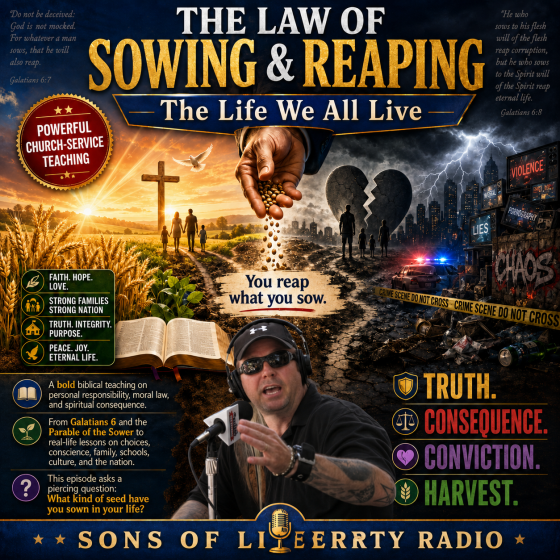
SONS of LIBERTY Radio with Bradlee Dean The Law of Sowing and Reaping-The Life We All Live The Harvest of Our Choices: Faith, Consequence, and the Seeds We Sow Summary The Principle of Sowing and Reaping The episode centers on the host's teaching that people inevitably reap consequences from what they sow through choices, habits, beliefs, and influences. He connects the theme to Galatians 6 and presents sowing and reaping as a spiritual law that applies to individuals and whole societies. A story about duck hunters, dynamite, a retriever, and a truck becomes an early illustration of misconduct producing an immediate consequence. Throughout the teaching, the host repeatedly asks listeners to examine the seed they have allowed into their lives and the harvest those seeds have produced. He frames repentance, obedience, and sowing to the Spirit as the positive alternative to destructive patterns. Personal and National Consequences The host expands the theme from personal behavior to national life and argues that cultural consequences can be traced to seeds planted through institutions, public policy, entertainment, and education. He cites numerous statistics and historical turning points, especially around 1962, to support his view that moral and social decline followed changes in American public life. These figures are presented in the transcript as the host's claims and are not independently verified here. He discusses family structure, education, crime, alcohol, drug use, abortion, sexuality, and political institutions as examples of what he sees as collective sowing and reaping. His repeated point is that a population cannot permit or participate in conduct without eventually sharing in its consequences. Moral Law, Culture, and Accountability A substantial portion of the episode argues that biblical moral law provides a standard that exposes wrongdoing and helps restrain destructive behavior. The host uses traffic laws and the sight of a police officer as an analogy for conscience, restraint, grace, and accountability. He criticizes what he sees as leniency in criminal justice and the normalization of harmful conduct through television, movies, advertising, schools, government programs, and other cultural channels. He also describes his objections to public-school drug-prevention messaging, alcohol marketing, and programs that, in his view, unintentionally teach or normalize the behavior they claim to discourage. The teaching consistently presents these cultural critiques as applications of the larger sowing-and-reaping principle. The Parable of the Sower The episode then turns to Mark 4 and the parable of the sower, with the host treating the different soils as pictures of the human heart. He discusses the wayside, stony ground, thorns, and good ground as different responses to the Word of God. The host argues that hearing is not merely receiving information but should lead to obedience, although the original-language terminology used in this section is badly garbled in the automated transcript and therefore remains flagged. He criticizes prosperity-oriented preaching and uses examples involving television, smartphones, distraction, and material concerns to illustrate how competing influences can choke spiritual fruitfulness. The desired outcome, in his teaching, is a prepared heart that receives the Word and bears fruit. Testimony, Repentance, and Spiritual Formation The host draws heavily on personal testimony to illustrate the consequences of earlier choices and the possibility of a changed direction. He recounts alcohol and drug use, multiple arrests or dangerous episodes, overdoses, hospitalization, violence, and other experiences from his former life, presenting them as a harvest from the seed he had sown. He contrasts that past with his present ministry and repeatedly credits Christ and the Holy Ghost for the change. Stories about youth ministry, hard soil, plowing, and breaking up fallow ground reinforce his argument that hard hearts sometimes require direct confrontation before they become receptive. The overall appeal is for listeners to examine themselves, repent where necessary, and intentionally sow toward righteousness. Historical Warnings and Ministry Closing Near the end, the host gives a series of historical and biblical examples that he presents as cases of people or governments reaping consequences from persecution, injustice, rejection of Christ, or other wrongdoing. Several names, dates, quotations, and numerical details in this rapid historical section require verification because the automated transcript is uncertain. He then returns to the present, arguing that sowing and reaping operates both individually and nationally and that people are responsible for what they tolerate as well as what they personally do. The closing shifts to ministry updates, recent travel to Johnstown, Colorado, past appearances, financial support, online resources, broadcast times, the Minnesota State Fair, and a booking phone number. He thanks supporters and connects charitable giving back to his teaching about sowing good seed before the recording ends abruptly mid-thought.
Embed this episode
Ready to play
Sons of Liberty Radio, August 16, 2026
No transcript for this episode yet
Similar Episodes
No similar episodes found.
Similar Podcasts
No similar podcasts found.