
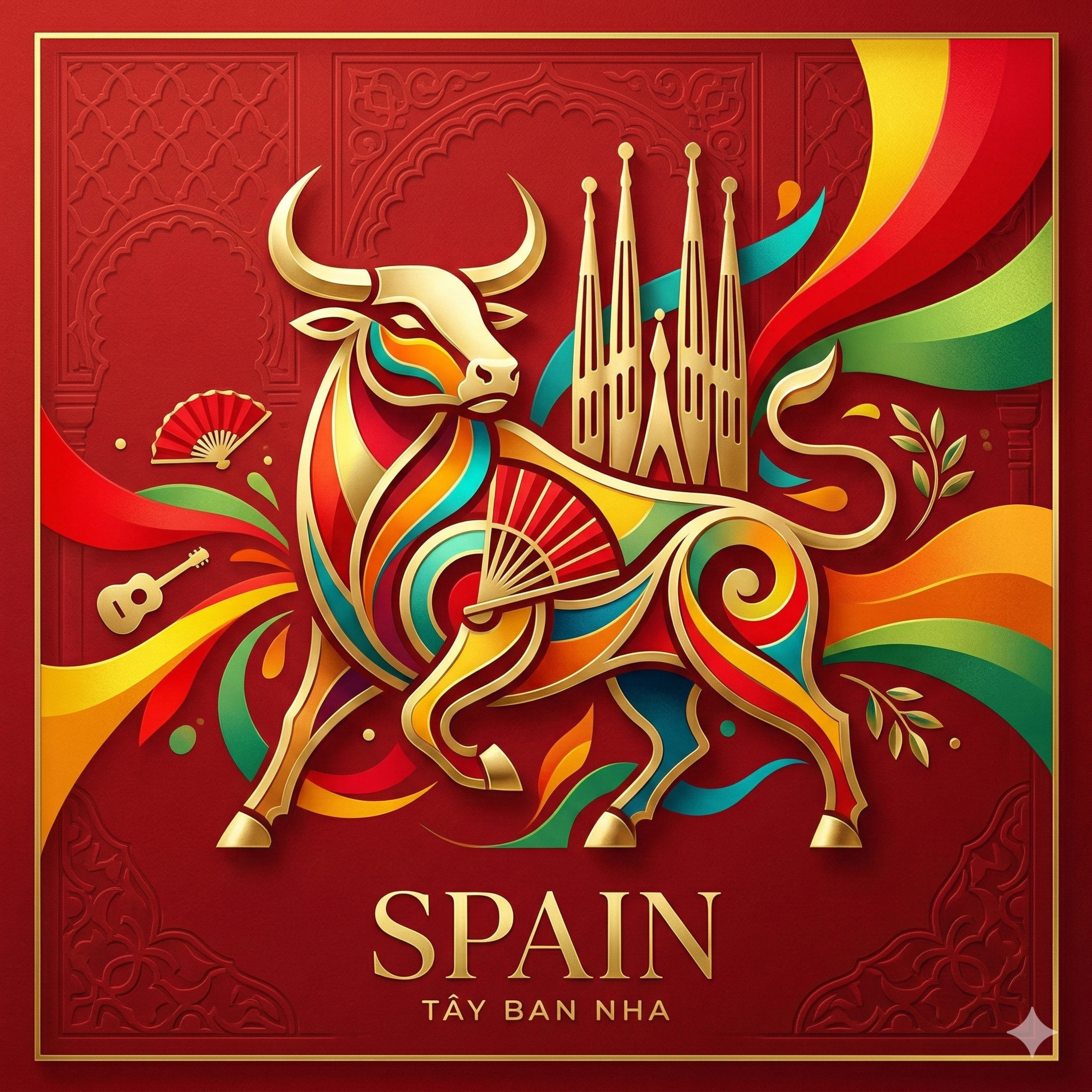
EPISODE · Mar 9, 2026 · 54 MIN
🇪🇸Spain: A Transcontinental Cultural Powerhouse Shaped by Empire, Diversity
from One Group · host Đàm Tuấn Quỳnh
Few countries in the world embody the deep continuity of European civilization as vividly as Spain. Situated on the Iberian Peninsula in southwestern Europe, Spain occupies a strategic geographical position between the Mediterranean world, the Atlantic Ocean, and the African continent. This location has shaped its history for millennia, turning the country into a crossroads of cultures, empires, religions, and trade routes. The result is a nation whose identity is defined not by a single tradition, but by a remarkable fusion of civilizations that have interacted across its territory since antiquity.One of Spain’s most distinctive features is the extraordinary depth of its historical layers. Long before the formation of the modern Spanish state, the Iberian Peninsula hosted diverse societies including Iberians, Celts, Phoenicians, Greeks, and Carthaginians. The arrival of the Roman Empire transformed the region into one of the most important provinces of the Mediterranean world. Roman infrastructure, law, language, and urban culture left an enduring legacy that continues to shape Spanish society today. Many Spanish cities—including Madrid, Barcelona, and Seville—still contain architectural and cultural traces rooted in Roman urban traditions.The formation of modern Spain emerged during the late medieval period with the union of two powerful kingdoms: Castile and Aragon. The marriage of Ferdinand II of Aragon and Isabella I of Castile in the 15th century marked a decisive moment in Spanish history. Their reign consolidated political power across much of the peninsula and culminated in 1492 with the completion of the Reconquista—the Christian reconquest of territories previously ruled by Muslim states. That same year also witnessed one of the most transformative events in global history: the voyage of Christopher Columbus, sponsored by the Spanish crown, which initiated sustained European contact with the Americas.From the 16th to the 18th century, Spain rose to become one of the most powerful global empires ever established. The Spanish Empire extended across vast territories in the Americas, Asia, Africa, and Europe. At its height, Spanish influence stretched from Mexico and Peru to the Philippines, forming a transcontinental network of commerce, governance, and cultural exchange. This imperial era not only reshaped global trade and geopolitics but also spread the Spanish language across multiple continents. Today, Spanish is one of the most widely spoken languages in the world, used by hundreds of millions of people and serving as one of the major global languages of diplomacy, culture, and communication.Today, Spain is recognized as one of Europe’s largest economies and one of the world’s leading tourist destinations. Its combination of historical monuments, cultural festivals, Mediterranean coastlines, and vibrant cities attracts tens of millions of visitors annually. Cities such as Madrid and Barcelona function not only as political and economic centers but also as hubs of art, architecture, and international cultural exchange.Yet Spain’s significance extends beyond tourism and heritage. The country plays an important role in global diplomacy through its linguistic and cultural ties with Latin America, forming part of a wider Hispanic world that spans multiple continents. Through these connections, Spain maintains a unique transatlantic cultural influence that links Europe with the Americas.In essence, Spain represents far more than a single European nation. It is a historical crossroads where Roman, Islamic, and Christian civilizations converged; a cultural mosaic shaped by powerful regional identities; and a former global empire whose language and culture continue to resonate across the world. This remarkable combination of deep historical layers, artistic brilliance, and enduring global influence makes Spain one of the most fascinating countries in the study of world civilizations.
Embed this episode
NOW PLAYING
🇪🇸Spain: A Transcontinental Cultural Powerhouse Shaped by Empire, Diversity
No transcript for this episode yet
Similar Episodes
No similar episodes found.
Similar Podcasts
No similar podcasts found.