This message comes from Viking, committed to exploring the world in comfort. Discover the heart of Europe by river on an elegant Viking longship with thoughtful service, destination-focused dining, and cultural enrichment on board and on shore. And every Viking voyage is all-inclusive with no children and no casinos. Learn more at viking.com. Starting my own business. Wawanisa. Signing a new contract. Wawanisa. Buying new machines. Wawanisa. Supply chain disruptions. Wawanisa. Time to modernize. Wawanisa. A lasting legacy. Wawanisa. Through every decision, Wawanisa has your back.
Business insurance for Canadians by Canadians. Just say the word. Visit wawanisa.com to find an insurance broker today. Hello, and welcome to this special series of Our Fake History. My name's Sebastian Major, and this is the podcast where we explore historical myths and try to determine what's fact, what's fiction, and what is such a good story it simply must be told. I'm sure you're wondering, special series? What makes this one so special? Well, friends, the day that this episode drops, I will be in Greece with a crew of Our Fake History listeners exploring the country's many historical treasures.
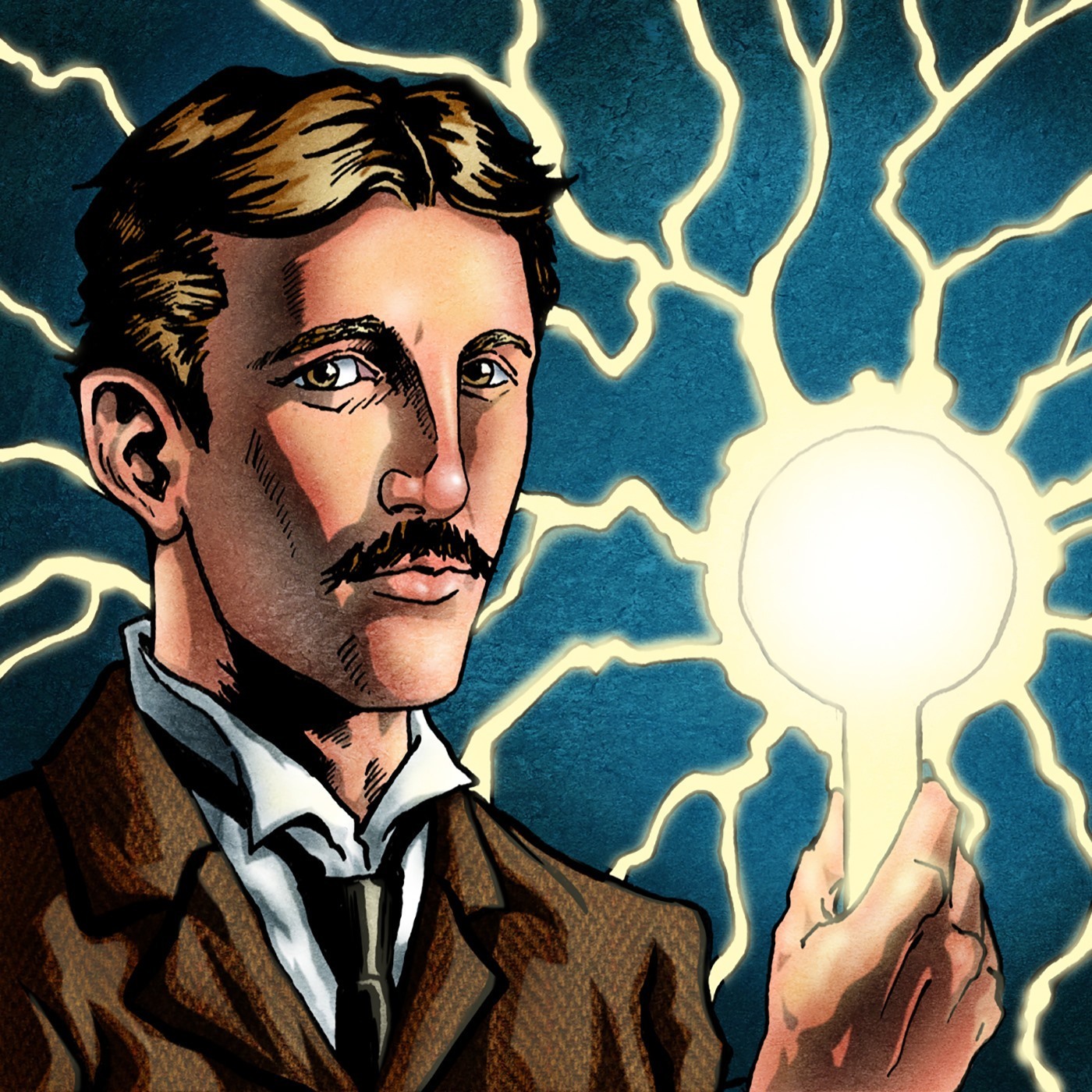
In fact, the day that this comes out will be the day that we will be on the Acropolis, checking out the Parthenon and all the amazing buildings that are there. Now, I've been talking up this trip for a solid year now, and it's finally happening. Now, if this trip sounds cool and you feel bummed that you weren't able to join us on this one, I'm really hoping that this will be the start of a whole series of trips that we'll do with listeners. So stay tuned. But to make sure that I could throw myself into this trip, I needed to clear my schedule. So that meant pulling something special out from behind the paywall. I wanted to give listeners a taste of what the patrons get when they support the show and showcase some work that the vast majority of our fake history listeners have never heard before. So what you are about to hear is a podcast on the life and legend of the famous inventor Nikola Tesla that I originally created for the patrons back in 2020.
As you will hear, six years ago, this topic won our listeners' poll. So this was originally released as a monster-sized, three-hour-long mega-episode. But I've decided that for this special series, I'm going to be releasing it in two parts. Part one you will hear today, and part two will drop in two weeks' time. Now, I absolutely love my patrons. They keep this podcast viable, so I'm always cautious when I pull something out from behind the paywall. In fact, I've only ever done it once before, and I try not to do it very often. This is their stuff, and I want to respect that. But given the topic of this particular episode, and the fact that it was now over six years old, I thought that this was the right choice for this special series. Patrons, I hope you agree.
When I revisited this show from 2020, I was happy to discover that it still felt relevant. I was worried that in the last six years, the cultural mood around the Tesla Motor Company had changed so drastically that my evaluation of the company's namesake might feel dated. There's no denying that Tesla means something different in 2026 than it did in 2020. I was happy to discover on the re-listen that this episode holds up. In fact, I think it's a good time to release it for the wider Our Fake History audience. But I would like to make a small correction.
As you will hear in this episode, I suggest that it was Elon Musk who chose the name Tesla for the electric car company. That is not true. In fact, that's a misconception promoted by Elon Musk himself. The name was chosen by the company's co-founders, Martin Eberhard and Mark Tarpenning. They were the ones who were looking to honor the memory of Nikola Tesla. Musk came on later and then, through some legal finagling, secured the right to call himself a co-founder. He was not the guy who chose the name Tesla for the car company.
But with that said, I feel confident that this examination of the much mythologized 19th century inventor has not suffered because of the events of the last six years. If anything, the story of Nikola Tesla is more relevant than ever, as is our relationship with his myth. So I really hope you enjoy this. Now, patrons, since I'm pulling an episode out from behind the paywall, it only seems right to put a fresh one right back in there. I am currently taking suggestions for the next patrons-only episode. Please drop your suggestions in the chat section of the Patreon page. I will look over those suggestions, I will choose my five favorites, and then patrons will get to vote on those five options. Whichever topic wins the poll will be turned into the next patrons-only extra episode. I know it's not a perfect democracy, but hey, it's the one we got.
So, if you want to hear all the extra episodes and get in on the voting for the new patrons-only show, then head over to patreon.com slash ourfakehistory and find a level of support that works for you. Alright, without any further ado, here is part one of our special series, How Do You Explain Tesla? In the 1870s, there was a professor of physics named Jacob Paschel, who taught at Austria's prestigious Graz University. By all accounts, Professor Poshel fit the stereotype of the brilliant but unkempt academic. He was clearly a great mind and an exceptional lecturer, but when it came to his personal grooming, he was a touch eccentric. One of his students would describe him like this, quote, Professor Poshel was peculiar. It was said of him that he wore the same coat for 20 years, but what he lacked in personal magnetism, he made up in the perfection of his exposition. I never saw him miss a word or gesture, and his demonstrations and experiments came off with clock-like precision, end quote.
During a class in 1876, Pauschel was undertaking one of these famed demonstrations, except this one wasn't running with the same clock-like precision that was usually his hallmark. The professor had with him a device known as a gram dynamo. This was a Belgian invention used to produce a strong but steady current of electricity. The type of current it produced was known as direct current, or DC. At the time, DC was considered the only form of electricity that could be reliably harnessed for human use. The other form of current...
known as alternating current or AC, was theoretically more powerful and able to be transmitted greater distances, but put simply, AC was hard to tame. In the 1870s, if you were using electricity, you were using DC, electricity that had been harnessed to flow in one steady direction. The Gram Dynamo was a simple but effective DC generator that by the 1870s was being used across Europe. Miniature versions of these generators were also popular in classrooms, as they made for great teaching tools. During this particular lecture, Professor Pauschel was demonstrating how one of these generators could be run as a motor when connected to a source of power like a battery.
But to get the Gram Dynamo functioning as a motor, it required a very careful adjustment of a device known as a commutator. The commutator helped convert the AC current being generated into the desired DC current. But if you didn't set your commutator just right, the whole thing could really start sparking. And sure enough, that was exactly what happened. This was not one of Professor Poshel's normally seamless demonstrations.
As he ran the dynamo as a motor, sparks started to fly everywhere. The professor assured his class that this was nothing to worry about and could be fixed with a precise adjustment of the commutator. But getting the adjustment just right proved challenging for the professor that day, and the sparks kept shooting from the machine. One student sitting in the lecture hall that day found this whole display to be pretty ridiculous. There was his esteemed professor fussing with an inefficient and clumsy-looking device, awkwardly shooting sparks from the lecture dais. In that moment, he became convinced that direct current was clearly not all that it was cracked up to be. There had to be a way to use alternating current and eliminate the clunky, sparking commutator.
That student was none other than Nikola Tesla, a man soon to be celebrated as one of the greatest scientists and electrical engineers of his age. But at this point, he was still just a precocious undergrad, and today, he had a question. He raised his hand and said, surely there must be a way to run this device using alternating current. Why was the professor fussing with this clearly embarrassingly inefficient machine? Why not design an AC motor that wouldn't require this sparking device?
For Professor Paschal, this question was bold, bordering on arrogant. So he stopped everything and spent the next section of the class lecturing on why what young Tesla had said was completely impossible. The whole class was treated to a withering breakdown of the problems with alternating current, and why Tesla's question was so very ignorant. Tesla would later say that the lecture concluded with these biting words from the professor on creating an AC motor. Quote, Mr. Tesla may accomplish great things, but he certainly will never do this. It would be the equivalent of converting a steady pulling force like that of gravity into a rotary effect. It is a perpetual motion scheme and impossible idea.
End quote. To really hammer the point home, Poshul then went over to his gram dynamo and disconnected the commutator. The result was that the machine immediately stopped working, much to the amusement of the entire class. The cocky star student had just been dunked on by his disheveled old professor in his stinky 20-year-old coat. Now, depending on where you read this story, Tesla either took this all in good humor, or he was deeply embarrassed. In either case, this day stuck in Tesla's memory. He took this professor's very public rebuke as a challenge. He would show them all that his idea was not impossible. AC could be harnessed, and AC motors could be built. This would become his obsession.
Now, I love this story because it seems like something straight out of a comic book. Okay, a very technical scientific comic book, but a comic book nonetheless. If you needed an origin story for a mad scientist character, I mean, this would be it. A brilliant but unconventional student proposes a controversial scientific idea and is publicly embarrassed by his ivory tower professor and laughed out of class. The disillusioned and bullied genius then obsessively turns his mind towards revenge.
Now, in Tesla's case, he wasn't really bent on revenge. In fact, this little incident probably wasn't the embarrassing moment it's sometimes built up to be. Paschal was actually Tesla's favorite professor, and in turn, Paschal had a lot of affection for Tesla as a student. In fact, Tesla would later describe the impromptu lecture in response to his question as, quote, an honor. So, while Tesla was certainly inspired to explore electricity more deeply by Pauschel's class, his quest to unlock the secrets of alternating current probably wasn't fueled by a desire to get his comeuppance on his snickering classmates or imperious professors. But despite that, this story often gets brought up because it fits with a very specific image of Nikola Tesla. He's often portrayed as something akin to a mad genius. His fans see him as a visionary, the inventor of the electrical age, whose ideas were always a few steps ahead of their time.
From this perspective, his revolutionary proposals should have changed the world, but they were foiled by small-minded businessmen who simply could not comprehend the immensity of Tesla's vision. His critics, on the other hand, have characterized Tesla as an emotionally unstable dreamer who was never able to deliver on his most ambitious proposals. In both cases, the literary trope of the mad scientist is always being hinted at. And, you know, this image has only been bolstered by the fact that, you know, Tesla may have developed a death ray. I mean, if you got a death ray, you might be a mad scientist.
But one of the things that made Tesla a little different from many of his contemporary inventors was that he had a flair for poetics. He understood the power of a good story. In this way, he helped to shape his own myth in the American media of the late 1800s. He wasn't simply an electrician. He was a quote-unquote wizard, a master of lightning, and a visionary who proposed a marvelous electrical future.
Around the turn of the 20th century, Nikola Tesla claimed to be on the precipice of some truly revolutionary breakthroughs. He claimed to be a few months away from creating technology that could transmit electricity wirelessly all around the world. Imagine whole cities powered without a single wire. In his quest to drum up funding for his ambitious ideas, Tesla presented himself as a once-in-a-generation genius who was able to perform electrical miracles. This image has informed the cult of Tesla ever since.
But who was this guy really? What were the real contributions that Tesla made to the world of electrical engineering? Could he really do all the things he claimed were possible? Was this guy really using his electrical inventions to hear messages from other planets? Let's see what we can figure out today on Our Fake History. Special Series, How You Explain Tesla, Part 1.
Hello, and welcome to a very special extra episode of Our Fake History. My name is Sebastian Major, and this is the podcast that explores historical myths and tries to determine what's fact, what's fiction, and what is such a good story that it simply must be told. But of course, you already know that, because if you're listening to this right now, that means that you are one of the patrons. You are one of the people that voted on this topic and have been waiting patiently for this extra episode. Well, you're in luck, because this is going to be the mother of all extra episodes.
Now, I shouldn't have been surprised. Almost every time I asked the patrons to suggest a topic for an extra episode, the name Nikola Tesla was brought up. In fact, the very first time I had patrons vote on an extra topic, Tesla lost the ballot by only two votes to Vlad the Impaler. But... This was clearly Tesla's time. This topic was far and away the most popular of all of those suggested, and the most recent ballot included Jesus Christ as a potential topic. So, I mean, I think that tells you just how popular Tesla is among our fake history listeners. So, why has this one 19th century inventor become such a magnet for historical myths and misconceptions? Well, I think there are a few reasons. First has to do with the nature of Tesla's place in our shared historical memory.
Tesla was someone who was famous for a period of time in the late 1800s. Then he faded into obscurity and was largely forgotten. As time progressed, his name became less and less well-known. His contributions to the development of electricity, wireless technology, and science in general were only really remembered by experts in the field. For years after his death, the name Tesla was basically unknown to most people.
I can tell you that as a kid growing up with a real interest in history, I had heard all about Tesla's contemporary inventors like Thomas Edison or Alexander Graham Bell or the Wright brothers, but Tesla just wasn't a part of the conversation. As such, he built up a mystique as the great lost genius of the early electrical age. This mystique and romance inevitably led to a Tesla revival. This started in a small way in the 1980s, thanks mostly to Margaret Cheney's book, Tesla, Man Out of Time. Then over a decade later in 1996, Mark Safer would publish his own biography, Wizard, The Life and Times of Nikola Tesla, which also seems to have got people thinking about Tesla again. But the revival really got going in earnest in the early 2000s.
This is in no small part thanks to the founding of Tesla Motors in 2003. When Elon Musk's famed electric car company took Tesla as their namesake, he was still kind of an underappreciated figure, so the name was kind of cool. But as soon as they chose that name, it ignited a new wave of interest in the inventor. Two years later, you have David Bowie playing Tesla in the Christopher Nolan movie The Prestige. 2006 was kind of the year of Tesla. The renewed interest in the inventor just happened to coincide with what would have been Tesla's 150th birthday. In 2006, Tesla was the subject of a number of scientific conferences in Serbia, Croatia, Australia, Canada, and the United States. In that year, Belgrade's International Airport was officially renamed Nikola Tesla International Airport in honor of the famous Serbian inventor.
2006 also saw a statue of Tesla unveiled on the Canadian side of Niagara Falls to honor his contributions to the science behind the power plants at that site. Even the band The Handsome Family wrote a song about Tesla in 2006. It's called Tesla's Hotel Room, and it's heartbreaking. Check it out. So, post-2006, I don't think you can really argue that Tesla is still a forgotten great. This feverish revival of Tesla's memory has been accelerated and enhanced by the internet. The veneration of Tesla online has become, well, pretty wild. If you coast through some of the Reddit threads on Tesla, you'll see him described as everything from the greatest genius who ever lived, to an electrical messiah, to an early hacker, and of course, a victim of the Illuminati.
So, in the revival of Tesla, the pendulum may have swung a bit far in the other direction. He has gone from being an unfairly forgotten electrical pioneer to the greatest scientist and possibly greatest human being to ever live. Some of this deification can be credited to a hugely popular internet cartoon about Tesla, posted on the oatmeal.com by an artist named Mark Inman. Now, I know what you're thinking. Really, Sebastian? An internet cartoon? It really had that much influence?
But I'm telling you, the answer is yes. Inman's cartoon was so popular that he was able to spearhead a crowdfunding campaign to build a new Tesla museum that has to this date raised over $1.3 million. The cartoon was called Why Nikola Tesla Was the Greatest Geek Who Ever Lived, and it actually quite neatly summarizes the modern Tesla myth. That myth is that Tesla was a pure, nearly saintly inventor, an authentic genius, or as Inman calls him, a true geek. Inman defines Tesla's geekiness like this, quote, Geeks stay up all night disassembling the world so they can put it back together with new features. They tinker and fix things that aren't broken. Geeks abandon the world around them because they are busy soldering together a new one. They obsess, and in many cases, they suffer. Over 100 years ago, a Serbian-American inventor by the name of Nikola Tesla started to fix things that weren't broken, end quote.
If Tesla is the hero in Inman's comic, then the American inventor Thomas Edison is undoubtedly the villain. Inman writes this about Edison. Quote, End quote. Inman sums it all up with this pithy closing thought. Quote, the only thing Thomas Edison truly pioneered was douchebaggery. End quote. Strong and hilarious words from Mark Inman. But how accurate is that really?
Well, that's one of the questions I hope to address on this show. Now, don't get me wrong, I'm not here to nitpick the historical accuracy of what is essentially a fan cartoon. I'm just using Inman because he very succinctly, and often hilariously, sums up a number of pervasive ideas about Nikola Tesla. These are ideas that can be found all over the internet, by the way. In the more glowing assessments of Tesla, it's taken for granted that he was this great altruist who didn't invent for the sake of money, but for the good of all humanity.
or that Tesla's contributions to science were unfairly overshadowed by the likes of Edison, and that Edison and Tesla were mortal enemies, and their feud ultimately defined Tesla's career and eventually led to his downfall. I think if we look closely at all of those claims, very few actually stand up to close scrutiny. It's the opinion of writers like Christopher Cooper that as a culture we have over-corrected in our appraisal of Tesla, and we've put them on a somewhat ridiculous pedestal. Cooper explains it this way, quote, Tesla's story helps reveal how cults of personality are crafted in the zeal to venerate those whom history may have forgotten. But this zealotry often runs the risk of repeating the mistakes it seeks to redress. Prudence gives way to passion, and even those attempting to correct history unwittingly contribute to its distortion. End quote.
Amen, brother. That is an excellent point. It's actually something I've come across quite a few times while creating this podcast. The mythical overcorrect. But it's also worth noting that other Tesla biographers place the responsibility for the Tesla myth squarely at the feet of Tesla himself. Bernard Carlson, the author of the 2013 biography Tesla, Inventor of the Electrical Age, argues quite convincingly that in the latter half of his career, Tesla started to consciously nurture a public image of himself as an electrical miracle worker.
Carlson argues that Tesla, quote, resorted to illusions to convince ordinary people of the value of his creations. Tesla came to believe that along with identifying the ideal for an invention, he also had to create the right illusion about the exciting and revolutionary changes his invention would bring about for society. Tesla sought to capture the imagination of the public as well as entrepreneurs who would purchase and develop his inventions, end quote. In the end, Carlson believes that Tesla became too focused on the creation of this public illusion, and this kept him from creating working machines later in his career. In other words, Tesla became overwhelmed by his own myth, which Carlson thinks may have contributed to the decline in his mental health around the turn of the century.
So I think it goes without saying that when it comes to Nikola Tesla, there is quite a lot to unpack. I mean, seriously, I've been talking for like 25 minutes or so, and I haven't even mentioned that some people think that he was in communication with aliens. Yeah, aliens from outer space. So I mean, we've got a lot to talk about here. So let's start working our way through Tesla's life and see if we can make sense of this wonderful but complex human being.
Viking, committed to exploring the world in comfort. Discover the heart of Europe by river on an elegant Viking longship with thoughtful service, cultural enrichment, and all-inclusive affairs. Learn more at viking.com. Like any truly fascinating figure, the myths and controversies that surround Nikola Tesla begin at birth. Tesla was born at the stroke of midnight on July 10th, 1856 in the province of Smiljan in what is today Croatia.
But since Tesla's family identified as ethnically Serbian, both Croatia and Serbia like to claim him as a native son. As many of you know, there are few quagmires stickier than questions of ethnicity in the Balkans. All of this is complicated even further by the fact that at the time, this region was on the military frontier of the Austro-Hungarian Empire. Tesla himself seems to have identified most strongly as a Serbian. However, at different points in his life, he would refer to himself as Croatian and even Austrian when it seemed beneficial.
When it comes to Tesla's early life, our only source is Tesla himself, who described it in his slim autobiography, My Inventions. Many of his subsequent biographers have pointed out that while Tesla is generally reliable, he did have a flair for the dramatic, and often leans into his own myth as an electrical wizard. Take, for example, the story of Tesla's birth. The story goes that while Tesla's mother was in the throes of labor, a massive electrical storm raged outside. The midwife apparently declared that this baby was going to be a child of the storm. Tesla's mother quickly replied, no, he will be a child of light.
It's a great little story, but it's a little on the nose for a guy who would later be called the Master of Lightning. It seems just a little too perfect, a little too poetic for one of the world's great electrical geniuses to have been born during an electrical storm. Biographers have looked for weather records from Croatia in 1856 to try and confirm the story, but as Christopher Cooper has pointed out, they have long since been lost. So who knows, maybe it did really happen, but honestly, I'm a little skeptical. According to Tesla, his childhood was in turns idyllic and tragic. His father, Milutin Tesla, was a priest in the Serbian Orthodox Church, a profession that he hoped his son Nikola might take up himself one day. Being the son of a priest in rural Croatia meant a simple but comfortable country life. However, young Nikola didn't show much of an interest in following his father into the priesthood.
According to Tesla, from a young age, he had an exceptionally vivid imagination. In fact, he would later describe having dreams so vivid that he became convinced they were real. He spoke of living entire lifetimes in faraway dream worlds that seemed as real to him as our reality seems to us. This intense imaginative power could often be disorienting and sometimes terrifying. Tesla would describe it like this, quote, End quote. Whoa.
The funeral, referred to by Tesla in this passage, may very well have been that of his older brother, Dane, who died as a child after being thrown from a horse. This traumatic event seems to have loomed large in Tesla's young life, and if we take him at his word, he may have relived this funeral in the form of vivid dreams for years. But it's important to note that Tesla's incredibly intense imagination is often cited as the key to his great genius. As an adult, Tesla would claim that he had the ability to design complex machines entirely in his mind. He claimed to be able to see every wire, every small component of a complex invention in his mind's eye. This is how Tesla explained it himself upon winning the Edison medal in 1917. Quote,
My method is different. I do not rush into constructive work. When I get an idea, I start right away to build it up in my mind. I change the structure. I make improvements. I experiment. I run the device in my mind. It is absolutely the same to me whether I operate my turbine in thought or test it actually in my shop. It makes no difference. The results are the same. When I have gone so far that I have put into the device every possible improvement I can think of, I can see no fault anywhere, I then construct this final product of my brain.
Every time my device works as I conceive it should, and my experiment comes out exactly as I plan it. End quote. Wow, I mean, that's quite a claim. People that adore Tesla often point to this ability he describes here as an example of his nearly supernatural genius. I mean, he claims here that everything he designs in his mind always comes out perfectly and works first try. So, I mean, the question is, is he exaggerating? Was he really that good?
Well, it depends on which biographer you ask. Bernard Carlson gives Tesla quite a lot of credit on this front, and goes so far as to argue that to truly understand Tesla, you need to take into account what he calls an idealist style of invention. Christopher Cooper, on the other hand, thinks that while Tesla's vivid imagination certainly was important to his creative abilities, it's an exaggeration when he says that every invention emerged from his brain perfect and without flaw. He points out that Tesla did his share of practical experimenting and tinkering, and had more than one failed prototype of an invention. So while it's romantic to think of Tesla creating these perfectly formed brain babies, Cooper reminds us that it wasn't always that clean.
But Tesla's intense bouts of imagination, or perhaps hallucination in childhood, have also led to some speculation about the nature of Tesla's mental health. Biographer Margaret Cheney has proposed that Tesla may have been schizophrenic. Others have suggested that he may have been bipolar, manic-depressive, or obsessive-compulsive. But... Honestly, none of these really seem to fully encapsulate Tesla's very unique psychological type. Not to mention the fact that it's always kind of sketchy to try and diagnose a historical figure. You know, we get it wrong so often. In the 1800s, most were happy ascribing to him an artist's temperament, or more glowingly, a genius temperament. Friends would speak of his inventor's mind, quote, overheating. So who's to say exactly what was going on?
What is clear is that throughout his life, Tesla would suffer from severe depressive episodes, some of which could derail him for months and even years. But despite all this speculation about Tesla's mental health, as a child, it was actually his physical health that was of greater concern. He suffered through a rash of childhood illnesses, including a bout of cholera that nearly killed him as a teen. According to Tesla, it was this battle with cholera that ultimately set him on his path towards electrical engineering. You see, as a kid, Tesla had developed a fascination with physics and machines, but his father was adamant that young Nikola would join the Orthodox priesthood. Well, the story goes that while Nikola was bedridden with cholera, his father dutifully stayed by his bedside. In one particularly sickly moment, Nikola looked over at his father and said, perhaps I may get well if you let me study engineering, to which his father solemnly promised, you will go to the best technical institution in the world.
Tesla reports that this buoyed his spirits so massively that he was able to recover from the terrible disease. I mean, imagine that. Imagine being a teenager that was like, Dad, all I want is to be an engineer. I feel like most fathers would just be over the moon to hear that, but it took a deathbed wish to get Malutin Tesla on side. But Malutin Tesla kept his promise to his son, and when he came of age, Tesla was sent off to Graz University in Austria.
Now, despite the fact that it had been Tesla's dying wish to study engineering at a top-flight school, his university experience ended up being a bit of a mixed bag. He started out as the most overachieving undergrad you've ever heard of. He visited his professors in the off hours. He stayed after class. He threw himself into his studies in an obsessive way. It was during this time that he developed a personal relationship with Professor Poshel, the scientist I mentioned in the introduction. When Poshel teased Tesla in class that one day, this was after months of getting to know a very over-eager student, which makes me think the whole exchange was meant in good humor.
In fact, Tesla's professors got to know him so well that they started to worry about him. While they appreciated his zeal, they were concerned that the young man was literally working himself to death. Tesla himself would later claim that he worked on his schoolwork and other extracurricular projects from 3am to 11pm every day. This unhealthy routine so worried his professors that they wrote a letter home to Tesla's father sharing their concerns. Imagine that, your university profs writing a letter to your dad. Oof. So when Tesla returned home after his first year at university, he was expecting to be praised for achieving top grades in all of his courses. Instead, he found his stern father not only unimpressed, but worried about his mental health.
Malutin asked Nikola to pump the brakes. Relax. Stop going so hard at school. Ironically, Malutin's advice produced the opposite of the desired effect. It sent Tesla into a depressive spiral that would characterize the rest of his school days. When Nikola returned to Graz, he was no longer the brown-nosing overachiever that his professors had come to know.
Tesla reinvented himself as the other undergrad stereotype, the hard-drinking party boy who was too hungover to go to class. It was in these years that Tesla also got a taste for gambling that he would carry with him for his entire life. He became an expert pool player and a bit of a hustler when it came to billiards. Eventually, he stopped going to class altogether. Not long after that, Tesla ran out of money and disappeared from the town of Graz itself. Friends began to openly worry that Tesla had succumbed to despair and drowned himself in the river.
But the young man eventually turned up in the town of Maribor in what is today Slovenia, where he was arrested for vagrancy and was deported back to Croatia. The rollercoaster ride of Tesla's university years, from star student to pool hustler to homeless person, I think could be viewed as a microcosm of the tumultuous ups and downs of his entire life. He was either rocketing towards scientific breakthroughs or spiraling down towards mental collapse. It's a cycle we'll see repeat a few times in this story. This particular low point in Tesla's life would be compounded by the sudden death of his father at the age of 60. Nikola was deeply embarrassed that his father had passed away while his resume essentially read, college dropout, arrested for vagrancy. So Tesla decided to honor his father's dying wish and returned to his studies. At least, that's what Tesla tells us in his autobiography. You see, he convinced a pair of uncles to lend him some money ostensibly to finish his degree at a university in Prague.
Tesla moved to the Bohemian capital, and while he insists in his autobiography that he studied there and got a degree in engineering, the Czech government has no record that Tesla ever attended any of Prague's universities. So there's a good chance he moved to Prague just to hang out and gamble. Eventually, Tesla's indulgent uncles became suspicious and stopped sending him money. So, in 1881, flat broke and desperate for an opportunity, Tesla moved to Budapest. There, he hoped to get a job working for one Ferenc Puskas, who was one of his uncle's old army buddies. Tesla had read that Puskas had been authorized by Thomas Edison to build a telephone exchange in Budapest. Tesla wanted to be a part of this project, so he impulsively made the move.
But when he got to Budapest, he found out that while Puskas was open to hiring the young man, he hadn't yet secured the funding for the project. He was like, I'd love to hire you, kid, but right now no one's doing anything until I can get my cash sorted out. So now Tesla was unemployed in a different European capital, and he once again fell into a deep depression. But despite this inauspicious start, it was in Budapest that Tesla would have a breakthrough that would shape the rest of his life and form a cornerstone of the Tesla myth. So let's take a closer look. While unemployed in Budapest, Tesla's depression became so acute that he rarely left the tiny room he was renting. But luckily, he was shepherded through this episode by his best friend and later lab assistant, Anatel Zagetti, who he called Tony. Worried that Tesla's depression was bordering on suicidal, Zagetti started insisting that Nikola walk with him every evening through Budapest's city park. This little ritual seems to have brought Tesla back from the brink, and indeed seems to have once again inspired his creative imagination.
It was during one of these walks that Tesla claims he had a life-changing eureka moment. Ever since Tesla had seen the demonstration of the Graham Dynamo that I mentioned in the introduction, he had been toying with the idea of a motor that could be run using only alternating current. Well, on one fateful walk, Tesla claims that a design for a perfect AC motor appeared in his mind's eye. Tesla would later describe this moment of inspiration like a, quote, flash of lightning. People that really idolize Tesla often point to this moment as evidence of his unique, nearly magical genius. The perfect motor just appears in his mind. And honestly, if that's how it happened, that is legitimately very cool. What is clear is that after that day, Tesla was motivated to build a working version of this AC motor.
This epiphany also seems to have corresponded with a general turn in Tesla's fortunes. Frank Puskas finally got his money together to create the telephone exchange in Budapest, and he hired Tesla. Tesla threw himself into the job and soon distinguished himself as one of the most talented mechanics in Thomas Edison's continental operation. This got him invited to Paris to work for Edison's French subsidiary. In Paris, he was working on making the fabled gas lamp city of light one of electric light. Success in Paris eventually got Tesla invited to America to work on improving the electric dynamos Thomas Edison was developing in New York City. Through all of this, Tesla was still independently working on his AC motor. It's also worth noting that through all of these moves from Budapest to Paris and then eventually to New York City, Tony Zaghetti was always by Tesla's side. Now...
This brings me to Tesla's romantic life, or potentially lack of romantic life. There is some speculation that Nikola Tesla was gay. You see, Tesla famously never married. In fact, he once claimed that he never once touched a woman. During his lifetime, Tesla always insisted that this disinterest in women came from a monk-like devotion to science and invention. Tesla was married only to electricity. Tesla also dabbled with Eastern religion and favored a particular form of Buddhism that advocated celibacy. So, Tesla may have been asexual, or he may have truly shunned any type of romantic attachment in pursuit of a type of mental purity.
But there is quite a lot of evidence that suggests that Tesla was actually attracted to other men. In the late 1800s, it was basically impossible to be an openly gay man in Europe or America. So it's entirely possible that Tesla carried on closeted relationships and affairs. His relationship with Zagetti is often cited as evidence of this. Now, we need to be careful when jumping to conclusions, because in the Victorian era, heterosexual male friendships were considerably more affectionate and even romantic than they would become later in the 20th century. When you read letters between male friends in the 1800s, the language is often so tender that you might make the mistake of thinking that they were romantically involved when they were just good friends. But Tesla's relationships with other men often went a step further.
First, there's the fact that Zagetti, who had little training in science and engineering, kept getting the gig of Tesla's lab assistant. In 1891, when Zagetti finally parted with Tesla, many biographers have commented that this was the first real instance of heartbreak in Tesla's life. Tesla also loved commenting on the beauty of male bodies. He once said that Zagetti had the body of Apollo. After Zagetti left him, Tesla continued hiring Svelte athletic young men as his lab assistants, and he was never shy about commenting on their physiques. Tesla biographer Bernard Carlson has also pointed out that Tesla carried on an especially close and deeply flirtatious relationship with an American Navy officer named Richard Hobson while he was living in New York. Later in life, when Tesla took up residence in the Hotel Marguerite, he was known to have private liaisons with athletes, including boxers like Henry Doherty and Fritzie Zivik.
Finally, rumors about Tesla's homosexuality even got in the way of potential opportunities and accolades. In the 1890s, Tesla served as the vice president of the American Institute of Electrical Engineers. But curiously, he was never elected president of the body. Years later, a member of the institute named Richard Sog admitted that Tesla had been kept out of the top spot due to rumors about his sexuality. So, we really have no hard evidence concerning Tesla's sexuality, but I've personally been convinced that he was probably gay. This puts me in the company of biographer Christopher Cooper, who was pretty positive that he was gay, and Bernard Carlson, who thinks that he at least harbored attractions towards other men. But I should point out that the biographer Mark Safer is less convinced.
For me, Tesla's hidden sexuality actually helps explain a number of things, including some of his bouts with depression. It's kind of heartbreaking to think that Tesla may have had to hide this aspect of who he was. Living as a closeted person may have added to his anxiety. Remember, this was a time where if you were revealed to be homosexual, not only would you be ostracized by polite society, you may have even been institutionalized. If Tesla had been able to live openly, we might today regard him as an icon of the LGBTQ community.
But as it stands, it's still a bit of a mystery. Anyway, in 1884, Tesla got the opportunity to move to America, and he eagerly took it. Now, almost everything about Tesla's trip to the U.S., including his first day on American soil, is coded in a thick layer of myth. So, let's break it down. Tesla was recruited to go to the United States by Thomas Edison's right-hand man, Charles Batchelor, who also worked as the overseer of Edison's workshops in Europe. There's a story that when Tesla got to the United States, all he had was $2 in his pocket and a letter from Batchelor addressed to Edison saying, quote, I know two great men and you are one of them. The other is this young man, end quote.
Now, this story gets repeated a lot, as it adds to the lore of Tesla's genius being undeniable. It also sets up the fabled conflict between Tesla and Edison. These are Charles Batchelor's two great men. But most Tesla biographers point out that this letter seems to have not been real. Bachelor was already in New York by the time Tesla got there, so the letter would have been extraneous.
We also have other letters from Bachelor where he makes reference to good European employees, and in those letters he never once mentions Tesla by name. This suggests that he wasn't particularly overawed by the young Nikola Tesla. He wasn't the second greatest man he ever met, at least not according to those letters. Finally, it's likely that Tesla had already met Edison when the inventor had visited Paris a few years earlier, so the letter of introduction wouldn't have been necessary. Now, the story of Tesla's Atlantic Crossing is its own odyssey.
According to the inventor, right before he was about to board the ship, he was robbed and lost everything he was planning to bring to America. Then, to make matters worse, during the voyage, a type of passenger mutiny broke out on the ship that led to Tesla nearly being tossed overboard. Now, this isn't even the craziest part of the story. When Tesla got to America, he claims to have had a truly unbelievable first 48 hours. Now, it's been pointed out that Tesla's recollection of this shifted and changed over his lifetime.
In other words, depending on who Tesla was talking to, he might spin this into a pretty fantastic yarn or keep it a little bit more reasonable. Anyway, Tesla claimed that after being processed through Castle Garden Immigration Center in New York City, he asked a police officer for directions and headed towards Edison's New York offices. On the way to the offices, he claims that he passed a mechanic shop where he saw the proprietor struggling with an electric motor. Tesla says that he rolled up his sleeves and volunteered to fix the device for the man, which, of course, he did in record time. According to Tesla, the obliged mechanic handed the young immigrant $20 for his troubles, which, by the way, is the equivalent of someone handing you $500 today.
When he reached Edison's office, now $500 richer, there was a work crew being dispatched that moment to repair two electric dynamos on a ship called the SS Oregon. Without any hesitation, Tesla volunteered for this work crew and was immediately put to work repairing and testing generators on the ship. The story goes that he worked through the night, the Oregon was repaired, and that morning the ship departed and set a new speed record for an eastbound transatlantic run. After doing all of this, Tesla then headed back to Edison's office, where he found Thomas Edison himself standing on the street out front with Charles Batchelor. When Tesla told them that he had just come from repairing the Oregon mere hours after getting off the boat from Europe, a stunned Edison apparently muttered, Batchelor, this is a damn good man. Now, is any of this true?
Again, the only source we have for this is Tesla himself. It's possible that Tesla may have exaggerated some things, or he may have potentially compressed the timeline of the story to make it more impressive. As I mentioned earlier, Tesla would tell the story slightly differently a few times in his life. You see, Tesla liked to paint himself as the ultimate immigrant, the man who arrived with nothing and pulled himself up by his bootstraps thanks only to his genius and an unholy work ethic. The story may very well be true, but it's at least worth noting how perfectly it fits within a very specific narrative that Tesla made part of his public persona. Nevertheless, Tesla was now in New York and working for Edison. His relationship with the famous inventor would go on to define much of the Tesla myth. But is the popular perception of the rivalry between Tesla and Edison really accurate? Well, let's take a closer look. Thomas Alva Edison was one of the most prolific inventors of the 19th century.
Now, interestingly, in the last few years, as Tesla's star has risen in public memory, Edison's has declined. But it's worth remembering that for quite a long time, Thomas Edison was very fondly remembered as one of America's great geniuses. In fact, up until a few decades ago, he may have been in the running for Greatest American, period. Now, I've been tossing his name around like we all know who Thomas Edison is, but perhaps I should introduce him a little more properly. By the time Tesla started working for Edison in America in 1884, Thomas Edison was already enormously famous. Edison is indelibly associated with the invention of the light bulb in 1878. But the idea that Edison invented the light bulb out of thin air is a bit of a historical myth. A British inventor named Warren De La Rue demonstrated the first working light bulb nearly four decades earlier, in 1840.
After Delarue, there were nearly a dozen different inventors who created their own version of the invention. So there were a number of people who had created tubes that glowed through various means before Edison developed his very specific incandescent bulb. Edison's light bulb became the light bulb, thanks to some clever marketing and the relative ease with which his invention could be used. Edison's bulbs famously lit the home of one of his millionaire patrons, J.P. Morgan, making his house the first house in America to be lit electrically. The novelty of this helped Edison promote his system. I mean, hey, don't you want to live like a millionaire?
In 1882, the opera house in Brno, in what is today the Czech Republic, was also completely installed with Edison's electric lamps, a point of pride that is still celebrated in that city today. These high-profile early adopters made Edison's light bulbs the industry standard. Now, those that want to take Edison down a few pegs love to point out that he didn't actually invent the first light bulb. This is often brought up as evidence that he was actually an opportunistic hack. The other thing that Edison detractors like to point out is that he worked with a team. In 1876, Edison founded the world's first industrial research laboratory in Menlo Park, New Jersey. There, he employed teams of engineers and mechanics to help develop new inventions.
If you're being uncharitable, you might say that these teams of decidedly less famous people did all the work and Edison got all the credit. This line of thinking is clearly what got our cartoonist friend to declare that Thomas Edison pioneered nothing except douchebaggery. And while I find that very funny, I also think that it's unfair. So, if I may, I think I might need to take a minute to vouch for Thomas Edison, at least a little bit. First, it's both reasonable and accurate to challenge Edison's invention, quote-unquote, of the lightbulb. But that doesn't mean that the guy invented nothing. Famously, in 1877, Thomas Edison invented the phonograph, the first machine that could ever play audio recordings. While many of Edison's patents, and he held over a thousand different patents, were designed as improvements over prior art, that's the technical term, improvements over prior art,
The phonograph really had no precedent. It was, dare I say it, pioneering? So the entire history of recorded music, and really recorded anything, begins with Thomas Edison. Honestly, you could make the case that podcasting starts in 1877 in Menlo Park, New Jersey. Okay, that might be a stretch, but there could be no digital recording without analog recording, and Edison and his team gave us that.
And that wasn't the only world-changing invention that came out of Menlo Park. Edison and his team would eventually give us an early form of motion picture technology. So, you know, all of movies may not have existed had it not been for Thomas Edison. The other unfair assertion is that Edison did none of the developing himself and just took credit for the work of a talented team. That is just not accurate. By all accounts, Edison had a nearly obsessive work ethic and was elbow deep in the development of all his major inventions, especially in the early days. It's true that Thomas Edison's team did a lot, and the names of those people who worked for Edison have largely vanished from history, which, you know, isn't really fair. But to say that Edison just sat back and slapped his name on their hard work is a mischaracterization.
There's even a famous anecdote that when Edison was married in 1871, he left his wedding as soon as he could to return to his workshop. In one version of the story, he apparently forgot about his bride on their wedding night because he was busy working away on a new stock ticker he was developing. Now, there's a good chance that that story is an exaggeration, but it illustrates not only Edison's obsessiveness, but the fact that he was a tinkerer. He was the boss, to be sure, but he was pretty hands-on. The thing that really differentiates Edison from Tesla is the difference in their inventive process. Edison was always focused on making devices that were marketable and ready for consumer use. He sat and worked with stuff until he or his team made something that they could sell.
Remember, Edison's most famous little quip was that, quote, genius is 1% inspiration and 99% perspiration, end quote, meaning that hard work was far more important than a brilliant mind. Well, those who love Tesla, on the other hand, love him precisely because his style of invention was 100% inspiration and barely any perspiration. This was the man who apparently tested all of his machines in his imagination before he tried to build them. For Tesla's most devoted acolytes, this style of invention or this type of genius seems so much more pure than Edison's team of sweaty engineers. But with that said, the big myth we need to bust here is that Tesla and Edison had some form of personal beef that extended well beyond a professional rivalry. The myth is that while Tesla worked for Edison, Edison ripped him off. Then, when Tesla struck out on his own and started developing AC motors and other devices, Edison went on a personal crusade to ruin him.
This vendetta became known as the War of the Currents, where Edison championed his DC current and led a smear campaign against AC current. This eventually culminated in Thomas Edison electrocuting an elephant to help make his point. The myth goes that Edison's smear campaign was instrumental in keeping Tesla from truly becoming the greatest inventor of his age. Now, this particular version of the story isn't really one that's been put out there by Tesla's biographers. Instead, it's been pop culture that has perpetuated this particular historical myth. The popular internet cartoon I continue to reference promotes this version of the story. But the main culprit is the usually delightful show, Drunk History. Now, I actually love Drunk History, but we should always remember that the stories being told on that show are historical tales that are being misremembered by drunk people.
So, one of the first episodes of Drunk History, while it was still just an internet show on Funny or Die, was about Edison, Tesla, and the War of the Currents. Hilariously, Crispin Glover played Edison, and John C. Reilly played Tesla. Once again, the version of the story that comes across in that show was that Edison was a vindictive jerk who single-handedly kept Tesla from fulfilling his dream of bringing free electricity to the masses. I love you, Drunk History, but you kinda led people astray with that one.
So, what really happened here? Well, to start, it's important to know that Thomas Edison held a number of key patents on direct current technology. He had also created a lighting system that was built around direct current. So, the success of DC was very important to Thomas Edison. Also, there was some acrimony between Tesla and Edison stemming from Tesla's brief tenure as Edison's employee.
Now, accounts of this are all over the shop, and like many of Tesla's stories, he would recount it slightly differently at different points in his life. But basically, Tesla was given the task of making improvements to Edison's direct current electrical generators. Tesla would later recall that one of his managers made him a deal. The deal was that if Tesla was able to make the generator run more efficiently, he would personally be given a $50,000 bonus. Now, $50,000 is obviously a lot now, but in 1884, it was the equivalent of $1.25 million. So, Tesla goes away and makes some tweaks. Specifically, he changes up the type of magnets being used in the generator, and when he's done with it, not only is it more efficient, it's actually cheaper to manufacture. But when Tesla confronted his manager about getting that promised $50,000, the manager apparently laughed in his face and said something along the lines of, oh, you simple Serbian, you clearly don't get my sarcastic American sense of humor.
His defense for not giving Tesla the 50k was that he was speaking hyperbolically, like, I swear, I'll give a million dollars to whoever can fix this thing. Now, this story sometimes gets told with Edison himself in the role of the snarky manager, which really makes the beef appear all that much more personal. But it's important to note that Tesla himself always said it was some anonymous manager and never named Edison specifically. It's also claimed that after this insult, Tesla resigned immediately in disgust. But this also doesn't seem to be entirely accurate.
Christopher Cooper has pointed out that Tesla actually continued working for Edison in the design of a lighting system for at least a few more months after that incident. It was only after Tesla's lighting system was sidelined that he seems to have tendered his resignation. It makes for a much cleaner story if Tesla had resigned right after the 50k snub. But as always, things in real life are a bit more messy. It wasn't like once Tesla was unfettered from Edison's workshop, he went on to immediately make his own million-dollar invention. In fact, after quitting the workshop, Tesla was once again dead broke. He actually spent two years digging ditches for Western Union just to make ends meet.
But fortunately for Tesla, his foreman at Western Union happened to be friends with a wealthy investor named Alfred Brown, who took an interest in the young Serbs' ideas for AC power generation. Brown and his friend Charles Peck took a chance on the young inventor and set him up with his first proper laboratory on Liberty Street in New York City. Now, why would they do this? Well, these two men had connections with the enormously wealthy American entrepreneur George Westinghouse. Westinghouse was Edison's real rival in the story of the War of the Currents. In 1884, Westinghouse had seen the successful long-distance transmission of AC power at the World's Fair in Turin, Italy. Since that time, he had been employing a number of European engineers to create an AC power generation system that could compete with Thomas Edison's, then more popular, DC system.
So, Peck and Brown were willing to take a chance on a ditch digger because if that guy could create a good AC motor, they could probably make a fortune selling it to Westinghouse. Okay, so already there are a few things to unpack here. First, one of the big misconceptions about Tesla is that he was the first person to master AC power. Well, that's not true. The Italian scientist Galileo Ferrari first proposed ideas about alternating current that would later inform the creations of inventors Lucien Gulliard and John Dixon Gibbs. Gulliard and Gibbs conducted the demonstration of AC power at that 1884 World's Fair in Turin. So while Tesla would create a much better AC motor, he wasn't the first person to harness AC technology. Ironically, Tesla's relationship to AC power is actually quite similar to Edison's relationship with the light bulb.
They both made a better version of an existing thing that became the industry standard. But the other thing to note is that the war of the currents between Edison and Westinghouse was actually well underway before Tesla got involved in the process. In 1885, while Tesla was still digging ditches, Westinghouse was selling an AC power system based on Gulliard and Gibbs technology. And interestingly, he was selling more of these systems than Edison was selling of his direct current systems. Well before Tesla became a player in the war of the currents, Westinghouse would brag to have, quote, sold more central power stations on the alternating current system than all the other electrical companies in the country combined on the direct current system, end quote. On top of that, there was also a third competitor in the mix. The inventor Elihu Thompson had also developed an AC system that he was actively pushing in the market at the same time. So it was against these two competitors, Westinghouse and Elihu Thompson, that Edison was really campaigning against during the so-called war of the currents.
Now, what is true is that the war of the currents was legitimately nasty, and the nastiest belligerent was easily Edison. So, you know, if you want a reason not to like Thomas Edison, I'm about to give you a few. The biggest drawback to Edison's direct current system was that the electricity couldn't be transmitted over great distances. The system also worked on relatively low voltages. Now, this was all fine and good when you were powering freight elevators or streetcar systems, where the appliances using the energy would always be relatively close to the generator or power plant.
AC systems, on the other hand, could transmit power over considerably larger distances and generated much, much higher voltages. These high voltages, Edison claimed, were dangerous, which was maybe only half true. Yes, a high voltage shock certainly is more likely to kill you than a low voltage shock, but as Tesla would later demonstrate, even super high voltage AC systems could be operated completely safely. Still, in 1886, when AC systems were still new, Edison launched what was essentially a smear campaign against AC power. He wanted to convince the world that AC was dangerous and the high voltages would inevitably cause death by electrocution.
To this end, Edison hired an electrician named Harold Brown to tour the United States and put on a gruesome spectacle under the guise of demonstrating the great dangers of alternating current. In these shows, Brown would publicly electrocute animals to death using alternating current. He would usually kill stray dogs, and on the rare occasion, he would electrocute a horse for a real showstopper. These acts of animal cruelty were all done to pack a simple rhetorical punch. By the end of the show, the message was clear.
Tell your local politicians and businessmen that we don't want alternating current in this town. Now, the most infamous of all of Thomas Edison's animal victims was a circus elephant named Topsy. Whenever anyone talks about the war of the currents, they always bring up the electrocution of Topsy. Now, it is true that Thomas Edison did have a hand in publicly electrocuting a circus elephant. There was even a film made of the event that you can still watch today on YouTube, you know, if you like watching elephants being electrocuted. It's pretty brutal, actually, so maybe steer clear of that.
But it's important to note that this particular animal electrocution, while dramatic, wasn't really part of Edison's original smear campaign. The unfortunate Topsy was electrocuted in 1903. The War of the Currents was essentially settled by the mid-1890s. Topsy was electrocuted on Coney Island at the request of her owners. She was an abused animal who had become violent, so the circus owners were planning on putting her down anyway.
To turn it into a spectacle they could sell tickets to, they enlisted the help of Edison, who notably supplied power to Coney Island. So, yes, it is true that Edison helped electrocute an elephant, but it wasn't really part of the War of the Currents, and it certainly wasn't done as part of a personal vendetta against Tesla. The War of the Currents had been raging for at least two years before Tesla really emerged as a player. In 1888, Peck and Brown's gamble on the Serbian ditch digger paid off. In that year, Tesla finally built the machine that had been living in his mind since he was walking in the parks of Budapest. In 1888, Tesla patented his AC motor, which by all reports was the best designed motor of its type to date. Later that year, Peck and Brown sold the design to Westinghouse, and the perpetually cash-strapped Tesla finally got a big payday.
Westinghouse paid $75,000 upfront with a further guarantee of $2.50 for every watt generated by Tesla's AC system. This was a deal totaling roughly $250,000 over the next 15 years. In today's money, Tesla was in line to make over $6 million. But for a number of reasons that I will get into a little later, Nikola Tesla would never see the lion's share of that promised windfall. But this sale was a high point in Tesla's life. And credit where credit's due, Tesla's AC motor was a truly exceptional invention. I know a lot of the show has been about challenging the mystique associated with Tesla, but this invention is really why anyone takes him seriously. It signaled a huge step forward for electricity. So, you know, hats off to Tesla here. He created something really great.
But a huge part of Tesla's fame would come from what Westinghouse would do with his invention. In 1893, Westinghouse won the contract to light the Chicago Columbian Exhibition. Now, if you've never heard of the 1893 Columbian Exhibition in Chicago, I don't really have time to get into what it was. But let's just say this. It was a big deal. It was like the flashiest World's Fair there had been up to that point. And there have been some pretty cool ones.
Westinghouse actually underbid Edison to get what he knew would be the ultimate publicity for his new AC system, which was partially designed by Tesla. When the world's attention was focused on Chicago in 1893, the city was lit by Westinghouse and Tesla. The War of the Currents really came to its end in 1895 when the International Niagara Falls Commission would choose the Westinghouse AC system equipped with Tesla's motors to form the basis of the new power plant going in at the falls. By 1896, huge swaths of the American Northeast would be powered using Tesla's technology.
So when people try to claim that the War of the Currents ruined Tesla or somehow prevented him from flourishing, that's simply out of touch with the historical facts. Alternating Current won the war, and by extension, so did Westinghouse and Tesla. And by the time Tesla was involved in the war, the nastiest parts had already been fought. As for Tesla and Edison's personal relationship, the two men never seemed to bear much ill will towards each other. The worst criticism that Tesla ever leveled against Edison was that he was inefficient in his methods, saying, quote, if he had a needle to find in a haystack, he would not stop to reason where it would most likely be, but would proceed at once with the feverish diligence of a bee to examine straw after straw until he found the object of his search.
I was almost sorry to witness such doings, knowing that a little theory and calculation would have saved him 90% of his labor. End quote. So, I mean, that's a backhanded compliment at worse. As for Edison, while he campaigned viciously against alternating current, he never really attacked Tesla personally. By the late 1890s, he was even begrudgingly doffing his cap to Tesla and admitting that the Serbian inventor was a great mind. Long story short, these two guys did not hate each other.
All in all, it's safe to say that 1888 was a turning point in Tesla's life. While it would take several years for the applications of his AC motor to reach fruition, the sale of the design provided him with a much-needed influx of cash and confidence. You see, Tesla had much bigger ideas than just an effectively designed electric motor. His Liberty Street lab had been home to some truly amazing experiments that he was now ready to show the world. The next phase of Tesla's life was about to begin as electricity's greatest showman. Okay, that's all for this week. Join us again in two weeks' time when we will conclude this special Our Fake History series. As you've probably already put together, I am recording these episodes in advance, so I am going to forego the normal shout-outs that I do for new patrons. Don't worry, though, folks. I will shout you out. Just wait until this special series has concluded, and I promise I will say your names loud and proud.
If you want to get in touch with me, feel free to send me an email at ourfakehistory at gmail.com. Find me on Facebook, facebook.com slash ourfakehistory. Find me on bluesky at ourfakehistory. Find me on Instagram at ourfakehistory. I'm on TikTok. I'm on YouTube. Everywhere, I'm called Our Fake History. As always, the theme music for the show comes to us from Dirty Church. Check out more from Dirty Church at dirtychurch.bandcamp.com. All the other music you heard on the show today was written and recorded by me. My name is Sebastian Major, and remember, just because it didn't happen doesn't mean it isn't real.
The moment a body is found, the clock starts ticking. 48 hours before the trail goes cold. From A&E and Crime House, this is the official podcast from the famous true crime series, The First 48. I'm Carter Roy. Every Thursday, I revisit a landmark homicide investigation in depth with long-form storytelling built for your ears. Listen to and follow The First 48 on Apple Podcasts, Spotify, Amazon Music, or wherever you listen to podcasts.
and welcome to PlutoFoe. If you know the name of the movie you'd like to see, just stream it for free on Pluto TV, where all your blockbuster favorites are landing all summer long. Catch Anchorman, The Legend of Ron Burgundy. Fantastic. The Matrix Trilogy. Welcome to the real world. Mean Girls. Titanic. I'm the king of the world. And so much more. For show times, press nothing. They're free 24-7. That is so fetch. On Pluto TV. Stream now. Pay never. Viking. Committed to exploring the world in comfort. Discover the heart of Europe by river on an elegant Viking longship with thoughtful service, cultural enrichment, and all-inclusive affairs. Learn more at viking.com.