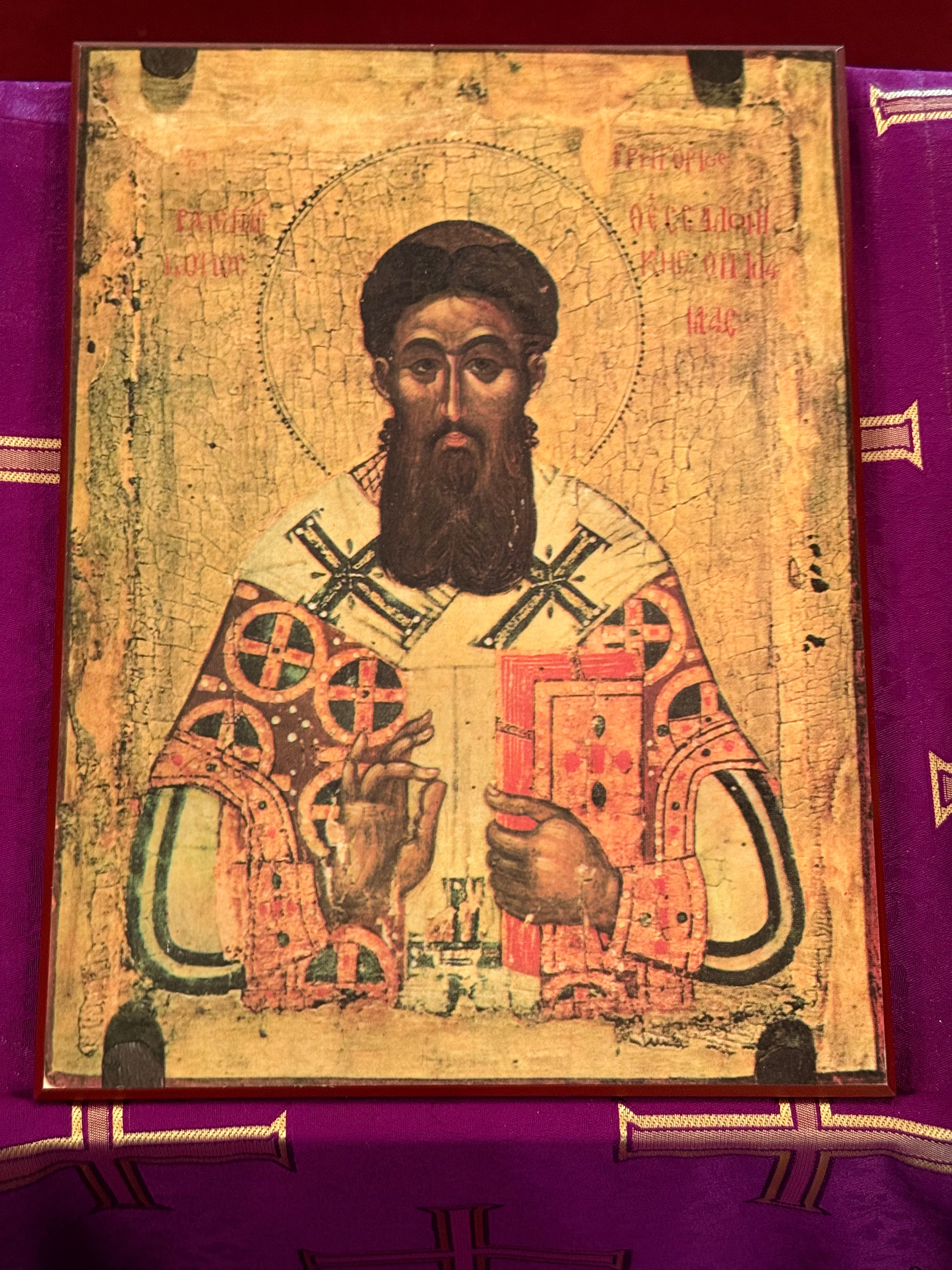
St. Gregory Palamas Sunday
from Translating the Tradition
There’s supposedly an ancient Chinese curse: “May you live in interesting times.” Well, apparently we’ve all been cursed. People are concerned. Some are worried that Islam is encroaching on our civilization. Some are concerned that with the continual elevation of the culture wars, civil war may not be far off. We’ve been through a pretty weird time with sickness. These are interesting times. If you listen to the hymnography for the saint that we are celebrating today, Saint Gregory Palamas, you would probably not notice—you’d certainly not know from the hymnography—that he lived in even more interesting times. St. Gregory Palamas was a well-educated young man. His education was encouraged and supported by the emperor himself, who was really hoping that this brilliant young man would go into the imperial service. But Gregory instead went into monasticism at a very young age and engaged in the hesychastic tradition. As I said, he lived in interesting times. The Muslims were actually encroaching on their civilization. The Byzantines were being gradually driven back. So that when Gregory was eventually ordained a priest, he was ordained in Thessalonica because that was relatively safe because some of the other places, like Nicaea, had already been taken by Islam. Gregory also lived during a time of civil war. The order of the empire was shaky at best since the Fourth Crusaders had actually taken over Byzantium, and they had only just gotten back their capital city, Byzantium. The imperial family was shaky at best. There was a young emperor on the throne who needed to be protected, and there were people arguing over who should protect him. And so he had different candidates vying for the regency, which actually broke out into civil war. And there was the actual plague: the Black Death. You remember that one, the plague that took out half the population of Europe? That was there in Gregory’s time as well. So he definitely lived in interesting times. More than that, just as we are at some points worried about what controls people might be placing on religious expression, Gregory himself suffered from this, and this is why we remember him. See, one of the problems with God is he’s kind of hard to put in a box. But we human beings don’t like that. We like to be able to explain things, have things nice and rational and ordered. And there was a movement towards that in Gregory’s day. There was a man named Barlaam. He came from Italy. He may well have been influenced by scholasticism that had arisen in the West, which was a very rational approach based on Aristotelian logic, because the West had lost contact with that. And then in the high Middle Ages, in the 1200s, they rediscovered Aristotle, thanks to the Muslims, and realized, “This is great! Logic! We love it. We should apply it to everything, because it will make everything nice and neat and rational and ordered and controlled.” And there’s some good stuff about logic. I like logic. But it doesn’t necessarily explain—or manage to let us control—everything. Barlaam moved from Italy to Constantinople and was invited to see some of these hesychastic monks, the ones that Gregory was now hanging out with and with whom he was actually doing this practice of silence. And it was a fairly rigorous physical discipline of prayer and meditation which had significant spiritual effects. Barlaam came in, and he started interviewing and talking to some of the monks. It reminds me a little bit of maybe some aspects of the internet nowadays. When you’ve got those people who get interviewed, and they suddenly get famous, and they’re not necessarily the best representative of whatever it is that you think. That’s kind of what Barlaam encountered. And so he came away—he was already kind of prejudiced against them with his rationalist, scholastic mindset— but he came away from this encounter basically ridiculing these guys as navel-gazers, because they would actually sit and meditate, looking down towards their navel. And he highlighted all sorts of stories he heard, like someone told him that the spirit came out through the nose and then came back in again, and things like that, which are maybe a little bit weird. And admittedly, when you stop to think about it, a lot of the encounters with God, even the ones that we have recorded in the Old Testament and maybe even some of the New Testament, are a little bit weird. God is not very good at sticking in our little boxes. Barlaam was concerned about this, and he then decided he was going to fix this. So he writes this book, essentially ridiculing the monks and saying basically that God is not knowable. This is a bit of a problem. Because on the one hand, as Orthodox Christians, we know that God is ultimately unknowable. He doesn’t fit in the box. He doesn’t even fit in our ability to comprehend him as human beings. We just don’t have it, not in the sense of being able to know him fully. But that doesn’t mean that we can’t know anything about God. Admittedly that may be slightly overstating Barlaam’s case, but then he was slightly overstating his case as well. Barlaam was slandering the very thing that St. Gregory and his companions were involved in. Because St. Gregory was a well-educated young man, the monks asked him to please respond to this. And so he did. He wrote his Triads, three essays which are interconnected, and there were three of those structures, written at different times in response to Barlaam. Gregory, in addressing the main concern that Barlaam had, which was, how can you see the invisible God? Because what these hesychastic monks—who were practicing inner silence and prayer—were experiencing was a vision of God. They saw the uncreated light, that they identified with the light that glowed from Christ and even from his garments on Mount Tabor. And that was something that they treasured. They were willing to spend an entire lifetime pursuing that, even if they didn’t actually experience that. And here Barlaam was just lampooning them as “navel-gazers”—and, more than that, he’s suggesting that there’s another hypsostasis, another “person”, that they’re worshiping, this “visible” God. And so St. Gregory dives in, and he uses the tools that are at his disposal. He also uses Aristotelian logic (because we like logic: logic is good!) and categories, and he makes this very important distinction between the unknowable essence of God and the knowable, experienceable energies of God. God is ultimately unknowable, St. Gregory says, in his essence, absolutely, in that which is the inner part of him, in that which ultimately makes him what he is. But he is and always has been knowable in his energies, in the work that he does as he engages with the world that he made. He makes himself known to us. And so, as a result of God’s mercy, God’s energies, God’s work, we actually do know something about him, and we can speak positively about him, and we can actually experience God himself. The first thing I want us to consider and take away from this is even in the interesting times that we live in, even in the highly polarized times that we live in, we actually do need to be willing to speak up for that which is good. As the Apostle says, “Let not your good be evil spoken of.” However, it is not unwise or an abdication of responsibility to seek out those who are actually good at talking about these things and saying, “Maybe you should represent us,” because we’re not all experts. We might end up saying things in a way that’s wonky or weird and end up getting picked up on YouTube and ultimately throwing something into disrepute. We are not all experts, and that’s OK. But it is important that we are willing to speak up for that which is right. As St. Peter says, “Always be prepared to give a reason for the hope that lies within you.” And, at the very least, we can speak honestly, openly, lovingly about that which we have experienced. But, when you do speak up, be prepared to suffer for it … This is a public episode. If you would like to discuss this with other subscribers or get access to bonus episodes, visit translatingthetradition.substack.com
Embed this episode
No transcript yet.