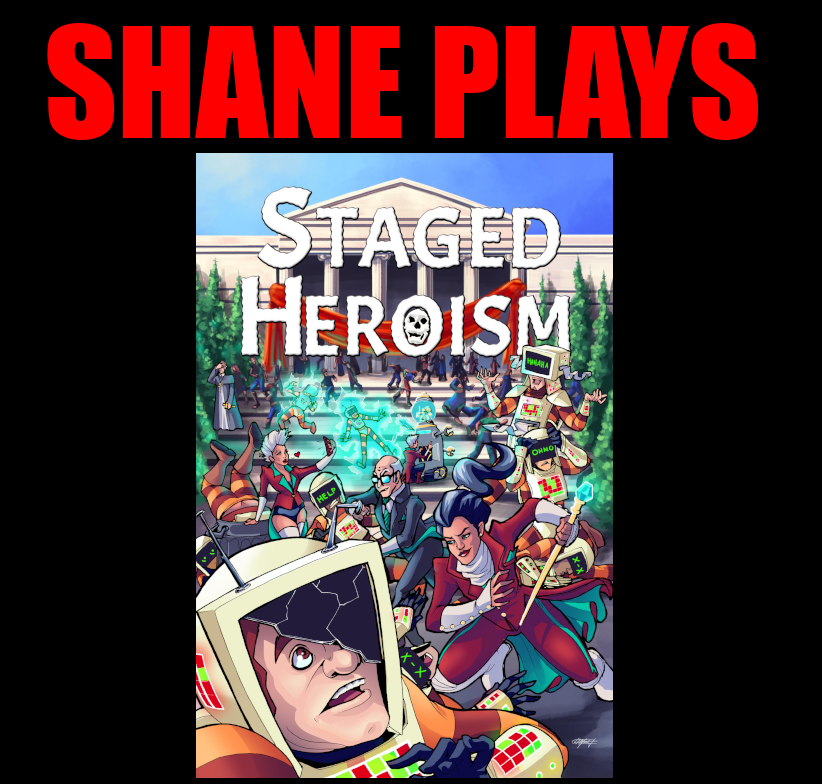
Hey, welcome to another episode of Shane Plays Geek Talk. Thanks so much for pressing play. Today's episode, as always, is a lot of fun. I'm joined by tabletop RPG developers John Kennedy, with credits such as Star Trek Adventures and Stargate 5e, and Shireen Mad Fishmonger Gilchrist. That's right, Mad Fishmonger, and we talk about where that nickname came from in the episode and agree that it's one of the best nicknames ever. Anyway, she's worked on titles such as Capers and Vast Caveat. They both joined to talk the new staged heroism RPG, a comedic RPG of superheroics, supervillainy, and failure at its best, inspired by shows like The Venture Brothers. During the course of the episode, I'm-
Among other things, we talk about designing not to fail forward, but to embrace the fail, the Roger Rabbit style of gameplay, flashback scenes as a game mechanic, venomous monarch butterflies. As mentioned before, where did Shireen get her nickname? Cops raiding a vampire LARP session. Yes, that comes up. And the design philosophy behind Star Trek Adventures. John gets a no prize for a deep cut in comics trivia. And all of us are entirely too amused by the Burger King Kids Club from the 90s, especially John's take on the fate of Kid Vid. So setback.
Relax, enjoy the show, and here we go. Why, yes, I believe we shall. Oh, I got a high one here. Getting Geeky on Little Rock, it's Shane Plays Geek Talk, a journey into the things we love. I'm your host, Shane Stacks. Thanks so much for tuning in. Got a couple of great guests today. Today is a day where I will be talking about games. As I like to point out, to avoid any confusion, even though it's Shane Plays Geek Talk, it's not just about playing games, video games, board games, role-playing games, although that's very often a topic. And today, that is a topic. But like last episode, we talked with Paul Kupferberg, who has over 1,400 writing credits in comic books. So comic books, anything geeky.
And it goes on ShanePlaysGeekTalk. But today, one of my loves is tabletop role-playing games, and I have a couple of very cool guests here to talk about that. There is a new Kickstarter out there, a new game out there called Staged Heroism, or Heroism, if you want to say it that way. It's Staged Heroism RPG, a comedic RPG of superheroics, supervillainy, and failure at its best. And it's actually inspired by a beloved animated series that we'll get into here in a little bit. I'll let my guests talk about that.
And this is also, I believe, being published under the auspices of Nerdburger Games, who Craig Campbell is no stranger to Shame Plays. He's been on before. And there's another person involved in some capacity that I'm going to ask our guest about because he's also no stranger to the show. Anyway, with no further ado, in no particular order, we have tabletop game developers Shireen, a.k.a. Mad Fishmonger Gilchrist, and John Kennedy. John and Shireen, welcome to the show.
Hello. Thanks for having us. Yeah, it's good to be here. Yeah, glad to have you guys. Now, I'm going to go ahead before I forget to ask.
So Craig reached out to me, Craig from Nerdburger Games, who, if I understand right, you're developing it, but Nerdburger is publishing it. Is that correct? Yeah. Okay. Because I know Craig develops a lot of his own games as well. And then I had also, about the same time, Mike Myler reached out to me, who's been on the show multiple times. And I know him through Ian Publishing, and we worked together on Level Up Advanced 5th Edition. But Mike reached out to me. Now, does Mike have a role in the development of stage heroism, or is he just a friend who made a connection, or what's going on there?
Oh, no, he's done lots of work on it. Oh, yeah. He's also a developer on Stage Terrorism. Yeah. Okay, cool. I want to give you both a chance to tell the audience about your history with developing role-playing games. You know, John, I looked a little bit. I know that you've done some stuff with, like, if I remember, like Star Trek Adventures and some other stuff. So let's start with you, and then we'll move over to the mad fishmonger, Shireen. So, John, tell us a little bit about your history with developing tabletop role-playing games.
I have worked in this industry for over 18 years. I started when I was in college and I just I used to write really kind of simple and basic adventures for 3.5 for Dungeons and Dragons 3.5 and just slowly work my way up. And yeah, I get to work on Star Trek adventures on Stargate 5th edition. I get to work with Alan Baer on the tiny RPG line. And people just say I tend to find my work almost anywhere whenever you go to the Gen Con. So that's just pretty much what I've been doing. So are you one of the rare developers that gets to do it full time?
I used to. Thanks to COVID, I had to go back to a day job. But my day job is also pretty cool. I get to work for the Indiana Historical Society. But yeah, I used to. And I remember the grind where every day you had to work on something to get results. And I kind of enjoy the stability now that comes from working in a museum. But still, I've been incredibly fortunate to get to work with some amazing people and get to work on some amazing projects. And like Mike, which we just mentioned, who has just been one of the strongest supporters for getting stage terrorism out the door.
Yeah, so those are some interesting titles that you've worked with. I'm actually personally pretty interested in that Stargate RPG. We're not going to spend a lot of time on that because we're here to talk about stage heroism. But I love the idea of the Stargate RPG because, you know, the concept of away team adventures, it fits so well with RPGs, right? Tonight's session is, you know, we're going to go through the gate and see what's on the other side. And so that seemed like a really, really interesting setting. And I know there's more to Stargate than just going to the Stargate. There's like a whole...
you know, galaxy or universe of interesting races and stuff like that. But that caught my attention when I heard about it. And Star Trek Adventures seems to have been doing really well. You know, I know that there's a lot of, you know, they keep coming out with more source books and things like that. So they don't normally do that unless the title is selling. So what was your role on Star Trek Adventures?
I was there right at the beginning. I was actually visiting Chris Birch, who's the head of Modiphius. I was visiting him in London, and he let me know the moment that he got the license. He was really excited. So we were just playing a board game, and then he pulled out his phone, and he just got excited. So you were there at the very moment when he found out. Oh, yeah. Oh, that's cool. And Chris is a great guy, and the fact that watching the excitement on his face and that sigh of relief when you know you finally won and you've achieved the prize.
Chris is the one who actually told me about what the design philosophy would be behind Star Trek, which was we weren't just making a Star Trek game. We were making a game for you to tell your Star Trek story in. And that philosophy just defined all the books that came after. Because I know it sounds a little basic when you hear it for the first time. When you think about it, it's too easy to make a Transformers movie. Like Michael Bay, the first couple of Transformers movies, he made giant robots going out and doing giant robot things. And then I know some people like them, but for a lot of people, they just didn't feel like really good Transformers movies. But then you get to Bumblebee, which was just a lot of fun. And they were playing with the universe. They were also doing their own thing.
And it's a lot like that, where with Star Trek Adventures, it's less about us putting the Star Trek label on a book and hoping it sells. And it's more about, hey, what if a group of strangers, we don't know them. What if they want to play Star Trek? How would they play Star Trek? What can we do to make it so it's easy for them, that they can have fun, that they can tell whatever story that they want? And how can we be hands-off and just give them the structure and the framework to go forth and just go nuts and to enjoy themselves?
That's interesting. So yeah, I think having now seen, you know, one of the reasons that I asked Russ Morrissey from Ian Publishing and Mike, I was like, can I be involved with Advanced 5th Edition? It's because I wanted to see what it takes. You know, how do you make the sausage for a role-playing game? And there's a lot more thought put into stuff than I think most people would realize. So that's a really interesting insight that it was like, you know, sort of the piece of paper thumbtacked up on the wall was that. You know, it's like, let's give people the tools to tell their Star Trek game. And that kind of thing will define, you know, if you show it respect and stick to it, that will define the entire product.
So that's really interesting. And another thing I actually had, before Star Trek Adventures even came out, Chris Birch came on my show and I was very pleased to have him. And you could tell he was all excited. But I think another smart move that Star Trek Adventures did was abstracting so many things. And I'll use an example.
I asked him, I said, so how do you handle the economy? Because the Federation doesn't use currency. And then you got half the galaxy using latinum and this and that. And all these different races, he said, we just abstracted it as resources. And I think that's very smart. So that kind of also feeds into that. Let's just give them a structure to tell whatever story they went with. So was there any other highlights of your current or past tabletop RPG experience you'd like to offer the audience?
Uh, I don't know. Um, I think currently, I mean, I always struggle when it comes to self-promotion because I never know if I'm going to sound like, you know, like just really egotistical and everything. I am pressuring you. I'm putting a metaphorical gun to your head and saying you must self-promote. So, so feel free. Uh, I've won, well, I've been on the teams that have won two judges choices awards from the innies and I've won three silver innies and, uh, not a gold though. That's my, that's my white whale. I'm going to get that gold innie someday. The proudest thing I think that I, in all my gaming career that I've just been super proud of is, um,
is when someone came up to me and told me how I had taught their kid who had a developmental difficulty with math, how to love math. And they viewed it through gaming, and they got better at learning math because they wanted to do better at gaming. And they had struggled in school. And it wasn't just something that I worked on. It was a bunch of other games that they got introduced to as well. But they said that just the fact that they wanted to do better at, as they put it, killing monsters and, you know, just going through the dungeon. And that was the impetus to help this, I think it was an eight-year-old, learn how to do math better because they wanted to know, hey, if I need a 13 to hit the monster and I've got a plus five sword.
So I'm going to need at least one eight on this die in order to hit the monster. And they just went from there. And knowing that I had some play to small parks or other, again, other games, other writers, everything else. But knowing that things that I've worked on, like not only like entertain people, but can help educate. That was that was just mind blowing to me. And I'm not saying that I've got like, you know, like, you know, educator of the year that belongs to all the teachers out there who, whether they are homeschooling or working for, you know, school districts. But it was just really nice to know that in some small way, I've at least helped like one kid through my writing. That's great. I love that. So that's great, man. And congratulations on your awards.
Uh, so moving over to Shereen, um, AKA mad fishmonger, one of the best nicknames in game design. Now that's a great nickname. It's the best. So a monger, at least one of the definitions of somebody who sells something. Yeah. So are you selling mad fish or are you a salesperson of fish who has gone mad? What is a different definition here? That's the eternal question. Okay. It's, it puzzles. Yeah. They, I, you know, they've, uh, it's, it's in philosophical textbooks everywhere. Yeah. So, you know, it's from a book actually. Is it?
The Trotter's Cat trilogy by Robert Anton Wilson, who is a well-known writer of Psychedelia. So I've been using it since about 2001, I think, when I had a live journal. So 2001, A Fishmonger Odyssey. Wow, live journal is not a name. I've not heard that in such a long time. I used to have a live journal. So tell us a little bit about your history and career in game design. Well, I started out gaming ages ago.
probably 94 or so when I got into third edition D&D with some people. I had some older friends while I was in high school. They were in university and there was a gaming group. And so they got me into it. And that gaming group got a hold of the, at the time, new Vampire the Masquerade game.
And I was a little goth. So that was just my jam. And in high school, I had played D&D 3.5, and then I'd also played Shadowrun. And I played a couple of other games as well, but I always found them very crunchy, and I didn't like the math. I'm not a math person. So I would often get very frustrated with these games. And then, you know, here comes Vampire LARP. And our troop, our particular group at the university, at one point was over 100 players.
We were interviewed and we had a number of visits. We even had to deal with the police at one point because they thought we were gang. Because we did hand signals to signify different things like I'm invisible or whatever. And it was just so funny because we invited the gang, the police who work the gang unit. to come and watch us at the game like you know hey we've got nothing to hide we're just a bunch of nerds and they came in there and they hung out with us for about like you know they came in looking very suspicious and then about five minutes later they were like oh my god these nerds nerds are the most harmless bunch of nerds i'm just nerd i can't just see it in their faces you know and uh i have to ask you this though did any of like the cops come like any of sheepishly come back later like wanting to play sadly but no it didn't happen Speaking of hand signals, in your LARP, did you do the rock, paper, scissors? Was that your way of randomizing the dice roll? I know some LARPs do that when they're trying to work out who won. It's so useful. It's so fast. Sometimes some gives you a bonus or whatever, but yeah, it's so fast. And then sometimes, too, one of the fun things that our group would do, they would actually do all the testing beforehand, and then they would act out the scene.
They would actually work through some of the results, and then they got to act it out. That's interesting. I've never heard of that style before. So I've got to put on my game trivia hat real quick. So most people, if you weren't there in the 90s, it's really kind of hard to understand how big the World of Darkness games got very quickly. And from a trivia standpoint, World of Darkness did outsell D&D for a while. Yeah, so it was big. Now, did you ever do the tabletop, or were you just purely... Oh, yeah, I did tabletop. I did everything. And I got really into Changeling.
as well. And I now have a huge collection of the original Changeling source books. I have to say that when Changeling came out, the first book, at the time, and it still holds up really well, but at the time, that was the prettiest book I've ever seen. I've never seen a book that pretty. I've never seen a gaming book that pretty.
Yeah, it was almost like an illuminated manuscript. It was really pretty. And I remember, you know, buying it just because it was so pretty and like taking over a friend's house. And like, I was like, look, and he was like, whatever. But I'm like, this is so pretty. So how did you, what was your first professional or how did you get into the professional arena? There was, I had been doing a lot of just personal writing and someone pointed out to me that there was a call for a game called O-Run. And they were giving chances to people who they were saying, you know, we're taking on people who haven't worked in the field before.
And so some, you know, a couple of people I had been gaming with bugged me to apply. And I was like, okay. And they actually accepted me. And it was called O-Run? Like O-R-U-N? And so I thought it was sweet. And I ended up, I started writing for that. Okay. So it's a post-apotheosis space opera RGG. Okay. It's really cool. Oh, the book is gorgeous. It's a really pretty book. And that ended up going, you know, getting kind of delayed. There was a lot of things that happened with it. But after I started writing for it.
you know, and just sort of talking about writing for it. I can't remember how Craig was introduced to me, or I think Craig and I met through hanging out with Little Red Dot. And, and he heard that I was doing some writing and he's like, oh, I need some writers. Do you want to write for me? And I was like, yeah, absolutely. I am taking this opportunity. And, and he really turned out he really liked my writing and we, you know, we work really well together. I'm seeing here that you guys, it looks like you did a lot of work with Vascavia with Mike. Yeah. I actually, just so you know, I have Vascavia right here on my desk. Do you really? Oh, nice.
And it looks like you've also worked on, again, with Craig at Nerdburger, it looks like the Secrets of the Vibrant Isle. That was the first book that I co-wrote. And we worked out all of the details and did everything from a sort of base idea that Craig had. And then we went from there. And that was so much fun to write. It's so delightful. We're working on a sequel for it, actually.
So I'm going to pull John back in here now, now that we've kind of got both of y'all's kind of backgrounds in game development and everything. But let's take it to staged heroism now. Staged heroism RPG. And people can go to the show notes at shameplays.com or just type in staged heroism and go to for Kickstarter. You'll find it. But it's a comedic RPG of superheroics, supervillainy, and failure at its best. So John, tell us what...
What beloved cartoon out there is this? The Kickstarter says that it's a love letter to and inspired by. Hold on. I've got sirens in the background. Let's see if that goes away. Now I've got dogs. Anyway, go ahead, John. Tell us what cartoon is this inspired by? Well, this is our homage to Venture Brothers.
I remember when Venture Brothers came out. It came out when I was in college. It came out my sophomore year, which makes me really old. But it had been on the air... It's had like eight seasons over 16 or 17 years. Because the creators, they want to make sure they get all the episodes written and they want to perfect it first before they actually turn it into episodes. It was kind of like that little hidden gem where people who knew about it love to talk about it, but when you try to describe a show to people, it sounds just like you're having a fever dream.
Because it's Hanna-Barbera cartoons, like a look at them, what happened afterwards. Like, what if Johnny Quest ended up a drug addict who sleeps in his family's old sea bell? And the main characters in Venture Brothers are based around the Venture family, which Rusty Venture is the son of world-famous adventurer Jonas Venture. And Rusty never quite peaked as much as his father did. In fact, he ends up selling his dad's old, broken-down equipment to keep the lights on and pay the power bill. And it's a show of glorious failure. And that is a lot of meanings. It's really about...
Like, on the surface, the comedic part of it is, yeah, it's a scientist who can't do anything right, and he fights a supervillain who dresses up as a venomous monarch butterfly. Yes, he's right. Go ahead, say that again. A venomous monarch butterfly. Well, there you go. And if that doesn't, I mean, that should right there tell you the tone of the game. And I want to be clear, this is not a Venture Brothers game. It's inspired. It's in that vein of the Venture Brothers. So, you know, I don't want to accidentally confuse anybody into thinking that it's that. But if you love the Venture Brothers, you'll probably get it right off. It's kind of what I'm thinking. And interestingly, I've had him on the show before. I'm going to have him on again to talk about animation and stuff. But I know a guy, Jeff Nodelman.
who his, his production company, noodle soup produced the first three seasons of the venture brothers. Um, yeah. So I'm, I'm hoping to have him on, uh, before we've talked about it, you know, just cause he's done so much cool stuff in animation. He did, he was there with Doug and he's done stuff with Batman, the animated series and just other stuff. But, um, but anyway, that's, that's very much a tangent. So, um, so what, whose idea was it? Uh, was it either of your ideas, uh, John or Shireen, or was it somebody else's idea for stage terrorism? How did this come about? Uh, it was like a mutual thing. I don't, I can't remember now whether it was Mike who had it first or I had it first.
Mike and I chat just in the middle of the night because, you know, we're both insomniacs. And I think it was during the pandemic. And we just saw the headline that Venture Brothers was finally coming to an end and that they were giving it a movie. And like a lot of the old Adult Swim cartoons were getting like last movies to kind of like wrap them up. And yeah, it's just as we were talking, we were just like, hey, you know, what kind of game system would do this best? And then from there, it just emerged into, you know what, you know, why don't we try to make a Venture Brothers game? And we couldn't get the license. I mean, we tried. We really wanted to make an official Venture Brothers game, but it never worked out. But from there, like.
Mike and I just put our heads together and we're like, hey, we're both pretty good game designers and we know a lot of really cool people. What if we try to make the game? And yeah, so Mike put together the team and a lot of Mike's genius in game design is in this game. He is really great at understanding intuitive mechanics and building a universe that just, well, building the mechanics that just make the game do what you want it to do. Because that can be really hard sometimes where you can just put together a basic system that lets you be like, I'm going to shoot the Orc. How do I shoot the Orc? But he's really good at going, nah, we need a game that reflects both.
fighting supervillains, spies, and ninja, while at the same time, embraces the fact that things could fail. Yeah, embrace the failure. It almost sounds like it's more entertaining when failure happens. Is that a fair characterization? Yeah, yeah.
Definitely. Well, my philosophy for running or playing stage heroism is you have to keep the Roger Rabbit attitude in mind. And if you don't remember from the movie, Roger Rabbit is handcuffed to the dude. And the dude is sitting there. I can't remember the guy's name. And he's sitting there trying to get the handcuff off. And Roger Rabbit's hand slips out at one point. And he's like, wait a minute, you could get your hand out at any time. And Roger Rabbit says no, only when it was funny.
keep that in mind while you're running the game right can you do this only if it's fun so is that kind of like your take on it or is that baked into the rules a little bit of both uh and that was kind of like how i was thinking when i was um i got to write some of the characters and um you know, and I developed out some of the rules and stuff like that. Okay, well, so I'm going to kind of point out some of the stuff that the Kickstarter page talks about. It's a comedy action tabletop role-playing game about legacies and failure. And it's a rules-light love letter to Saturday morning cartoons of years past, as well as some contemporary superhero cartoons that bend and sometimes nuke the tropes of the genre. So hilarious heist, superheroics, and absurd plans for world domination have gone delightfully awry. So some of the game features listed that I'm seeing here, you can play hero or villain.
Secret agent or sidekick, each with unique capabilities. Call upon flashbacks to your character's famous ancestors and personal history to manipulate the current situation. John, mechanic-wise, how does that work? Just like with the episodes of Adventure Brothers, sometimes you... Like we were structuring the game. We wanted it to play out very much like an episode where you've got your main cast and you've got your supporting characters. And so as you're going into a big scene, you might have to go back to an earlier scene, essentially, where it's like we kick in the door and there's a man with a strange like starfish on his face. And then you just immediately, you know, you go back to, you know, like exactly how we word it, the prequel to what's about to happen. And you can play through the events there so that then you're building the episode. And then later on, it just combines back together.
Like I said, it's just one of those games where when you describe it to people, I know it sounds like, oh, so why aren't you just playing one whole game consistently? But for this one, it's just that we've worked on making the rules so that your characters not just jump around and make it seem erratic, but that you can literally go back into one character's past and the other characters can kind of play like the NPCs to help tell the story to fill out the world of the episode, essentially, and bring everybody to the modern time. Does that make sense? It does. I'm curious. Sometimes some games...
And I believe that if I remember right, that some of the 2d20 game systems have this too, from Adipia's, you know, like Star Trek adventures or whatever, is that you can spend game currency to introduce a new fact into a scene. So what this, like, if you go back and play a flashback, could you set up something that would change the current? Yeah. Like, in one of the playtest sessions, we ended up having to fight these gun smugglers that were using a... This is already going to sound really surreal to people who have never watched Fincher Brothers. One of the players was playing essentially a billionaire heiress who had her own little mini conventions. And all her fans had showed up. And the rest of us were kind of roped into playing security for it. And we ended up running afoul of just the smugglers because we discovered that they were sneaking AK-47s to the island on boats.
And then we had to go back, like for the flashback, we had to go back earlier where we're playing like, you know, our characters on the docks just as the criminals were getting there. And so right when we cut back to the heiress character giving her speech on stage, gunfire just erupts from the other side of the island. So we were both on the stage and we briefly went back to just as the event was getting set up and then back to the staging. Yeah, so it's all tying together. I think of those scenes as like, you know, in cartoons, they do talking about something and then they'll sort of jump to another place, another time, another, you know, yeah. So that's sort of what those... You get the wavy line.
Yeah, exactly. Yeah. I see here that, you know, in the list of things, the features, it says both super technology and super powers. So super technology, you know, the big death ray, the super spy, all that stuff. Super powers, how superhero is this game? Like if somebody wants to play a, you know, iron jawed, you know, superhero, is that, I mean, is that what we're talking about with superheroes? What do we mean by that? Literally anything. Like if you can imagine it, you can play it. And so like the rules around what your powers are.
are very open. I had someone ask, I did a Q&A about this yesterday, and they were like, well, how strong are your powers? And the truth is, as strong as your group wants them to be, right? The vibe of the game is generally that you are people who don't have particularly exceptional powers. The vibe of the game is more that you're kind of the C-listers, you know, you throw bagels from his hands guy.
Okay, so let me explore that a little bit. So I love Dr. Horrible's sing-along vlog. I don't know if you two are familiar with that or not, but one of the characters in there just makes stuff moist by touching it. Are we talking that level or more like the pink pummeler? Sure, like really, it's anything you want, right? Now, personally, because I'm a longtime gamer because I've gamed a lot, you know, I've played so many different kinds of games. I love playing, you know, someone who has, I guess, what you maybe call a useless power or like a bit of an odd power and then just sort of having to...
get super creative with it and one of the ways i was sort of describing the game is also like you know when you think of a world in which there have been superpowers and superheroes and everything for a couple of generations now This is all very normal. This is all, you know, you know, their, their organization and people have jobs and, you know, you can, you can go and work at the, you know, the supervillain lab. That's just a, that's a thing. Right. Right. You punch your clock as a henchman. Right. It's all perfectly normal because humans are human and we adapt and we will just make it normal.
And so, you know, what if there was a huge threat to the world? All the crazy, powerful superheroes are gone and throws bagels from his hands. Guy is the only person there who can save them. You know, but you can imagine a useful situation. Good. You know, I love, quote unquote, broken characters because they lead you to be creative. Bagels from his hands. Guy, like you can have a flock of killer pigeons coming and then you just throw some bagels and everybody gets away. What was it?
Man, there was that superhero movie that had all the weird superheroes in it from the 90s. Yeah, but you had the guy who was only invisible and nobody was looking. I'm seeing here, one of the mechanics that y'all have in the game is the failure bank. So this kind of addresses... What I was talking about with John earlier about the ability to spend game currency to change a fact about a scene. So it looks like you've kind of combined that with failing forward, which is more and more of a popular concept in RPGs these days. So it says in staged heroism, you fail at things, sometimes spectacularly. So take the sting out of those failures. Each time you blow it, you build up a currency in your failure bank. You can spend points from the bank to help avoid failing when you really need to get it right. So the more you fail, you're actually statistically, objectively building up a chance to get it right at some point. How does that work?
How many failure points do you have to have, you know, kind of thing? Or how do you get a failure point? So when we designed the game, and I'm going to get through how the process works, but so, yeah, we wanted to imitate how, you know, you could be this person where, despite your best intentions, you probably fail a lot when you roll your dice. I play D&D. I am just well-known in my gaming group as just having really bad luck with just slinging dice back and forth. And so when you try to make your test in the game, which you do using, you know, 2D10, you have to score over a certain point, over a certain threshold in order to get a success. Well, in our game, we made it so that if you are very near to what the number is,
And, man, I thought of my notes right next to me about the exact, the average roll would need it. I mean, the average roll needed is 13. If you are near that, depending on what the difficulty is, then you get, you know, you fail, but you get to, you know, that's how you build up the bank slowly. And then if you go, like, really high, then you get your normal success, you know, you accomplish what you're trying to do. And the reason we patterned the system like that, because I know it seems really weird to kind of encourage people to fail, is not because we want to make a game that punishes people and makes it so it's unfun. Because we've all played in role-playing games where if your dice are really bad, then you're not having fun for the evening. In this one, we want to make it so that perhaps... Okay, so, um...
trying to stop the supervillain. He is just whomping you left and right. You cannot get a shot in. You cannot, you know, do anything that stops the villain. But maybe at some point when you're trying to make your checks, maybe your ray blast, it misses the villain, but maybe it hits the machinery behind the villain that slowly builds to an overload and then just knocks the villain out where eventually, you know, you've failed so much that you succeeded at some point.
You have an unintentional, you know, success pretty much. And that's just how it's structured. And it's not meant to encourage people to fail. It's to encourage people to be like, hey, maybe you're not going to succeed your first time around, but you're probably going to succeed at some point throughout the evening and it'll be a great success. So it's not a mechanic like try to fail you spectacularly. So the GM will assign you points. Okay. You can reroll something later. So, you know, maybe your failure now might lead to your success later.
And that just, it just, you know, a lot of times when you fail, like you said, we've all had those games where you're just rolling terribly and you just feel like you have no control knowing that you have these dice and you have this option that you can re-roll. you know, makes you feel like you have a little bit more say in that. So on a, you know, I see, well, actually I want to point something out here real quick because we're talking a lot about cartoons and Venture Brothers and that kind of thing. But there is a, there's a very clear blurb on the, on the Kickstarter that says, just to be clear, familiarity with the Venture Brothers is not necessary to play and enjoy this game. You don't even need to give a crap about the TV show. So I just want to throw that out there. You know, I don't want to accidentally set this up that, you know, you have to be familiar with that show or that kind of show to enjoy the game. I've seen Rules Light mentioned a couple of times in the description on a scale of one to 10.
With one being GURPS or Role Master and ten being you don't even need paper, dice, or pencils. How rules like it? Like a three or four. You need the book. You need some dice. You need some paper.
That's it. 2D10. So the basic system is 2D10? Yeah. Yep. You roll 2D10 for everything. Is that percentages or do you add them together? You add them up and that's it. It's just, you know, it's nice. We just want to keep it nice and simple. Okay. So would you agree with that, John, that that's about where it lands on the... Oh, yeah. It's not a difficult game at all. So it's not that Mike and I are afraid of designing difficult games. And when you look at both games that Mike and I have worked on, you can see how we just like to raise different levels of the technical nature for games.
It's just that this game, it was just more like, hey, we're here to have fun and we're here to tell like, you know, funny stories. And comedy is like, you know, at its best when it's not followed by a series of really staggeringly complicated and somewhat boring dice rolls. So, yeah, if you're having a supervillain dressed as like a giant waffle who's trying to bring back of syrup on New York, it's not fun to be like, okay, I've rolled this die and I can salt chart J. You don't want to be getting your slide rule out to figure out where the syrup lands. Yeah, I got you. So, you know, I almost kind of feel like that the...
the Teen Titans Go would fit well in this. Not the regular Teen Titans, but the Teen Titans Go, which is just a lot of fun. Actually, on that note, you could do both. In fact, you could have both in the same game. In our game, I played a villain named Time Out, who I based off of Instant Replay, who was a supervillain from the Super Pro Marvel comic. And he was a very serious, grim assassin who had the superpower to stop time for 10 seconds or go back in time 10 seconds.
When you think about it, that's not a really powerful superpower, considering how it took all of his energy to do it. But he was like the very serious, grim, vigilante hero. And then just like he's up against all these other characters who like we once fought sentient radishes. And what do you do when you're the serious gun toting, you know, like assassin and you're fighting mutant vegetables? I got to do this, John.
I'm going to give you a no prize. Now I don't work for Marvel comics, so I can't officially give no prizes out, but I'm still going to give you a no prize because on a gaming related episode, you threw out one of the deepest cuts in comics, I think has ever been thrown out on the show. And I talk about comics a lot. NFL pro, the superhero was, yes, it is what it sounds like. It is a superhero that was based around.
like an NFL player with the NFL pads and the helmet and all that stuff. So congratulations on your unofficial no prize, sir. So that's, that's almost, but not quite team America level. It's a deeper cut than team America. Yeah. So, and I can't remember if Jack, I know Jack Kirby did some superhero football player designs. I don't know if he was involved with that. I'm thinking that he wasn't, I think it was like an actual license thing they did with the NFL. I think it's been a while, but man, that was a deep cut. So good for you. Do you see this as.
like people just kind of get together and play it every now and then for fun? Or do you see this as an ongoing campaign style? Honestly, either way. Yeah. So when we like Mike and I, when we matched up our design philosophies, like, So one thing I liked doing as a kid was I would buy role-playing games. And even if I never played the game, if the setting was interesting enough, I would crack out that book from time to time and read the setting again. And we wanted to make a game that if you will play this game for months and months and months and you have a blast, then that is awesome. And we are so happy for that. If this is a game that you bust out because you're two players short in your Mutants and Masterminds group, but you still want to play superheroes, but you don't want to roll up new Mutants and Masterminds characters, play this. And that's just how we designed it. It's not that we're being very lackadaisical and uncaring in how people play, but we just, you know, it's...
We just want this game to just be fun like the show is. And I feel like it would have, you know, make so much sense to just have a game that can tackle deep themes and, you know, like have you explore a lot about the human condition and only take like 10 minutes to roll up a character. And if your character dies, you can come back in 10 minutes later with a whole new one. Right, yeah, just, oh, there's a new character in the mix now, because it's already bonkers. Yeah, and a lot of the things that I was thinking, if you've ever watched those procedural shows, particularly like the CSI types and whatever, you know, I drove my partner crazy watching Lucifer, that sort of thing, but what people like about those shows, they're procedural, so there's like a format to every episode, so you always know what's going to happen, and you don't watch it to find out what's going to happen. You watch it for the character development. You watch it for the characters are interesting, you like.
how they interact with each other and how they interact with the world. You know, if they have supernatural powers, you kind of learn about that. And so that's sort of my thought for, that was sort of my, like a lot of my thinking behind this game was sort of that framework. So you could, was sort of giving you this like procedural cop show framework kind of a thing, right? And you could play one session or you could get super into these really interesting characters and see what happens to them over time.
Um, which is, you know, what I would do because that's the kind of nerd I am. I mean, do you foresee, I guess related to that, like how you foresee people are going to play it and you're saying, you know, it's, it kind of fits either approach. Uh, I mean, is there other plans for episodes, you know, adventures, uh, you know, pre-written stuff or is it, you know, mainly what's in the book and, you know, here's the tool set and have fun. Um, you know, what, what are the plans, any plans there? So for now, we are like, we just want to get this book out. Mike and I are very excited about it. And we just kind of want to do a one and done approach for this Kickstarter. And we want to focus the Kickstarter around helping us make as big and as great a book as possible. And if it's super successful, then we might revisit it in the future because there's so many stories that you can tell. And we've had so many ideas just about like what we could do with it. But for now, we just feel like just doing just this book and getting this book out to people and have this be like their window into the world, so to speak. And the nice thing about stage heroism is that improv is kind of key.
So you can make an adventure out of anything. And even if your adventure goes into a completely silly tangent, that would totally fit the Venture Brothers aesthetic, essentially. And let's be honest, even though it drives DMs and GMs nuts sometimes, some of the most memorable and fun RPG sessions are where it goes like, you know, like, how did this even happen? And, you know, you're just off on some tangent. So let's talk about the Kickstarter a little bit. We haven't talked about that a whole lot. One thing I want to point out, we're recording in March, and this is projected to deliver in July.
So it sounds like a lot of the development has already happened. Yeah. So we worked on this during the pandemic. Mike and I and Shereen, we all had projects that kind of got paused or canceled because, you know, COVID was a major thing. And we're all like, we try to keep busy. And it's, that was the time to kind of bust out ideas that, you know, just seem a little too oddball for like major studios to pick up. And it was one of those things where it kept our writing chops, you know, sharp. And that's, this was a work of love. And over two years with a couple breaks in between.
We put it together and Mike got the artwork out and we polished the mechanics and we ran a play test. And so, yeah, this book, it's going to be coming to print real soon. Barring any delays. It seems like last time I was on Kickstarter and we talked a lot about like a book coming out, you know, the pandemic happened. And that's why several books of Stargate got stuck on the San Diego docs. So just, you know, I like this Kickstarter because it's, it's very straightforward with its options. You know, you can get a PDF for 15 bucks. You can get a soft cover for 20 bucks that comes with PDF. If you're a retailer, you can get multiple copies of the soft cover or you can get a PDF. You can get a soft cover and you get art prints. That's it.
Straight and simple, you know, and affordable, very affordable. So you've already funded. First day. Congratulations. Thank you. Thank you. It was a couple hours. It was so fast. So, but we want to keep it going. And these art prints look pretty cool. So that's kind of different to see art prints as part of an RPG Kickstarter. So what was the, whose idea was that?
Hey, Craig. Oh, yeah. Actually, I don't think we've talked enough about Craig. Craig, like, he was one of the last people to come to the project, but Craig's been brilliant when it comes to marketing. He knows everything. Yeah, and when we were talking about putting together the Kickstarter, he just had, like, you know, ideas of how to market it, and he had all these, like, people ready to go to to talk about for, like, for doing interviews and for streaming, and Craig was like, hey, we've got these art assets, and they're really good. What if we offer prints? That would be a great way for people to have their own little mementos of it, because we have some really amazing art. Like, I don't...
It's so good. I love the piece with the guy who kind of looks like the shredder, but he's being the crossing guard with the little stop sign. I got to write some of the characters for this. So we've got some pre-generated characters at the end of the book. And they are also used as examples throughout the book to show you how to run scenes and stuff. And so the characters are featured in a couple of scenes in the book, and then they also have art.
to you know especially as a longtime gamer like to to create characters and then see them come to life yeah and artists did a couple of time-lapse videos too where you watch you could watch the whole thing and i just said you're going Yeah, sounds like it was a real thrill. This sounds like a lot of fun. As a reminder, we're talking about staged heroism. It's a comedic RPG of superheroic, supervillainy, and failure at its best. Sounds like a lot of fun. And Shireen, in your honor, when I play this game, I'm going to make a villain called the Fishmonger, and his fish will make people mad. It will drive them insane. That will be in Shireen's honor.
I got to do this to y'all. Mike's been through it. Mike Myler's been through it. Craig Campbell has been through it. I've got to do it to you. The bad joke of the week. I always end with my show on a bad joke. So before I do that, is there anything else that either of you would like to make sure to mention before we draw to a close?
If you buy this game, you get this game, and you make a character, tell me about it. I want to hear about your character. All right. What's the best way for people to do that? Are we talking to me or just listeners? On my Twitter. It's MadFishmonger. Okay. At MadFishmonger. Shireen wants to know about your character. What about you, John? Any last minute thoughts? Not a whole lot other than I hope you love it. We did our best to make a game that's funny, but also engaging. It's got so many great villains in there and heroes. My favorite is Kid Mac, who's the last survivor of a team of teenage superheroes. And he's based around the teenage adventures from the old Burger King Happy Meals.
I don't remember those guys or that team. I've got to look this up now. If anything, next time you see Mike, remember that Mike had to sit through line after line of me pitching jokes at him for writing into the book. He heard a lot of the good ones that are in the book, but a whole lot of bad ones. A lot of patience. Is the book in and of itself funny to read? Let me explain what I mean by that. One of the funniest things I've ever read in my whole life was an RPG book called Hold.
Oh, that's so funny. I love that book. Yeah, and it was from an offshoot of White Wolf called Black Dog Publishing or something like that. It was so funny. So is the book itself or the rules funny to read? I mean, we tried.
You know, but also we were mostly just trying to keep it fairly simple. We tried to throw some humor. It's serious and funny. So tell me, John, I gotta know. I'm not gonna be able to sleep till I... You're saying that Burger King had a superhero teen squad for its version of the Happy Meal? Yeah, let me see if I can find them real quick. Back in the 90s. I searched for Burger King Happy Meal teen superheroes, and I didn't find them. This is gold. I live for this kind of thing. I know they existed. I remember this, and there was one guy. One guy was called Jaws.
Because he could eat Whopper in one bite. And they had, I think it was wheels, which was in the wheelchair. But the funny part is in Canada, we have everything in English and French. And so Jaws was called the French word for Jaws, mandib, which is mandible. We just, for some reason, we thought this was the funniest thing ever that his name was mandible. I don't remember these at all. Based off Google search. They were called what?
King Kids, I believe. Yeah, because I'm just doing a quick Google. I found the Burger King Kids Club. Yeah, they got Wheels, the kid in the wheelchair, which I don't think that's staged well. Boomer, Jaws, Lingo, because he can speak multiple languages. Snaps, Kid Vid, because he was so cool. And IQ, the nerd, and their little dog, JD. Oh my goodness. Kids, see Wheels, Jaws. What were some of the other names? Boomer. That doesn't mean the same thing anymore. I found him. Boomer, Jaws, IQ.
Yep, I found KidVid, Lingo, Snaps. Yep, okay. That right there is a setting for the game waiting to happen. Yeah, that's beautiful. Kid Mac is the last survivor of that team. Is he bitter? Is he all emotionally traumatized? He is, because he is on the run from the authorities, and he's trying to keep their little robot mascot alive, because he holds the secret of the universe in it. Oh my goodness. He's pursued by all these government groups, and he has a skateboard and a throwing shield. Oh my goodness. Like I said, we wanted to play off that surreal nature of the show. Right.
That's too crazy. All right, I need to wrap this up because I know y'all have lives. Okay, so here we go. I have to do it to you. I'm not responsible for any mental damage. Here is the bad joke of the week or the episode because it's been a couple weeks since the last episode. All right, I picked this out because you're both riders. All right, so you ready? Are you braced? Okay. My favorite word is drool. You know why? Why? Because it just rolls off the tongue.
Love it. There you go. You've now, you've now been officially bad joked of the week and you've joined the club with, with Mike and Craig. Cause they, they both had to endure that. Well, uh, John Shireen, it's been a pleasure talking to you. Um, you know, congratulations on already funding. You know, I hope that it continues to fund. Well, it gets out there. It sounds like it sounds like a really fun game. So, uh, I appreciate both of your times and, uh, tonight and I wish you nothing but success in the future. Thank you. All right. That's a wrap for this episode. Thanks so much for listening. And we'll catch you next time on Shane plays.
Thanks so much for listening to ShanePlays Geek Talk. I certainly hope you enjoyed this journey into the things we love. For your convenience, show notes with helpful links for each episode can always be found at ShanePlays.com. You can catch the podcast in several places, including on the blog at ShanePlays.com, iTunes, Google Play Music, Stitcher, Podbean, Amazon Music, Verbal, YouTube, and more. ShanePlays is also carried on Sci-Fi.radio. Sci-Fi.radio is sci-fi for your Wi-Fi.
S-C-I-F-I dot radio. If you like what you hear and would like to support Shame Plays Geek Talk, you can do so for as little as $1 per episode on Patreon at patreon.com slash shameplays. Thanks again for listening, and we'll see you next time. Stay geeky, my friends.