
EPISODE · Oct 25, 2026 · 9 MIN
Start Here With Us
from The Scroll Feed Podcast · host The Scroll Feed 📜
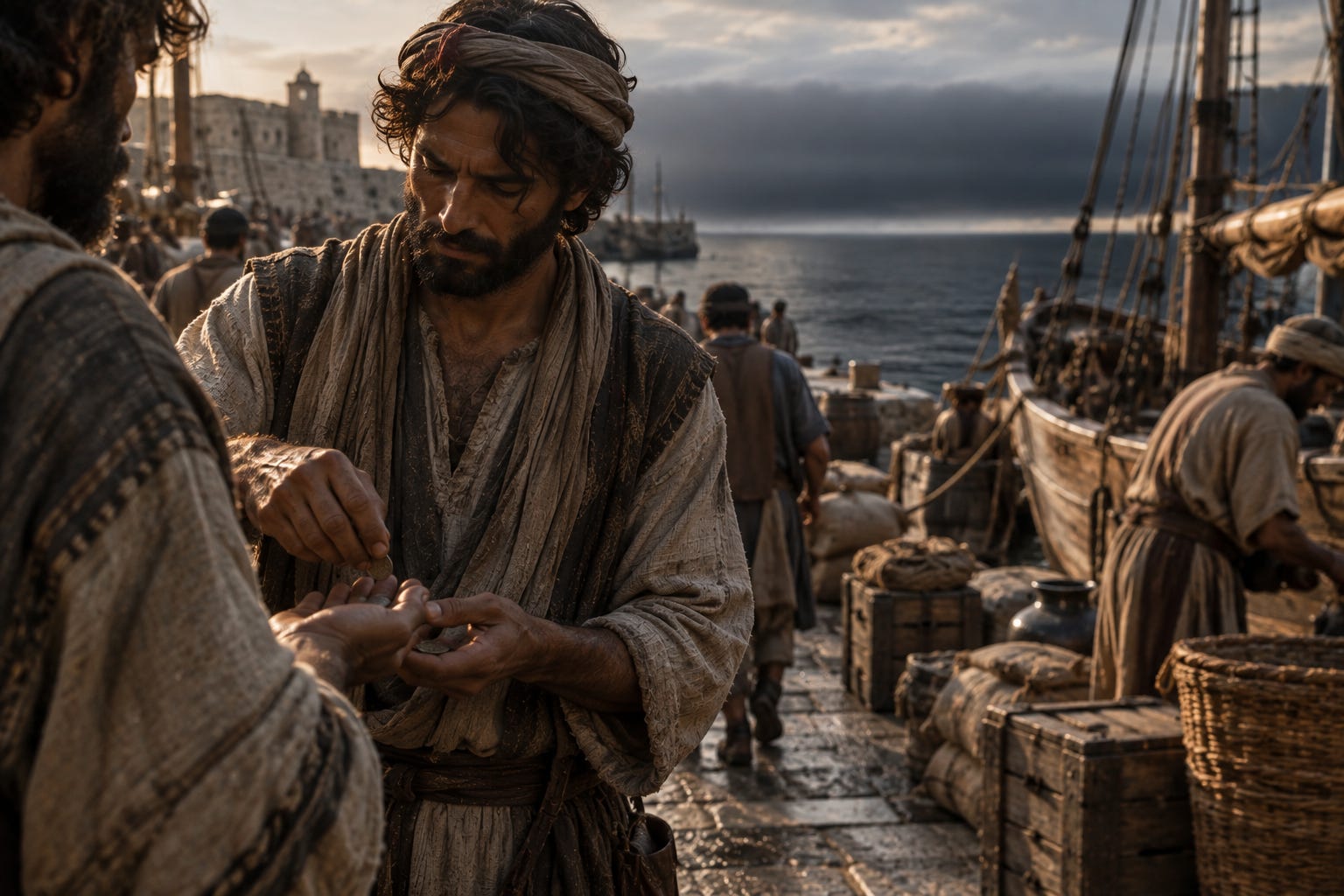
JONAH: I paid the fare myself. That’s the part that still gets me — stood on the dock and counted it out into a man’s hand. MOSES: You’re not the only one. I asked Him to send somebody else. Out loud, in those words. He sent me anyway. Your fear isn’t the deciding vote, Jonah. JONAH: You were afraid you’d fail. I was afraid I’d succeed. RUTH: Then maybe it was never about how it turns out. Nobody called me anywhere. She told me to go home, and I kept walking. You can want the wrong ending and still take the next step. PAUL: Stop arguing with it. I set out with letters in my hand to drag people back in chains, and I was sure I was right. Then I wasn’t. Go, Jonah. ESTHER: Paul says go like it’s simple. For some of us, going means a room you might not walk out of. Three days without food, then into the king’s court without being called. JONAH: So the question was never whether I’m afraid. It’s what I’m going to do with it. That’s The Scroll Feed. Every line of it is imagined — our conjecture of what each of them might have said about their own hour, had you caught them at the end of it. The Scripture inside it is quoted exactly, King James, with book and chapter and verse. And the vantage is the one the text itself fixes: Jonah speaks from the dock, the fare gone out of his hand, with no idea on earth what the next three days hold. Imagined words, exact Scripture, a man who doesn’t know how it ends — that’s the whole arrangement, and it’s marked on every page. Why a feed Think about what keeps you scrolling. It isn’t really that each post is quick. It’s that you get caught up in the details. Somebody’s real life rather than a summary of it. A voice talking instead of a text explaining. Other people answering underneath, agreeing, pushing back. And something new waiting every time you come back. The feeds on our phones were built around what genuinely fascinates us, and they’re very good at it. Now look at what we were handed. Scripture has almost all of it already. It’s the record of real people in real trouble, told half the time in their own words. Jonah is a man who paid his own fare to run from God and ended up in the water with it. That’s a story you can’t look away from. People were caught up in it long before anybody thought to build a feed. The one thing the pages can’t do is put those people in the same room, and that’s the part we add: the others turning up underneath to answer. What most of us got instead was the summary. The famous part. Four verses on a Sunday morning and the moral read out at the end so nobody would miss it. So here is the whole idea, and it isn’t complicated. The thing your thumb already loves to do — read a short piece, hear a voice, see who answered, come back for more — turned toward the stories God actually gave us, told close enough that you can smell the fire somebody was sitting next to. A scroll, in a feed. The oldest thing we have, in the shape attention already takes. Closer to the people God gave us The Scroll Feed follows story arcs out of Scripture, one person’s story at a time, so that when you open the Bible yourself you hear the people in it in far greater detail. Most of us know them at a distance. The famous scenes, a dozen people attached to a dozen conclusions. Up close you get everything the distance leaves out: the man who hasn’t decided yet, the woman going about her work while the thing that will reorder her whole life is already walking up the road toward her, the brother about to do something he’ll carry for the rest of his life. There’s a moment in Luke where a rich man, in torment, begs Abraham to send someone back from the dead to warn his five brothers. Abraham’s answer is short: “They have Moses and the prophets; let them hear them” (Luke 1629, KJV). And when the man presses, Abraham tells him that if they won’t hear Moses and the prophets, “neither will they be persuaded, though one rose from the dead” (Luke 1631). That’s why we stay with the people God already put in front of us. Nobody here is adding to the Book or improving on it. Moses at the bush, Esther at the king’s door, Peter in the water — they were given to us on purpose, and pondering them turns out to be a joy. You get a vivid look at real people living the stories God wanted us to think deeply about, and you get to enjoy the journey right alongside them. Each episode is a story, with a beginning and an end the person living it can’t see yet. Several of those sit inside a larger arc, the way the small stories of a life sit inside the life. Come back and he’s further in, still with no view of how it finishes. What an episode looks like One person out of Scripture, telling a story out of their own life from inside it — what they wanted, what it cost them, what they got wrong, and what they couldn’t possibly have known yet. The research is in the room with them. The real place on a real map, the season the text anchors, what the air was doing at that hour, how far a man could walk before dark, what he could smell from where he was kneeling. A body is how a person receives a day, so the day gets written as a body received it. Then the others turn up underneath and answer. Mostly they’re kind about it. These are people who know what it costs to be in the middle of something, and a man who has carried the same weight is far more likely to say I know, and here’s what held me than to argue with you. So you’ll find them encouraging each other, agreeing out of their own experience, strengthening somebody who’s wobbling. They don’t always agree, and when they don’t it’s worth staying for — one of them says go, another says for some of us it isn’t that simple, and both of them are right. Nobody tells you the moral. You’ll recognize something or you won’t, and that part belongs to you. If your hands are busy, every episode also comes read aloud, with the whole cast voiced and the replies included. Who’s behind it People. A small team with a degree in theology and master’s-level training in education, and a strict review that every episode passes before it publishes: each verse checked word for word against the King James, each line weighed against what Scripture actually says, and nothing ever put in God’s mouth that He didn’t say. AI tools are part of the workshop. They help with drafting, they render the illustrations, and they voice the audio. People decide what gets said, and Scripture is never generated. None of it is meant to stand in for your Bible. It’s meant to send you further into it. When the Law was read to the people in Nehemiah’s day, the readers “read in the book in the law of God distinctly, and gave the sense, and caused them to understand the reading” (Nehemiah 8:8). That’s the work we want to do. How to read it The first Psalm describes a man whose “delight is in the law of the LORD; and in his law doth he meditate day and night” (Psalm 1:2). Day and night is a rhythm, and it’s the one we’d suggest. In the morning, read an episode the way you’d read a devotional, with your Bible open beside it if you like. In the evening, come back. Listen to it read aloud, see who answered underneath, and add your own reply. Where to start Anywhere. Pick a name you already know and read that story. One episode is enough to tell whether this is for you. If you’d rather take it in order, the first one is sitting at the top of the archive, waiting. Where to find it Substack is home — read it there, or have it land in your inbox. Podcast apps carry every episode read aloud, free. X is where the characters answer on the same feed you’re already scrolling. Reach out and ask any of them what you’ve always wanted to know. If you’re the one doing the introducing You don’t have to explain any of this. Send somebody this page and tell them to start here with us. That’s the whole introduction. © The Scroll Feed 2026 This is a public episode. If you would like to discuss this with other subscribers or get access to bonus episodes, visit thescrollfeedco.substack.com
Embed this episode
Ready to play
Start Here With Us
No transcript for this episode yet
Similar Episodes
No similar episodes found.
Similar Podcasts
No similar podcasts found.