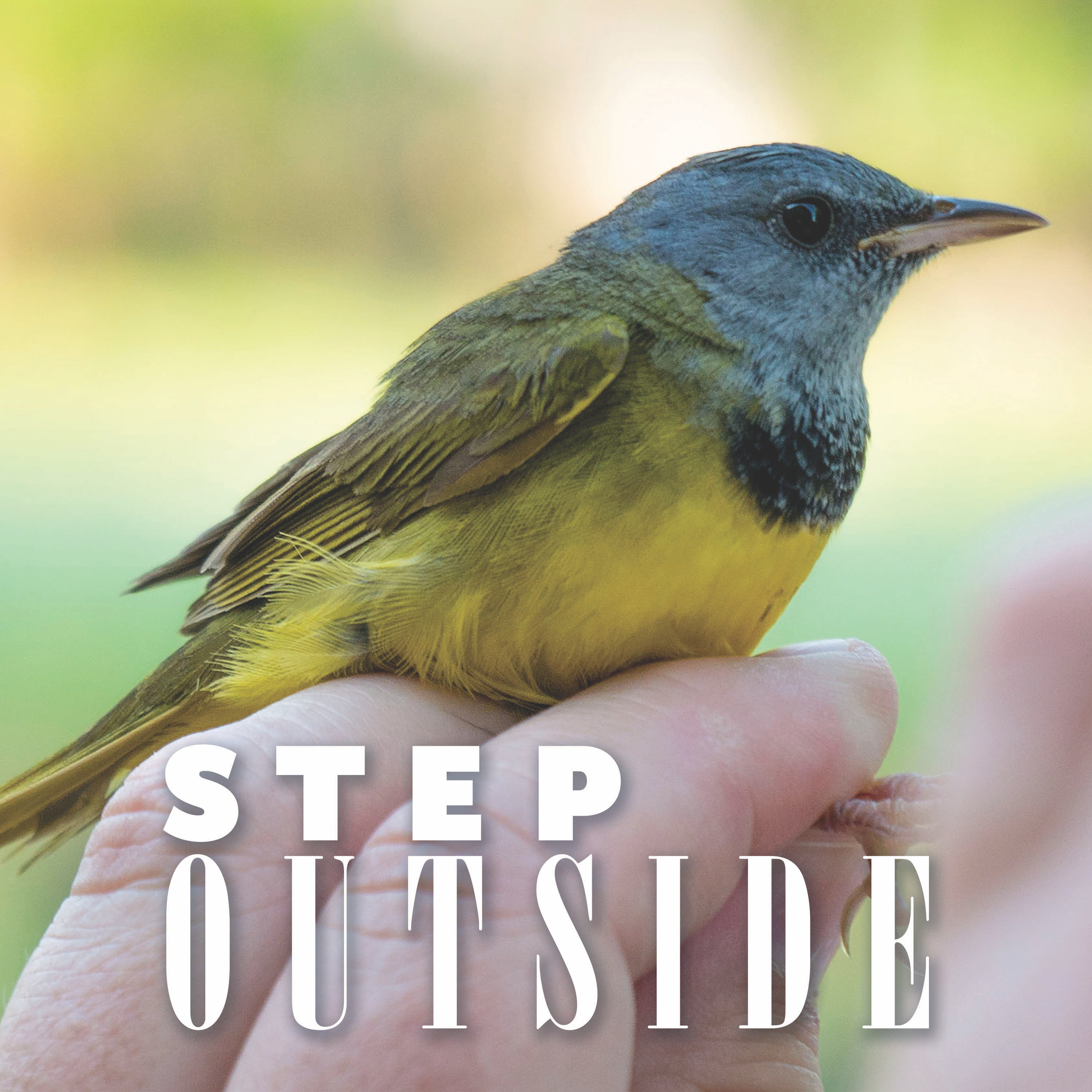
Hi everyone, welcome to the Step Outside podcast from the Department of Forestry, Wildlife, and Fisheries at the University of Tennessee Institute of Agriculture. I'm your host, Christy Kiel Blackman. Today I would like to welcome Kyler Hecke to our podcast. Kyler is a PhD student here in our department and today we're going to talk about his research on the sickle darter.
Welcome, Kyler. Hi everybody, how's it going? Thanks for being here. So let's jump in and if you would just introduce us on a kind of basic level to your dissertation research.
Yeah, so I'm a third year PhD student. Kind of my dissertation research comes to a lot of different things. So when I first got here, Dr. Alford, my advisor and I, we wanted to assess historical distributions of both fish and mussels of greatest concentration of meat in the clint of river drainage.
It's a really diverse drainage as far as the number of species of both mussels and fish that occur there. So we acquired a lot of historical data sets, distribution data sets, and we wanted to figure out how distributions of these species have changed over time and kind of what mineral factors have influenced the distributions of these species. Another part is we're assessing the current distribution of the sickle darter. It is a species only found in the upper Tennessee river drainage in Tennessee, Virginia, and North Carolina.
So we assessed that. Also, we kind of did a little side project where we're tracking the small-scale movement of the species to try to figure out if it actually stays in the same kind of habitat year-round. But in short, that's pretty much my dissertation research. You sent me a research paper ahead of time so that I could review it, and I looked over that.
So why are we looking at the sickle darter specifically? Why is that one species so important? So like I just said, it's only found in the upper Tennessee river drainage, but ultimately, nobody's ever assessed its actual distribution. In the past 100 years, kind of here and there, in other standard sampling programs by DWRA or TDA, it's been observed.
And you just put down lat-long where it occurred, but that's it. So we kind of had maybe a general idea of where it occurred, but we didn't actually know does it actually occur in all these other sites like the ones we find in it. Also, because of that, U.S. Fish and Wildlife Service has petitioned it to be elicited as potentially federally threatened or endangered because we realized that historically where it was observed, say, maybe 100 years ago, it no longer does.
So we're seeing kind of a reduction in its distribution. So it's important that we currently figure out where it occurs and we're trying to figure out what the best management position is to help recover that species and figure out also if it actually needs to be elicited as federally threatened or endangered. Okay. So is it safe to say that the sickle darter is not the only fish of concern?
This is just one species that you're looking at? Yeah, it's not the only one. There are not only just darters, but a lot of fish species, you know, that don't get necessarily the attention they need to understand if there are changes in their species status or their distribution. So the grant we got is the State Wildlife Grant.
And State Wildlife Grant is mainly focused on, you know, the species of conservation need to try to figure out if, you know, there's been drastic changes in their distribution or their species status and try to also help them, based off the research done, determine what kind of conservation measure needs to be done to, you know, help them by reintroductions or habitat improvement work. Would you be working with reintroduction projects eventually? I'm doing an ecological index model for, based off the distribution data we're collecting for sickle darters. And basically what that is predicting is within the upper Tennessee river drainage, which stream regions have the highest probability suitable habitat for sickle darters.
So how that model and the data I'm collecting are going to be utilized are, well, you've got to ground through the model. All right, so there's a high probability suitable habitat for sickle darters, but I may not sample there. Well, let's go sample there and see if it actually occurred there first. But also, TWRA, TVA, whoever ends up making conservation decisions for the species, they will ultimately do it once I'm gone, like, well, we need to go reintroduce the species in the North Fork Coulson River or something like that, where it historically occurred, and I wouldn't sample there, but we were unable to observe any sickle darters out there.
So I personally will be able to be a part of that, which I'll follow it. Sure. So your research is directly contributing to whether the species gets listed? Yep, pretty much.
Oddly enough, next week I'm actually meeting with the species status assessment team, and we're going to sit down and we're going to read some chapters for the species status assessment of the sickle darter to review, and kind of we're all sitting down and making sure we have everything fine-tuned of what we need to say and kind of what we know about the species to submit to the official wildlife service so they can hopefully make the best decision for the species. But yeah, my data is going to help contribute to what was ultimately determined for that species. That's great. That's really fascinating.
Going back to this little fish itself, what type of threats is the sickle darter facing currently? In my analysis of the historical distribution of the species compared to what I've observed with my sampling data for the species, they have positives, they have negatives, but dams, the hydropower dams, and then small mill dams, which a lot of them are not even used anymore, but that has caused habitat fragmentation for these species or for this species. And when we find these species, a lot of times when you think of this species, it's the best water quality, the best kinds of habitat. Sickle darters are like, you're in some pretty nasty stuff sometimes, which is odd, but they can make do.
But what we've noticed is that the habitat fragmentation appears to be one of the major threats to the species. So historically, you know, before dams, all these dams were built in over Tennessee river drainage, they were pretty, what we like to think, is widely distributed across these similar habitats. But when you put in mill dams, you separate these species so you don't have immigration and immigration in between these two populations of the species. So we like to hypothesize that's the major threat to the species.
As far as, you know, water quality changes, maybe, but we don't really have a lot of data to support that yet. So it's a pretty intolerant species of... Yeah. You know, we were in the middle of Fort Colston River, I think it was two summers ago, and it's right in the middle of Chilpau, Virginia, in that town.
And, you know, you have all this runoff from concrete pavement, from parking lots and other things. And so basically everything that's run on the ground, you just put in the river, and you're like, I don't know if this species will be there. And you find it, and you're like, oh, sure enough, I guess it likes this kind of stuff. Yeah, it's pretty remarkable that you can be in such what you call bad habitat, I guess you could say, and you still find simple waters.
Yeah, that's interesting. They are very tolerant, I guess. I also read in your paper that you sent me that it's easier to find these fish while snorkeling rather than seining or electroshocking. Yeah, as far as fisheries research goes, we're sampling streams and rivers.
You know, the standard is to, you know, use minnow seines or seining, but also use backpack electrofishing, and most times with those in tandem with one another, where you backpack electrofish down into a seining. And so ideally, all fish you're looking for, you can find them that way. But because simple waters are kind of semi-plagic, where a lot of darters are bent, you find them on the bottom, so that makes it easier to sample, be up, shopping, or seining. Simple darters, I like to call them escape waters, because we've gone snorkeling, and we'll observe one, and we'll put a marker down in the stream so we'll come back later and try to get it'd be shocking or sane, and you go right through that habitat, and well, you'll get other fish, but you won't get simple darters.
But also, we've gone and we've shocked insane certain habitats at certain sites, we won't get simple darters. Well, then we'll put, you know, we try to do that first, and cool off, I guess you could say, by snorkeling. And we'll go snorkeling and snorkeling with the same habitat, and we'll find simple darters. That's pretty impressive, but that's the best way to observe the presence of simple darters.
Beyond contributing to the listing status of the species, what do you hope comes out of this research that you've been doing for three years? Yeah, prior to coming to UT and doing this research, I did not have a lot of experience snorkeling. You know, I've done it at the time or two, but it really shows light on how sometimes it might have to change our sampling methods to increase our detection rates or our probability of taking a species at the highest rate, so we can make sure we're collecting the kind of data we need to answer the research question we're trying to answer. But also, I hope, building an ecological niche model for the species, I really hope that other researchers kind of utilize the application of ecological niche modeling to, you know, these species-based conservation, even how they might contribute to future conservation measures for these species.
Like I said, ecological niche model predicts the probability of a suitable habitat. On the scale of, you know, statistics, ecological niche modeling is relatively new, 15, 20 years old enough. It really started in, you know, birds and amphibians, and it's just not trickling over to, you know, ecological niche modeling to see how you can apply it to, you know, predicting distributions of these species. And I'm not going to say it's going to be the best one, but it's another good example to use a reference when you're designing other studies to assess other distributions of species of greatest conservation niche.
Great. So this could be contributing to scientific data collection as a whole. Yeah, in my opinion, when you obviously research, you like to think that what you're doing will contribute to scientific data collection, that you're doing some good, and somebody will benefit it, whether it be the species or researchers in the future, they saw what they're doing, so I like to think we're doing that. Yeah, absolutely.
That's great. Are there any last words you'd like to say about your research, or is there anything that you'd like to leave with people? Yeah, I would say, you know, a lot of people, based on time around water bodies, rivers, streams, or lakes, but, you know, a lot of times people just see fish darting around, or they think they're all mooners and shiners, which, you know, even I thought that was okay, because I didn't know any better, but now that, you know, I've gone through school and I've learned, like, there are so many different kinds of species starters, you know, sculpins and shiners, I would tell people, just so you can open your eyes to it, I'm going to call it the aquatic world, go snorke on me sometime. I mean, you can get, you know, a goggle on a snorkel for fairly cheap, but just stick your head in the water, and you'll be amazed at what you can see, not only fish, but mussels, crayfish, aquatic insect water, and to me, that's one of the best things you can do, is just observe kind of how the aquatic ecosystem works by seeing your head in the water.
Oh, yeah, that's what I would hope people would want to do in the future, I try to tell all my friends back out, like, you know, the water's clear and the water's fairly warm, there's nothing better than that. It's basically swimming, but you're, I'll call it seeing a movie when you're swimming. That's awesome, yeah, so you heard it here first, go stick your head in the water, direct from Kyler Hecke. Thanks, Kyler, for joining us, this was awesome, and I certainly learned a lot about the sickle darter because I was not familiar with this fish at all, and I'm assuming that most other people who aren't doing their dissertation on the sickle darter.
Yeah, I hope people learned as well. Yeah, that's great, well, thank you for joining us. Yeah, thanks for having me. And everyone who's listening, thank you for joining us.
Please be sure to tune in next time, we'll speak with another grad student about research in the Department of Forestry Wildlife and Fisheries. For more real-life solutions provided by the UT Institute of Agriculture, go to our website at ag.kennessee.edu.