
EPISODE · May 5, 2026 · 14 MIN
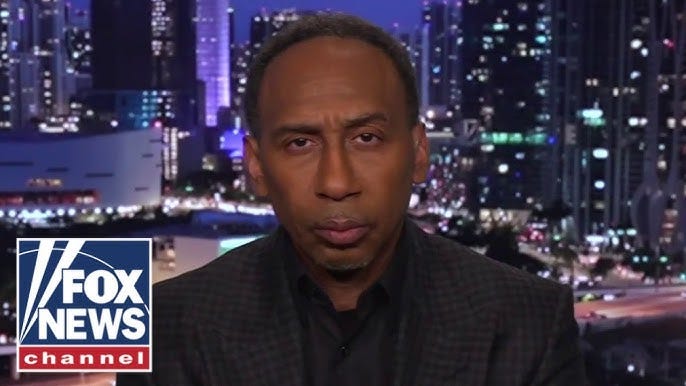
Stephen A. Smith Voted for Kamala, Regretted It, and Got Endorsed by Trump — Now He Wants to Be President
from Education is Elevation · host The Conscious Lee
Education Is Elevation is a reader-supported publication. To receive new posts and support my work, consider becoming a free or paid subscriber.Y’all already know how this goes. Somebody with a microphone, a Black face, and a national platform spends years telling us he’s one of us, then turns around and starts auditioning for the very people who built this country on our backs. That’s where we are with Stephen A. Smith. And if we don’t break this down with receipts, the algorithm is gonna do what it always does — flatten the contradiction and serve us the polished version.Research over MeSearch. Let me lay it out.In November 2024, Stephen A. Smith voted for Kamala Harris. By January 2025 — barely two months later — he was sitting on Bill Maher’s couch calling himself and every other Harris voter a “damn fool” for it. Not critiquing the campaign. Not pushing the party to do better. Calling Black voters who showed up for the Black woman on the ticket fools. Then he went on Sage Steele’s show in March 2026 and confirmed it again — yeah, he regrets that vote. Sage Steele. The same Sage Steele who built her brand attacking Black women like Serena Williams for talking about race. Two things can be true: a person can have legitimate grievances with the Democratic Party AND choose to air those grievances exclusively on platforms that exist to demonize Black political consciousness. Stephen A. is choosing.In May 2025, when Donald Trump publicly said he’d “love to see” Stephen A. run for president, Smith said he was “aghast.” Then he went on CNN’s State of the Union with Jake Tapper and admitted there’s “a bit of flattery” in being praised by “the man who holds the highest office in the land.” When Tapper pressed him on whether he could actually win, Smith said, “You’re damn right.” Every accusation is a confession. And every aw-shucks denial is a confession too. By February 2026, he’s on The Hill telling reporters he’s a “fiscal conservative” who’s “social liberal” — the exact language Black conservatives have used for forty years to launder right-wing economics through cultural identity. He says he supports “strong borders.” He says he’s “disgusted” with the left. He says any “construction worker” could beat the Democrats. The man is running. He just wants us to act surprised when he announces.Now here’s where the pro-Black branding starts cracking. In October 2025, Smith devoted a full episode of his SiriusXM show Straight Shooter to attacking Congresswoman Jasmine Crockett — a Black woman in Congress doing the actual work of holding this administration accountable. He called her communication style “street verbiage.” He questioned whether her “rhetoric for the streets” was “going to get you anywhere.” Where is the smoke for Trump? Where is the smoke for Stephen Miller? Where is the smoke for Russell Vought? Stephen A. has a multi-million-dollar microphone and he aims it at a Black woman congresswoman before he aims it at the architects of the regime she’s fighting. That’s not analysis. That’s not even disagreement. That’s the same coded language white folks have been using on outspoken Black women since Ida B. Wells. The only difference is now it’s coming out a Black man’s mouth on a Sirius XM show.And he only apologized after Trump himself called Crockett “a very low IQ person.” Read that again. Stephen A. Smith didn’t pull back because he reflected on what he said. He pulled back because Trump used Stephen A.’s framing to attack a Black woman, and Stephen A. realized — out loud, on tape — that he’d handed the president ammunition. He said, “with Trump feeding into that nonsense, giving him fodder or ammunition, to continue to go out there and talk about our Black women that way… I don’t want to be associated with nothing like that.” Cool. But the question Crockett herself asked when she finally responded on TSR Live in October 2025 cuts to the bone — “If you hadn’t gotten smoke, would you have done it?” Liberalism is a hell of a drug, but careerism is the strongest dose.And Crockett ain’t a one-off. Smith has spent the better part of a decade making his money diminishing Black resistance. In 2016, when Colin Kaepernick told reporters he didn’t vote, Stephen A. went on First Take and called Kaep “absolutely irrelevant.” Not the system that blackballed him. Not the league that stole his career. The Black man kneeling. In 2019, when Kaepernick showed up to that staged NFL workout in a Kunta Kinte t-shirt, Stephen A. lost his entire mind on air. He kept telling us he understood the protest — but every time Kaep moved out of the box Stephen A. drew for him, Stephen A. punished him for it on national television. In 2025, after Serena Williams danced at Kendrick Lamar’s Super Bowl halftime show, Stephen A. used his platform to lecture her on her marriage to Alexis Ohanian. A grown Black woman, the most decorated tennis player of all time, dancing at a Black cultural moment, and he found a way to make it about her supposed disrespect to her husband. Lost in the sauce.When Shucking and Jiving Goes WrongNow connect this to the larger pattern. In May 2025, on NewsNation’s Cuomo show, Smith argued Black voters had “played the role of suckers” for the Democratic Party for sixty years. In March 2026, on his Straight Shooter podcast, he told us, “I ain’t giving you anything” — meaning his vote — and pivoted to the line that Democrats “focus on 1% of the population” instead of Black folks. We need to be precise about what he’s doing here. The 1% he’s talking about is trans people. He’s running the same divide-and-conquer playbook the right has been running since the Southern Strategy — pit one marginalized community against another, and reframe Black liberation as something that happens at the expense of trans liberation, immigrant liberation, queer liberation. Kimberlé Crenshaw been told us this is how it works. Cedric Robinson been told us racial capitalism profits from these splits. And Stephen A. is up on Fox News-adjacent platforms running it for the cameras.Two things can be true. The Democratic Party has earned every ounce of Black skepticism. Black voters absolutely should demand more than fear-mongering and lip service. Cory Booker’s voting record told us that. The Voting Rights Act dying in front of our eyes under a Roberts Court told us that. But there is a difference between critiquing a party from inside the community to push it left, and critiquing a party on conservative platforms to push the community right. SNCC critiqued the Democrats. Bayard Rustin critiqued the Democrats. Fannie Lou Hamer critiqued the Democrats from the floor of the 1964 Democratic National Convention. None of them were on Bill Maher complaining about “woke culture.” None of them were sitting next to Bill O’Reilly taking a phone call from Donald Trump. The destination matters. The audience matters. The platform matters.This is where the responsibility piece comes in, and it’s the part nobody wants to hear. Black platforms — and Stephen A. Smith is the most-watched Black voice in American sports media — carry a structural responsibility that white platforms simply do not. When ESPN signs you to a $100 million extension in 2025 and gives you a daily show, a primetime show, a podcast, and a guest chair on every cable news network in the country, you are not just “giving your opinion.” You are setting the terms of debate inside Black households. You are shaping what young Black boys think it means to be a successful Black man with a microphone. You are deciding which Black women get critiqued and which white men get a pass. The influence is the product. ESPN didn’t pay him $100 million for his takes on the Knicks.Here’s the framework. Cedric Robinson’s Black Marxism teaches us that racial capitalism doesn’t just exploit Black labor — it commodifies Black voice. Saidiya Hartman’s afterlife of slavery shows us how the structures of unfreedom shape what gets rewarded in Black public life: Black voices that confirm white anxieties get amplified, Black voices that disrupt them get marginalized. Frank Wilderson’s work on antiblackness as a structuring logic asks us why a Black man with national reach reflexively reaches for Black women and Black resistance figures as the targets of his critique, instead of the white power structure that funds his check. The system isn’t broken. The system is doing exactly what it was built to do. And Stephen A. is being paid handsomely to play his position inside it.The responsibility on Black platforms is not to be uncritical of Black politicians or Black movements. The responsibility is to do that critique with the receipts, with the historical context, and with an awareness of who else is in the room. When Stephen A. Smith says “I want Democrats to earn the Black vote” on Fox News-adjacent platforms in 2026, the audience hearing that line is not Black voters running back to a more progressive politics. The audience is white moderates and Black conservatives who use his words as cover to suppress Black turnout, gut the Voting Rights Act, and redraw districts to dilute Black political power. The Supreme Court just gutted Section 2 of the Voting Rights Act in Louisiana v. Callais. Republicans are mid-decade gerrymandering five states right now. And the loudest Black voice in sports media is on national television telling Black folks the Democrats took us for granted. Whose interest does that actually serve?We can hold this up against the standard a Cornel West or a Ta-Nehisi Coates would hold themselves to. We can hold this up against the standard Killer Mike held when he sat across from Bernie Sanders. We can hold this up against the standard Angela Davis still holds at 82 years old. The receipts are clear. Stephen A. Smith built his platform on the labor of Black athletes, the suffering of Black communities, and the loyalty of a Black audience that took him seriously when he said he was one of us. Now that the platform is built, he’s renting it out to the highest bidder — and the highest bidder right now is Trump’s America.I’m not telling you to cancel Stephen A. Smith. Cancel culture ain’t the move and it ain’t the strategy. What I am telling you is this: when somebody on a Black platform starts telling you that the people fighting for your liberation are actually the people standing in the way of your liberation, run the receipts. Ask who’s paying. Ask who’s clapping. Ask what the platform looks like in five years if everybody on it talks the way the loudest one talks. Ask whether the analysis lines up with the material conditions of Black life — Black maternal mortality, Black wealth gap, Black voter suppression, Black incarceration — or whether the analysis exists to make white moderates comfortable while we get rolled.Stephen A. Smith says he might run for president in 2028. He says elected officials and billionaires have encouraged him. He polled at 2% in a 2025 Democratic primary survey. He wants us to believe this is organic. It is not. It is the same playbook that gave us Herman Cain, Ben Carson, Tim Scott, Byron Donalds, and every other Black face used to legitimize a politics that treats Black liberation as a niche concern. The faces change. The function doesn’t.Where is the smoke for the people doing the actual harm? Where is the receipts-based critique of the donors funding the gerrymandering? Where is the half-hour monologue on the Heritage Foundation’s role in Project 2025? Where is the smoke for the white owners who blackballed Kaepernick, the white prosecutors who let R. Kelly’s enablers walk, the white politicians who built the prison pipeline? When Stephen A. saves his loudest energy for Black women in Congress and his softest energy for the president of the United States, the contradiction is the message.Y’all be safe. Stay informed. Read your Robinson. Read your Hartman. Read your Crenshaw. And when somebody with a microphone tells you who the enemy is, always — always — check who signs the back of their check.Why Black Platforms Have a ResponsibilityThis is the framing paragraph the user requested — drop-in ready for newsletter pull-quote, post header, or social card.Black platforms carry a responsibility white platforms do not, and the math on that is structural, not moral. When a Black voice with national reach speaks into a Black audience, the trust being extended is intimate — Black folks come to Black voices because we are exhausted from being misrepresented everywhere else. That trust is not free. ESPN paid Stephen A. Smith a reported $100 million in 2025 because the influence is the product, not because his Knicks takes are remarkable. Cedric Robinson taught us that racial capitalism commodifies Black voice the same way it commodifies Black labor — the system pays handsomely for the Black voices that confirm what power already wants said, and it marginalizes the ones that disrupt. Saidiya Hartman’s afterlife of slavery shows up in who gets the $100 million extension and who gets blackballed out the league. So when the loudest Black voice in American sports media uses that platform to redirect Black political grievance toward Democrats and away from the architects of voter suppression, that is not opinion. That is editorial cover. The responsibility is not to be uncritical of Black politicians or Black movements — SNCC, Fannie Lou Hamer, and Bayard Rustin all critiqued the Democrats. The responsibility is to do that critique with receipts, with historical context, and with full awareness of who else is in the room when you speak. The destination matters. The audience matters. The platform matters. Pro-Black branding is not a substitute for pro-Black behavior, and a Black audience that has been lied to from the outside our entire lives deserves Black platforms that don’t replicate the lie from the inside.Education Is Elevation is a reader-supported publication. To receive new posts and support my work, consider becoming a free or paid subscriber.Five Key TakeawaysTakeaway 1. Stephen A. Smith voted for Kamala Harris in November 2024, called himself a “damn fool” for it on Bill Maher in January 2025, and confirmed his regret again on Sage Steele’s show in March 2026. Two months between vote and public regret. That’s not political evolution — that’s a pivot, executed on the platforms most hostile to Black political power.Takeaway 2. Smith’s framing of Democrats as the party that “forgot” Black voters and is “focused on 1% of the population” (his March 2026 Straight Shooter language) maps directly onto the right’s divide-and-conquer playbook. He’s not pushing Democrats left — he’s running cover for the Trump administration’s attacks on trans people, immigrants, and other marginalized communities, with Black grievance as the wedge.Takeaway 3. His pattern of punching down on Black women — Megan Thee Stallion (May 2025 breakup commentary), Serena Williams (after Kendrick’s 2025 halftime show), Jasmine Crockett (October 2025 “street verbiage” comments) — is not coincidence. It is the through-line. He apologized to Crockett only after Trump used his framing to attack her, which Crockett herself called out on TSR Live: “If you hadn’t gotten smoke, would you have done it?”Takeaway 4. Trump publicly endorsed Smith for president in May 2025 on NewsNation. Smith called himself “aghast” then went on CNN and admitted he was flattered, said he could win, and by February 2026 was openly calling himself a “fiscal conservative.” He polled at 2% in a 2025 Democratic primary survey. He has never held office. The trajectory is not subtle.Takeaway 5. Black platforms carry structural responsibility because of structural reach. ESPN signed Smith to a $100 million extension in 2025. He sets the terms of debate in Black sports media every single morning. When the loudest Black voice in American sports tells Black audiences that the Democrats took them for granted while saying nothing comparable about the architects of voter suppression, that’s not opinion — that’s editorial cover for the people dismantling Black political power.EXPLICIT ASK TO BECOME A PAID SUBSCRIBERIf this kind of receipts-based, framework-rooted analysis is what you come to Education is Elevation for, the way you keep it coming is by becoming a paid subscriber. This platform runs without corporate backing. No advertisers. No sponsors telling me what I can and can’t say about Stephen A. Smith, ESPN, the Democratic Party, or anybody else. The work — the research, the citations, the writing, the production — is sustained entirely by y’all. Less than 1% of folks who follow me have converted to paid, and the math on that is what it is. If you’ve gotten value from this piece, the move is simple: hit the subscribe button, lock in the paid tier, and put yourself on the side of independent Black analysis that doesn’t bend for the algorithm or the advertiser. Research over MeSearch. Education is Elevation. Let’s keep building.Education Is Elevation is a reader-supported publication. To receive new posts and support my work, consider becoming a free or paid subscriber.CITED SOURCES 1. Smith, Stephen A., interview on Real Time with Bill Maher (HBO, January 24, 2025).Smith’s on-camera admission, alongside Rep. Ro Khanna and Jesse Eisenberg, that he and other Harris voters were “damn fools” for the November 2024 vote. The pivot point for the political phase of his platform.2. Smith, Stephen A., interview on The Sage Steele Show (March 2026), reported in Fox News, April 1, 2026.Smith confirms his regret for the Harris vote on Steele’s platform — a notable choice of venue, given Steele’s history of attacking Black women on race issues.3. Trump, Donald, on NewsNation Town Hall (May 2025), with Bill O’Reilly and Stephen A. Smith.Trump’s public endorsement of a Smith presidential run. The original document for the choreography of the endorsement-and-denial sequence.4. Smith, Stephen A., interview with Jake Tapper, CNN’s State of the Union (May 4, 2025).Smith’s first network response to the Trump endorsement. “There’s a bit of flattery” and “You’re damn right” he could win. The denial that wasn’t a denial.5. Smith, Stephen A., Straight Shooter podcast (October 14, 2025 episode), reported across BET, The Hill, The Grio, Black Enterprise, Ebony, and TheRoot, October 14–November 1, 2025.The original Crockett “street verbiage” comments. Read the BET and TheRoot coverage together for the most complete community response.6. Smith, Stephen A., apology to Rep. Jasmine Crockett, Straight Shooter (October 22, 2025).The apology. Smith’s own framing — that Trump was using his words as “fodder” — confirms the apology was reactive to the political consequences, not the original critique.7. Crockett, Jasmine, interview on TSR Live (The Shade Room, October 30, 2025).Crockett’s response in her own words. The “if you hadn’t gotten smoke, would you have done it?” question is the core analytic frame for the entire Smith pattern.8. Smith, Stephen A., interviews with The Hill (February 13, 2026) and Yahoo Sports (February 14, 2026).The “fiscal conservative, social liberal” framing, the 2028 confirmation, the “strong borders” line. Together these establish the political identity Smith is building heading into 2028.9. Smith, Stephen A., interview on NewsNation’s CUOMO (May 2025).The “played the role of suckers” framing of Black voters. Establishes the rhetorical move of redirecting Black political grievance toward Democrats and away from the structural drivers of Black disenfranchisement.10. Robinson, Cedric. Black Marxism: The Making of the Black Radical Tradition (1983).Foundational text for understanding how racial capitalism commodifies Black voice and labor. The framework for analyzing what ESPN’s $100M contract is actually purchasing.11. Hartman, Saidiya. Lose Your Mother: A Journey Along the Atlantic Slave Route (2007); see also “The Time of Slavery,” South Atlantic Quarterly (2002).The afterlife of slavery as analytic framework — useful for understanding which Black voices get amplified in mass media and which get blackballed. The Kaepernick / Stephen A. asymmetry lives inside this analysis.12. Crenshaw, Kimberlé. “Demarginalizing the Intersection of Race and Sex,” University of Chicago Legal Forum (1989); “Mapping the Margins,” Stanford Law Review (1991).Intersectionality as the frame that exposes the “1% of the population” rhetorical move for what it is — a divide-and-conquer device that depends on pretending Black communities and trans communities don’t overlap.13. Wilderson, Frank B. III. Red, White & Black: Cinema and the Structure of U.S. Antagonisms (2010); Afropessimism (2020).Antiblackness as a structuring logic. The framework for analyzing why a Black man with $100M in platform reach reflexively reaches for Black women and Black resistance figures as targets of his loudest critique.14. Mallory, Tamika; Rye, Angela; Gillum, Andrew; Cross, Tiffany — public commentary on Native Land Pod and across Instagram, October 2025. This is a public episode. If you'd like to discuss this with other subscribers or get access to bonus episodes, visit theconsciouslee.substack.com/subscribe
Embed this episode
NOW PLAYING
Stephen A. Smith Voted for Kamala, Regretted It, and Got Endorsed by Trump — Now He Wants to Be President
No transcript for this episode yet
Similar Episodes
No similar episodes found.
Similar Podcasts
No similar podcasts found.