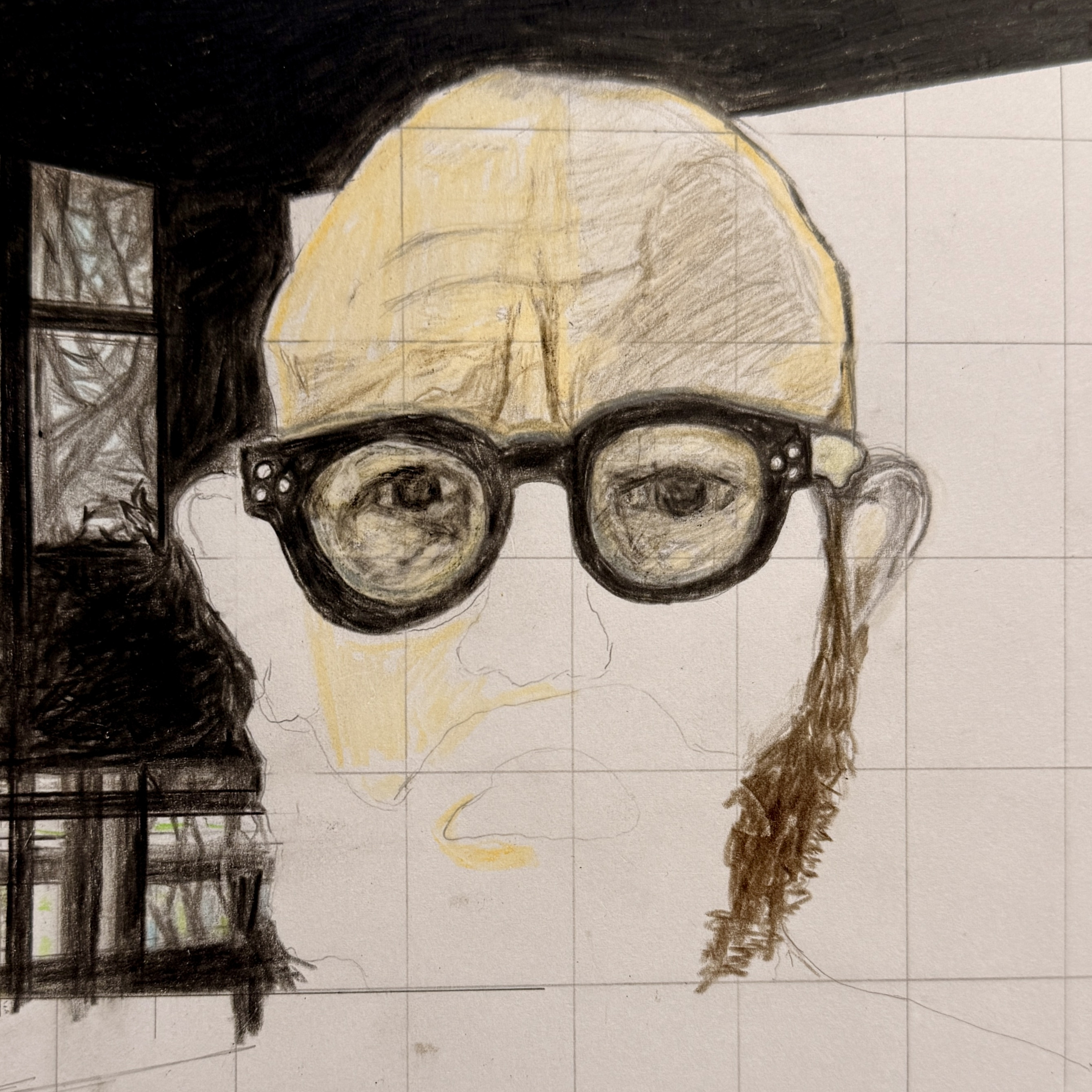
Steve and the linguistic creatures: a bad disciple's confession
from What Are Days For Hosted by Fernando Pessoa
Wednesday morning (no time given) 1. Inverting the exercise: Steve admits his honest answer to Pol's imaginative questions is "I don't really know, and I don't really care" — but reframes this as a data point, not a failure. He riffs that not-knowing and not-caring are entangled: "if you really know something maybe, you also care about that." He casts Pol as the one with the developed visual imagination, the same faculty behind Pol's response to video games, and locates his own imagination as "more emotional or conceptual." 2. Characters as letters: The core insight — Steve doesn't see Avice as a person, he sees five letters, A-V-I-C-E, and Scile as S-C-I-L-E. "I see them linguistically... I see them as creatures created by an alphabet." He clocks the vice inside Avice, the flirtation with "avarice" without avariciousness, the scythe echo in Scile. Contrast: the people in East of Eden, whose names he's forgotten but who still feel viscerally real to him. 3. The Ariekei as trees: His one point of imaginative traction — walking, talking trees whose speech is the rustle of wind through leaves: "the wind and the leaves create the language of the tree, and that is what language sounds like." Tied to the huge oak by his garden, "the magic mystery tree," he keeps meaning to climb without dying. Pol's "what's it like to be a tree" musings gave him the way in. 4. Language is dualistic (the real philosophy): Steve's takeaway — to use language rather than be chained to it, humans must "speak as an ambassador," holding two voices at once. He maps it onto therapy: when a client delivers a charge sheet against their partner, he also wants the love. "I want to hear the hate and I wanna hear the love... they don't cancel each other out but they actually give us the full picture." 5. MCR bit: Mid-filming his anti-humanist piece he ended up "bopping around" to The Black Parade, and now wonders about blagging into Wembley — "I'd like to be in that seething mass of emo idiots of which I am one. Uh very much so." The escalation (won't pay 200–300 quid, probably won't get in, would love to be there stoned) is reusable material. 6. The alien in the pond: The uncanny centre. Cooling off in his Lumi pond after filming, he leaned over for a reflection and saw something alien in his own shimmering image: "I saw the alien in me in that moment." Otherness located not in the Ariekei but in himself. 7. It smells like the page: Embassytown has no smell for Steve — he's the fish who can't perceive the water, same as with Queensbury. He riffs to places that do have one (tropical heat off the plane in Togo, Lomé, Cape Town, Durban) and turns to Pol, "the person with the nose," to supply the answer. 8. Mrs Patel and the Farage within: The most charged passage — Avice's relation to Embassytown becomes a mirror for his to Queensbury, detouring into his neighbour of 50-plus years who still can't hold a conversation in English. Steve watches "the Nigel Farage in me" surface — resentment that she takes everything and won't assimilate, set against his own "super assimilationist tribe" — then walks it back: he's not Farage, he smiles and bends over backwards. "I'm such an idiot, aren't I?" is him catching himself half-meaning a reactionary bit. 9. The junkie Ariekei (the one break): The single thing that snaps his suspension of disbelief. "How does a tree become a junkie?" He calls Miéville out directly — "oh China you're pushing it a bit there, you're losing me a little bit there" — and hands it to Pol to explain, closing as the self-styled "bad disciple" whose not-knowing is itself the honest answer.
Embed this episode
No transcript yet.