
EPISODE · Jun 16, 2026 · 1H 18M
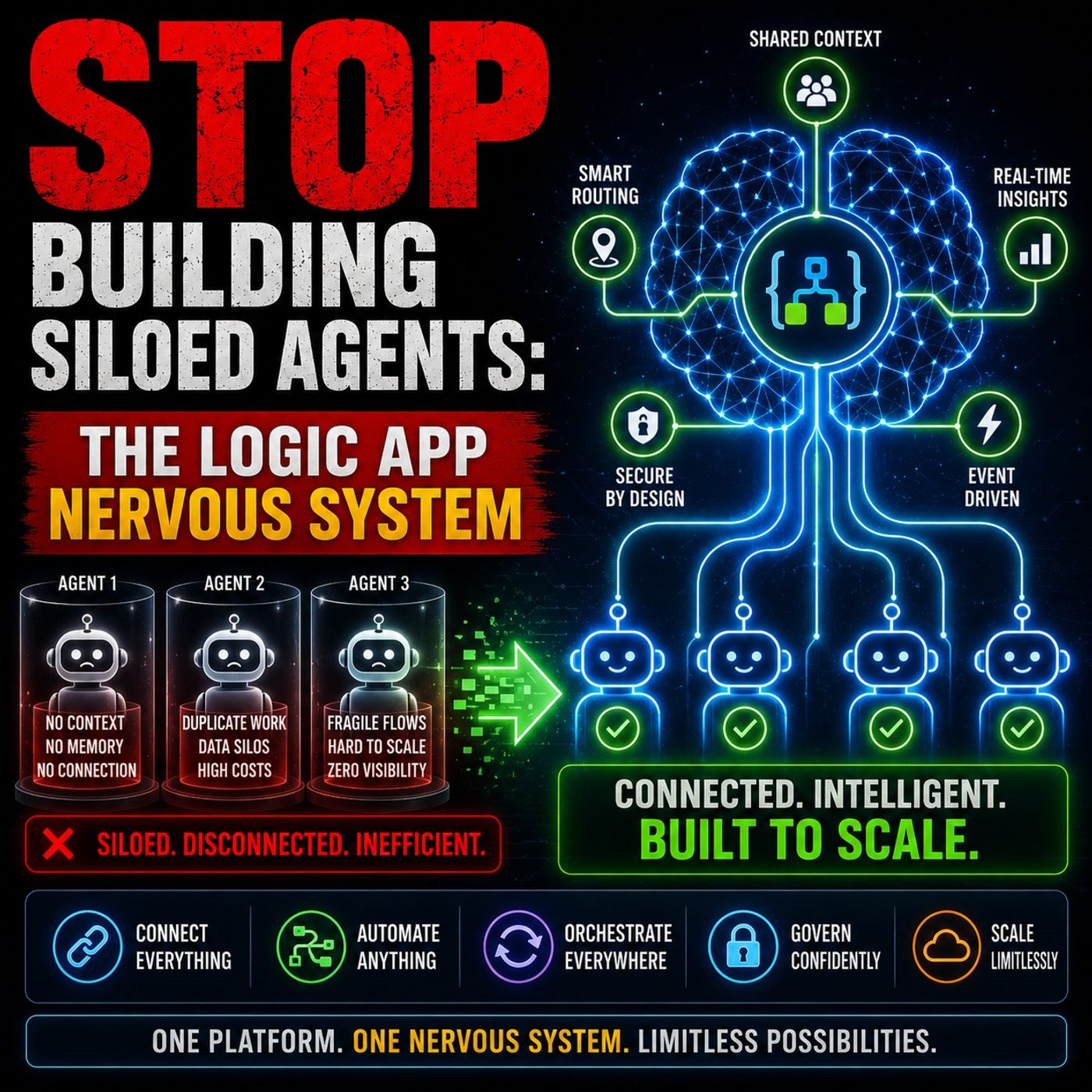
STOP BUILDING SILOED AGENTS: The Logic App Nervous System
from M365.FM - Modern work, security, and productivity with Microsoft 365 · host Mirko Peters - Founder of m365.fm, m365.show and m365con.net
Everyone is building AI agents.Very few organizations are building agent architectures.Across Microsoft 365, Copilot Studio, Azure OpenAI, Power Platform, and custom AI solutions, enterprises are racing to deploy copilots, bots, assistants, and autonomous workflows. Teams are creating agents for customer service, IT support, HR onboarding, knowledge discovery, incident management, and business operations.Most of them work.At least in the demo.But something very different happens when organizations move beyond a single agent and attempt to coordinate dozens of AI-powered systems across multiple business units, multiple platforms, and multiple Microsoft 365 tenants.The result is often chaos.Disconnected bots. Duplicate integrations. Credential sprawl. Governance gaps. Broken workflows. Untraceable actions. And increasingly, AI agents that cannot collaborate because they were never designed to operate as part of a larger system.In this episode, we explore why enterprise AI is repeating the same architectural mistakes organizations made during the early API revolution, why point-to-point agent integrations are becoming unsustainable, and how Azure Logic Apps is emerging as the orchestration layer that connects reasoning, execution, governance, identity, and automation into a single enterprise nervous system.If your organization is investing in Copilot Studio, Azure OpenAI, Microsoft 365 Copilot, Power Platform, or custom AI agents, this episode provides a blueprint for building agent ecosystems that actually scale.THE CHATBOT MIRAGEMost enterprise AI projects begin with a simple success story.A team creates a bot.The bot answers questions.The demo works.The project gets funded.Then another department builds another bot.And another.And another.Soon the organization has dozens of isolated AI systems solving local problems but creating enterprise-wide complexity.We explore:Why AI demos rarely reveal architectural weaknessesThe difference between local optimization and enterprise orchestrationHow siloed agents create operational debtWhy successful pilots often fail at scaleThe hidden cost of disconnected automationThe problem isn't the agents.The problem is the architecture beneath them.THE POINT-TO-POINT INTEGRATION TRAPEvery agent needs data.Most agents get it the wrong way.Organizations frequently allow agents to connect directly to APIs, databases, SaaS platforms, and Microsoft Graph endpoints.Initially this feels efficient.Eventually it becomes unmanageable.This episode examines:Point-to-point integration sprawlCredential proliferationDuplicate business logicDecentralized error handlingGovernance fragmentationObservability challengesThe more agents you deploy, the more dangerous direct integration becomes.WHY AGENTS FAIL AT ENTERPRISE SCALEThe most advanced language model in the world cannot compensate for poor architecture.We discuss why:Reasoning is not orchestrationIntelligence is not governanceConversation is not workflow managementTool calling is not process executionAI is not a replacement for enterprise integrationEnterprise success depends less on model sophistication and more on execution architecture.THE STATEFUL GAPOne of the most important concepts in this episode is the distinction between reasoning and memory.Most AI agents are stateless.Enterprise processes are not.We explore:Stateless automationStateful orchestrationLong-running workflowsProcess persistenceWorkflow recoveryCorrelation and context managementAn employee onboarding process may last days or weeks.A chatbot conversation may last minutes.These are fundamentally different workloads.WHY COPILOTS NEED A NERVOUS SYSTEMHuman brains don't directly control every muscle individually.The nervous system coordinates actions.Enterprise AI requires the same model.This episode introduces the Logic App Nervous System architecture where:Agents reasonLogic Apps orchestrateConnectors executePolicies governIdentity securesObservability monitorsThe result is coordinated intelligence instead of isolated automation.AZURE LOGIC APPS AS THE ORCHESTRATION LAYERAzure Logic Apps was originally designed for enterprise integration.It is rapidly becoming one of the most important foundations for agentic workflows.We examine:HTTP-triggered orchestrationsEvent-driven automationWorkflow persistenceLong-running process supportEnterprise connectorsBusiness process orchestrationLogic Apps becomes the central coordination layer between agents and enterprise systems.STANDARD VS CONSUMPTIONot all Logic Apps are equal.Choosing the wrong hosting model can limit scalability before your architecture even launches.We compare:Logic Apps ConsumptionLogic Apps StandardStateful workflowsStateless workflowsDevOps integrationNetworking capabilitiesPerformance characteristicsFor serious agent orchestration, the answer becomes increasingly clear.STATEFUL WORKFLOWS: THE MEMORY LAYERMemory is what transforms automation into orchestration.Stateful workflows provide:CheckpointingPersistenceRecoveryWaiting statesApproval handlingCross-system coordinationWe explain why workflow memory is often more important than model memory.THE AGENT LOOP ACTIONOne of Microsoft's most important innovations for agentic workflows is the Agent Loop action.This episode explores:Think-Act-Learn cyclesTool executionIterative reasoningMemory retentionAI-assisted orchestrationWorkflow-native agentsRather than bolting AI onto workflows, Agent Loop embeds reasoning directly into the orchestration layer.CONNECTORS AS NEURAL PATHWAYSIn the nervous system analogy, connectors become the nerves.They connect orchestration to execution.We discuss:Microsoft GraphSharePointTeamsOutlookDataverseDynamics 365Azure ServicesCustom APIsThe orchestrator becomes the central intelligence that routes activity across the enterprise.CUSTOM CONNECTORS AND LOGIC-IN-APIModern enterprises cannot expose proprietary business logic directly to agents.Instead, they need contracts.We explore:OpenAPI specificationsCustom connectorsInternal APIsEnterprise service layersReusable business capabilitiesGovernance boundariesCustom connectors become the contract layer between AI and enterprise systems.THE CROSS-TENANT CHALLENGEMost organizations no longer operate in a single Microsoft 365 tenant.Mergers, acquisitions, regional operations, and regulatory requirements have changed the landscape.This episode examines:Multi-tenant architecturesCross-tenant identityMicrosoft Entra collaborationSovereign boundariesTenant isolationEnterprise coordinationCross-tenant orchestration is becoming the default, not the exception.MANAGED IDENTITIES EXPLAINEDSecrets are one of the biggest weaknesses in enterprise automation.We explain how managed identities eliminate:Client secretsCredential sprawlManual rotationShared credentialsConfiguration riskIdentity becomes a platform capability instead of an operational burden.WORKLOAD IDENTITY FEDERATIONCross-tenant automation introduces a new challenge.How do workloads authenticate without secrets?This episode explores:Workload identity federationAzure AD Token ExchangeFederated credentialsCross-tenant trustSecretless authenticationZero Trust architecturesThis becomes one of the most important building blocks for enterprise-scale agent ecosystems.MICROSOFT ENTRA AGENT IDIdentity is becoming a first-class concern for AI agents.We examine how Microsoft Entra Agent ID enables:Agent governanceAgent identitiesBlueprint-driven permissionsSecurity boundariesAuthorization controlsAI accountabilityThe future of AI governance begins with identity.ERROR HANDLING AS INTELLIGENCEFailures are inevitable.Resilience is optional.We explore advanced orchestration patterns including:Scoped error handlingAdaptive retriesCompensating transactionsAI-assisted error triageSelf-healing workflowsRecovery orchestrationThe goal is not preventing failure.The goal is surviving failure intelligently.Become a supporter of this podcast: https://www.spreaker.com/podcast/m365-fm-modern-work-security-and-productivity-with-microsoft-365--6704921/support.
Embed this episode
What this episode covers
Everyone is building AI agents.Very few organizations are building agent architectures.Across Microsoft 365, Copilot Studio, Azure OpenAI, Power Platform, and custom AI solutions, enterprises are racing to deploy copilots, bots, assistants, and autonomous workflows. Teams are creating agents for customer service, IT support, HR onboarding, knowledge discovery, incident management, and business operations.Most of them work.At least in the demo.But something very different happens when organizations move beyond a single agent and attempt to coordinate dozens of AI-powered systems across multiple business units, multiple platforms, and multiple Microsoft 365 tenants.The result is often chaos.Disconnected bots. Duplicate integrations. Credential sprawl. Governance gaps. Broken workflows. Untraceable actions. And increasingly, AI agents that cannot collaborate because they were never designed to operate as part of a larger system.In this episode, we explore why enterprise AI is repeating the same architectural mistakes organizations made during the early API revolution, why point-to-point agent integrations are becoming unsustainable, and how Azure Logic Apps is emerging as the orchestration layer that connects reasoning, execution, governance, identity, and automation into a single enterprise nervous system.If your organization is investing in Copilot Studio, Azure OpenAI, Microsoft 365 Copilot, Power Platform, or custom AI agents, this episode provides a blueprint for building agent ecosystems that actually scale. THE CHATBOT MIRAGE Most enterprise AI projects begin with a simple success story.A team creates a bot.The bot answers questions.The demo works.The project gets funded.Then another department builds another bot.And another.And another.Soon the organization has dozens of isolated AI systems solving local problems but creating enterprise-wide complexity.We explore: Why AI demos rarely reveal architectural weaknesses The difference between local optimization and enterprise orchestration How siloed agents create operational debt Why successful pilots often fail at scale The hidden cost of disconnected automation The problem isn't the agents.The problem is the architecture beneath them. THE POINT-TO-POINT INTEGRATION TRAP Every agent needs data.Most agents get it the wrong way.Organizations frequently allow agents to connect directly to APIs, databases, SaaS platforms, and Microsoft Graph endpoints.Initially this feels efficient.Eventually it becomes unmanageable.This episode examines: Point-to-point integration sprawl Credential proliferation Duplicate business logic Decentralized error handling Governance fragmentation Observability challenges The more agents you deploy, the more dangerous direct integration becomes. WHY AGENTS FAIL AT ENTERPRISE SCALE The most advanced language model in the world cannot compensate for poor architecture.We discuss why: Reasoning is not orchestration Intelligence is not governance Conversation is not workflow management Tool calling is not process execution AI is not a replacement for enterprise integration Enterprise success depends less on model sophistication and more on execution architecture. THE STATEFUL GAPOne of the most important concepts in this episode is the distinction between reasoning and memory.Most AI agents are stateless.Enterprise processes are not.We explore: Stateless automation Stateful orchestration Long-running workflows Process persistence Workflow recovery Correlation and context management An employee onboarding process may last days or weeks.A chatbot conversation may last minutes.These are fundamentally different workloads. WHY...
NOW PLAYING
STOP BUILDING SILOED AGENTS: The Logic App Nervous System
No transcript for this episode yet
Similar Episodes
No similar episodes found.
Similar Podcasts
No similar podcasts found.